Virginia
Archaeologists in Virginia unearth colonial-era garden with clues about its enslaved gardeners


WILLIAMSBURG, Va. (AP) — Archaeologists in Virginia are uncovering one of colonial America’s most lavish displays of opulence: An ornamental garden where a wealthy politician and enslaved gardeners grew exotic plants from around the world.
Such plots of land dotted Britain’s colonies and served as status symbols for the elite. They were the 18th-century equivalent of buying a Lamborghini.
The garden in Williamsburg belonged to John Custis IV, a tobacco plantation owner who served in Virginia’s colonial legislature. He is perhaps best known as the first father-in-law of Martha Washington. She married future U.S. President George Washington after Custis’ son Daniel died.
Historians also have been intrigued by the elder Custis’ botanical adventures, which were well-documented in letters and later in books. And yet this excavation is as much about the people who cultivated the land as it is about Custis.
“The garden may have been Custis’ vision, but he wasn’t the one doing the work,” said Jack Gary, executive director of archaeology at Colonial Williamsburg, a living history museum that now owns the property. “Everything we see in the ground that’s related to the garden is the work of enslaved gardeners, many of whom must have been very skilled.”
Archaeologists have pulled up fence posts that were 3 feet (1 meter) thick and carved from red cedar. Gravel paths were uncovered, including a large central walkway. Stains in the soil show where plants grew in rows.
The dig also has unearthed a pierced coin that was typically worn as a good-luck charm by young African Americans. Another find is the shards of an earthenware chamber pot, which was a portable toilet, that likely was used by people who were enslaved.
Animals appear to have been intentionally buried under some fence posts. They included two chickens with their heads removed, as well as a single cow’s foot. A snake without a skull was found in a shallow hole that had likely contained a plant.
“We have to wonder if we’re seeing traditions that are non-European,” Gary said. “Are they West African traditions? We need to do more research. But it’s features like those that make us continue to try and understand the enslaved people who were in this space.”
The museum tells the story of Virginia’s colonial capital through interpreters and restored buildings on 300 acres (120 hectares), which include parts of the original city. Founded in 1926, the museum did not start telling stories about Black Americans until 1979, even though more than half of the 2,000 people who lived there were Black, the majority enslaved.
In recent years, the museum has boosted efforts to tell a more complete story, while trying to attract more Black visitors. It plans to reconstruct one of the nation’s oldest Black churches and is restoring what is believed to be the country’s oldest surviving schoolhouse for Black children.
There also are plans to recreate Custis’ Williamsburg home and garden, known then as Custis Square. Unlike some historic gardens, the restoration will be done without the benefit of surviving maps or diagrams, relying instead on what Gary described as the most detailed landscape archaeology effort in the museum’s history.
The garden disappeared after Custis’ death in 1749. But the dig has determined it was about two-thirds the size of a football field, while descriptions from the time reference lead statues of Greek gods and topiaries trimmed into balls and pyramids.
The garden’s legacy has lived on through Custis’ correspondence with British botanist Peter Collinson, who traded plants with other horticulturalists around the globe. From 1734 to 1746, Custis and Collinson exchanged seeds and letters on merchant ships crossing the Atlantic.
The men possibly introduced new plants to their respective communities, said Eve Otmar, Colonial Williamsburg’s master of historic gardening. For instance, Custis is believed to have made one of Williamsburg’s earliest written mentions of growing tomatoes, known then as “apples of love” and native to Mexico and Central and South America.
Custis’s gardeners also planted strawberries, pistachios and almonds, among 100 other imported plants. It’s not always clear from his letters which were successful in the Virginia climate. A recent pollen analysis of the soil indicates the past presence of stone fruits, such as peaches and cherries, which weren’t a big surprise.
The garden existed at a time when European empires and slavery were still expanding. Botanical gardens often were used for discovering new cash crops that could enrich colonial powers.
But Custis’ garden was primarily about showing off his own wealth. A study of the area’s topography placed his garden in direct view of Williamsburg’s only church house at the time. Everyone would have seen the garden’s fence, but few were invited inside.
Custis delighted his guests with the likes of the crown imperial lily, which was native to the Middle East and parts of Asia, and boasted clusters of drooping, bell-shaped flowers.
“In the 18th century, those were unusual things,” Otmar said. “Only certain classes of people got to experience that. A wealthy person today — they buy a Lamborghini.”
The museum is still trying to learn more about the people who worked in the garden.
Crystal Castleberry, Colonial Williamsburg’s public archaeologist, has met with descendants of the more than 200 people who were enslaved by the Custis family on his various plantations. But there is too little information in surviving documents to determine if an ancestor lived and worked at Custis Square.
Two people, named Cornelia and Beck, were listed as property with the Williamsburg estate after Daniel Custis died in 1757. But their names prompt only more questions about who they were and what happened to them.
“Are they related to one another?” Castleberry asked. “Do they fear being split up or sold? Or are they going to be reunited with loved ones on other properties?”



CLARKSBURG, W.Va. (WBOY) — West Virginia has plenty of state symbols, be it the black bear as the state animal, the cardinal as the state bird or the rhododendron as the state flower, but did you know that the Mountain State also has its own official gun?
The Hall Flintlock Model 1819 was first manufactured in Harpers Ferry by John H. Hall in 1811 and was adopted by the United States Army in 1819, making it the first breech-loading rifle ever adopted by a country’s military.
-

Model 1819 Hall Breechloading Rifle presented by Congress to Gustavous A. Bird for his participation in the Battle of Plattsburgh 9/11/1814 by John C. Bird via the Smithsonian Institution -
Model 1819 Hall Breechloading Rifle presented by Congress to Gustavous A. Bird for his participation in the Battle of Plattsburgh 9/11/1814 by John C. Bird via the Smithsonian Institution


All of this information is listed in Senate Concurrent Resolution 7, which was introduced and passed during the 2013 West Virginia Legislative session, and officially recognizes the Model 1819 as the official firearm of the State of West Virginia.
On top of being created in West Virginia, the resolution also points out that the rifle saw use during the Civil War, an event that directly led to West Virginia’s statehood.
While having an officially recognized state firearm may seem far-fetched, West Virginia is not the only state that has one. As a matter of fact, a fifth of the states in the country have officially designated a state firearm, including West Virginia’s neighbors in Kentucky and Pennsylvania.

CHARLOTTE, N.C. — In this world of college football, with the transfer portal and recruiting battles, bad blood is present more than ever before between head coaches.
That’s not the case between the Virginia Tech head coach and Clemson head coach Dabo Swinney, however. In fact, Franklin revealed at ACC Kickoff on Thursday that the two are actually close friends, dating back to their time at the Nike trip that various coaches take over the summer.
“Dabo’s my guy,” Franklin said on Thursday. “We go way back. We’ve been on the Nike trip for a long time. His wife and my wife are friends.”
The long-time Penn State head coach is making the move to the ACC after being fired from the Nittany Lions in October. 12 seasons of being with the program had Franklin hold a 44-21 record against top 10 opponents, an impressive record for a new conference foe of Swinney’s.
But when that trip comes around, there’s a camaraderie between Swinney and Franklin and both of their wives. In fact, the two hang out with each other instead of the other coaches at times. It simply comes to an “edgy” time in college athletics that raises tempers.
“I’m going to be honest, I wouldn’t say we’re necessarily like the type of people that love a lot of other coaches and a lot of other programs,” Franklin said. “It’s hard when you just compete year-round.”
On Swinney’s end, there are a few who could immediately come to mind among Clemson fans. Perhaps the most recent would be Ole Miss coach Pete Golding, who played the most significant role in the tampering of former linebacker Luke Ferrelli.
It’s a select list of coaches who make the good side of the Tigers’ head coach, and Franklin is certainly on that list. On the other hand, Hokies’ head coach has Swinney on his own shortlist.
“Obviously, tremendous respect for what he has built at Clemson and what he’s done at Clemson, and what he’s done for the ACC,” he said.
The two will see that close relationship face off at Memorial Stadium this upcoming season. Clemson will host the Hokies on Oct. 24 in what could be a potential title-eliminator for the ACC Championship.
Of course, the last game that we’ve seen the Tigers play in was against Franklin’s former team in Penn State at the Bad Boy Mowers Pinstripe Bowl. That game ended in a 22-10 contest that saw a foundation of Franklin players end Clemson’s season in disappointment.
Swinney will see many of those players once again in October, including starting quarterback Ethan Grunkemeyer, in that contest. The anticipated Hokie starter recorded 260 yards and two passing touchdowns on the Tigers in the Bronx that day.
Although friends become foes, another ACC coach has given Swinney his flowers for what he’s been able to do for the conference. In the upcoming moments, Franklin will look to prepare his team to prove itself on one of the biggest stages in the ACC, while Swinney looks to put his team back at the top of a conference he’s dominated for over 15 years.
Follow

MARTINSVILLE, Va. (WSET) — Extreme drought conditions in parts of Virginia have prompted an emergency drought warning for a wide swath of the region, including Bedford, Campbell, Charlotte, Franklin, Halifax, Henry, Mecklenburg, Patrick, Pittsylvania and Roanoke counties, along with the cities of Danville, Roanoke, Salem and Martinsville.
The governor has warned that if conditions worsen, she will activate mandatory nonessential water-use restrictions.
In Martinsville, city leaders have issued a voluntary water conservation notice and are urging residents and businesses to cut back where they can. The request comes as local businesses that rely heavily on water say the drought is already affecting day-to-day operations.
SEE ALSO: Botetourt County residents adjust daily routines as voluntary water restriction continues
John Hughes, owner of John’s Car Wash, said the dry conditions have hit his business hard in recent weeks. “For the last 3 weeks, it’s been hitting pretty hard. We done three yesterday and haven’t done anything today with the drought and hot weather. Yeah, I’m really concerned about it,” Hughes said.
Restaurants are also feeling the strain. David Kitzmiller, an owner of Be Wiched, said water is essential for routine tasks such as washing dishes and preparing some menu items.
“We use a lot of water for washing dishes and some of our recipes if they limit us in anyway defiently can’t produce and its a scary aspect,” Kitzmiller said.
Kitzmiller added that cutting back is not always realistic for businesses that must meet sanitation needs. “Not really feasible for a business that depends solely relies on water to wash their dishes, so that can’t definitely be an impact there,” he said.
City leaders emphasized that the conservation request is voluntary for now, but they are encouraging everyone to do their part by taking shorter showers, turning off the faucet when it is not in use, washing only full loads of laundry, and limiting outdoor watering whenever possible.
-
 Business2 minutes ago
Environmental groups press to halt Imperial Valley lithium venture
-
 Entertainment8 minutes ago
Netflix stock plunges to 52-week low following mixed earnings report
-
 Lifestyle14 minutes ago
L.A. Affairs: After losing our spouses, we found love again. But were we cheating on our children?
-
 Politics20 minutes ago
A new piece of Democrats’ midterm strategy: Being ‘practical’
-
 Science26 minutes ago
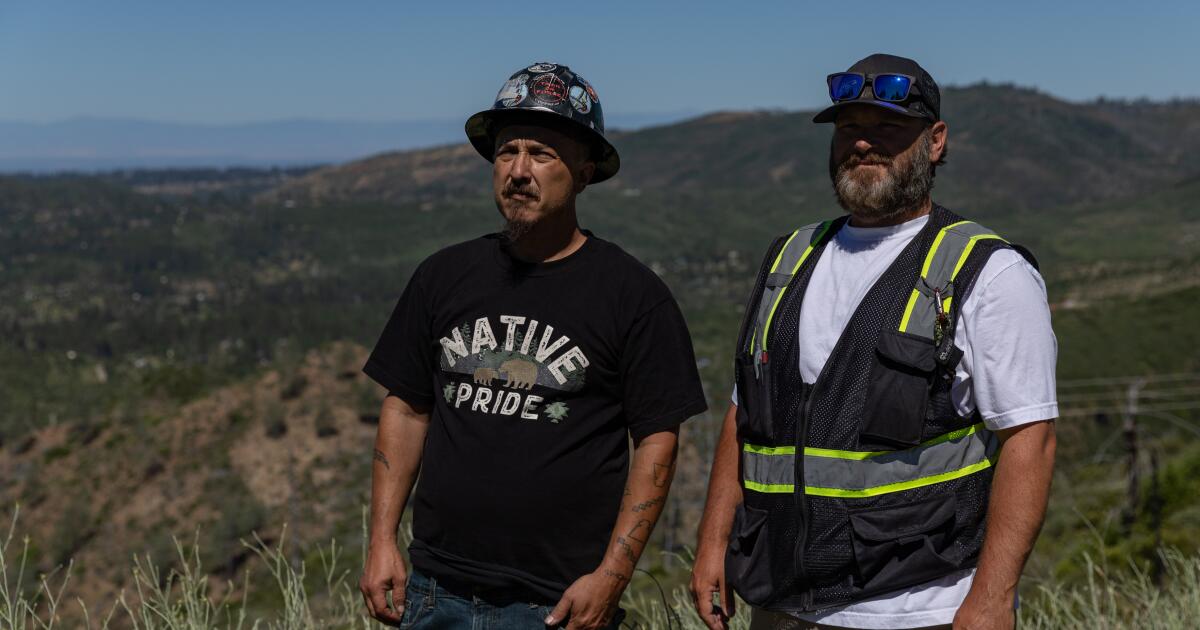
After wildfires destroyed 95% of this California tribe’s forests, members uncovered 1,200 ancestral sites
-
 Sports32 minutes ago
World Cup championship and third-place game: Start times and how to watch
-

 World44 minutes ago
Rule of Law in Hungary shows ‘radical change’ under Magyar, EU says
-

 News1 hour ago
Where Wildfire Smoke Is The Worst Right Now—And What To Do About It

