Virginia
Appointments of two key cabinet roles will trigger another special election in House District 17 – WTOP News


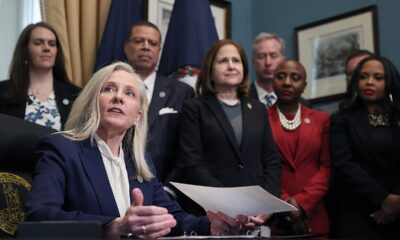
Rounding out key leadership roles as she prepares to take office, Virginia’s Gov.-elect Abigail Spanberger has announced two new cabinet appointments.
This article was reprinted with permission from Virginia Mercury.
Gov.-elect Abigail Spanberger on Tuesday announced two additional cabinet appointments, tapping longtime Del. Mark Sickles, D-Fairfax, to serve as Virginia’s next secretary of finance and public administrator Traci Deshazor as her secretary of administration, rounding out key leadership roles as she prepares to take office.
Sickles’ departure from the state legislature will also trigger a special election in the strongly Democratic House District 17, a seat that includes parts of Fairfax County, before the General Assembly is set to convene for its 2026 session next month.
Spanberger said Sickles, a senior budget writer in the House of Delegates, will bring deep fiscal expertise and a bipartisan approach to managing the state’s finances. Deshazor, a Danville native with experience across local, state and federal government, will oversee core administrative functions ranging from elections to workforce support.
“The secretary of finance plays an essential role in guaranteeing Virginia’s long-term economic strength, safeguarding taxpayer dollars, and addressing the challenges facing Virginia communities,” Spanberger said in a statement.
She pointed to Sickles’ role as vice chair of the House Appropriations Committee and said he has worked with lawmakers of both parties to pass budgets that offered tax relief for families while supporting economic growth.
Spanberger said Sickles shares her commitment to fiscal responsibility and to ensuring taxpayer dollars are used effectively, adding that she expects him to be a key partner in her administration’s efforts to lower costs for families and secure Virginia’s long-term financial footing.
Sickles, who is completing his 22nd year representing parts of South Fairfax County, said he is looking forward to assisting Spanberger as she works to make life in Virginia more affordable.
He said the administration must deliver results for families, young people and seniors by building budgets that reflect shared values and reduce the cost of living.
“We need to make sure every tax dollar is employed to its greatest effect for hard-working Virginians,” Sickles said, citing priorities such as keeping tuition low, expanding affordable housing, ensuring teachers are properly compensated and making quality health care accessible and affordable.
Sickles is widely known in Richmond for his influence over health and human services spending. Since 2004, he has served on — and chaired — the House Health and Human Services Committee. He joined the Appropriations Committee in 2014 and currently chairs its Health and Human Resources Subcommittee.
He has also played a central role in budget negotiations, having been appointed to the House-Senate budget conference committee in 2018 and reappointed each year since by successive House speakers.
Sickles currently chairs the Joint Legislative Audit and Review Commission and serves on several other influential panels, including the Major Employment Investment Commission, the Joint Commission on Health Care and the Governor’s Advisory Committee on Revenue Estimates.
Over his legislative career, Sickles has helped shepherd major policy changes through the General Assembly, including the transition from the federal health insurance marketplace to the Virginia Health Insurance Exchange, election administration reforms, legalization of sports betting and the creation of the Virginia Innovation Partnership Authority.
He has also championed investments in libraries, endangered species protection and bioscience initiatives, and is the patron of a pending constitutional amendment to protect marriage equality for LGBTQ Virginians.
Alongside Sickles’ appointment, Spanberger named Deshazor as her secretary of administration, a role responsible for overseeing the day-to-day operations that underpin state government.
She described Deshazor as a knowledgeable leader focused on making government work better for people at both the state and local levels.
Deshazor said her career has been centered on ensuring public institutions are effective and results-driven, and she emphasized the importance of administration as the foundation of good governance.
“I will bring a people-first, outcomes-driven approach to strengthening Virginia’s operations, promoting transparency, and strengthening trust in government,” Deshazor said.
Deshazor brings experience from multiple levels of government.
Most recently, as the deputy chief administrative officer for human services in Richmond, she oversaw a six-agency portfolio with more than 1,000 employees. During that time, she helped create a new Department of Neighborhood and Community Services, launched offices focused on homelessness and community services, and established a community resource and training center.
She also served concurrently as the city’s first chief equity officer.
At the state level, Deshazor previously served as deputy secretary of the commonwealth under Govs. Ralph Northam and Terry McAuliffe, supervising teams responsible for core constitutional and administrative functions.
In that role, she supported clemency efforts and contributed to actions restoring civil and voting rights to more than 300,000 Virginians and to the granting of thousands of pardons and sentence computations.
Earlier in her career, she represented Virginia as deputy director of intergovernmental affairs, working with Congress, the White House and federal agencies.
A graduate of programs at the University of Virginia, Virginia Commonwealth University, Yale University, Virginia Tech and Hollins University, Deshazor lives in Richmond with her husband and said she remains committed to serving the commonwealth she has always called home.











Virginia
West Virginia Lottery results: See winning numbers for Powerball, Lotto America on March 28, 2026
The results are in for the West Virginia Lottery’s draw games on Saturday, March 28, 2026.
Here’s a look at winning numbers for each game on March 28.
Winning Powerball numbers from March 28 drawing
11-42-43-59-61, Powerball: 25, Power Play: 4
Check Powerball payouts and previous drawings here.
Winning Lotto America numbers from March 28 drawing
15-29-30-32-35, Star Ball: 09, ASB: 05
Check Lotto America payouts and previous drawings here.
Winning Daily 3 numbers from March 28 drawing
0-7-1
Check Daily 3 payouts and previous drawings here.
Winning Daily 4 numbers from March 28 drawing
2-7-3-5
Check Daily 4 payouts and previous drawings here.
Feeling lucky? Explore the latest lottery news & results
When are the West Virginia Lottery drawings held?
- Powerball: 11 p.m. ET on Monday, Wednesday and Saturday.
- Mega Millions: 10:59 p.m. ET Tuesday and Friday.
- Lotto America: 10:15 p.m. ET on Monday, Wednesday and Saturday.
- Daily 3, 4: 6:59 p.m. ET Monday through Saturday.
- Cash 25: 6:59 p.m. ET Monday, Tuesday, Thursday, and Friday.
This results page was generated automatically using information from TinBu and a template written and reviewed by a USA Today editor. You can send feedback using this form.
Virginia
WRIC ABC 8News wins awards at AP Broadcasters awards for continuous coverage, special program

RICHMOND, Va. (WRIC) — At Virginia’s Associated Press (AP) Broadcasters awards on Saturday, 8News received seven awards, including three first-place awards. Our team was recognized for our coverage on the Waverly Two and special programs during Black History Month.
On Saturday, March 28, 8News attended the 2026 Virginia AP Broadcasters Award, which recognizes broadcast news operations in Virginia and West Virginia.
News anchor Deanna Allbrittin and Digital Producer Ryan Nadeau were honored for their continuous coverage of the Waverly Two, two men who were found not guilty but were still sentenced to life in prison.
We were also awarded first place in the Best Special Stream category for “Riverfront Rhythm” and Excellence in Diversity, Equity and Inclusion for “What is Black?“, a special program during Black History Month from 8New’s Lindsey West.
Additionally, MaryCatherine Price received second place for Best Daily Stream for her podcast, “The Rundown.” It is a podcast that gives viewers an inside look into the newsroom.
Our Taking Action team was also a finalist for Best Multi-Platform Story for our continuous coverage of “Homeowner Horrors” throughout Central Virginia. We were also a finalist for Best News Promo on the “Richmond Tax Delinquency.”
Lastly, our very own Nolan Knight earned second place for Best Sports Anchor for his groundbreaking coverage on local sports in Virginia. He was also recognized at the 2025 AP Broadcast Awards for his coverage of Virginia sports.


Players to watch in the 2026 Women’s NCAA March Madness Tournament
USAT’s Sam Cardona-Norberg and Meghan Hall give a few of their favorite players they will be keeping an eye on in the women’s March Madness tournament.
Sports Seriously
The NCAA Women’s Tournament Sweet 16 round continues Saturday, March 28, with a matchup between No. 3-seed TCU and No. 10-seed Virginia at Golden 1 Center in Sacramento, California.
The game tips off at 4:30 p.m. PT (7:30 p.m. ET, ABC).
No. 3 TCU is fresh from a nail-biting victory against No. 6-seed Washington in a final score, 62-59, during the Women’s NCAA Tournament Round of 32 on March 22.
The Horned Frogs were led behind a near triple-double from senior guard Olivia Miles who posted 18 points, 10 rebounds and eight assists. Clara Silva chipped in with 16 points and eight rebounds for TCU. Taylor Bigby added 15.
No. 10 Virginia is still riding momentum from their second round upset, a win against No. 2-seed Iowa, 83-75, on March 23.
The Cavaliers were paced by junior guard Kymora Johnson, who posted a game-high 28 points. Johnson and senior guard Paris Clark provided the bulk of scoring for Virginia. Clark could hardly miss as she added 20, herself. She shot 70% from the field, including 3-of-4 from three.
No. 10 Virginia will take on No. 3 TCU in the Sweet 16 round of the NCAA women’s basketball tournament on Saturday, March 28. Here’s how to watch the Women’s March Madness action.
What time is the TCU vs. Virginia women’s Sweet 16 game?
- Date: Saturday, March 28
- Time: 7:30 p.m. ET (4:30 p.m. PT)
- Location: Golden 1 Center, Sacramento, California
The No. 3-seed TCU Horned Frogs will play the No. 10-seed Virginia Cavaliers in the NCAA Women’s Sweet 16 round at 7:30 p.m. ET (4:30 p.m. PT) Saturday, March 28, at Golden 1 Center in Sacramento, California.
No. 10 Virginia vs. No. 3 TCU: TV, streaming

What Wisconsin men’s basketball needs to target in the transfer portal this offseason

West Virginia Mountain Bike Association holds Race to Lil Moe’s in Philippi

JCSD1 Board Hears Board-Level Updates

Crypto ATM Count Falls to 38,928 as 597 Machines Exit the Market in Q1 2026

State to appoint fiscal monitor over NOLA-PS, citing ‘significant’ financial management issues

Florida High School Football Rankings: Top 25 teams – Oct. 21

How old is Bo Nix? What to know about Oregon quarterback ahead of 2024 NFL Draft

Cleary's 21 help Le Moyne down Central Connecticut State 69-64 in OT

99th annual Pony Swim held in Virginia

Indiana Members Credit Union announced as new anchor tenant at Bottleworks District

Scathing report claims nation’s oldest labor union ‘betrayed’ MAGA members through ‘shocking’ spending

Republican US lawmaker demands Congress vote on any Iran troop deployment

So you went to a No Kings protest. Now what?

JD Vance says he was ‘obsessed’ with UFOs, believes aliens are actually ‘demons’
The EU's recipe for trade deals : easy on beef, tough on wine
-

 Sports1 week ago
IOC addresses execution of 19-year-old Iranian wrestler Saleh Mohammadi
-

 New Mexico7 days ago
Clovis shooting leaves one dead, four injured
-

 Miami, FL3 days ago
Jannik Sinner’s Girlfriend Laila Hasanovic Stuns in Ab-Revealing Post Amid Miami Open
-

 Tennessee6 days ago
Tennessee Police Investigating Alleged Assault Involving ‘Reacher’ Star Alan Ritchson
-

 Minneapolis, MN3 days ago
Boy who shielded classmate during school shooting receives Medal of Honor
-

 Technology1 week ago
YouTube job scam text: How to spot it fast
-

 Politics1 week ago
Schumer gambit fails as DHS shutdown hits 36 days and airport lines grow
-

 Science1 week ago
Record Heat Meets a Major Snow Drought Across the West