Texas
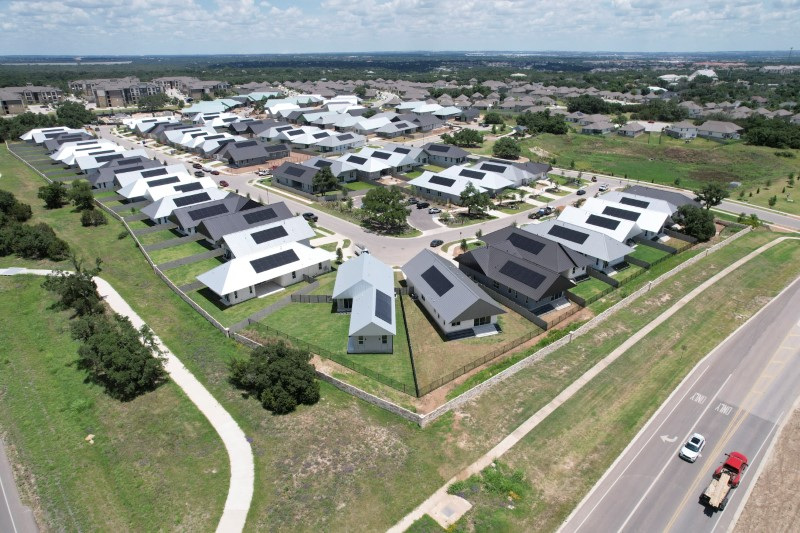
World's largest 3D-printed neighborhood nears completion in Texas

By Evan Garcia
GEORGETOWN, Texas (Reuters) – As with any desktop 3D printer, the Vulcan printer pipes layer by layer to build an object – except this printer is more than 45 feet (13.7 m) wide, weighs 4.75 tons and prints residential homes.
This summer, the robotic printer from ICON is finishing the last few of 100 3D-printed houses in Wolf Ranch, a community in Georgetown, Texas, about 30 miles from Austin.
ICON began printing the walls of what it says is the world’s largest 3D-printed community in November 2022. Compared to traditional construction, the company says that 3D printing homes is faster, less expensive, requires fewer workers, and minimizes construction material waste.
“It brings a lot of efficiency to the trade market,” said ICON senior project manager Conner Jenkins. “So, where there were maybe five different crews coming in to build a wall system, we now have one crew and one robot.”
After concrete powder, water, sand and other additives are mixed together and pumped into the printer, a nozzle squeezes out the concrete mixture like toothpaste onto a brush, building up layer by layer along a pre-programmed path that creates corduroy-effect walls.
The single-story three- to four-bedroom homes take about three weeks to finish printing, with the foundation and metal roofs installed traditionally.
Jenkins said the concrete walls are designed to be resistant to water, mold, termites and extreme weather.
Lawrence Nourzad, a 32-year-old business development director, and his girlfriend Angela Hontas, a 29-year-old creative strategist, purchased a Wolf Ranch home earlier this summer.
“It feels like a fortress,” Nourzad said, adding that he was confident it would be resilient to most tornados.
The walls also provide strong insulation from the Texas heat, the couple said, keeping the interior temperature cool even when the air conditioner wasn’t on full blast.
There was one other thing the 3D-printed walls seemed to protect against, however: a solid wireless internet connection.
“Obviously these are really strong, thick walls. And that’s what provides a lot of value for us as homeowners and keeps this thing really well-insulated in a Texas summer, but signal doesn’t transfer through these walls very well,” Nourzad said.
To alleviate this issue, an ICON spokeswoman said most Wolf Ranch homeowners use mesh internet routers, which broadcast a signal from multiple units placed throughout a home, versus a traditional router which sends a signal from one device.
The 3D-printed homes at Wolf Ranch, called the “Genesis Collection” by developers, range in price from around $450,000 to close to $600,000. Developers said a little more than one quarter of the 100 homes have been sold.
ICON, which 3D-printed its first home in Austin in 2018, hopes to one day take its technology to the Moon. NASA, as part of its Artemis Moon exploration program, has contracted ICON to develop a construction system capable of building landing pads, shelters, and other structures on the lunar surface.
(Reporting by Evan Garcia, Editing by Rosalba O’Brien)



In an incident that was horrific beyond words, late last month, a stunned family watched in horror as a car plowed into the Katy, Texas home of a 76-year-old mother and grandmother, killing her. The driver has been charged with manslaughter.
In the aftermath of the crash, it emerged that the car in question was a Tesla, and that the driver was making use of full self-driving mode (FSD) around the time the crash occurred. The victim’s family has named Tesla and the driver as defendants in a lawsuit. But per Electrek, Tesla was able to view crash data very quickly after the incident, and the head of AI at the company, Ashok Elluswamy, said the driver “manually overrode self-driving by pressing the accelerator all the way to 100% of the accel pedal in this residential area.”
In the days after the crash, Tesla fans took issue with coverage that characterized the car as in FSD when the crash occurred. CEO Elon Musk seemed to agree, replying to a post, “Yes, this makes no sense. FSD drives slowly through neighborhood streets and this was a high speed crash!”
But Musk seems to be assuming bad faith, as if coverage implied FSD had suddenly shifted into, perhaps, some kind of previously unannounced homicidal maniac mode and attacked a house. If anyone was saying this is what happened, they should apologize. It’s clearly not what happened.
And on Wednesday, the National Transportation Safety Board (NTSB) largely confirmed Tesla’s version of events. Their report reads, in part:
“Electronic data recovered from the vehicle indicated that before the crash, the driver manually overrode FSD (Supervised) by pressing the accelerator pedal to 100%, and the vehicle’s speed was greater than 70 mph when the crash occurred.”
But cooler heads had noted weeks earlier that, like with good old fashioned cruise control, accelerating doesn’t boot you from FSD. The car takes the input, and stays in FSD. The question isn’t one of mechanics and technology, but one of philosophy: if FSD is meant to be “driving” when someone jams on the accelerator in a residential area, FSD may not be the “driver” in one important sense, but the car was still in FSD mode.
Because as much as Tesla would probably like FSD to be a total non-factor in the incident, that may not be the case either.
ABC News noted that, according to court documents, the driver claimed he “passed out” with the car in FSD on the highway, and that’s the last thing he remembers before the crash. He says he wasn’t sick, and medical records show no seizures, cardiac episodes, drugs, or alcohol.
A local Fox affiliate says records show the car was making deliveries for DoorDash while in FSD in the “hours and minutes leading up to the crash.” While in a neighborhood, it apparently signaled it was going to turn left onto one street, but instead the pedal went to the metal. This took the Tesla onto the victim’s cul-de-sac instead, and put it on its fateful collision course with her house.
To make matters weirder, other court records now show, per Electrek, that the driver had Googled the terms, “Tesla fsd not aggressive enough 2026,” “FSD is not aggressive enough for city driving,” and “Tesla fsd too timid.” That’s the kind of thing you Google when you’re looking for a Reddit post from someone sharing your consumer gripe.
In any case, the odds aren’t good that the driver wanted this to happen, nor that Tesla programmed its cars with evil intent. But FSD was being used around the time of this unusual fatal incident, and the public deserves to know more. Fortunately, a lot more will come out as the lawsuit progresses.

AUSTIN – Texas Attorney General Ken Paxton said Wednesday he has secured a settlement of bankruptcy claims against genetic testing company 23andMe stemming from a 2023 data breach that exposed personal information, including some genetic ancestry data, of 6.9 million customers worldwide.
Paxton’s office said the settlement includes $150 million for a multistate coalition of 42 states. But because of limited funds in 23andMe’s bankruptcy estate and competing claims, the states’ recovery will be $18 million paid immediately, with Texas receiving $1,266,860.
23andMe disclosed in October 2023 that attackers had accessed accounts affecting 6.9 million consumers. Some of the information was later posted for sale on the dark web, according to Paxton’s office, which said the company learned of the breach months after the data became publicly available. The office said 23andMe initially denied a breach and later blamed consumers’ account settings and password practices.
Paxton joined a multistate investigation that concluded 23andMe used unreasonable security practices and failed to implement adequate safeguards against hacking, the office said.
23andMe filed for bankruptcy protection in March 2025. Paxton’s office said the settlement incorporates privacy and cybersecurity requirements, including enhanced security standards, comprehensive risk assessments and creation of an independent advisory board, along with enforcement of state privacy laws and continued consumer data deletion rights.
“Companies that collect and profit from Texans’ most personal information have a legal duty to protect it,” Paxton said in a statement.
The company also agreed to a $46.75 million class-action settlement in the bankruptcy case for affected U.S. consumers who submitted claims by Feb. 17, 2026, Paxton’s office said.
Copyright 2026 by KPRC Click2Houston – All rights reserved.

-
Lifestyle14 minutes ago
Apache chef Nephi Craig says cooking Native food saved his life
-

 Technology26 minutes ago
Google is better at playing the AI regulations game
-

 World32 minutes ago
Iran calls on Houthis to prepare to cut off Red Sea gateway — can the terror group do it?
-

 Politics38 minutes ago
Todd Blanche roasts Adam Schiff in heated hearing: ‘You’re a lawyer, you know the rules’
-

 Health44 minutes ago
Game-changing cholesterol pill wins FDA approval after cutting LDL nearly 60%
-

 Sports50 minutes ago
2026 AL, NL MVP Odds: Ohtani Favored; Alvarez Holding Off Challengers
-

 Technology56 minutes ago
Tesla helped save a driver. Is your car ready?
-
 Business1 hour ago
SpaceX stock erases all its gains and slides below IPO price in intraday trading


