Texas
New Gas Storage Facility Arrives Just In Time For The Texas Grid


HOUSTON, TEXAS – DECEMBER 14: Pablo Vegas, president and CEO of ERCOT, left, Texas Governor Greg … [+]
As a major sub-freezing arctic weather system makes its way down to Texas in the coming days, concerns are rising again about the ability of the state’s power grid, managed by the Electric Reliability Council of Texas (ERCOT), and natural gas delivery systems to handle the load. But with many citizens worried about the ability of ERCOT to avoid blackouts as forecasts predict the entire state to see sub-freezing temperatures for several days next week, CEO Pablo Vegas said generation capacity won’t be a problem.
“The power is not going to go out because we don’t have enough supply to meet demand for this week. We’ve got plenty of power for the demand and for the cold weather that’s coming. So, the grid’s gonna be running stably,” Vegas told Dallas/Fort Worth ABC affiliate WFAA Tuesday.
While local service interruptions such as downed power lines are always a possibility during major weather events, Vegas’s high level of confidence stems from grid reforms implemented in the wake of 2021’s deadly Winter Storm Uri, and from the large amount of generation capacity that has been added to the grid since that time.
New Gas Storage Arrives Just In Time
Most of that added capacity is intermittent, weather dependent solar power, a small percentage of which is backed up with stationary batteries, which will help keep homes heated during daylight hours. But additional natural gas baseload generation has also come online in recent years, and weatherization and other improvements mandated by the legislature and regulators should serve to prevent the kinds of system freeze-ups that took place during Uri.
For the first time in several years, a major new greenfield natural gas storage facility is also coming online in Texas, just in time to help provide stability and flexibility to the gas distribution system for the coming storm. On Thursday, Trinity Gas Storage announced commencement of operations at its 24 bcf (billion cubic feet) storage unit located near Carthage in East Texas, about 160 miles southeast of Dallas.
Because it is connected into an array of gas transmission lines and local distribution networks, the Trinity facility is able to help manage storage and direct gas flows not just into the Dallas/Fort Worth Metroplex and East Texas, but also to markets and power plants in and around Houston and Austin.
In an interview on Wednesday, I asked Trinity Gas Storage CEO Jim Goetz about the reasons why gas storage capacity has lagged the rapid growth of gas demand and pipeline capacity in Texas. “I think it boils down to two factors,” he says, “First, there’s the geological kind of requirements that have to be met. It’s not like we can just say, hey, this is a good spot for storage. You need either a depleted reservoir or a salt dome that’s conducive for the task.”
The second factor Goetz mentions is one that has been a common theme for oil and gas-related projects in recent years: A lack of access to capital in a world that for several years became dominated by the ESG philosophy. “That ESG movement drove folks, particularly the capital providers, away from hydrocarbon activity,” Goetz says, adding that things have changed over the past year. The result is that five private equity groups, with Transition Equity Partners, LLC in the lead sponsor role, are backing the project.
Complaints and horror stories about permitting delays have permeated the U.S. energy space in recent years, but such delays are not a part of the story for this specific facility. Trinity was able to get the project fully permitted very quickly, in large part because it was not required to deal with the federal government. Goetz speaks highly of the Texas Railroad Commission, whose employees worked diligently to ensure timely processing of the permits once all requirements and notifications were met.
“We operate under Rule 96 under the Texas Railroad Commission,” Goetz says. “From the time we submitted our application through full approval took around five months. We had full blown disclosures to all the relevant parties. There was no shortcutting of the principled things that must be done to make sure that all the affected parties are noticed and have the ability to weigh in. But you still can get it done in a very timely fashion.”
Plans for Future Gas Storage Expansion
Goetz says Trinity is already working on plans for future expansion. Noting that the underground formation being accessed is capable of holding and managing up to 50 bcf of gas, Goetz says he didn’t feel comfortable trying to raise the capital for a project that size given past market conditions, a factor he now says is “ironic” with the benefit of hindsight.
But the conditions have obviously changed now, resulting in the happy fact that, “we now have oversupply. We have more interested customers than we do have capacity to serve them. So, we’ve already laid out plans for phase two.”
Since 2010, data compiled by the U.S. Energy Information Administration shows that natural gas demand has risen by 60% and gas pipeline capacity has grown by about 30% during the same period. By comparison, storage capacity grew by just 8%.
Big energy data and analytics firm Enverus Intelligence Research recently projected that the U.S. is about to experience a significant boom in the construction of new natural gas power plants to meet rapidly rising power demand. This means a corresponding expansion of gas storage capacity will also need to take place, not just in Texas, but across the country. The business case for doubling capacity at the Trinity facility seems obvious.
The Bottom Line
The story of American energy growth has always been a story built in large part just in time delivery, and this is a good example. With capital markets now following the industry trend of the last two years of re-prioritizing energy security requirements over virtue signaling about ESG, it appears that market conditions are realigning just in time to help facilitate that expansion. Readers can expect to see more stories like this one about Trinity Gas Storage in the months and years to come.



A day off at the pool — and a little sunburn — didn’t stop the Minnesota Twins’ momentum.
Brooks Lee hit a three-run homer as Minnesota scored multiple runs in the first inning for the third consecutive game, and the Twins went on to complete a series sweep of the Texas Rangers with a 9-3 win Thursday.
Minnesota has won four games in a row and scored 25 runs in the three-games series in Texas. The two teams had a rare, mid-series day off on Wednesday with the England-Croatia World Cup game being played in Arlington.
“We’re locked in every day,” Lee told Audra Martin on the team’s broadcast. “Yesterday, taking time off, lay out by the pool, get a little burnt and then right back to it. We did a good job getting focused. I feel like we do that with rain delays, too, just lock back in and we’re doing it.”
Lee’s 12th homer capped a four-run first off Jack Leiter (3-7). Trevor Larnach made it 6-0 in the fourth with a two-run shot to straightaway center that just cleared the extended glove of leaping Alejandro Osuna. Larnach’s third hit was an RBI single in the fifth, and Ryan Kriedler hit a two-run homer in the eighth.
Joe Ryan (5-3) struck out seven but needed 97 pitches to get through five scoreless innings while allowing three singles. Leiter was done after the fourth, and has given up 17 runs while losing three starts in a row.
The Twins never trailed in the sweep that extended their winning streak to four, matching their longest this season. Their 14-5 record at Globe Life Field is the best for any American League opponent since the ballpark opened in 2020.
Wyatt Langford, Ezequiel Duran and Justin Foscue hit solo homers for the Rangers, who have lost five of six games. They are 0-15 when giving up multiple runs in the first inning.
Twins DH Josh Bell, who was born in nearby Irving and grew up in the area, had an RBI single before Lee’s homer. Bell hit a three-run homer in the first inning of the series-opening 4-2 win Monday, and had an RBI single for a 2-0 lead in the first of a 12-2 win on Tuesday.
“We’re just passing the baton each time,” Lee said of the offensive output. “Our guys are hot. They feel good and they came out swinging today. It was awesome to see. We’ve done that for a while now.”
Up next
Twins rookie left-hander Connor Prielipp (2-4, 5.26 ERA) starts Friday at Arizona. The Diamondbacks are scheduled to start right-hander Michael Soroka (8-3, 3.11).

Watch CBS News

A Texas state trooper was killed in a crash in the Panhandle, becoming the 244th Texas Department of Public Safety officer to die in the line of duty since 1823, according to the agency.
Sergio Romero, 27, died Wednesday after a semi-truck pulled in front of him as he attempted a traffic stop around 4 p.m. on U.S. 287 in Childress County, DPS said.
In a statement, Col. Freeman F. Martin praised Romero’s courage, integrity, and service.
“Today, we grieve the loss of one of our own,” Martin said. “… Our hearts break alongside his family, friends, fellow troopers, and all who loved him. We will never forget the ultimate sacrifice he made in service of his fellow Texans.”
Romero previously served with the Hall County Sheriff’s Office before joining DPS as part of Class B-2025 in Childress, the agency said.
He is survived by his wife, Francisca, and their two young sons.
Funeral arrangements are pending. The crash remains under investigation.
-

 Technology9 minutes ago
Barret Zoph is out at OpenAI again after just five months
-

 World15 minutes ago
Iran hardliner behind US deal warns Tehran won’t honor agreement if Trump fails to deliver
-

 Politics22 minutes ago
Top GOP lawmaker rallies around conservative school board member facing calls to resign
-

 Sports30 minutes ago
2026 World Cup Odds: How Far Can Mexico Go After Winning Group A?
-

 Technology37 minutes ago
6 in 10 identity crimes now begin with a new account
-
 Business40 minutes ago
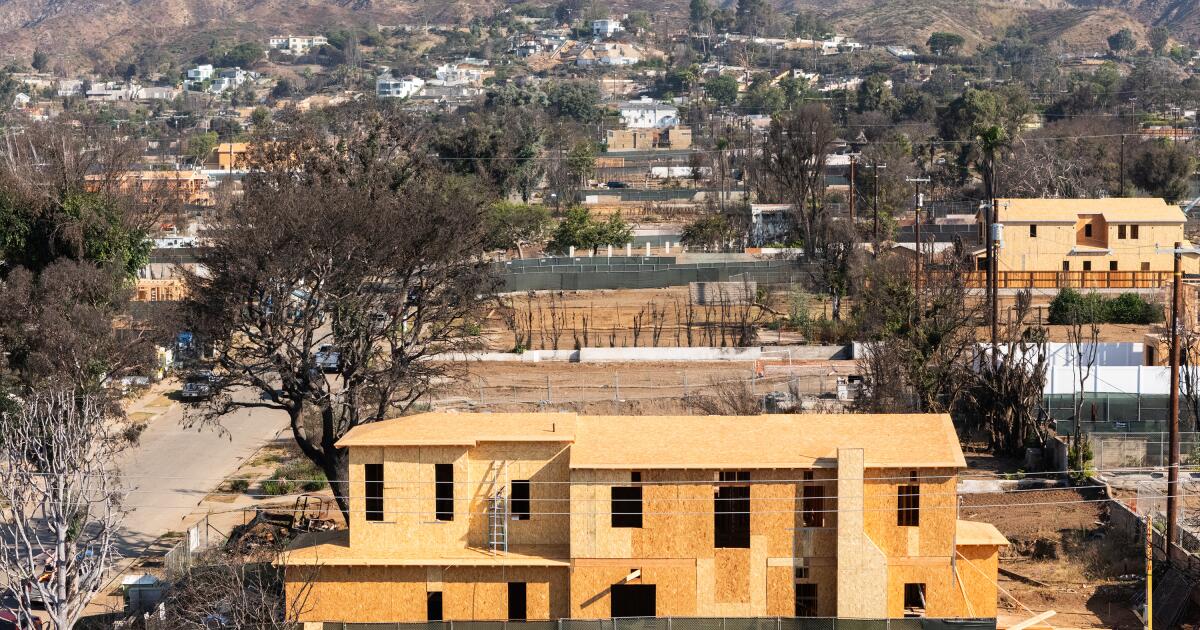
January 2025 wildfire victims seek tougher penalties against State Farm over claims handling
-
 Entertainment45 minutes ago
Review: ‘Sugar,’ with Colin Farrell as an alien private eye, gets a new and improved second season
-
 Politics55 minutes ago
Political watchdog fines Newsom for failing to report $5.5M in solicited donations on time

