Georgia
Can Harris' momentum swing battleground Georgia?

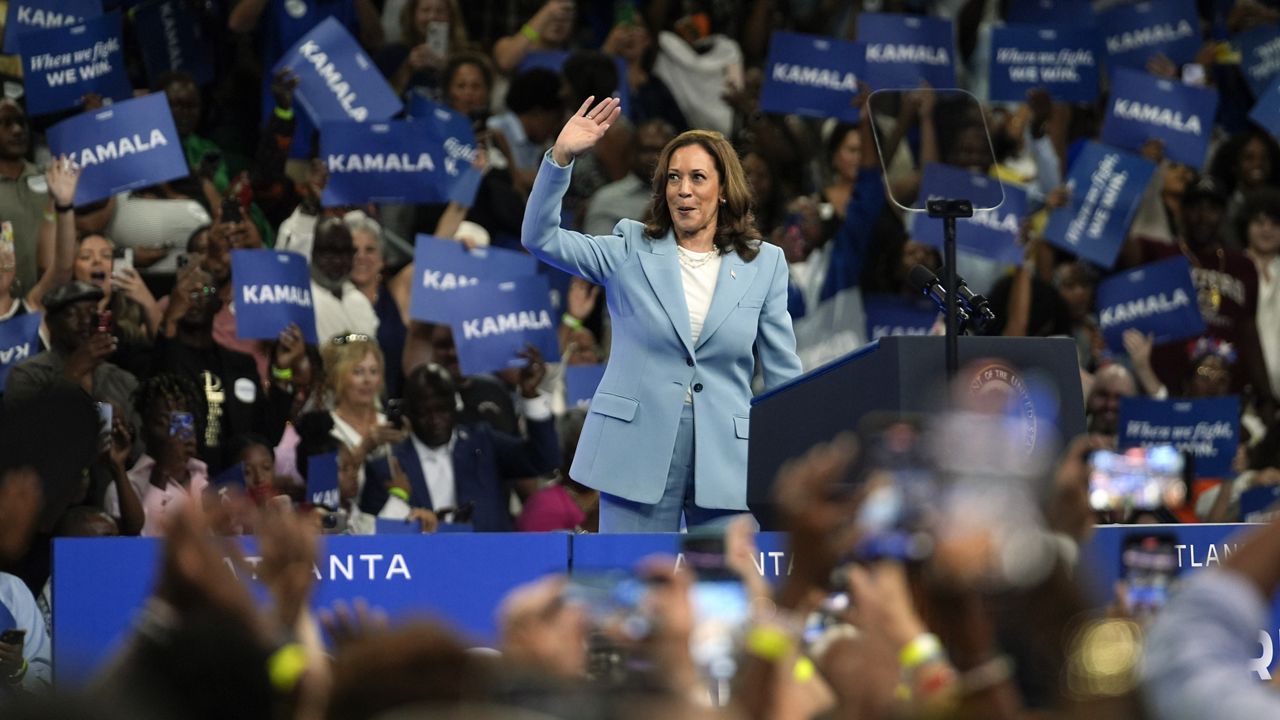
Vice President Kamala Harris’ rally in Atlanta on Tuesday night was nothing if not energetic.
In fact, if you ignored all of the “Kamala” signs and the cavalcade of Democratic power players, one could have mistaken it for a concert.
The crowd of thousands packed into the Georgia State Convocation Center danced and sang along to rapper Kendrick Lamar’s “Not Like Us” before Grammy Award-winner Megan Thee Stallion took the stage to perform — and coined the phrase “Hotties for Harris.”
“We’re about to make history with the first female president, the first Black female president,” she said as the introduction to her hit 2020 single “Savage” started to play, adding: “Let’s get this done, hotties.”
As former Atlanta Mayor Keisha Lance Bottoms put it: “This was the energy that we desperately need to get us forward to November.”
The energy at the Atlanta event was a stark difference compared to previous campaign events featuring President Joe Biden — and, among some of the attendees, between the two campaigns writ large.
“Just seeing from everyone, there is just a strong energy here that Joe Biden wasn’t bringing,” Georgia resident Ronald Ceesay told Spectrum News. “He was in his 80s, and he was an older candidate, even if he had that strong record, he was an older candidate.”
It’s undeniable that Harris’ ascent to become the likely Democratic presidential nominee has shaken up the stagnant race for president.
Biden won Georgia over Republican Donald Trump by less than 12,000 votes in the 2020 election, but polling showed the incumbent trailing the ex-president in key battleground states, particularly following the June debate that raised questions among Democratic about his mental acuity and fitness to serve.
But in the days since Biden dropped out of the race and endorsed Harris, polling has shown the vice president has erased Trump’s lead, even overtaking him in some polls.
“I feel like [Biden] didn’t necessarily represent me as a Black woman,” said Georgia voter Tayler Louise. “I didn’t look at him and see myself and that’s usually where the pride comes in.”
“But now I’ve done a complete switch. I got on the red, white and blue,” she added. “I’m feeling a more sense of patriotism that I hadn’t felt before.”
Younger voters and Black voters will be key for Harris’ coalition if she hopes to deny Trump a second shot at the White House. Harris would be the first woman, Black woman and person of South Asian descent to become president. She’s also a generation younger than both Biden and Trump.
But some say she’ll need to look beyond those groups to build her coalition, working to attract voters who don’t typically vote for Democrats.
“There’s a group of people that are disenfranchised with Donald Trump, conservative in nature, but ready to see somebody do something other than Donald Trump’s leadership style,” former Georgia Lt. Gov. Geoff Duncan, a Republican who endorsed Biden and is now backing Harris, told Spectrum News.”
Duncan suggests that Harris speaks to “issues like immigration, border control, inflation, things that were tough for the Biden administration, talk with an articulate voice” in an effort to build a broader coalition.
Many Democrats had written Georgia off, as well as the other southern battleground state of North Carolina when Biden was in the race, but they have new hopes with Harris emerging as the party’s likely nominee.
North Carolina hasn’t voted for a Democrat for president since 2008, though it was the state Trump won with the most narrow margin in 2020. Both both states have seen population increases and changing demographics that could help Harris.
“Georgia is happy to receive all of this attention, because we are nestled and very unique in our positioning in the South,” said Tammy Greer, a professor of politics at Georgia State University. “And it brings more attention to the realities that states, and their voting patterns, are not dormant.”
To be sure, Georgia is getting attention from both candidates, and has been since Biden’s narrow victory in 2020 and the subsequent wins by Democrats Raphael Warnock and Jon Ossoff in January 2021, which flipped the U.S. Senate. It’s also the site of one of Trump’s four criminal cases. (Trump was indicted last year along with more than a dozen co-defendants by Fulton County District Attorney Fani Willis, accusing them of creating a “criminal enterprise” to overturn the state’s election results in 2020; a few defendants pleaded guilty and cooperated with prosecutors, while Trump and the remaining co-defendants pleaded not guilty. The case has been mired in delays.)
Trump’s campaign says it has over a dozen fully staffed offices in Georgia, while Harris’ campaign says it has 24 coordinated offices already in the state.
Trump and running mate JD Vance will hold a rally on Saturday where Harris held her event on Tuesday, while Harris and her yet-to-be announced running mate will rally in Savannah, Ga., next week.



The Georgia Institute of Technology may be expanding as the Atlanta university works to finalize an agreement to buy a piece of property owned by the Coca-Cola Company.
The two organizations announced the plan for Georgia Tech to buy a two-story building and an adjacent two-acre park along North Avenue this week.
The area is expected to sell for $31.3 million and has been part of Coca-Cola’s holdings since 1988, a press release revealed.
School officials say that the property would strengthen the university’s capacity to advance research and educate its students.
“This strategic addition to our core campus will support our growth in enrollment and research activity for years to come,” said Georgia Tech President Ángel Cabrera. “I appreciate our long relationship with The Coca-Cola Company that allowed us to pursue this opportunity as we continue to invest in our campus, our neighborhood, and Atlanta’s innovation ecosystem.”
“When we decided this space was no longer needed for our corporate campus, our goal was to work with Georgia Tech, as this site offers a great opportunity for them to expand,” Quincey said. “Coca-Cola has a long legacy of involvement and partnership with Georgia Tech, and we are excited to see them redevelop this important area in Atlanta.”
Once the sale goes through, Georgia Tech will evaluate how the property can support its academic and student needs.

ROME, Ga. – An Armuchee Elementary School teacher is heading to the Boston Marathon this Monday with a new purpose after surviving a devastating crash that changed her life and could possibly change Georgia law.
What we know:
Hannah Nabors, a fourth-grade special education teacher, was driving to school last year when an impaired driver T-boned her vehicle. Nabors was trapped in the car for two hours before emergency crews could free her. The injuries were so severe that doctors had to amputate part of her leg. Despite the loss, the longtime runner and coach set a goal to compete in the Boston Marathon.
Runner fights for insurance reform
The backstory:
As Nabors began her recovery, she discovered that her state health benefits as a public school teacher only covered one basic prosthetic every three years. A specialized “blade” prosthetic used for running can cost tens of thousands of dollars. While her community held a 5K fundraiser to help her purchase the device, Nabors decided to push for a permanent change for all state employees.
What they’re saying:
“I got to testify in the House, cleared the House, moved into the Senate,” Nabors said, noting that Rep. David Clark sponsored the bill. Speaking on her upcoming race, Nabors added, “It’s not a run for performance for me. It’s a run for purpose. It really just tells the story of not only what my body can do, but what God can do through community.”
What we don’t know:
It is not yet confirmed if Gov. Brian Kemp will sign the legislation into law, though it is currently sitting on his desk for consideration.
By the numbers:
The proposed law would significantly expand access to medical devices for those with state health benefits:
- 3: The number of prosthetics allowed every three years (one for daily use, one for showering, and one specialized prosthetic).
- 1: The current number of basic prosthetics covered every three years under existing rules.
- 2027: The year the law would take effect (specifically Jan. 1) if signed by the governor.
A race for purpose in Boston
What’s next:
Nabors will join thousands of other runners in Boston this Monday. Meanwhile, the bill awaits the governor’s signature. If approved, the expanded coverage will provide relief to state employees who previously faced high out-of-pocket costs for specialized prosthetic limbs.
The Source: The information in this story was gathered from FOX 5 reporter Denise Dillon, who spoke with Hannah Nabors in Rome, Georgia.


Scandals shake up Capitol Hill ahead of midterm elections
Congressional reporter Zachary Schermele dives into the latest scandals on Capitol Hill and how they’re shaking up politics ahead of midterms.
Georgia primary season is a month away, and the race for the top of the ticket is fierce.
Voters will be deciding the Democratic and Republican candidate for governor on May 19, and they will have to choose from a crowded field.
Keisha Lance Bottoms, former mayor of Atlanta, leads the polls for Democrats among seven potential candidates.
On the other side of the ballot, however, it’s unclear if current Lt. Gov. Burt Jones or healthcare executive Rick Jackson will come out on top for the Republicans.
Jones and Jackson have spent much of the time since Jackson’s late entry into the race going after one another in ads and on social media. Jones has the Trump endorsement, but both candidates have aligned themselves closely with the MAGA movement and Georgia’s conservative base.
Jackson one of top ad spenders in the country
In analysis published by AdImpact, Rick Jackson is the leading Republican for ad spending across the nation, and is one of this election cycle’s top ad spenders.
Jackson has spent $47 million on his ad campaign, according to the report, contributing to the 2026 primaries being one of the most expensive gubernatorial primaries on record.
Georgia gubernatorial candidates have spent $100.5 million across the race, according to AdImpact. Of that, Republicans have spent $99.2 million while Democrats have only spent $1.2 million on ads.
Nationally, Jackson is behind Tom Steyer (running for governor of California), the Yes on 50: The Elections Rigging Response Act, and Abigail Spanberger (Governor of Virginia).
Jackson is just ahead of conservative group One Nation and the Greater Garden State in ad spending.
Is ad spending paying off?
Jackson may be far outspending his Republican rivals in the primary, but he will still have a fight on his hands come May 19.
Polling from the New York Times, which aggregates multiple political polls from multiple sources, finds Jackson leading by anywhere from 8 to 15 points in some polls, while Jones leads by anywhere from 7 to 10 points in others.
The most recent published polls date to March, meaning these leads could have changed in the weeks since as the race heats up.
Jackson not only takes on Jones with his political machine, but he has turned his attention to Keisha Lance Bottoms, his likely opponent in the midterm race in November.
He has also made it a point to acknowledge that most of the spending, if not all, is coming from his own pocket and not outside interest groups, thanks to the success of his multi-billion dollar healthcare company.
“My campaign doesn’t need money from donors or special interests — I don’t owe anybody anything. Period. Every decision I make will be based on if it’s good for regular Georgians, not some donor base,” Jackson said in an April 14 post on X.
Jones, Jackson fight in campaign finance lawsuit
Jones took a legal hit earlier this year when a judge ruled against him and the way he was operating his campaign finances.
Jackson’s campaign filed a lawsuit against Jones alleging his leadership committee, tied to his current role at lieutenant governor, allows him to fundraise unlimited contributions for his campaign while other candidates are limited by campaign finance law. Other candidates had tried to stop the leadership committee previously.
Leadership committees are able to raise money year-round for general election-related activities and for candidates, but the chairperson of the committee must be the governor, lieutenant governor or party nominees for those offices. That means if someone is both holding office and running for office, they can use funds from the leadership committees for their own campaigns.
Jones’ group is able to raise “unlimited contributions,” thereby setting up a “de facto second, super-duper campaign committee for Lieutenant Governor Jones that disadvantages Jackson” and the other candidates, Jackson’s lawsuit alleges.
Opponents of Jackson also argue his campaign financing has some gray area.
Jackson’s companies have been paid nearly $1 billion since 2020 by state agencies through various government contracts, according to a Healthbeat analysis. Jackson Healthcare includes 21 subsidiaries, including some that received $10 million from the Department of Community Health during the COVID-19 pandemic.
Jackson has told news outlets he was planning to spend $50 million of his own fortune to pay for his campaign, but government contracts also contributed to the success and profits of his healthcare companies. Jackson will likely need to separate his businesses from state agencies if he becomes governor to avoid conflicts of interests, Healthbeat reports.
Irene Wright covers midterm races in Georgia as the Atlanta Connect reporter with USA Today’s Deep South Connect team. Find her on X @IreneEWright or email her at ismith@usatodayco.com.

YouTube’s mobile app finally lets you share timestamped videos

South African ex-police chief gets tissue stuck on forehead while sweating during corruption inquiry

Tennessee governor signs nuclear family month resolution as critics push back on exclusions

Peptides may soon be easier to get amid RFK Jr’s push, but experts warn of risks

Mike Trout’s torrid Angels series vs Yankees ends in historic fashion after he blasts fifth home run

Florida High School Football Rankings: Top 25 teams – Oct. 21

How old is Bo Nix? What to know about Oregon quarterback ahead of 2024 NFL Draft

Cleary's 21 help Le Moyne down Central Connecticut State 69-64 in OT

99th annual Pony Swim held in Virginia

Indiana Members Credit Union announced as new anchor tenant at Bottleworks District
Tennessee governor signs nuclear family month resolution as critics push back on exclusions

Displaced Lebanese wary as ceasefire between Israel and Hezbollah begins

Retired Coast Guard officer with decades of public health experience is Trump’s pick to lead CDC | CNN

Video: A Look at the Plans for Trump’s ‘Triumphal Arch’

First-ever moratorium on AI data centers passes Maine legislature
-

 Ohio2 days ago
‘Little Rascals’ star Bug Hall arrested in Ohio
-

 Georgia1 week ago
Georgia House Special Runoff Election 2026 Live Results
-

 Arkansas6 days ago
Arkansas TV meteorologist Melinda Mayo retires after nearly four decades on air
-

 Pennsylvania1 week ago
Parents charged after toddler injured by wolf at Pennsylvania zoo
-

 Austin, TX1 week ago
ABC Kite Fest Returns to Austin for Annual Celebration – Austin Today
-

 Austin, TX1 week ago
Aaliyah Crump plans to transfer from Texas: report
-

 Politics2 days ago
Dem fundraising giant in the hot seat as GOP lawmakers demand answers over dodged subpoena
-

 Politics5 days ago
Trump blasts Spanberger ahead of Virginia meetings, says state faces tax base exodus like New York, California