Florida
Here are places to explore Black history across Northeast Florida


Jacksonville and its surrounding areas are deeply rooted in rich Black history, leaving a lasting impact on the world we know today.
In honor of Black History Month, here’s a list of places in Northeast Florida you can explore to learn about the many stories, contributions and moments continuously shaping the future.
Jacksonville
Norman Studios
Norman Studios is the sole surviving studio from Jacksonville’s heyday as a major film production hub and one of the first to produce films starring African American characters in positive, non-stereotypical roles, according to the museum’s website.
Norman Studios Silent Film Museum honors preservationist Rita Reagan with gala event
The studio produced films such as “The Green Eyed Monster” and “The Flying Ace.”
The museum is open the first and third Saturday of each month from 11 a.m. to 3 p.m.
Located at 6337 Arlington Road. It’s free and open to the public.
Henry L. Aaron Field at James P. Small Memorial Stadium
Built in 1912, this baseball stadium was home to the Jacksonville Redcaps and housed numerous sporting legends.
Henry Aaron, Leroy “Satchel” Paige, Roy Campanella, James “Cool Papa” Bell and William “Judy” Johnson passed through on their way to baseball’s “Hall of Fame”.
‘Steeped in history’: Modern upgrades honor legacy of historic J.P. Small Park and Hank Aaron Field in Durkeeville
Located at 1701 Myrtle Avenue, the field includes a free museum dedicated to the Negro Leagues that is open for tours with an advance reservation, according to the Durkeeville Historical Society.
Ritz Theatre & Museum
Located on the site of the 1929 Ritz Theater movie house in Jacksonville’s historic African American community of LaVilla, the museum celebrates African American heritage through the stories of famous Floridians.
From their website: “Listen to Jacksonville’s native sons, James Weldon and John Rosamond Johnson tell you how their song Lift Ev’ry Voice and Sing became the African American National Anthem. Peek into Clara White’s Mission. Feel the vibe of the “Harlem of the South” nightclub in the 1940’s. Find your relative or neighborhood in the society photographs of Ellie L. Weems. Experience a sit-in at the Woolworths counter as the Civil Rights Protestors did in the 1960’s.”
Located at 829 N Davis St, Jacksonville, FL 32202. Standard admission is $8. Click here to view museum hours.
The Jacksonville Public Library
The Jacksonville Public Library offers readers at any of its 21 locations the ability to search through its African American History Collection. The collection includes books, pamphlets, photographs, newspapers, documents and more.
Browse the catalog here.
St. Augustine
The Lincolnville Museum and Cultural Center
Located in the Lincolnville Historic District, which was settled by freedmen and women in the wake of the Civil War, visitors can learn about more than 450 years of St. Augustine’s Black history.
From the empires of West Africa and the early black presence in colonial Florida to the 20th century: View full list of exhibits here.
In 1947, Black residents weren’t allowed on St. Johns County beaches. So Frank Butler created his own
The museum is housed in the historic Excelsior School Building, which served as the first public Black high school in St. Johns County in 1925 at 102 M. L. King Avenue St.Augustine, FL, 32084.
Hours of operation
-
Sun – Mon: 1:00 p.m. – 4:30 p.m.
-
Tue – Sat: 10:30 a.m. – 4:30 p.m.
Admission
-
Adults – $10
-
Youth 17 and Under; College Students with valid I.D. – $5
-
10% Military and Senior Discount
Fort Mose
Fort Mose is the site of the first legally sanctioned free African American settlement.
While the Fort itself no longer stands, the site is the location of the National Underground Railroad to Freedom, the Florida African American History Trail, and the Gullah Geechee Cultural Heritage Corridor.
Located at 15 Fort Mose Trail St. Augustine, FL 32084, the grounds are open daily from 9 a.m. – 5 p.m. Admission is free.
The Visitor Center is open Thursday – Monday only. The museum entrance fee is $2. Children under 6 enter for free.
Admission to the park grounds is free.
For a list of special events click here.
ACCORD Civil Rights Museum & Freedom Trail
Founded in 2014 by the Anniversary to Commemorate the Civil Rights Demonstrations (ACCORD), the museum houses displays sharing stories from the local 1960s Civil Rights Movement.
According to the city, St. Augustine was a leading battlefield during the movement and the only place in Florida where Dr. Martin Luther King was arrested. Events and demonstrations in the city led directly to the passage of the landmark 1964 Civil Rights Act.
The museum is located at 79 Bridge Street, St. Augustine, which was previously the dental office of Doctor Robert B. Hayling, the leader of the local Civil Rights Movement.
It is open Tuesday through Friday from 10 a.m. to 3 p.m.
ACCORD also hosts The Freedom Trail Project, and cell phone audio tour, which consists of 31 historic markers located at significant sites throughout St. Augustine.
Here’s a full list of locations on the ACCORD Freedom Trail.
ACCORD Freedom Trail brochures and maps are available at the Visitor Information Center at 10 S. Castillo Drive St. Augustine, FL 32084.
Amelia Island
The A.L. Lewis Museum
American Beach, which was founded by A.L. Lewis in the 1930s, served as a place of refuge for African Americans during segregation.
The A.L. Lewis Museum is dedicated to the history and contributions of African Americans in American Beach and throughout Amelia Island.
Located at 1600 Julia St, Fernandina Beach, FL 32034.
Hours of operation
-
Fri – Sat: 10 a.m. – 2 p.m.
-
Sun: 1 p.m.- 5 p.m.
Tickets for adults are $10. Student tickets are $5.
Former American Beach Museum reveals new sign ahead of grand re-opening in Amelia Island
Missed your favorite spot? Shoot us an email at digitalteam@wjxt.com.
Copyright 2025 by WJXT News4JAX – All rights reserved.



POMPANO BEACH, Fla. (WFLA) — Body camera footage shows the moment deputies saved a woman after her car plunged into a Pompano Beach canal on Monday.
Officers arrived at the canal and spotted the car, which was rapidly taking on water with the driver trapped inside, according to the Broward Sheriff’s Office.
Video shows officers jumping into the canal and swimming toward the sinking car.

Deputy Zachary Kerin shattered a window, allowing rescuers to pull the woman through the water to safety.
“An elderly woman is alive today thanks to the quick actions of BSO Detective Robert Rutkowski, Deputy Zachary Kerin and off-duty Fort Lauderdale Fire Rescue Captain Keith Costa, who raced against time,” BSO said.

The vehicle disappeared beneath the water’s surface moments after the woman reached the shore, BSO said.

The CBS News Miami NEXT Weather Team is tracking the return of drier air for the upcoming weekend with only a few stray showers in the mix.
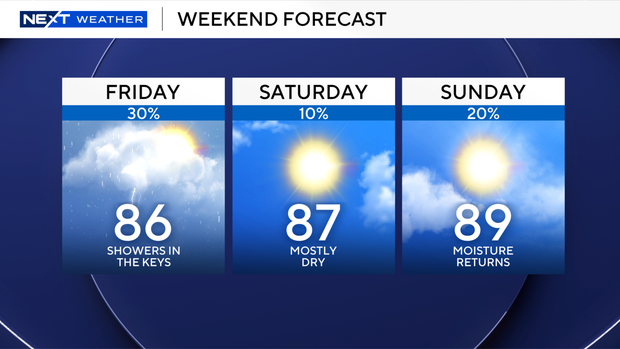
Scattered showers and isolated storms will be possible on Friday, but mostly in the Keys.
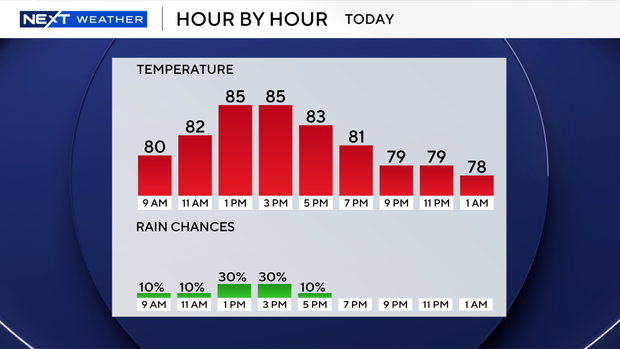
Drier air continues to move into South Florida over the weekend with only 10-20% stray shower chances.
As rain chances go down, temperatures go up over the next several days.
Mostly cloudy skies will keep highs in the mid-80s on Friday, but more sunshine arrives for the weekend and will cause highs to climb into the upper 80s.
Beachgoers should be aware of a high rip current risk at the coast for Friday through Sunday due to the easterly breeze.
Tropical moisture slowly starts to return on Sunday, leading to warmer and wetter conditions for the upcoming workweek.
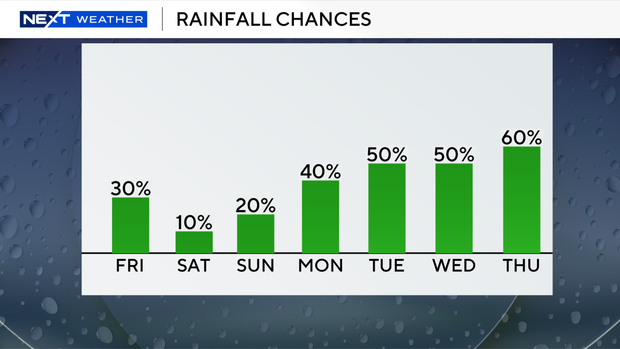
Afternoon highs peak around 90 for Monday as scattered shower and storm chances linger through the first half of the workweek.

If you need help with the Public File, call (407) 291-6000
At WKMG, we are committed to informing and delighting our audience. In our commitment to covering our communities with innovation and excellence, we incorporate Artificial Intelligence (AI) technologies to enhance our news gathering, reporting, and presentation processes. Read our article to see how we are using Artificial Intelligence.
-

 Miami, FL4 minutes ago
Wildlife officers investigate raccoon attack in North Miami
-

 Boston, MA11 minutes ago
Boston Pride for the People Parade is set to step off, with history, protest in mind
-

 Denver, CO14 minutes ago
How a Christian Braun Trade to the Mavericks Could Help Nuggets
-
 Seattle, WA19 minutes ago
Seattle Hotel Workers Are on the Verge of Striking Ahead of the World Cup – The Stranger
-

 San Diego, CA26 minutes ago
San Diego restores $10M in arts funding, reversing proposed budget cuts. Here’s how.
-

 Milwaukee, WI29 minutes ago
With Banana Ball coming to Milwaukee, here’s how it all got started
-

 Atlanta, GA34 minutes ago
What are the chances the U.S. men’s national team plays a World Cup match in Atlanta?
-

 Minneapolis, MN41 minutes ago
Limited ministry to continue amid changes at St. Boniface in Minneapolis – Archdiocese of Saint Paul and Minneapolis

