News
How Trump’s Proposed Arch Could Complicate D.C.’s Congested Airspace


The mammoth triumphal arch President Trump wants to build would sit under one of the most complex sections of the national airspace — directly in the paths of flights in and out of Ronald Reagan National Airport and just a few miles from the site of a catastrophic midair collision last year.
Airplane traffic in April 2026
The Trump administration said on Thursday that the Federal Aviation Administration had compiled preliminary findings from an initial review of whether the proposed arch presented any risks to Washington’s airspace.
But the extent to which those findings, which have yet to be made public, will influence the administration’s plans to move ahead with construction as planned is uncertain. According to a New York Times analysis, the arch as currently planned would warrant further study under at least one F.A.A. guideline.
The F.A.A. had been looking into the administration’s plan for about a month to determine whether the proposed 250-foot structure — a height chosen to commemorate 2026 being the 250th year since American independence — would pose any hazard to flights in and out of Reagan National.
But in recent days, the National Park Service, acting on behalf of the Trump administration, appeared to change tack, quietly asking the F.A.A. to conduct a feasibility study — an advisory review that is normally preliminary and that, according to the F.A.A.’s own procedures, is usually given lower priority than official evaluations.
The reason for the new request, which administration officials defended as routine, was not immediately clear. Though the F.A.A. requires proposed structures over 200 feet to submit to a formal evaluation to determine their impact on local air traffic, feasibility studies are voluntary.
Some aviation experts said the administration’s decision to pursue one at this stage could indicate that possible problems had been identified with the height of the structure, which climbed from 250 feet in the initial filing to 259 feet in the feasibility study request, making the top of the arch sit 288 feet above sea level. In that case, they said, asking for an advisory study could be a strategy to avoid the potential black mark of having Mr. Trump’s pet construction project labeled a risk to flight safety.
It could suggest a project “ran into some issues and is more complicated than they had hoped,” said Michael O’Donnell, an aerospace consultant who previously worked as a senior F.A.A. official focused on air traffic safety.
The change in approach may reflect the sensitivity with which the federal government has approached potential risks in the airspace surrounding Washington since a midair collision last year that killed 67.
In the wake of that accident, in which an Army helicopter flew into a commercial jet 278 feet up in the air just southeast of Reagan National Airport, the F.A.A. shut down much of the surrounding sky to most helicopter traffic. It also instituted new prohibitions against pilots relying on “see and avoid” methods to avoid hitting planes going in and out of the airport.
Change in helicopter traffic
An airspace of unparalleled complexity
Should the arch proceed as planned, some aviation experts said it could be just the latest complication to befall a section of airspace already considered one of the nation’s most complicated.
Air traffic within a half-mile radius of the proposed arch location
Reagan National poses special challenges to pilots navigating the surrounding airspace. Planes cannot fly below 18,000 feet over the National Mall — a wide swath of Washington sitting just north of the airport — and the Naval Observatory, where the vice president lives, meaning that pilots routinely have to make tight turns when ascending from and descending to the airport to avoid them.
Flight restrictions for special events and security surrounding movements of government officials are frequent. Noise concerns in the surrounding metro areas push planes to tightly follow the Potomac River. And two of the airport’s three runways are short, which reduces the margin of error for flights landing or taking off — and contributes to the congestion of Runway 19, which is the nation’s busiest commercial runway.
Air traffic in April 2026 for Runway 19
The Reagan airspace has “just about every congested airspace issue that you can have,” said Dennis Tajer, a 737 pilot who is a spokesman for the American Airlines pilot union. “And we know the tragedy that happened — there’s room for error, but not much.”
A New York Times analysis of federal regulations, traffic patterns and flight procedures found that if the arch were built at the 250-foot height, it would penetrate what is known as the 40-to-1 obstacle clearance surface, an imaginary slope that begins at the departure end of the runway and represents a baseline standard for evaluating the impact of a nearby structure.
How the arch would penetrate the 40-to-1 slope
A structure that breaks through the surface does not necessarily pose a risk but requires further study to determine whether it can safely be built; whether changes such as reducing its height or adding obstruction lighting may be necessary; or whether the F.A.A. could make reasonable changes to flight operations and procedures to accommodate its construction as proposed.
The top of the arch as planned only slightly pushes through the bottom of the 40-to-1 slope — an altitude that virtually all planes would be well above when passing over the planned structure.
Still, some experts speculated that throwing an arch of such height and proximity into the mix could still prompt the F.A.A. to change flight procedures in and out of Reagan National in order to minimize risk. Such changes could affect the work of pilots and air traffic controllers, limit the number of planes allowed to take off or land, or change the maximum amount of weight they can carry.
“The accommodation may be just: Change other things that make it work,” said Scott Dunham, a former air safety investigator for the National Transportation Safety Board and former air traffic controller.
Buildings taller than the arch are farther from the airport
While the height of the planned arch would put it among the tallest structures in the airport’s vicinity, the structure wouldn’t break records. Both the Capitol building and the Washington Monument are taller, but they are both located in a no-fly zone. Memorial Circle, the planned location for the arch, is not.
The arch would also be dwarfed by some structures in Arlington, Va., including a pair of highrise apartments in the Crystal City neighborhood and the towers at Amazon’s new campus in the Pentagon City neighborhood, all less than a mile from the perimeter of Reagan National — and all of which were the subject of heated debate and intense F.A.A. scrutiny. But those structures are not under the main flight path in and out of the airport like the location of the planned arch is.
The nearest buildings that are over 250 feet and in proximity to the climb and descent paths to the airport are clustered in the Rosslyn neighborhood of Arlington, but those sit nearly a mile farther north than the arch, at a greater distance away from the airport.
Several of the buildings in Rosslyn have red obstruction lights to warn approaching pilots to steer clear, a common way to mitigate concerns about height.
Almost 1,700 public comments about the arch, nearly all in opposition, had flooded into the National Capital Planning Commission ahead of its Thursday meeting. Commenters protested issues ranging from its appearance to its significance to its potential impact on flight patterns.
The Department of the Interior, which oversees the National Park Service, said in a statement that feasibility studies, like the one the administration requested, were “standard practice as part of the compliance process.” It did not respond to questions about what prompted the study at this stage or what may have been communicated by the F.A.A. during the previous evaluation.
Under federal regulations, the arch must still complete the full evaluation to receive a final determination about whether it poses a hazard. But the F.A.A.’s determinations are not enforceable. A notice of hazard would typically prevent a commercial structure from obtaining insurance, a factor unlikely to prevent the president from proceeding if he so wishes.
Aviation experts and former F.A.A. officials interviewed by The Times said they trusted that any actions ultimately taken by the F.A.A. would not compromise safety standards. Among them was Michael McCormick, a member of the National Academies of Sciences, Engineering and Medicine committee reviewing risks in the Reagan National airspace in light of the 2025 collision.
But “in my assessment, the airspace and procedures in and out of Washington National are very complex and should not be modified to accommodate a new structure being built,” said Mr. McCormick, who previously led the F.A.A.’s air traffic control operations. “Instead, the structure should be modified to accommodate the procedures in and out of Washington National.”
Sources
Air traffic data shown in this article is for the entire month of April 2026 and Jan. 1-28, 2025, as provided by ADS-B exchange historical records.
The obstacle clearance surface shown is based on the Aeronautical Information Manual and is not a complete set of surfaces that the F.A.A. will review.



News
ICE should do traffic stops despite recent shootings, Trump says, seeming to oppose new suspension

WASHINGTON (AP) — The Immigration and Customs Enforcement agency should continue vehicle stops after recent fatal shootings, President Donald Trump said on Wednesday, seeming to oppose a new suspension of the practice used as part of his immigration crackdown.
ICE is “doing a GREAT job, one that has to be done,” Trump wrote on his social media site.
The Republican president said that to remove criminals he claims were let into the country under the previous Democratic administration “we must be strong, tough, and smart, and we CANNOT give up one of ICE’s most important and effective Crime Fighting tools, THE TRAFFIC STOP!” Trump said, “Once we do, we are playing right into the criminal’s hands.”
Trump administration officials have told Immigration and Customs Enforcement officers to suspend most vehicle stops after two deadly shootings within a week, people familiar with the decision said Tuesday.
The suspension was ordered after an ICE officer shot and killed a Colombian driver Monday in Maine and a week after another officer shot and killed a motorist in Houston, renewing criticism of the agency’s enforcement tactics that were widely condemned last winter after the killings of Alex Pretti and Renee Good in Minnesota.
In Florida on Tuesday, a third man in roughly a week died during an encounter with immigration officers. This time, a 28-year-old man was killed after he was hit by a tractor trailer while running from immigration and other federal officers, authorities said.
It’s a narrative that has been repeated again and again since the Trump administration’s immigration crackdown began, with federal officers confronting drivers and then saying they opened fire when the drivers’ vehicles became a danger. That’s despite decades of warnings from policing experts that shooting into moving cars presents a danger of its own and should almost always be avoided.
There have been at least 10 deaths involving encounters with immigration agents since Trump launched his deportation campaign. At least four of those deaths involved people in vehicles, including the one last week in Houston, a trend so troubling that U.S. Sen. Susan Collins, R-Maine, said Tuesday that she had urged Department of Homeland Security Secretary Markwayne Mullin “to cease all non-urgent vehicle stops.”
John Sandweg, who was acting director at ICE, which is part of DHS, during President Barack Obama’s Democratic administration, estimated recently that there have been roughly 18 traffic stop shootings during the Trump immigration crackdown.
The office of Maine Sen. Angus King, an independent who caucuses with Democrats, was told by DHS that ICE was suspending traffic stops, office spokesperson Matthew Felling said.
ICE, which has been under pressure to beef up arrest and deportation numbers, often says people it’s trying to arrest are increasingly resistant to leaving their homes. ICE officers blame immigration advocates who advise immigrants to stay in their homes unless ICE produces a warrant signed by an independent judge instead of the administrative warrants the agency generally uses that are signed by another ICE officer. So, ICE officers say, they’re forced to find other areas in which to make arrests.
Shooting angers Maine
Hundreds of people in Maine protested Tuesday over the fatal shooting of Johan Sebastián Durán Guerrero, a 25-year-old Colombian national. Advocacy groups said Guerrero, who had a wife and a young daughter, was authorized to work in the United States.
DHS said Monday that an officer, “fearing for public safety,” shot and killed Durán Guerrero while officers were watching the home of someone they believed was in the U.S. illegally and facing a final order of removal from the country. It said in a post on X that when ICE tried to stop a car driven by someone who came from the home, the person attempted to flee in the vehicle and the officer fired.
That was a shift from how King earlier described the encounter, when he said Mullin told him the officer opened fire after the man tried to use his vehicle as a weapon. King said Mullin told him the officers were trying to serve an arrest warrant but not for the man who was shot.
In a scathing post on X, outgoing Colombian President Gustavo Petro called the shooting a targeted killing “at the hands of the U.S. government.”
Petro, who has openly quarreled with Trump, urged Trump to provide an explanation and accused ICE officers of treating Durán Guerrero as “an inferior being without rights.”
In Wednesday’s social media post, Trump told ICE to be “judicious, fair and smart, and go back and do your very important job.”
Maine’s congressional delegation on Tuesday demanded a “comprehensive, transparent, and expedited investigation.”
Questions surround the shooting
Photos showed bullet holes in Durán Guerrero’s car windshield, but the officers involved in the shooting didn’t have body cameras, leaving many questions. Among them are how close the officer was to the vehicle when shooting, whether officers told Durán Guerrero to stop and why ICE believes he had put the public in danger.
Border czar Tom Homan told reporters Tuesday that the investigation needs to play out and that officers will be held accountable if they are found to have acted inappropriately or illegally.
Maine’s attorney general’s office, which said it is working with federal agencies to investigate, said initial statements suggest the driver was trying to flee in the direction of the officer, whose name hasn’t been released and who was placed on leave.
Collins said Mullin told her the DHS inspector general is investigating in cooperation with the FBI.
Democrats seeking to unseat Collins in November have sought to connect her with ICE’s methods, which have drawn public scrutiny and derision. Collins later said in a statement that although ICE needs to improve, eliminating the agency would make the nation less safe.
Maine Secretary of State Shenna Bellows, a Democrat who is vying for Collins’ seat, called the ICE officers at the shooting “thugs” during a vigil Tuesday in Lewiston.
___
Whittle contributed from Biddeford, Maine; Brook from New Orleans; and Sisak from New York.
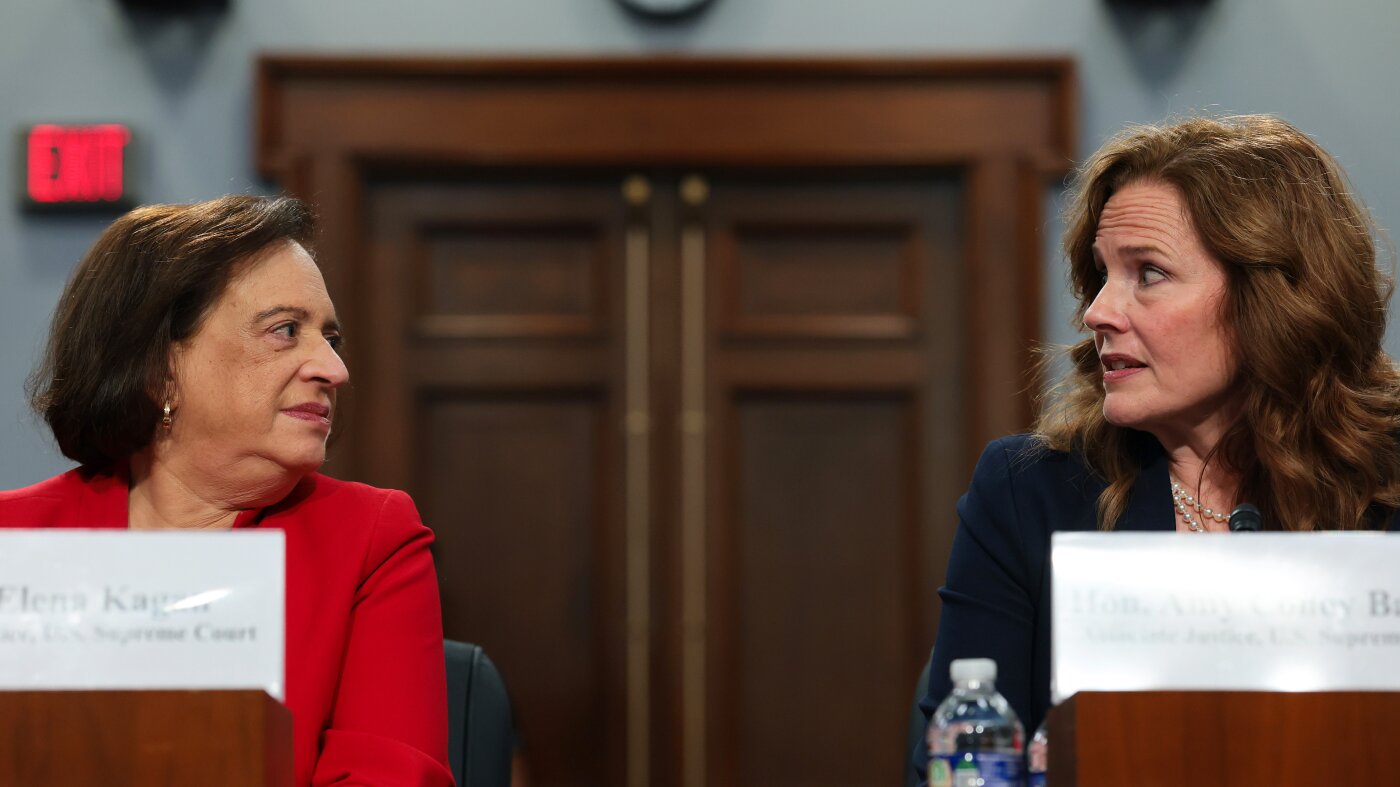
Supreme Court Justices Elena Kagan and Amy Coney Barrett testify before the House Appropriations Committee on Capitol Hill on July 14, 2026 in Washington, D.C.
Anna Moneymaker/Getty Images
hide caption
toggle caption
Anna Moneymaker/Getty Images
The Supreme Court did something Tuesday that it has not done in seven years. It sent two of the justices to Capitol Hill to testify about the court’s budget request for the coming year. The budget has grown dramatically in recent years because of the equally dramatic rise in the number and intensity of threats to the justices’ safety.
Designated as the court’s representatives were Justice Elena Kagan, appointed by President Obama, and Justice Amy Coney Barrett, appointed by President Trump.
As Kagan pointed out in her testimony, it was Republican Darrell Issa and Democrat Elijah Cummings who insisted that the court beef up its security ten years ago after Justice Antonin Scalia died in his sleep on a hunting trip, with no security anywhere nearby to respond quickly.

“They said, kind of like, we think you’re crazy, you know, that that you have less security than director of the Office of Personnel Management does,” she recounted the Congressmen as telling the Court, “and we think that you have to do better.”
Before that, the justices basically had little to no security. They drove their own cars to work; went to the movies and shopped at supermarkets unaccompanied, and did their private travel on their own. And frankly, they liked it that way, because having security is personally invasive.
In recent years, however, the court has undertaken major changes, including continually expanding the court police force to protect the justices and their homes at all times, and funding additional cybersecurity measures.
And yet, as Justice Kagan pointed out, the Court’s $207 million budget request is less than one tenth of one percent of the entire federal budget.
The justices spoke at length Tuesday about how rising threats impacted their lives. Justice Barrett came prepared with two harrowing stories. First was the day she brought home a bullet-proof vest.
“My 12-year-old son was standing in the doorway of my bedroom and he wanted to know what it was,” she testified, “and I didn’t know how to respond. I didn’t expect that performing this service was going to put me in the position of explaining to my children what a bulletproof vest was and why I had to wear one.”
She also described how just six weeks ago, her house was swatted, with local police responding to a fake emergency call. Local police could have stormed her home, but for the fact that her own security detail was there to prevent it.
Indeed, threats have deeply affected judges across America. After U.S. District Court Judge Esther Salas’s 20-year old son was murdered by a gunman seeking to kill her, many federal judges have reported receiving packages bearing the name of her slain son. Those threats, Justice Barrett testified, “are meant to intimidate and they’re meant to harass.”
Sen. Jack Reed (D-R.I.), asked questions about President Trump’s furious response to adverse rulings in the tariff and birthright citizenship cases, and whether Trump’s heaping insults on the court could play a role in jeopardizing the safety of some justices. Kagan had a two-part reply.
“Criticism is fair game. I mean, go for it. You know, life in the big city is that you’re subject to all kinds of criticism. But intimidation is a different thing entirely. And when political figures of any stripe are trying to intimidate judges,” she said, “that’s where we really have crossed the line.”
The hearings were not confined to issues of safety. Congresswoman Rosa De Lauro (D-Conn.) asked about the Supreme Court’s ethics requirements, noting that members of Congress and the executive branch are limited to gifts under $50, while the Supreme Court has no such limit.
She is supporting a bill that would impose upon the Supreme Court the same restrictions on receiving gifts that apply to Congress. And she called for an enforcement mechanism for the ethics rules adopted by the Supreme Court itself.
But Justice Kagan, who said she favors an enforcement mechanism, added that creating such a system is “hard.” After all, as she noted, “you wouldn’t want either the President or Congress” imposing a system on the court because that could well lead to compromising the independence of the judiciary.
One idea that Kagan seemed to like would be to create a panel of distinguished retired judges to enforce the court’s ethics code. But Justice Barrett seemed unpersuaded.
“Who selects the judges? How is the panel composed? There’s just a lot of complexity,” that hasn’t been worked out, she said. The disagreement between the two was, if anything, illustrative of just how hard it was to get the court to finally agree on even the relatively porous ethics code it voluntarily adopted in 2023.
The Justices were also questioned about the court’s emergency docket, dubbed by critics “the shadow docket.” These cases were extremely rare until the Trump administrations.
The critical difference between the emergency docket and the so-called merits docket is that emergency docket appeals often leapfrog over the lower courts, allowing the high court to decide cases without full briefing and argument, and inevitably without much, if any, explanation.
Critics, including Justice Kagan, have often criticized these unsigned and unexplained emergency docket orders for making it difficult for lower courts to know what the law is. Some have in fact accused the court of inviting the Trump administration to treat the docket like a fast-pass to getting policy rubber-stamped.
Questioned by Senator Chris Van Hollen (D-Md.), Kagan observed that part of the reason for the Court’s increasing use of the emergency docket comes from the fact that “we’ve granted a number of these…And when people know that relief is available, there are a lot of smart lawyers out there in the world who are going to say, ‘Why don’t we take our shot at that?’” In other words, the court’s own behavior may have invited the existing problem to metastasize.

Mexico has begun filing criminal complaints with state prosecutors in the United States over the deaths of its citizens in U.S. immigration custody and during enforcement operations, the foreign mini

Maine ICE shooting caught on security camera
Surveillance footage from two local businesses shows a white car driving in circles at a street intersection.
MEXICO CITY, July 13 (Reuters) – Mexico has begun filing criminal complaints with state prosecutors in the United States over the deaths of its citizens in U.S. immigration custody and during enforcement operations, the foreign ministry said on Tuesday.
Mexico’s government has also sent cease-and-desist letters to U.S. detention centers where Mexican nationals have died, the ministry added in a statement.
The filings follow the deaths of at least 14 Mexican nationals in ICE custody and several others during arrest operations, including the recent fatal shooting of a Mexican citizen by an ICE agent in Houston.
President Claudia Sheinbaum announced Mexico’s intention to escalate its response to the deaths last Friday, as she claimed that the government “cannot turn a blind eye to the Mexicans who have died.”
In addition to the measures in the U.S., Mexico’s foreign minister also contacted the United Nations High Commissioner for Human Rights regarding the deaths of Mexican nationals in ICE custody.
Mexico expects the U.N. office to gather information from U.S. authorities, analyze the events and “refer the case to the relevant special procedures of the Human Rights Council,” the statement added.
-

 Fitness5 minutes ago
More Muscle, Less Fat—Is This High-Tech Workout A New Fitness Answer?
-

 Movie Reviews17 minutes ago
Film Review: “The Odyssey” – MediaMikes
-
World29 minutes ago
Movie Review: In Christopher Nolan’s ‘The Odyssey,’ an ancient epic is reborn
-

 Health59 minutes ago
The Epicenter of Drug Deaths in America Is Shifting West
-
 Lifestyle1 hour ago
Homelessness is more common than you think. : It’s Been a Minute
-

 Technology1 hour ago
Lucid’s bankruptcy rumor is a bad sign for the EV future
-

 World2 hours ago
Slain American mother Jamey Carney remembered as ‘ray of sunshine’ at Ireland funeral
-

 Politics2 hours ago
Canadian woman accused of slapping Trump-supporting teen turned over to ICE


