Florida
Florida reportedly using millions in opioid settlement money on anti-marijuana campaign targeting Amendment 3


Florida state records have revealed that the state has reportedly channeled millions of dollars from a settlement with opioid manufacturers and distributors into a campaign targeting the proposed Amendment 3, which would legalize recreational marijuana for adults over 21.
>>> STREAM ACTION NEWS JAX LIVE
The Florida Department of Children and Families (DCF) recently allocated nearly $4 million from the Florida opioid settlement trust fund to Strategic Digital Services, a Tallahassee-based marketing agency, for an educational campaign on the “dangers of marijuana, opioid, and drug use,” specifically directed at Floridian families and youth. You can view the purchase order information HERE.
Two ads were recently released as part of this effort to highlight the potential mental health risks of marijuana use in teens, including links to schizophrenia. One advertisement claims that modern marijuana is “engineered by corporations all for one purpose: to rewire the human mind.”
Below is one of the ads:
Research shows that marijuana can do real damage to the developing brains of young people — leading to higher risks of psychotic disorders, suicides, and learning loss. Protect your children from the risks of extensive marijuana use. pic.twitter.com/jc7gZM0ja8
— Florida Department of Children and Families (@MyFLFamilies) October 21, 2024
Although the ads do not mention the amendment by name, supporters of Amendment 3 argue they represent a deliberate effort by the administration to sway voters ahead of the November election.
READ: Former President Trump announces he will vote yes on Florida’s Amendment 3 on marijuana legalization
Funding Scrutiny from Amendment 3 Supporters:
The use of opioid settlement funds, intended to mitigate the opioid epidemic, is raising questions among Amendment 3 supporters who argue the campaign is cannibalizing public money for political ads.
The $4 million contract with Strategic Digital Services will be funded by Florida’s opioid settlement trust, established as part of a multi-billion dollar agreement to hold pharmaceutical companies accountable for their role in the opioid crisis.
Over the next 20 years, Florida is slated to receive $3 billion from a nationwide opioid settlement, with funds directed toward combating the opioid epidemic. State law mandates the trust fund’s use in combating the opioid crisis, though it also includes provisions for broader substance use disorders.
The ads’ focus on a marijuana-focused campaign —rather than opioids—has raised questions about the DeSantis administration’s allocation choices in the run-up to the election.
Sen. Joe Gruters, R-Sarasota, joined a bipartisan group of Amendment 3 advocates at a press event Friday, where he criticized the administration for using funds to allegedly advance a political agenda. “Tax dollars should not go to fund propaganda, bottom line,” Gruters said.
The DCF has yet to clarify if both recent ads fall under the $4 million contract with Strategic Digital Services, though they appeared after the contract was enacted, suggesting that opioid settlement money may be funding the campaign.
Anti-Amendment Campaigns:
In recent weeks, Governor DeSantis has intensified his anti-amendment campaigns, utilizing state resources against ballot measures like Amendment 3 and Amendment 4, the proposed amendment aimed at enshrining abortion rights in Floria’s constitution.
READ: DeSantis escalates legal fight against Amendment 4 abortion ads, leveraging state resources in opposition
In numerous press conferences held across the state, the DeSantis administration warned of what he calls the “dangers” of legal marijuana, stating that he considers Amendment 3 as “more liberal” than laws in Colorado and California. At one press event, he invited a mother who lost her son to opioids to share how his struggle began with marijuana, which the administration described as a gateway to harder drugs.
Below is the referenced press event: (Note: The mother appears at the press conference starting at timestamp 37:30.)
Meanwhile, Florida’s First Lady Casey DeSantis and Florida Surgeon General Dr. Joseph Ladapo have joined the anti-amendment efforts.
The First Lady has attended several events supported by law enforcement, where she has publicly opposed the amendment.
“This is not about freedom. This is about corporate greed,” First Lady Casey DeSantis said.
Meanwhile, Dr. Ladapo, previously criticized by federal agencies for spreading misinformation on COVID-19 vaccines, recently discussed the potential health risks of marijuana in a televised interview.
Upcoming Vote:
With early voting underway and a recent UNF poll showing 67% of people support Amendment 3, this election could represent a significant policy shift in Florida. While the DeSantis administration contends the measure risks public health, Amendment 3 advocates argue it would bring much-needed tax revenue to the state and regulate marijuana safely.
The final decision now rests with voters, who will cast their ballots on November 5. In Florida, each amendment requires a supermajority of 60% to pass, making your vote all the more critical in deciding the direction the state will go.
READ: What’s on Florida’s 2024 ballot?: A complete guide to the six proposed state amendments
[SIGN UP: Action News Jax Daily Headlines Newsletter]
Click here to download the free Action News Jax news and weather apps, click here to download the Action News Jax Now app for your smart TV and click here to stream Action News Jax live.



Florida
Judge cites ‘stand your ground’ law in clearing 3 more Florida officers in shooting of a UPS driver

FORT LAUDERDALE, Fla. (AP) — A South Florida judge on Monday cleared three more police officers of wrongdoing in the shooting death of a UPS driver who had been taken hostage during a 2019 robbery.
Broward Circuit Judge Ernest Kollra ruled that Miami-Dade police officers Richard Santiesteban, Leslie Lee and Rodolfo Mirabal — who had been charged with manslaughter in the death of UPS driver Frank Ordonez — could not be prosecuted because Florida’s “stand your ground” law justified the shooting. The same judge cleared officer Jose Mateo in September for the same reason.
The Broward State Attorney’s Office said it will appeal all four rulings.
“Immunity from prosecution is not the same as a defense presented to a jury from this community,” the state attorney’s statement said. “It is our belief that Stand Your Ground immunity does not apply in matters involving innocent bystanders, like Frank Ordonez and Richard Cutshaw, who presented no danger to officers. In this incident, two innocent men were killed, and the lives of numerous other innocent bystanders were endangered.”
Cutshaw was also killed in the barrage of gunfire that afternoon.
Ordonez, 27, had been delivering packages in Miami-Dade County on Dec. 5, 2019, when police said two would-be jewelry store robbers abducted him and forced him to drive from the scene. A rush-hour police chase ended at a busy intersection in neighboring Broward County.
Prosecutors said Mateo fired the shots that killed Ordonez. The two robbers and a passerby were also killed in a hail of gunfire at an intersection in Miramar, Florida.
Footage from a body camera that was played in court showed Mateo’s pursuit of the UPS truck that afternoon. His partner could be seen in the passenger seat with a long gun drawn. The video also showed Mateo approaching the UPS truck. He emptied his firearm’s magazine, reloaded and then pulled Ordonez from the vehicle.
The judge ruled the officers had reason to believe deadly force was necessary to end the confrontation.
The four officers are currently suspended from the their jobs.

After a beautiful weekend across South Florida, the warm weather continues for the workweek.
A cool start mostly in the lower to mid-60s will lead to a warm and sunny afternoon with highs in the lower to mid-80s.
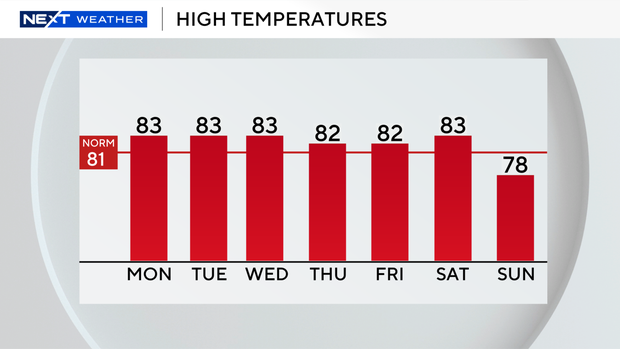
Afternoon highs linger in the lower to mid-80s each day for the workweek with changes not arriving until the weekend.
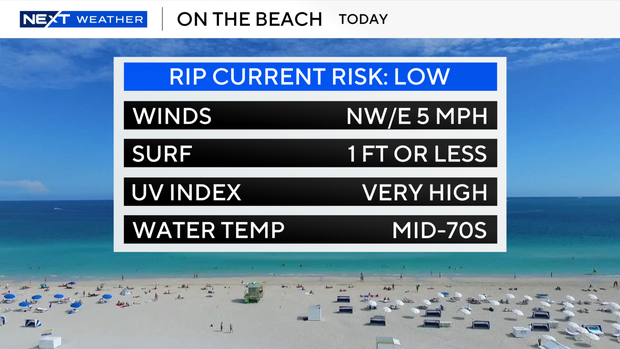
Beachgoers can expect excellent conditions with a low rip current risk as water temperatures remain in the mid-70s.
The NEXT Weather Team will continue to monitor an enhanced fire weather risk due to dry air and the ongoing drought conditions.
While there are no major wildfires being reported in South Florida, light north and northwesterly winds overnight have been bringing smoke from ongoing fires along the Gulf Coast and the Southeast U.S. into South Florida, lowering our air quality for the morning hours.
Conditions improve by midday as the wind shifts.
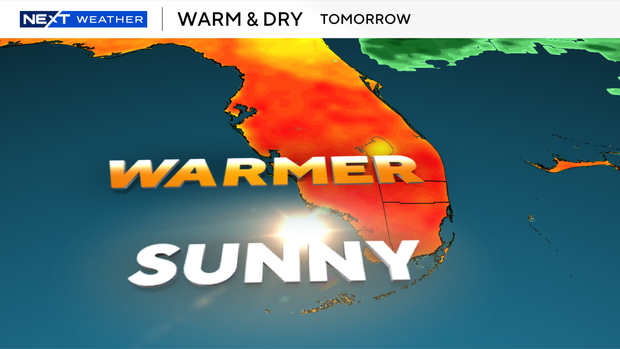
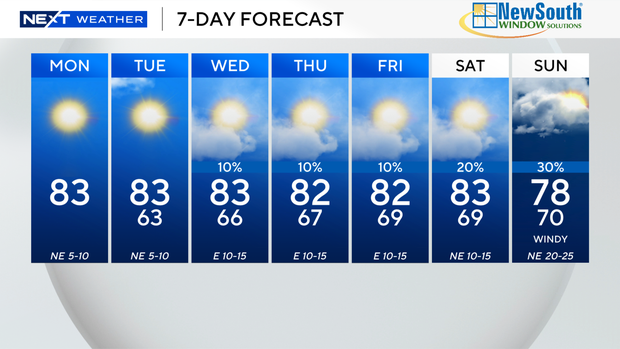
No significant rain chances will be found throughout the workweek with just a slim 10% shower chance Wednesday through Friday.
However, rain chances will be on the rise over the weekend as our team monitors a possible disturbance bringing the potential for scattered showers on Sunday.
These showers could help lower afternoon highs to upper 70s by the end of the weekend.

WEST PALM BEACH, Fla. (CBS12) — Florida has become the country’s busiest hub for immigration arrests this year, with ICE agents in the Miami Field Office — which oversees Florida, Puerto Rico and the U.S. Virgin Islands — logging more detentions than any other region in the nation according to our news partners at the South Florida Sun Sentinel.
According to figures reported by the New York Times, agents under the Miami office are averaging about 120 arrests a day, totaling nearly 9,900 arrests as of March 10. That pace puts Florida well ahead of other regions experiencing federal “surge” operations, including Minnesota, where a high-profile enforcement push drew national scrutiny after two U.S. citizens were killed.

Kentucky takes down West Virginia, will face Texas in Sweet 16

How Wyoming Game Wardens Cracked The Cody Serial Poaching Case

Capital B Completes Capital Increase and Acquires 44 Additional Bitcoin, Now Holds 2,888 BTC

Oil rollercoaster pushes prices higher as US-Iran talks raise questions

The HFA Show 2026 Demonstrates the Power of Community With Strong Turnout and Programming – Health & Fitness Association

Florida High School Football Rankings: Top 25 teams – Oct. 21

How old is Bo Nix? What to know about Oregon quarterback ahead of 2024 NFL Draft

Cleary's 21 help Le Moyne down Central Connecticut State 69-64 in OT

99th annual Pony Swim held in Virginia

Indiana Members Credit Union announced as new anchor tenant at Bottleworks District

See How the LaGuardia Plane Crash Unfolded

Mullin confirmed as DHS chief as lawmakers near solution on shutdown standoff

Von der Leyen clinches Australia trade deal

Trump administration places Christopher Columbus statue on White House grounds

See TSA Wait Times at Major U.S. Airports
-

 Detroit, MI5 days ago
Drummer Brian Pastoria, longtime Detroit music advocate, dies at 68
-

 Oklahoma1 week ago
Family rallies around Oklahoma father after head-on crash
-

 Georgia1 week ago
How ICE plans for a detention warehouse pushed a Georgia town to fight back | CNN Politics
-

 Alaska1 week ago
Police looking for man considered ‘armed and dangerous’
-

 Movie Reviews5 days ago
‘Youth’ Twitter review: Ken Karunaas impresses audiences; Suraj Venjaramoodu adds charm; music wins praise | – The Times of India
-

 Education1 week ago
Video: Turning Point USA Clubs Expand to High Schools Across America
-
 Science1 week ago
Long COVID leaves thousands of L.A. county residents sick, broke and ignored
-

 Sports3 days ago
IOC addresses execution of 19-year-old Iranian wrestler Saleh Mohammadi