

Entertainment
Review: ‘The Artist’ is an oddball comedy filled with big stars and historical figures
The first, or maybe the second thing to be said about “The Artist,” a six-part comedy written and directed by Aram Rappaport, is that it streams from the Network, a free ad-supported streaming service Rappaport created to release his previous series, “The Green Veil.” The first three episodes premiere Thursday; the concluding three are due at Christmastime.
The second, or maybe the first thing to say about it is that it comes pulling a tramload of heavy talent — including Mandy Patinkin, Janet McTeer, Danny Huston, Hank Azaria, Patty Lupone, Zachary Quinto — which begs for it to be taken seriously, though that might not be the best way to take it.
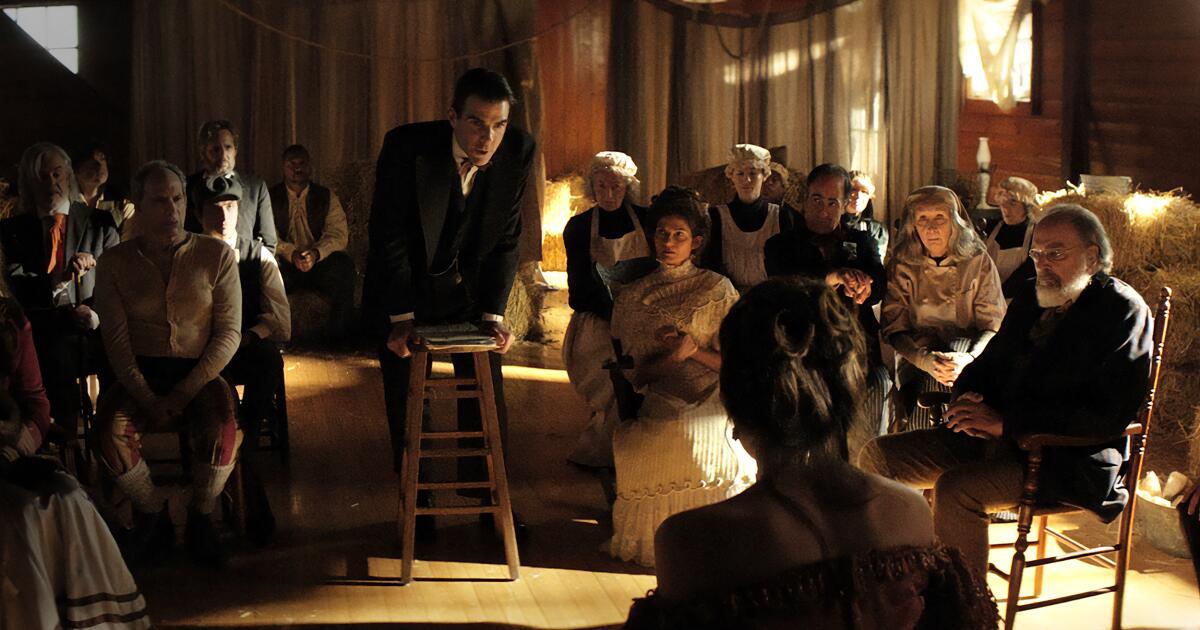
Set in 1906, peopled with ahistorical versions of historical figures, the series is set largely in and around the Rhode Island “country home” of Norman Henry (Patinkin), identified by a title card as “an eccentric robber baron,” and seemingly what we’d call a venture capitalist today. (And one seemingly in need of capital.) Norman begins the series dead, carried out rolled in a carpet and set on fire like a Viking, before we skip back in time, meeting his wife, Marian (McTeer), who narrates from her journal and advises “the reader” that it is only on the final page that “you might be well enough equipped to tell fact from fiction, hero from villain.” I’ve seen only the first three episodes, so I have no idea, apart from where the story misrepresents its real-life characters. But that’s just poetic license and, of course, perfectly acceptable.
The staff, for no evident reason, apart perhaps from the house lacking “a working kitchen,” lives in tents on the front lawn. They’re called inside by bells, attached to cords running out the windows, labeled the Maid, the Ballerina, the Boxer, the Doctor. The ballerina, Lilith (Ana Mulvoy Ten), is a sort of protege to Henry; she believes he’ll arrange for her to dance “Coppelia” back home in Paris, the fool. (Their scenes together are creepy.) Sometimes we see her naked (though tastefully arranged) in a metal tub. Her dance instructor, Marius (David Pittu), is waspish, bitter and insulting. The boxer is a sparring partner for Marian, who works out her aggression in the ring. She’s told us that she loathes her husband, and he her (though he professes his love in a backhanded way).
Danny Huston plays Edgar Degas, the artist in the series’ title.
(The Network)
And then there’s the eponymous artist (Huston), eventually identified as Edgar Degas, real-life French Impressionist, who was not, in fact, literally stumbling around Rhode Island in 1906, and certainly not accepting a commission to paint French poodles. (So much French!) You are free to make the connection between the show’s ballerina and those he famously painted, and her nude in the tub with his masterpiece pastels of bathing women. But apart from bad eyesight, a hint of antisemitism and Huston muttering in French, there’s no substantial resemblance to the genuine article. Here, he seems half out of his mind, or half sober. He is quite concerned with getting paid, and I don’t blame him.
The news of the day is that another person from history, Thomas Edison (Azaria) is coming to the house, looking for an investor for his new invention, a Kinetophone, a peep show with sound, like a turn-of-the-century take on a virtual reality headset. (There was such a thing; it was not a success.) This sets up a long flashback in which we learn that Marian and Edison knew each other in college, and that he betrayed her. Next up are Evelyn Nesbit (Ever Anderson) and her mother (Jill Hennessy), who have booked it out of New York after Evelyn’s unstable husband, Harry K. Thaw (Clark Gregg), shot architect Stanford White in the rooftop restaurant of White’s Madison Square Garden. That happened.
It’s a loud show, with much shouting and some brief violence, which, in its suddenness, verges on slapstick, and some less brief violence which is not funny at all. There is a superfluity of gratuitous profanity; F words and the less usual C word fly about like bats at twilight, clutter up sentences, along with many rude sexual and anatomical imprecations. Most everyone is pent up, ready to pop. At the beginning of the series, setting the table for what’s to come, Marian declares, “This is not a story in the conventional sense”; it’s “a cautionary tale,” but “not a tale of murder. This is a story of rebirth,” presumably hers. There’s a feminist current to the narrative: The men are patronizing and possessive, the women — taken advantage of in more than one sense — find ways to accommodate, manipulate or fight them, while holding on to themselves.
One can see why Rappaport might have had trouble landing this series elsewhere, or preferred to avoid notes from above. Aesthetically and textually, it’s the sort of absurdist comedy that used to turn up in the late 1960s and early ‘70s, something like the works of Robert Downey Sr. or William Klein, or maybe an ambitious film student’s senior thesis, given a big budget and access to talent; in its very lack, or perhaps avoidance, of subtlety it feels very old-fashioned. I wouldn’t go so far as to call it bad, or for that matter good, but it seems to me the perfect realization of the creator’s idea, and there is something in that. And there are those three concluding episodes, which will bring in Lupone and Quinto, their characters yet unknown, and may move the needle one way or the other. In any case, it’s not something you see every day.
Movie Reviews
FILM REVIEW: ROSE OF NEVADA – Joyzine
‘4’, the opening track on Richard D James’ (Aphex Twin) self titled 1996 album is a piece of music that beautifully balances the chaotic with the serene, the oppressive and the freeing. It’s a trick that James has pulled off multiple times throughout his career and it is a huge part of what makes him such an iconic and influential artist. Many people have laid the “next Aphex Twin” label on musicians who do things slightly different and when you actually hear their music you realise that, once again, the label is flawed and applied with a lazy attitude. Why mention this? Well, it turns out we’ve been looking for James’ heir apparent in the wrong artform. We’ve so zoned in on music that we’ve not noticed that another Celtic son of Cornwall is rewriting an art form with that highwire balancing act between chaos and beauty. That artist is writer, director and composer Mark Jenkin who over his last two feature films has announced himself as an idiosyncratic voice who is creating his very own language within the world of cinema. Jenkin’s films are often centred around coastal towns or islands and whilst they are experimental or even unsettling, there is always a big heart at the centre of the narrative. A heart that cares about family, tradition, culture, and the pull of ‘home’. Even during the horror of 2022’s brilliant Enys Men you were anchored by the vulnerability and determination of its main protagonist.
This month sees the release of Jenkin’s latest feature film, Rose of Nevada, which is set in a fractured and diminished Cornish coastal town. One day the fishing boat of the film’s title arrives back in harbour after being missing for thirty years. The boat is unoccupied. And frankly that is all the information you are going to get because to discuss any more plot would be unfair on you and disrespectful to Jenkin and the team behind the film. You the viewer should be the one who decides what it is about because thematically there are so many wonderful threads to pull on. This writer’s opinions on what it is about have ranged from a theme of sacrifice for the good of a community to the conflict within when part of you wants to run away from your roots whilst the other half longs to stay and be a lifelong part of its tapestry. Is it about Brexit? Could be. Is it about our own relationships with time and our curation of memory? Could be. Is it about both the positives and negatives of nostalgia? Could be. As a side note, anyone in their mid-40s, like me, who came of age in the 1990s will certainly find moments of warm recognition. Is the film about ghosts and how they haunt families? Could be…I think you get the point.
The elements that make the film so well balanced between chaos and calm are many. It is there in the differing performances between the brilliant two lead actors George MacKay and Callum Turner. It is there in the sound design which fluctuates from being unbearably harsh and metallic, to lulling and warm. It is there in the editing where short, sharp close ups on seemingly unimportant factors are counterbalanced with shots that are held for just that little bit too long. For a film set around the sea, it is apt that it can make you feel like you’re rolling on a stomach churning storm one minute, or a calming low tide the next. Dialogue can be front and centre or blurred and buried under static. One shot is bathed in harsh sunlight whilst the next can be drowned in interior shadows.
Rose of Nevada is Mark Jenkin’s most ambitious film to date yet he has not lost a single iota of innovation, singularity of vision or his gift for telling the most human of stories. It is a film that will tell you different things each time you see it and whilst there are moments that can confuse or beguile, there is so much empathy and love that it can leave you crying tears of emotional understanding. It is chaotic. It is beautiful. It is life……
Rose of Nevada is released on the 24th April.
Mark Jenkin Instagram | Threads
Released through the BFI – Instagram | Facebook
Review by Simon Tucker
Keep up to date with all new content on Joyzine via our
Facebook | Bluesky | Instagram | Threads | Mailing List
Related
Entertainment
Larry David discusses ‘Curb Your Enthusiasm,’ ‘Seinfeld’ legacies and new HBO series
Inside the ornate Bovard Auditorium, Larry David kept a full audience in stitches as he discussed the creation and legacy of his improv hit, “Curb Your Enthusiasm,” which concluded in 2024 after 12 seasons.
In a conversation with Lorraine Ali — who wrote “No Lessons Learned: The Making of Curb Your Enthusiasm,” which retraces the show’s 24-year run with cast interviews, episode guides and behind-the-scenes material — David reflected on the separation between himself and the abrasive on-screen persona he adopted for more than two decades.
“I wish I was that Larry David,” he said.
David spoke about the outrageous audition process for “Curb,” wherein actors tried to navigate a brief written scenario without any dialogue to guide them as David lambasted them in character. Out of this process came iconic one-liners and beloved characters, such as Leon, played by J.B. Smoove.
“People bring out certain things, and when I would act with them, some of them would make me seem funny,” David said. “I go, ‘Oh, that’s good — let’s give him a part.’”
David cited “Palestinian Chicken” as one of his favorite episodes of the show. In the episode, David is caught between a delicious new Palestinian chicken restaurant, a Palestinian girlfriend and an outraged inner circle of Jewish friends.
He also spoke briefly about his upcoming episodic HBO series, “Life, Larry and the Pursuit of Happiness,” a historical spoof that will retrace United States history for the country’s 250th founding anniversary. The series will premiere on Aug. 7.
“A lot of wigs, costumes, beards — fake beards,” David said. “Nothing worse than fake beards.”
The controversial ending of “Seinfeld,” which David co-wrote with comedian Jerry Seinfeld, was polarizing among fans when it was released, David said. After a recent rewatch, however, David said he thought it was “pretty good,” to a round of applause from the audience.
Near the end of the panel, an audience member asked a question some definitely had on their mind: Will “Seinfeld” ever get a reunion?
“No,” David replied without missing a beat.
Movie Reviews
‘Hen’ movie review: György Pálfi pecks at Europe’s migrant crisis through the eyes of a chicken
A rogue chicken observes the world around it—and particularly the plight of immigrants in Greece—in Hen, which premiered at last year’s Toronto International Film Festival and is now playing in Prague cinemas (and with English subtitles at Kino Světozor and Edison Filmhub). This story of man through the eyes of an animal immediately recalls Robert Bresson’s Au Hasard Balthazar (and Jerzy Skolimowski’s more recent EO), but director and co-writer György Pálfi (Taxidermia) maintains a bitter, unsentimental approach that lands with unexpected force.
Hen opens with striking scenes inside an industrial poultry facility, where eggs are laid, processed, and shuttled along assembly lines of machinery and human hands in an almost mechanized rhythm of production. From this system emerges our protagonist: a black chick that immediately stands apart from the others, its entry into the world defined not by nature, but by an uncaring food industry.
The titular hen matures quickly within this environment before being loaded onto a truck with the others, presumably destined for slaughter. Because of her black plumage, she is singled out by the driver and rejected from the shipment, only to be told she will instead end up as soup in his wife’s kitchen. During a stop at a gas station, however, she escapes.
What follows is a journey through rural Greece by the sea, including an encounter with a fox, before she eventually finds refuge at a decaying roadside restaurant run by an older man (Yannis Kokiasmenos), his daughter (Maria Diakopanayotou), and her child. Discovered by the family’s dog Titan, she is placed in a coop alongside other chickens.
After finding a mate in the local rooster, she lays eggs that are regularly collected by the man; in one quietly unsettling scene, she watches him crack them open and cook them into an omelet. The hen repeatedly attempts to escape, as we slowly observe the true function of the property: it is being used as a transit point for migrants arriving in Greece by boat, facilitated by local criminal figures.
Like Au Hasard Balthazar and EO, Hen largely resists anthropomorphizing its animal protagonist. The hen behaves as a hen, and the humans treat her accordingly, creating a work that feels unusually grounded and almost documentary in texture. At the same time, Pálfi allows space for the audience to project meaning onto her journey, never fully closing the gap between instinct and interpretation.
There are moments, however, where the film deliberately leans into stylization. A playful montage set to Ravel’s Boléro captures her repeated escape attempts from the coop, while a romantic musical cue underscores her brief pairing with the rooster. These sequences do not break the realism so much as refract it, gently encouraging us to read emotion into behavior that remains, on the surface, purely animal.
One of the film’s central narrative threads is the hen’s search for a safe space to lay her eggs without them being taken away by the restaurant owner. This deceptively simple instinct becomes a powerful thematic mirror for the film’s human subplot involving migrant trafficking. Pálfi draws a stark, often uncomfortable parallel between the treatment of animals as commodities and the treatment of displaced people as disposable bodies moving through a similar system of exploitation.
The film takes an increasingly bleak turn toward its climax as the migrant storyline comes fully into focus, sharpening its allegorical intent. The juxtaposition of animal and human vulnerability becomes more explicit, reinforcing the film’s central critique of systemic indifference and violence. While effective, this escalation feels unusually dark, and our protagonist’s unknowing role feels particularly cruel.
The use of animal actors in Hen is remarkable throughout. The hen—played by eight trained chickens—is seamlessly integrated into the film’s world, with seamless editing (by Réka Lemhényi) and staging so precise that at times it feels almost impossible without digital augmentation. While subtle effects work must assist at certain moments, the result is convincing throughout, including standout sequences involving a fox and a dog.
Zoltán Dévényi and Giorgos Karvelas’ cinematography is also impressive, capturing both the intimacy of the hen’s low vantage point and the broader Greek landscape with striking clarity. The camera’s proximity to the animal world gives the film a distinct visual grammar, grounding its allegory in tactile observation rather than abstraction.
Hen is a challenging but often deeply affecting allegory that extends the tradition of animal-centered cinema while pushing it into harsher political territory. Pálfi’s approach—unsentimental, patient, and often confrontational—ensures the film lingers long after its final images. It is not an easy watch, nor a comfortable one, but it is a strikingly original piece of filmmaking that uses its unusual perspective to cast familiar human horrors in a stark, unsettling new light.
-
New York38 minutes agoInside the NYC Power Stations That Keep Trains Moving — or Bring Them to a Halt
-
Detroit, MI1 hour agoDetroit Pistons already facing must-win Game 2 vs Orlando Magic
-
San Francisco, CA1 hour agoGiants Head Home to San Francisco After Shutout Loss
-
Dallas, TX1 hour agoNew video of Lake Dallas explosion draws focus on order decades ago to remove old plastic pipes
-
Miami, FL2 hours ago
Ty Simpson considered staying in college for $6.5 million offer from Miami
-
Boston, MA2 hours agoTools for Your To Do List with Spot and Gemini Robotics | Boston Dynamics
-
Denver, CO2 hours agoDenver beekeeper says swarm season came a month early this year thanks to warm weather
-
Seattle, WA2 hours agoHere, Kitty, Kitty: Scenes from POP Cats Seattle 2026
