As climate change exacerbates extreme heat, organizations across the city are looking for solutions to mitigate its effects. Advocates say a relationship of trust with the community needs to be built for these solutions to be effective.
Dallas, TX
Texas Trees a five-year plan to make South Dallas more green


Anamelia Jaramillo has lived in Jubilee Park for almost 20 years and is concerned about the heat getting worse every summer.
She fears her air conditioning system failing because her husband has diabetes and can be vulnerable to extreme heat.
“I wish we didn’t have to have the A/C running all day long, but it is impossible to survive in the summer without it,” said Jaramillo, 54, after attending a Zumba class at Jubilee Park on Nov. 11.
In 2023, more than 20 people died in Dallas and Tarrant counties from heat-related illnesses as Texas saw record heat waves and triple-digit temperatures, according to the counties’ medical examiners. The lack of trees and green spaces, such as community gardens and parks, in an urban area contributes significantly to the ‘urban heat island effect,’ as buildings, roads, and other hard surfaces absorb and retain more heat.
Dallas’ District 7, where most of the neighborhoods participating in the South Dallas Greening Initiative are located, was ranked the third-highest priority for tree canopy, according to the Dallas Tree Equity Mapping Report published in 2022 by the Texas Trees Foundation.
Districts 4 and 6 ranked as the first and second highest priority for tree canopy, and the organization has been deploying some of their programs to plant more trees in these areas. Early this year, the Texas Trees Foundation released its plan to tackle the lack of trees in the Southwestern Medical District as part of its initiatives to combat the urban heat island effect.
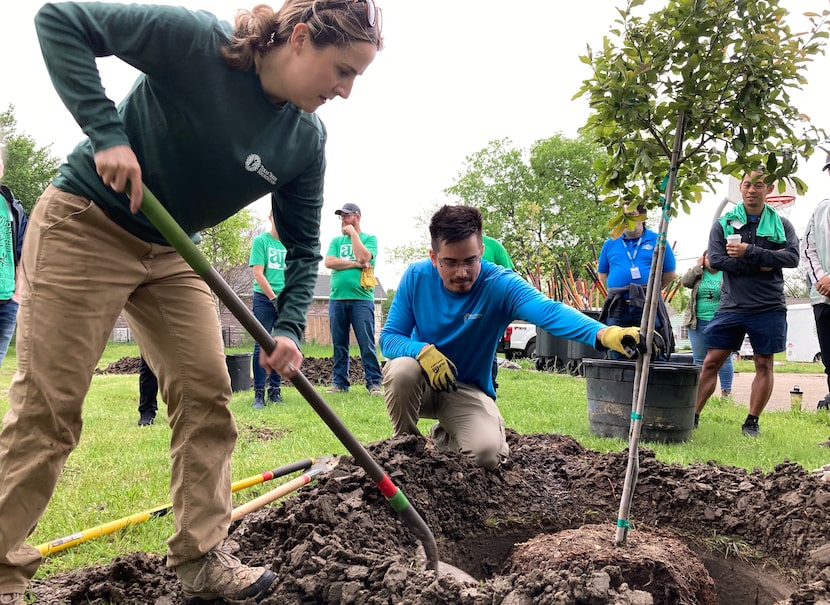
Texas Trees, through the South Dallas Greening Initiative, also is working in the Jubilee neighborhood to address the area’s lack of trees to combat the extreme heat affecting residents’ health and quality of life. The nonprofit is providing thousands of trees to the almost 50,000 residents of Fair Park, Mill City, Queen City, Wheatley Place and adjacent neighborhoods over five years. Jubilee Park is just below Interstate 30 and north of Fair Park.
Chandler Stephens’ father, Calvin W. Stephens, has owned two vacant lots in South Dallas since the 1980s. The younger Stephens has been talking with the nonprofit Texas Trees about working together on his vision to create a community garden.
Stephens dreams of having a green space in every corner of South Dallas to improve residents’ quality of life.
“I can see [the initiative] as something that will prolong the community’s livelihood. Not only with addressing the urban heat island issue but just by providing greenery,” Stephens said. “Plants and our health is so linked to the health of the earth and the planet.”
The Dallas Comprehensive Environmental Climate Action Plan established protocols for adapting to climate change challenges in 2020. It states that Dallas needs approximately 735,000 trees to reach a goal of 37% tree canopy cover and, specifically, mitigate the urban heat island effect.
Since Its founding in 1982, Texas Trees has planted an estimated 1.5 million trees across the Dallas-Fort Worth region. In 2023, the Dallas-based nonprofit secured a $15 million grant from the Reduction Act through the U.S. Forest Service’s Urban and Community Forestry program for the South Dallas Greening Initiative.
The project, however, is part of a long-term solution to extreme heat, and many of Jubilee’s residents want to see more.
“I am in favor of the initiative and for them to plant more trees in the area, but we also need help with how to pay the electricity bills,” Jaramillo said.
In any community, including South Dallas, trees may not be at the top of each resident’s list of the needs they see for their community, said Elissa Izmailyan, chief strategy and operations officer with Texas Trees.
“We are showing up with a commitment to help and the ability to offer trees and urban forestry education but realize that we’re entering a landscape where there are a lot of other needs and priorities,” Izmailyan said.
“So first, we need to be sensitive to that broad range of priorities and capacities. Second, we need to think about how our offering intersects with other needs in a way that’s additive.”
The project will have several components beyond planting trees in the community, Izmailyan said.
The first phase has been to reach out to the community and work with nonprofits and organizations in South Dallas to establish a trusting relationship and understand the community’s needs and wants.
That’s where partnerships with local organizations come into play, as well as involvement with community leaders.
The Jubilee Park and Community Center is a nonprofit that works to restore equity and resources for the 3,000 residents of the Jubilee neighborhood. The community center has been around for almost 30 years and offers education, health, food access and after-school programs.
Emily Plauche, Texas Trees’ community greening manager, said the initiative includes an educational component that teaches residents about trees, their benefits, how to care for them, green jobs, and other measures that can be taken to combat extreme heat.
“So there’s always going to be other needs or things that arise, too, and we can’t necessarily, with our money, purchase that. But we can help advocate and get the city involved and bring other people to the table who have some of these potential solutions,” Plauche said. “We are deeply committed to the well being of the community.”
Texas Trees will work with some of the area’s schools to boost green spaces and tree planting on the campuses. The organization already runs a program across the city focusing on schools needing more canopy.

907 Bank Street in Dallas on November 11, 2024.(Steve Hamm / Special Contributor)
Marissa Castro Mikoy, president and chief executive officer at Jubilee Park, said over the years, Texas Trees has helped plant over 150 trees on their campus, and they can see the benefits to the community, from providing shade to beautifying the park.
Benefits of trees
In April, Dallas shared findings from a study that identified at least 10 neighborhoods as ‘urban heat island spots.’ Some of these spots have less green space, and the temperature is 10 degrees hotter in these areas than in other parts of the city.
Trees can help reduce the urban heat island effect and improve people’s and the environment’s health in several ways.
They provide shade and block incoming solar radiation, lowering temperatures by several degrees. They also release water vapor, which can help cool temperatures. According to the Environmental Protection Agency, trees sequester carbon from the atmosphere in their wood and roots, absorb gases and provide a place for harmful air particles to land.
At the same time, according to the U.S. Forest Service, trees provide mental health benefits such as stress reduction, improved mood, and a sense of well-being due to increased exposure to nature.

Cities across the country and the world have documented the long-term effects of planting trees strategically in urban areas.
In Chicago, Illinois, according to studies, neighborhoods with higher tree canopy cover have experienced temperature reductions of up to 2.7–3.8°C compared to areas with little or no tree canopy.
Similarly, in Medellin, Colombia, temperatures fell by 2°C in the first three years of their program installing green corridors, and officials expect a further decrease of 4 to 5C over the next few decades, even taking into account climate change, the Secretary of Environment of Medellin reported.
Limitations
Trees are one solution that can help residents in South Dallas combat extreme heat, but Castro Mikoy said the initiative needs to be combined with other solutions to the area’s problems.
Displacement, making ends meet, and food insecurity are some issues facing South Dallas residents that make heat waves even more damaging for them.
Silvia Herrera, 48, a Jubilee resident, avoids turning on lights and household appliances during the day in the summer to keep her home cooler and reduce her electricity bills. She said her bill is around $500 in the peak summer months.
“You have to make decisions such as when you turn on the A/C and what things to avoid to spend less energy so the bill [electricity] is not too high because then I can’t pay for it,” Herrera said.
Planting trees and having the ecosystem to purchase, transport, and maintain them can also be expensive. The South Dallas Greening Initiative was able to come to life because of the grant Texas Trees secured. Not all cities or organizations can afford this type of solution, which is a limitation to replicating this program everywhere.
Community First
Through the five-year plan, Brittani Hite, strategic director of Ethos Equity Consulting, which is working with Texas Trees on the initiative, said there should be no surprises for the residents.
The project is for the community and by the community, said Hite.
“We understand that the solutions are already within the community,” Hite said. “South Dallas residents know what they want. They know what they need, but because of environmental and ultimately systemic racism, unfortunately, we lack green spaces, trees and other basic necessities in our city’s Black and brown neighborhoods.”
From Hite’s perspective, the conversations of the Jubilee moms after the Zumba classes to Stephen’s dream of having community gardens that work with the wants and needs of the South Dallas community will have an impact on finding the right solution.
María Ramos Pacheco wrote this story as part of a climate solutions fellowship with the Solutions Journalism Network. Did you know that what you just read was a solutions journalism story? It didn’t just examine a problem; it scrutinized a response. By presenting evidence of who is making progress, we remove any excuse that a problem is intractable.



The Texas Department of Public Safety, the Drug Enforcement Administration, and Garland Police Department conducted the investigation. Assistant U.S. Attorneys Abby Policastro and Marissa Aulbaugh prosecuted the case.
“This verdict should send a clear message to drug dealers that we will dismantle any effort to peddle deadly fentanyl in our community,” said U.S. Attorney Ryan Raybould. “I want to thank our law enforcement partners for their dedicated collaboration in taking thousands of fentanyl pills off the streets of Dallas.”

If the Dallas Cowboys want to get over the hump and back into the playoffs in 2026, they’ve got to see a massive improvement in the defense.
Owner Jerry Jones was brutally honest with just how much the Cowboys were held back by their defense in 2025, and the numbers very clearly spell that out.
How does a Cowboys team that ranked top 10 in passing, rushing and points on offense still miss the playoffs?
Well, Dallas also ranked 30th in total yards allowed, 32nd in passing yards, 23rd against the run and 32nd in points against, that’s how. That putrid showing rightly cost Matt Eberflus his job, which set the stage for Dallas to hire Christian Parker.
It also set the stage for a total overhaul of the defense, with Dallas making many additions to that side of the ball, including at corner, where the Cowboys were bad on the boundary and in slot last season.
Fow now, we’re more focused on the boundary competition, as the Cowboys appear set to roll with Caleb Downs in the slot.
Cowboys’ CB competition is crucial for 2026
The Cowboys won’t have much hope for a playoff appearance if the cornerback play doesn’t improve. Of the 10 teams that landed in the bottom 10 in passing yards allowed last season, only two of them made the postseason.
Of course, the pass-rush played a part in that, and while Dallas has made multiple additions to that group this offseason, there really aren’t any guarantees with Rashan Gary, Malachi Lawrence or Donovan Ezeiruaku.
If that trio fails to improve a pass-rush that was tied for the seventh-fewest sacks in the NFL in 2025, the cornerbacks become even more crucial.
DaRon Bland and Shavon Revel did not play well in 2025, and while the former appears safe for now when it comes to a starting job on the outside, his leash could be short if he struggles again.
Revel, on the other hand, isn’t locked into a starting job on the boundary and is competing with Durant and Caelen Carson. It’s also worth keeping an eye on who finishes in second in that battle because that player could replace Bland if he struggles or gets hurt again.
There is hope Revel can bounce back now that he’s another year removed from the torn ACL he suffered in his final year in college and can enjoy a full offseason, but we’ll have to see it first before we can believe it.
“It’s very beneficial,” Revel said of having a normal offseason. “Just because I can clean up a lot of things, a lot of errors I didn’t see last year, or I did see last year, that I could clean up this year.”
“My knee is 100%, so now it’s time to focus on situational ball and I’ve got to see what I need to fix or get better at,” Revel added.
When training camp kicks off next month, we’re going to be locked into watching the battle at cornerback because it could very well make or break Dallas’ entire 2026 campaign.
Add us as a preferred source on Google
Follow

The NFL offseason is moving along as the Dallas Cowboys recently wrapped up their mandatory minicamp. Their next big event takes place at the end of July when they meet in Oxnard for training camp.
Coming off a 7-9-1 campaign, the Cowboys have several areas they would like to improve, and while defense has been the focal point, there will be plenty to watch on offense as well with players fighting for their spot on the depth chart.
That means there will be no shortage of storylines to follow, including keeping an eye on these three players who enter camp with their stock trending in the wrong direction.
Jonathan Mingo, WR
It has been a roller coaster for Jonathan Mingo ever since being traded to Dallas ahead of the 2024 deadline. He made no impact during his first eight games, recording just five receptions. He seemed ready to rebound in 2025, however, as he took advantage of his first full offseason with the Cowboys.
Mingo was one of the stars of training camp and put himself in the WR3 conversation. A knee injury put an end to that run and he wound up playing in just six games and had one catch. Now, Mingo heads into camp with very little chance of making the 53-man roster.
Joe Milton III, QB
At this time last year, Joe Milton III was one of the hottest names in Frisco. The former New England Patriots quarterback was expected to give them a more explosive QB2 behind Dak Prescott after Cooper Rush left in free agency. LeSean McCoy went overboard by saying Dak Prescott’s job was in danger, but there was still a lot of understandable hype.
Now as he enters his second season with the franchise, Milton is going to be battling for the backup spot with Sam Howell, who was signed this offseason. Milton still has a rocket for an arm and unbelievable athleticism for a 6-foot-5, 246-pounder, but he could be in danger of losing his roster spot if he can’t find more consistency.
Malik Hooker, S
Dallas added three safeties this offseason, signing Jalen Thompson and P.J. Locke in free agency and selecting Caleb Downs in the first round of the NFL draft. Thompson has yet to fully practice due to an injury but Downs has been turning heads and Locke has taken advantage of the extra snaps.
That’s not ideal for Malik Hooker, who has also been sidelined with an injury. Unlike Thompson, Hooker isn’t in the first year of his deal, so his missed time is more detrimental. He also doesn’t have experience with the coaching staff the way Locke does. That means he’s entering camp without much momentum at all, and could be in danger of losing his spot.
— Sign up for the Cowboys Daily Digest newsletter for more free coverage from Dallas Cowboys on SI —
 Add us as a preferred source on Google
Follow
-

 Boston, MA4 minutes ago
Your next Uber ride in Boston could be a taxi
-

 Denver, CO7 minutes ago
Nuggets 2026 NBA mock draft tracker 2.0: What national experts predict Denver will do
-

 Seattle, WA12 minutes ago
How to watch Bosnia vs. Qatar in next Seattle World Cup match
-
 San Diego, CA19 minutes ago
San Diego Unified leaders propose policy to limit technology in classrooms
-
 Milwaukee, WI22 minutes ago
Racine’s Greek community reflects on Giannis’ celebration of Greek culture
-
Atlanta, GA27 minutes ago
Report: Atlanta Falcons agree to terms with Kyle Pitts on contract extension
-

 Minneapolis, MN34 minutes ago
Mayor Frey outlines timeline for selecting next Minneapolis police chief
-

 Indianapolis, IN37 minutes ago
Rain & storms will return soon, hot & humid next week


