South
Australia and Laos elevate bilateral relations at Southeast Asian summit

MELBOURNE, Australia (AP) — Leaders of Australia and Laos signed an agreement that deepens bilateral ties on Wednesday on the final day of a Southeast Asian summit.
Australian Prime Minister Anthony Albanese and his Laos counterpart Sonexay Siphandone are co-chairing the Association of Southeast Asian Nations’ special summit being held in Melbourne to mark 50 years since Australia became the 10-nation bloc’s first external partner.
SOUTHEAST ASIAN NATIONS MEET TO DISCUSS BURMESE CIVIL WAR, SOUTH CHINA SEA CONFLICTS
The agreement elevates the relationship to a comprehensive partnership which will become the foundation for collaboration on defense, environment, climate, clean energy, agriculture and education.
Laos, the bloc’s poorest nation, took over ASEAN’s rotating leadership from Indonesia this year and is pursuing a theme of enhancing connectivity and resilience.
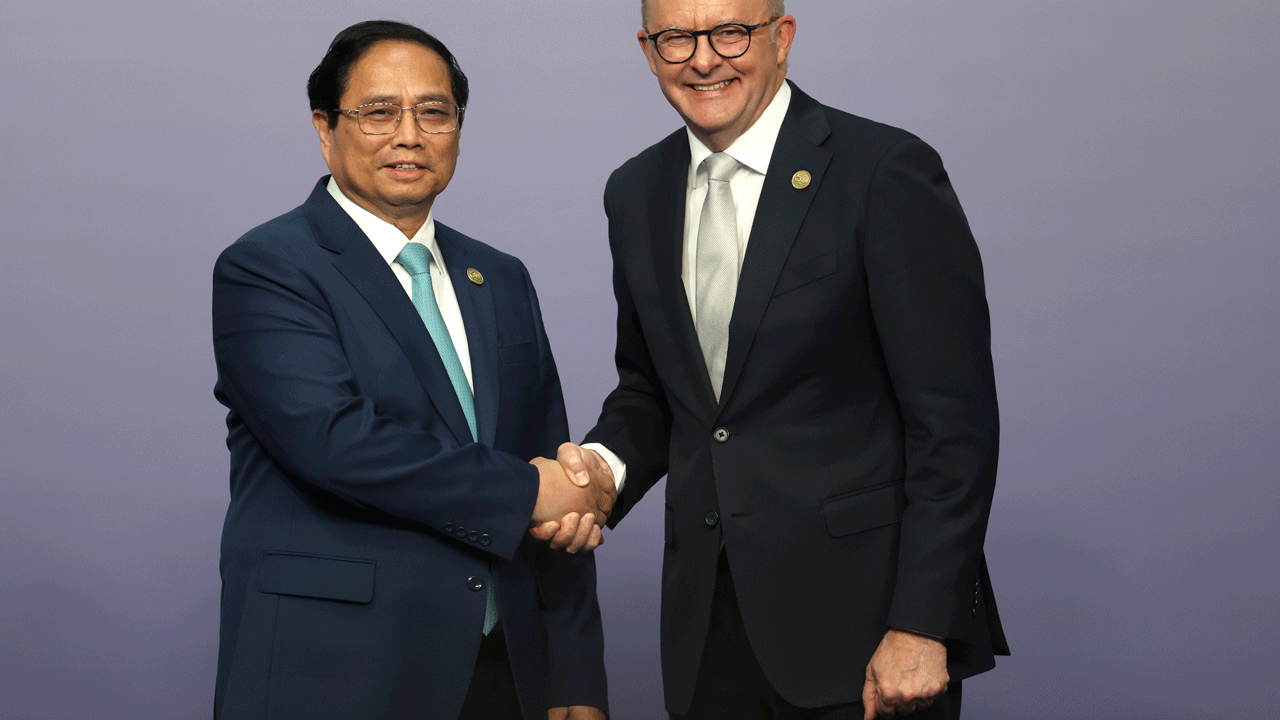
The Prime Minister of Vietnam, Pham Minh Chinh, shakes hands with Australian Prime Minister Anthony Albanese at the ASEAN-Australia Special Summit in Melbourne, Australia, Tuesday, March 5, 2024.
Albanese said the key themes of Wednesday’s discussions would include trade, investment, climate change, clean energy and maritime cooperation.
These will be reflected in the leaders’ communique to be adopted later on Wednesday.
China’s increasing assertiveness in the region and the ongoing violence and humanitarian crisis in Myanmar, as ASEAN state, have also loomed over the three-day summit.
Myanmar has been denied political representation at the meeting over its failure to stem violence in that country since a military junta seized control in 2021.
CLICK HERE TO GET THE FOX NEWS APP
East Timorese Prime Minister Xanana Gusmão is also attending the summit after ASEAN agreed in principle to admit Asia’s newest country.
The former independence fighter has called on ASEAN do more to restore peace and democracy in Myanmar.


For the Dallas Cowboys and their owner, Jerry Jones, the hope is always that the changes made will improve the product on the field. Every team heading into training camp will have questions to answer, and the Dallas Cowboys are first on our list with 3 of the biggest ones. This will be an ongoing series for the next couple of weeks until camp starts, and answers start to reveal themselves in real time.
Another season of change for the Dallas Cowboys. Will it make a difference this time around to end the drought? Jerry Jones sure hopes so. Dallas hasn’t had a title in 30 years, and Jerry Jones promised to look in the mirror and make much-needed dramatic changes. The 34-year-old Christian Parker, who has no defensive coordinator experience, must embody the change upfront. Veterans were added, and Dak Prescott is back and healthy, running a new scheme. We shall see.
I wouldn’t worry about whether CeeDee Lamb and George Pickens can coexist long-term. I’m more concerned about whether you can keep them happy with the culture and get them to commit long-term. They declined to negotiate with Pickens and instead slapped him with the franchise tag. If Dak Prescott continues to spread the ball around, he should be able to keep them happy, but it comes at a cost: winning in the playoffs or a Super Bowl title.
Tight end Jake Ferguson’s role could diminish during the upcoming season. Even after signing a four-year, $52 million extension, former undrafted free agent Brevyn Spann-Ford is a better blocker and could have a major impact on the Cowboys’ offense in 2026.
Miami, FL
“Love & Hip Hop: Atlanta” star Tommie Lee among 6 arrested during World Cup match in Miami, sheriff says

Reality television personality Tommie Lee — whose real name is Atasha Jefferson — best known for her appearances on “Love & Hip Hop: Atlanta,” was among six people arrested during the England vs. Norway FIFA World Cup match in Miami on Saturday, according to the Miami-Dade Sheriff’s Office.
The sheriff’s office said 60,024 fans attended the match. Deputies also reported 19 ejections from the stadium, adding that all incidents were isolated and handled quickly.
Authorities have not yet released the circumstances surrounding Jefferson’s arrest or any charges she may face.
A social media account that regularly reports celebrity news claimed Sunday that Jefferson was arrested July 11 and released July 12 after posting a $1,000 bond. The post also alleged she is facing a felony charge of interference with a sporting or entertainment event and said she later shared a video on Snapchat appearing to be in good spirits after her release.
What we don’t know
CBS News has not independently verified those claims, including the reported charge, bond amount or release information, and Miami-Dade Sheriff’s Office has not publicly confirmed those details.
CBS News has also not independently verified what led to the encounter, and the sheriff’s office has not said what prompted deputies to take Jefferson into custody.
CBS News has requested Jefferson’s arrest report, booking information and any charging documents from the Miami-Dade Sheriff’s Office. A request for comment has also been sent to Jefferson’s representatives.
Reality TV star’s legal troubles in South Florida amid World Cup festivities
Jefferson rose to national prominence as one of the breakout personalities on “Love & Hip Hop: Atlanta” before later appearing on several Zeus Network reality series, where she has remained a frequent cast member.
This is not Jefferson’s first legal issue in South Florida. In 2024, she was arrested in Miami Beach on a battery charge following an incident outside LIV Nightclub. Court records from that case alleged she physically confronted another person before officers took her into custody.
Saturday’s arrest comes as Miami continues hosting FIFA World Cup matches that have drawn tens of thousands of fans from around the world. Despite the arrests and ejections, the sheriff’s office said the event proceeded safely and described the incidents as isolated.
This is a developing story. CBS News will update this article as additional information, including the exact circumstances surrounding Jefferson’s arrest and any charges, becomes available.

Officials in Atlanta, a World Cup host city, threw away tents, medication, identification, and other items belonging to homeless people without any warning, according to a report.
The items were collected from a public park not far from where many soccer fans have been gathering to watch the soccer tournament, The Guardian reports.
Some of the items taken by city workers reportedly include blood pressure pills, an insulin kit, and hormones.
In response to the accusations, the city’s senior advisor on homelessness, Chatiqua Ellison, told the paper that the area that the affected area of Freedom Park was “not an encampment” and that the item removals were part of “routine park maintenance.”
She reportedly said that because the site was not an encampment and the action was not considered a “sweep,” the city was not obligated to give a warning before officials moved in to seize the items.

One person who lost belongings, named Kai, told The Guardian that she lost a bag filled with her possessions, including a flash light.
“Our whole lives was thrown away,” she said.
Kai said the site was effectively an encampment as it was used for that purpose, regardless of the city’s official definition.
Kelsea Bond, an Atlanta city council member whose district includes the park, told the newspaper that she was disappointed with the city’s handling of the situation.
“It’s disappointing that the city is more concerned about the strict, and perhaps arbitrary, definition of ‘encampment’ here rather than the impact these kinds of clearings have on the houseless community,” she said, adding that the city should be more focused on “the impact of a policy, not the intention on paper.”
Bond shared an email with the outlet from Major Peter Ries of the Atlanta Police Department in which he stated that the area in question was not an encampment, and the seized “property was considered abandoned, [and] park maintenance disposed of … unclaimed items.”
The Independent has requested comment from the city of Atlanta.
People from around the world have descended on Atlanta this summer to watch the eight planned soccer matches at Mercedez Benz stadium. But homeless advocates have argued that the city’s efforts to present a good face to visitors has been at the expense of some of the community’s most vulnerable members.

In the months leading up to the World Cup, Atlanta Mayor Andre Dickens made clear in a statement that he did not want the city’s homeless population anywhere near places where they might run into visitors.
“We want to make sure those unsheltered individuals don’t come anywhere downtown, and throughout the city of Atlanta, not just during the World Cup, but now,” he said.
Advocates told The Guardian that at least two of Atlanta’s downtown parks — often used by the homeless as gathering places — were fenced off in the weeks prior to the World Cup, forcing them to disperse into other parts of the city.
They said that disruption breaks up homeless individuals’ routines, access to healthcare services, and disrupts their social connections.
Allen Hall, who was homeless for decades and who now is active in street outreach for the American Friends Service Committee, told the paper that the city’s actions have forced homeless individuals to sleep on the streets and sidewalks because they have limited options outside of shelters.
-

 Movie Reviews5 minutes ago
Zoe Kavanagh’s ‘DEMON HUNTER: TIME 2 KILL’ (2026) – Movie Review – PopHorror
-

 World17 minutes ago
Anurag Kashyap, Vikramaditya Motwane Present Ravi Muppa’s ‘Incognito’ as New YouTube Shorts Channel Launches (EXCLUSIVE)
-
 Lifestyle1 hour ago
‘House of the Dragon,’ Season 3, Episode 4: “Now we begin?” It’s Season 3!
-

 Technology1 hour ago
Lorde says Ray-Ban Meta AI glasses are ‘not sexy’
-

 World1 hour ago
Four Americans caught in horrific Mexico highway pileup that killed at least 10
-

 Politics1 hour ago
Medical examiner releases preliminary findings in Lindsey Graham’s death as death certificate remains pending
-

 Health2 hours ago
Terminally ill man marries longtime love in hospital as final wish comes true
-

 Sports2 hours ago
Stefon Diggs, still seeking new NFL home, insists no team has a better No 2 receiver ‘than me’

