Austin, TX
We Heart: Feminist Art on Display in Texas Declares, ‘Be Afraid. We Are Coming for You.’


With just days before polls close in the 2024 elections, art on display in east Austin, Texas, declares, “You can’t control us. You can’t stop us.”
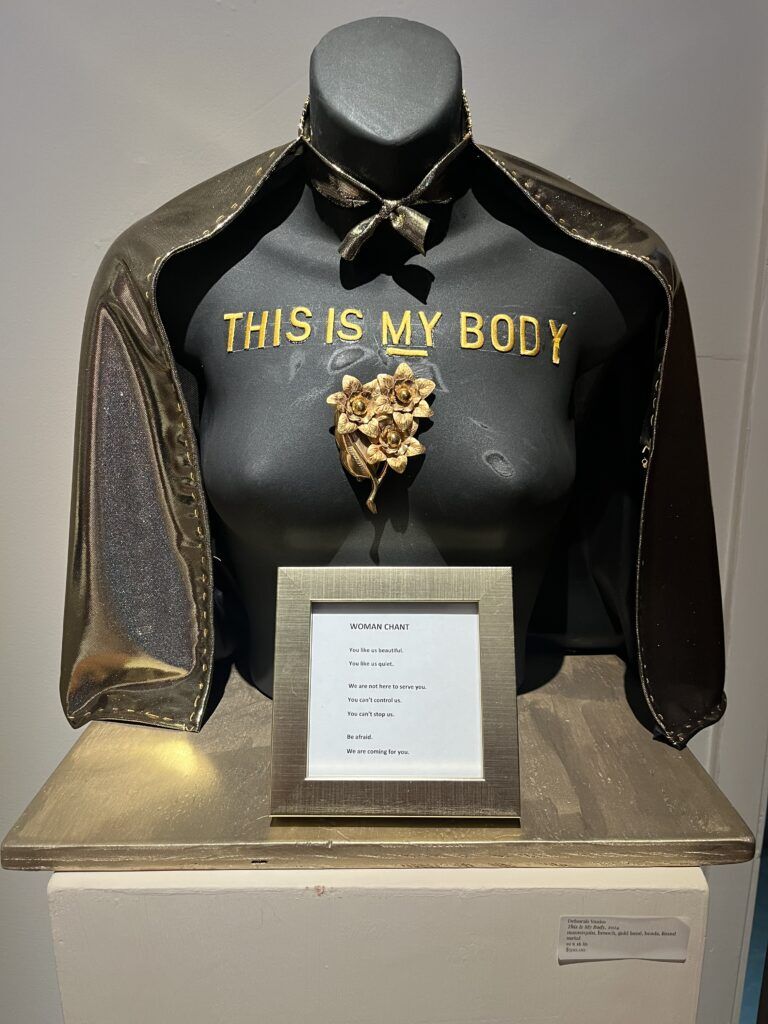
Designed and created by artist Deborah Vanko after the fall of Roe v. Wade, the art piece “This Is My Body” is part of Vanko’s collection, The Personal Is Political, on display at the Lydia Street Gallery in Austin until Nov. 17. (A sister display by Sarah Hirneisen, Heirlooms, is also available for viewing until mid-November.)

“I am a feminist artist who has been making art for over 45 years. I take on the issues of the female experience of love, sex, romantic relationships, discrimination and power,” said Vanko, who is also a psychotherapist and founding member of nonprofit arts organization Women and Their Work. “The empowerment I am speaking of is of sexual liberation and societal liberation.”
In the ongoing election, the gender gap—the measurable difference between women and men in public opinion polling and in voting—is set to break records, with Vice President Kamala Harris leading former President Donald Trump by double digits with women. As Jodi Enda wrote for Ms., “This election, it’s women’s choice.”
Today, two abortion bans are in effect in the state of Texas.
- In September 2021, SB 8 became law—the six-week ban with a “bounty hunter” provision. At the time SB 8 took effect, it was considered the most restrictive abortion ban to ever take effect in the U.S.
- The second is the Human Life Protection Act, colloquially known as the trigger ban, a total abortion ban which took effect shortly after the fall of Roe. The law makes performing an abortion from the moment of fertilization a felony. Violators of the law face punishments that include life in prison and a civil penalty of not less than $100,000, plus attorney’s fees.
In the past week, we’ve learned of at least two Texas women who died after doctors delayed emergency abortion care. Cases like these highlight just how crucial down-ballot legislative races and state Supreme Court races are. In Texas, three state Supreme Court seats are up for grabs. These elections could help determine the future of abortion access—and potentially save the lives of women.
Currently, all the justices on Texas’ state Supreme Court are Republicans. But even in a state with a Republican-dominated state legislature, electing Democratic justices is possible. We saw this happen last year in Wisconsin, when the court finally reached a Democratic majority with the election of Judge Janet Protasiewicz. Since then, the high court has rolled back the state’s 1849 abortion ban, ruled in favor of drawing new, non-gerrymandered electoral maps, and more.
At Ms. magazine, our mission is to deliver facts about the feminist movement (and those who stand in its way) and foster informed discussions—not to tell you who to vote for or what to think. We believe in empowering our readers to form their own opinions based on reliable reporting. To continue providing you with independent feminist journalism, we rely on the generous support of our readers. Please consider making a tax-deductible donation today if you value the work we do and want to see it continue. Thank you for supporting women’s voices and rights.
Up next:

Austin, TX
More dangerous Texas floods expected after at least 2 killed and hundreds of people rescued in high water, governor says – WTOP News

AUSTIN, Texas (AP) — More dangerous Texas floods expected after at least 2 killed and hundreds of people rescued in…
AUSTIN, Texas (AP) — More dangerous Texas floods expected after at least 2 killed and hundreds of people rescued in high water, governor says.
Copyright
© 2026 The Associated Press. All rights reserved. This material may not be published, broadcast, written or redistributed.

KERRVILLE, Texas (KXAN) — The City of Kerrville issued a shelter-in-place Thursday morning, with heavy rain causing reported evacuations early Thursday morning. A Flash Flood Warning is currently in place for Kerr County as the Guadalupe River continues to rise.
Around 5:30 a.m., the National Weather Service said a “large and deadly flood wave is moving down” the Guadalupe River.
KXAN First Warning Weather Meteorologist Kristen Currie said approximately 11 inches of rain have fallen northwest of Kerr County since 10 p.m. on Wednesday. The Guadalupe River is expected to reach major flood stage in multiple areas.
Kerr County PIO Lisa Walter said “there have been multiple swift water rescues and evacuations.” Officials emphasized not to drive through flooded streets and to turn around if water covers the roadway.
Evacuations were underway in multiple areas, according to the county, including:
- Goat Creek
- Arcadia Loop
- Lowery/Guadalupe area
- Junction Highway low-water crossings
- Other low-lying neighborhoods
Emergency shelters are open at Impact Church (Goat Creek evacuation point), Calvary Temple Church and City West Church for people in West Kerr County, the county said.
Here are the latest headlines:
Live updates
7:03 a.m.: KXAN’s Kevin Baskar is in Gillespie County providing updates on the latest flood conditions in the area. Watch his update below.
6:37 a.m.: Kerr County officials emphasized not to drive through flooded streets and to turn around if water covers the roadway.
Evacuations were underway in multiple areas, according to the county, including:
- Goat Creek
- Arcadia Loop
- Lowery/Guadalupe area
- Junction Highway low-water crossings
- Other low-lying neighborhoods
Emergency shelters are open at Impact Church (Goat Creek evacuation point), Calvary Temple Church and City West Church for people in West Kerr County, the county said.
6:27 a.m.: Video shows emergency crews hauling boats and rescue equipment through Kerrville.
6:15 a.m. NewsNation correspondent Xavier Walton and his photographer captured a structure being swept up in river water and crashing into a Kerrville bridge. The structure appears to be some sort of shipping container, pushing against the bridge.
Watch the video below:
6:08 a.m.: Kerr County PIO Lisa Walter confirms “there have been multiple swift water rescues and evacuations.”
6:02 a.m.: The Guadalupe River at Center Point is expected to crest at 35 feet, which is the same crest as July 4, 2025.
5:57 a.m.: The National Weather Service said “a large deadly flood wave” is moving down the Guadalupe River.
5:49 a.m.: The Comfort Volunteer Fire Department said it has units in Kerrville and Centerpoint alerting people along the Guadalupe River. They’re helping Kerr County with evacuations along Highway 27 between Comfort and Centerpoint. They said all VFD personnel are OK.
5:30 a.m.: The Kerr County Sheriff’s Office said in a Facebook post that it’s received reports of “street flooding in Ingram, and it’s likely many roads and city streets are flooded as well.”

AUSTIN (KXAN) — As flood threats continue across parts of South Central Texas, Austin Pets Alive! has activated emergency response efforts to support animal shelters affected by the inclement weather.
In a social media post, APA! wrote, “We began offering aid last night, working to secure fosters for 10 dogs in the Castroville shelter, an open-air shelter that sits at the bottom of a valley.”
APA! said the situation escalated overnight with additional shelters reporting flooding. One shelter confirmed that floodwaters reached its facility, APA! added.
Communities overwhelmed due to weather include Uvalde, Castroville and Sabinal.
The nonprofit is asking the Austin community to foster, adopt or donate to free up capacity for animals displaced by the disaster. APA! needs to clear out its facilities to assist the animals in need of shelter.
Here are ways you can help:
- Adopt: APA! is offering a “Name Your Own Adoption Fee” on all animals.
- Foster: The shelter is seeking foster homes for a minimum of three weeks.
- Donate: Proceeds will fund vans and response teams setting up a staging and triage center at the heart of the disaster zone, along with an expanded stockpile of preventatives, PPE and additional supplies.
If you would like to donate, click here.
-

 Mississippi37 seconds ago
Mississippi Lottery Mississippi Match 5, Cash 3 results for July 16, 2026
-
Missouri7 minutes ago
Missouri Lottery Pick 3, Pick 4 winning numbers for July 16, 2026
-

 Montana13 minutes ago
Missoula and Western Montana neighbors: Obituaries for July 17
-

 Nebraska19 minutes ago
Obituary | Stephen C. Mason
-

 Nevada25 minutes ago
Nevada Attorney Gen. Aaron Ford responds to what he calls President Trump’s ‘misleading speech on elections’
-

 New Hampshire31 minutes ago
Woman Taken To Concord Hospital On A Trauma Alert After A Rollover Crash On South Main Street
-

 New Jersey37 minutes ago
NY-NJ World Cup host group failed to register with state | Exclusive
-

 New Mexico43 minutes ago
Expectations Have Changed: UNM enters 2026 as a Mountain West title contender

