Austin, TX
Texas schools hoping lawmakers increase funding during legislative session


AISD budget deficit and the Texas legislature
The new legislative session starts soon. All this month, 7 On Your Side will be taking a look at some of the big issues at the state capitol. Among them is education after the legislature failed to pass a school funding measures during the last session. As a result, districts across Central Texas are finding themselves “in the red,” including Austin ISD
AUSTIN, Texas – The new legislative session starts in one week. Among the major issues facing lawmakers will be education, after the legislature failed to pass a school funding measure during the last session. Against that backdrop, districts across Central Texas are finding themselves in the red, including Austin ISD.
“In my time on the board, we have not had this much of a deficit,” said Austin ISD board president Arati Singh.
Singh is concerned about the current $92 million budget deficit, about 10% of the overall budget.
“It is tough. It’s not easy,” said SIngh.
“I am definitely concerned as a school leader,” said Melissa Rodriguez, principal of Lively Middle School.
In fact, about two-thirds of districts in Central Texas are operating in a deficit right now, and many ISD leaders point to stagnant public school funding from the state.
“There is something historic happening here that our state is choosing not to fund public education,” said Singh.
Texas: The Issue Is: School choice fight
Texas Governor Greg Abbott is confident that school choice legislation will pass during the next legislative session, but Democrats say they won’t roll over without a fight. FOX 7’s Rudy Koski talks to vocal voucher opponent State Rep. James Talarico, D-Austin, about the fight ahead and if there is room for common ground.
In 2023, Gov. Greg Abbott’s school choice voucher plan fell short, and public school funding measures that were tied to it stalled as well, like teacher pay raises, enhanced career training for students, and raising what’s known as the “basic allotment”, the per-student amount that districts get from the state. The basic allotment has been stuck at $6,160 since 2019, despite big-time inflation since then.
“We rank near the bottom nationally in this per student funding,” said Singh. “It’s not actually based on the cost of actually educating a child.”
Singh also points to increased costs related to House Bill 3, the school safety law passed in 2023.
On top of that, Austin ISD pays out hundreds of millions of dollars in school property tax money to the state every year in what’s known as “recapture,” a way to even out the wealth among Texas districts. Last year, AISD’s payment was $699 million, the highest in the state. That amount is based on local property values.
MORE 7 ON YOUR SIDE STORIES:
“Yeah, it is [unfair], because property values really don’t have a whole heck of a lot to do with the needs of students in a city,” said Singh. “Over half of our students are economically disadvantaged.”
So, with the $92 million shortfall in mind, a committee was formed, which spent the fall figuring out how to make it up over three years. That plan was presented to the board in December.
“It is difficult,” said Superintendent Matias Segura at the December 12 meeting. “Everything has an impact.”
In this current school year, the proposed cuts include things like eliminating some vacant positions, changes to technology, reorganizing departments, and reducing the number of special education vendors.
In the 2025-26 school year, the district plans to have some central office employees work from home, so it can lease space in that building, as well as changing bus routes, optimizing master schedules, and reducing portable classrooms, among other things.
AISD gives update on special education
Austin ISD leaders provided an update on its progress in meeting the requirement for special education services.
The catch?
“We don’t know yet how much of a cost reduction each of these will yield,” said Segura.
If the budget is not reduced by enough next year, that’s when district officials say the cuts will really start being felt at the school level.
“I am concerned that we would maybe have to consider increasing class sizes,” said Singh. “Cutting planning periods for our staff.”
“We have to do more with less,” said Lively Middle School Principal Melissa Rodriguez.
Rodriguez says any cuts to the arts would be very tough.
“Our students absolutely love participating in music, art, theater, guitar, orchestra. They are motivated by that,” said Rodriguez. “So if we take that from them, we’re really taking a big part of what they love.
Some parents and teachers are urging caution.
“I’m confused about why you would rush to vote on a budget when we don’t yet know what will come out of the legislative session,” said Tracy Dunlap, a teacher at Maplewood Elementary School, at the November 21 AISD board meeting.
Abbott moves even closer to passing school vouchers
Election night brought Texas Gov. Greg Abbott another step closer to getting his school choice plans passed, allowing taxpayer dollars to help parents pay for private school tuition.
But, as all this happens, some are opening up their pocketbooks to help.
“People who reach out to us and say ‘I’m seeing what’s happening to public schools and I care and I want to do something to support it,’” said Michelle Wallis, executive director of the Austin Education Fund.
“The work that we’re doing through the Austin Ed Fund feels even more critical now,” said Wallis. “We funded 66 projects across Austin to the tune of about $450,000 this year.”
Still, the district will need much more to get out of the current hole. Recent comments from Gov. Greg Abbott about the upcoming session has some people feeling optimistic.
“We will fully fund public schools in the state of Texas. We will provide teacher pay raises,” Abbott said in November.
Austin ISD listed recapture reform among its legislative priorities. But for Singh, boosting the basic allotment will be the real game-changer.
“We really need the state to step up,” said Singh.
Austin’s budget deficit would be even higher if not for $30 million in cuts that were made at the central office over the summer, including 12 layoffs, as well as $20 million from the passage of Proposition A by voters in November.
The upcoming round of cuts is expected to be finalized by the school board in the coming weeks.
The Source: Information from interviews conducted by FOX 7 Austin’s John Krinjak



AUSTIN (KXAN) — Governor Greg Abbott and the Texas Society Sons of the American Revolution unveiled a new monument at the Texas State Cemetery on Saturday, dedicated to Texas Revolutionary War soldiers.
“We must educate every generation about why it is that America grew from a tenuous 13 colonies into the most powerful country in the history of the world,” said Governor Abbott. “This monument here is an enduring testament to the heroes who fought for the freedom that is unique to America.”
The monument was dedicated to 69 soldiers who fought in the American Revolutionary War and later settled in Texas, according to a press release.
Among those that were honored, Abbott recognized:
- José Santiago Seguín, grandfather of Texas Revolutionary hero Juan Seguín.
- Peter Sides, who fought in the 2nd Battalion of the North Carolina Regiment of the Colonial Army, and was later killed in the 1813 Battle of Medina, fighting for Mexican independence against Spain.
- Antonio Gil Y’Barbo, the founder of Nacogdoches.
- William Sparks, who fought as a mounted rifleman in the American Revolution and later settled in Texas. He had two sons and two grandsons who fought in the Texas Revolution.
“This year marks the 250th anniversary of the American Revolution, which not only gave freedom to the British colonies of North America, but inspired movements for freedom and liberty all over the world,” said TSSAR President Mel Oller. “Texans played a role in the war too, and it’s important to recognize them, and the sacrifices they made for our freedom.”
At the monument unveiling, Abbott was also inducted into the Sons of the American Revolution and received its Silver Good Citizenship Medal.
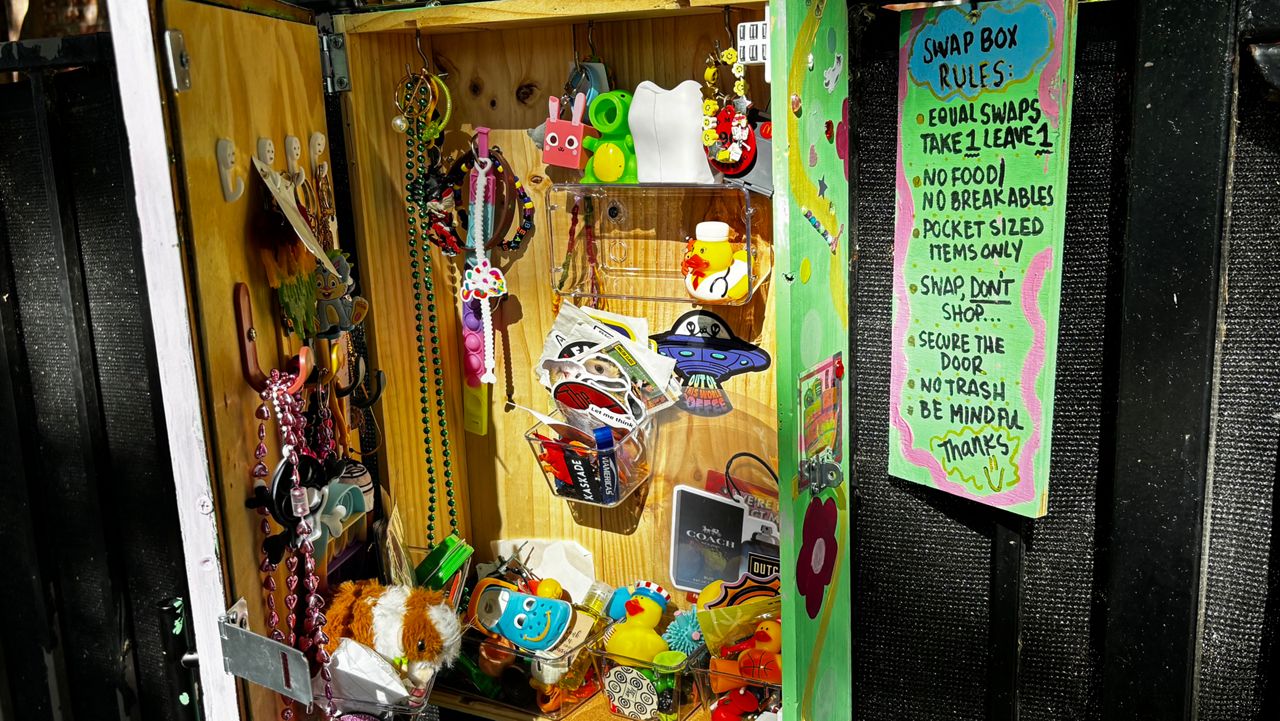
AUSTIN, Texas — Inside a green wooden box mounted to a steel fence, a treasure trove of trinkets awaits. Just a few miles north is another goodie box, this time covered in leopard print and inside a craft studio. Farther east, a simple white trinket box sits mounted on a wooden pole, decorated with stars and a crow saying, “Thanks for visiting!”
These boxes, filled to the brim with stickers, keychains, jewelry, collectibles and more, are known as trinket trade boxes. Austin has seen a sudden surge in these boxes over the last few months, and despite their varying locations, one sentiment ties them all together: trinket trading is a fun way to bring a bit of joy to the community.
“Little things that bring people joy is so important right now, which I think a lot of us can agree with, and I’ve seen all sorts of people use the box so far,” said Anna Arocha, whose trinket box is in The Triangle neighborhood downtown. “Little kids and all the way up to people in their 50s and 60s, I’ve seen stop by.”
Trinket trading operates on a simple system of take something, leave something. People can swap a toy car for a lanyard, a bracelet for a Sonny Angel, or a Pokémon card for a rubber duck.
“There was somebody who was just walking by with their kid in the stroller, and there was a finger puppet inside of the box, and I saw her swap something out and walk away with the little finger puppet,” Arocha said. “And it was just such a cute moment to see a mom and a kid enjoy something like that.”
Arocha put her crafting skills to work and made her green wooden box in just one day using craft wood and a wine crate last month. Amy Elms opted for a small, white junction box to ensure it could withstand harsh Texas weather. Ani’s Day & Night on East Riverside, which has a large outdoor space for picnic tables and food trucks, gave Elms permission to place her trinket box on their property in January.
Ally Chavez used her own property, Create! Studio ATX on West Anderson Lane, for her leopard-print box that opened in March.
“There wasn’t a ton up here in the north area, so we just kind of wanted to put it together and put it up for the studio just as a way to connect with the community in a way that no one has to spend money,” Chavez said.
Since their debuts, all three trinket boxes have garnered thousands of interactions on social media. When Arocha posted about the opening of her box in March, she racked up 100,000 views on TikTok. But with the excited comments came a bit of negative attention, and her cameras caught a thief trying to take all the trinkets. Arocha now locks the box at night.
“If somebody wants to do that, so be it,” Arocha said. “We can start over, and if the joy that it brings outweighs that every time, I think it’s worth doing.”
Arocha, Elms and Chavez’s boxes are now registered on a website called Worldwide Sidewalk Joy, alongside all the others in Austin and across the globe, as trinket trading grows to become a kind of new, modern geocaching.
“Honestly, it’s been I think even better than I expected so far,” Elms said. “I’ve had people… visiting Austin from out of town, and they’re making it a stop during their visit. I’ve also had multiple people reach out to me to ask how they can start their own trinket trade box, too, which I really love.”

AUSTIN (KXAN) — Forbes on Friday released its annual list of ‘New Ivies,’ and the University of Texas at Austin made it. This is not UT’s first time on the list; it was included in 2024 and 2025.
It’s important to note the Forbes designation does not make UT an Ivy League School. Schools currently designated as Ivy League are Brown University, Columbia University, Cornell University, Dartmouth College, Harvard University, Princeton University, the University of Pennsylvania, and Yale University.
Forbes argued its list was created because a growing number of employers have said they are less likely to hire an Ivy League grad today compared to five years ago. The list is curated by surveying over 100 C-Suite and hiring executives, as well as using data from the 2024 National Center for Education Statistics to gauge if a school fulfilled the criteria to be on the list.
One respondent said instead of prestige, employers are looking for graduates who have “complex emotional intelligence, radical adaptability and visionary creativity to orchestrate AI tools rather than compete with them.”
Forbes said colleges had to meet three criteria to be considered, which included:
- Size: Private schools must enroll at least 3,000 students, and public colleges must have at least 4,000 students enrolled.
- Selectivity: All but one private college had an admission rate of less than 15%; public college admission rates were 50% or less.
- Testing Requirements: At least half the entrants must have submitted either the SAT or the ACT scores
Forbes argued testing requirements indicated academic rigor, as a result. Schools such as the University of California and California State schools were not considered.
When it came to UT meeting the requirements for the list, UT had an undergrad enrollment of 44,663 students with a 27% acceptance rate. When it came to test scores, it had a median SAT score of 1390 and a median ACT score of 31.
For a full list of the public and private schools included in the Forbes 2026 New Ivies list, click here.
-

 Delaware6 minutes ago
State Police Arrest Dover Man for Assault and Aggravated Menacing in Dover – Delaware State Police – State of Delaware
-

 Florida12 minutes ago
SNAP benefits will be changing in Florida starting Monday
-

 Georgia18 minutes ago
Georgia on nobody’s mind: The Dawgs are under the radar, and that’s a compliment
-

 Hawaii24 minutes ago
Large section of Aloha Stadium demolished as project proceeds – West Hawaii Today
-
Idaho30 minutes ago
Idaho Lottery results: See winning numbers for Powerball, Pick 3 on April 18, 2026
-

 Illinois36 minutes ago
5 tornadoes confirmed in Illinois from Friday’s storms
-

 Indiana42 minutes ago
An Indiana district turned to voters to fund more preschool seats. Here’s what happened next.
-

 Iowa48 minutes ago
Vote: Who Should be Iowa’s High School Athlete of the Week? (4/19/2026)