Austin, TX
Five Dangerous Food Ingredients That Should Be Banned From Texas


I’m about to say a dirty word for some Texans, so brace yourself: California recently made the right move to ban five potentially dangerous foods from store shelves. And before you assume that it’s an act of pearl-clutching liberalism, let’s take a look at these ingredients and how dangerous they can be.
The California Food Safety Act was passed late last year, banning four food additives. A fifth food additive was dropped from the orginal bill. We will look at each ingredient, its use, and how it can harm your health.
But first: remember you are your own best advocate. You can be on the lookout for these ingredients and choose not to purchase them if you want to protect yourself or your family from potentially adverse effects.
Found in some fruit-flavored drinks, energy drinks, fruit-flavored syrups, and baked goods. It’s used to keep, “flavorings from separating and floating to the top of the beverage.”
What’s the problem? According to Consumer Reports:
Peer-reviewed studies conducted on rodents have linked brominated vegetable oil (BVO) to neurological problems; thyroid, heart and liver problems; and behavioral, developmental, and reproductive issues.
Found in baked goods and some frozen foods. Used to cause dough to rise higher, strengthen dough and enhance dough texture.
What’s the problem? It may increase a person’s risk of developing cancer.
Found In packaged foods like tortillas, baked goods, and cake icing. It is a preservative that extends shelf life.
What’s the problem? It has been shown, “to cause endocrine disruption and reproductive issues in lab animal testing,” according to Consumer Reports.
Found in red-colored foods. Many U.S. snack foods and drinks contain it.
What’s the problem? It has been linked to thyroid tumors in lab animals and hyperactivity in human children. Some people also experience a skin allergy to it nd it has been linked to bladder cancer. Weirdly, it’s been banned in cosmetics for decades but is still allowed in our food.
NOT BANNED IN CA YET: Titanium dioxide
Found in: creamer, sauces, chocolate, candy. It’s used to make foods look whiter, or as a primer to make other colorings look brighter.
What’s the problem? Its been linked to digestive problems and is banned in Europe because it may damage genetic material. Yikes.
Not really. Many of these ingredients have been banned in Europe for a long time. That’s why Italian Fanta is made with real orange juice, whereas U.S. Fanta is made with artificial dyes and colors. I know which one I would prefer.
Think Texas should follow California on this one particular issue? Head to Texas.gov to find your representative and let them know how you feel.
Big Yum: Texas Based Restaurant Chains With The Most Locations
Many iconic (and delicious) restaurant chains got their start in Texas. Here’s a look at Texas eateries with over 100 locations- some with over 1000!
Gallery Credit: Renee Raven
Rich & Smooth: A Look At Texas Best Whiskey Brands
Although the “tradition” of Texas whiskey distillation doesn’t go very deep into the past (at least legally) we still have an array of impressive and delicious micro-distilleries that are creating uniquely delicious Texas spirits.
Gallery Credit: Renee Raven
Texas’ Top Beauty Brands: Standbys & Up-and-Comers
From brands you’ve known your whole life to popular up-and-coming beauty powerhouses, these are beauty brands that were developed in and/or headquartered right here in Texas.
Gallery Credit: Renee Raven



FILE – LinkedIn logos are displayed on an iPhone and computer screen. (Photo by Carl Court/Getty Images)
AUSTIN, Texas – The Texas Attorney General’s office has opened an investigation into LinkedIn over allegations that the professional networking platform misleads consumers with advertising and profiting from misleading or fake job listings, otherwise known as “ghost jobs.”
LinkedIn investigation

In this photo illustration a Linkedin logo seen displayed on a mobile phone. (Photo Illustration by Stanislav Kogiku/SOPA Images/LightRocket via Getty Images)
What we know:
Texas announced on Tuesday it has issued a Civil Investigative Demand (CID) seeking documents, data and internal communications related to LinkedIn’s advertising, marketing, job listing verification practices and its Premium subscription services.
The investigation centers on whether LinkedIn violated Texas’ consumer protection laws by promoting paid subscription services while allegedly failing to disclose that some job listings on the platform may not actually be representative of hiring opportunities.
What is a ‘ghost job’?
An image of a woman holding a cell phone in front of a LinkedIn logo displayed on a computer screen. On Tuesday, January 12, 2021, in Edmonton, Alberta, Canada. (Photo by Artur Widak/NurPhoto via Getty Images)
Dig deeper:
LinkedIn is owned by Microsoft and the world’s largest professional networking platform, with more than 1 billion registered users worldwide.
A “ghost job” generally refers to a position advertised online that either is no longer available or that an employer has no immediate intention of filling. The attorney general’s office cited independent studies estimating that ghost jobs account for between one-fifth and one-third of online job postings.
Texas AG targets Premium Subscription Fees
Photographer: Mark Felix/Bloomberg via Getty Images
What they’re saying:
According to the office of the attorney general, LinkedIn does not independently verify the hiring status of most job listings on its platform. Ken Paxton’s office alleges that the company’s marketing for its Premium subscription services does not disclose that a significant number of postings could be inactive, unfilled or not reflect genuine employment opportunity.
“I will use every resource available to my office to help job-seeking Texans find and secure real employment opportunities,” Paxton said in a statement. “LinkedIn has a duty to provide the services it advertises and ensure that consumers paying for Premium subscriptions are receiving access to legitimate job postings.”
Texas officials said LinkedIn’s Premium Career and Premium Business subscriptions cost about $39.99 and $69.99 per month, respectively, and are marketed to jobseekers looking to improve their employment prospects.
What’s next:
The investigation does not include any formal allegations of wrongdoing, and no lawsuit has been filed.
The Source: Information in this article was provided by the Texas Attorney General’s Office.

Director Kristin Tièche says the seed for her new documentary, The Invisible Mammal, was planted back in 1999, when she was a film student in upstate New York.
“I was sitting at this pub on campus, and I looked up and the sky was just filled with bats,” said Tieche, a native Californian who had never seen a bat before.
“I just thought it was the coolest thing ever,” she said.
These days, such a sight is all but impossible to behold in New York and many other states. A deadly disease called white-nose syndrome is to blame.
The Invisible Mammal follows a team of researchers as they set out to protect bats from the disease, which has emptied entire caves and roosting spots once teaming with life. It’s being screened Tuesday night at AFS Cinema and will be followed by a Q&A.
White-nose syndrome is caused by an invasive fungus found in Europe, likely brought to America on the clothes of a visitor who came to see American bats up close. It kills by starving hibernating bats.
The disease causes bats to “wake up too often during winter and they burn up their fat reserves and die before spring,” said Winifred Frick, chief scientist at Bat Conservation International.
First detected in New York state in 2006, the disease steadily spread across the continent, inflicting catastrophic damage on bat colonies in the Northeast, mid-Atlantic and Midwest. In some parts of the U.S. and Canada, white-nose has wiped out over 90% of bat populations. While the disease exists in Texas, it has not proved as destructive so far.
When it appeared in California in 2019, Tièche thought back to that night decades before when she saw her first bat flight.
“I knew at that moment that it was time to launch this film project,” she said.
The result is a nonnarrated documentary that follows researchers and conservationists across the country, as they protect bats and study ways to battle white-nose syndrome.
Its primary focus is Frick and the team of scientists behind the Fat Bat Project, an initiative started in Michigan’s Upper Peninsula that aims to keep bats well fed around their winter hibernation.
“The idea was could we help bats get fat in the fall and also help them recover their body condition in the spring?” Frick said. “Because we had research that showed that the bats that were surviving tended to be fatter at the start of hibernation.”
Tièche said it was not until she arrived in Michigan to shoot that she realized the team of scientists working on the Fat Bat Project was comprised entirely of women.
“I knew at that point that I also was going to tell the story of women in science,” she said.
White-nose exists in Texas, but the colonies of Mexican free-tailed bats so celebrated in the Hill Country are at lower risk of death. That’s largely because they do not hibernate in the same way some other species do, and insect meals are available in Central Texas deeper into the winter months.
Still, Austin’s Congress Avenue bat bridge makes an appearance in the documentary. The film also opens and closes with immersive scenes — filmed by Austin wildlife cinematographer Skip Hobbie — of bats flying out of the Bracken Cave Preserve, home to the world’s largest bat colony.
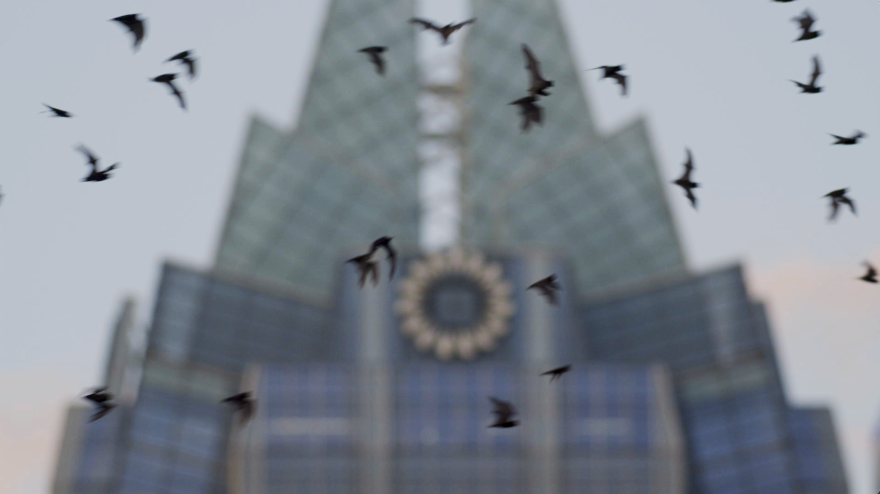
Courtesy of Kristin Tièchei
“I told him [Hobbie] I was hoping for people to fall in love with bats when they watch,” Tièche said. “You protect what you love.”
White-nose syndrome continues to decimate bats as it spreads, but there’s reason for cautious optimism. Some species that were nearly wiped out in the Northeastern states are beginning to show modest recovery, Frick said, though it is not fully clear why.
She said the Fat Bat Project, which has expanded across the Northeast and into Texas, is also showing promise as one tool of many that could stave off total population collapse in some areas.
The Invisible Mammal is screening at 6:30 p.m., Tuesday, July 14, at AFS Cinema. It will be followed by a Q&A with filmmaker Kristin Tièche, producer Matthew Podolsky, cinematographer Skip Hobbie and Winifred Frick of Bat Conservation International.

Brandywine Realty Trust sold 405 Colorado Street in Downtown Austin for $151 million.
Jerry Sweeney, Brandywine’s CEO, discussed how the company was looking to offload somewhere between $250 million and $300 million of its portfolio earlier this year, according to the Austin Business Journal. Earlier this year, the building was billed as 100 percent leased. Houston-based Hines announced that its real estate assets investment arm, Hines Global Income Trust, purchased the building in a statement published Monday. The sale price was disclosed in a Securities and Exchange Commission filing.
The Class-AA office property was completed in 2021, and features 206,000 square feet of office space across 25 stories. Hines paid around $733 per square foot for the building. Tenants at the building include JP Morgan Chase, Bain & Company and AllianceBernstein. Hines Global reports that as of May 2026, it controlled $6.4 billion in gross asset value. The statement from Hines is explicit in their reasoning for acquiring the property: Alfonso Mark, Hines’ global co-head of investment management said in the statement that the company believes that fully leased trophy office buildings are driving recovery in the United States’ office market.
Philadelphia-based Brandywine will still maintain a notable presence in Austin. The Uptown ATX development close to Austin’s second downtown, The Domain, is still receiving a $31 million facelift that’s expected to complete by the end of 2027. Last year, Brandywine stole headlines by snagging Nvidia as a tenant. The six-story, 172,000-square-foot building is getting a shiny new lobby to go with other new amenities. Last year, Brandywine sold Quarry Lake II and Four Barton Skyway, according to the outlet. Quarry Lake II’s 120,600 square feet of office space went to Brick Row Holdings, and Four Barton Skyway went to an unknown buyer.
In the same announcement, Hines confirmed that it had also purchased Wicker Park Commons in Chicago.
— Hunter Cooke
Nvidia takes the cake for Austin’s biggest office lease of 2025
Life after IBM: Brandywine tees up $31M in renovations for 66-acre Austin office campus
Private capital giant Apollo selects Austin as second HQ
Read more
-

 Los Angeles, Ca1 hour ago
Stabbing at Chino Hills liquor store ends in attempted murder arrest
-

 Detroit, MI2 hours ago
A small group of citizens rally for mental health coverage in Detroit
-

 San Francisco, CA2 hours ago
1 dead, 2 missing after boat capsizes near Alcatraz in San Francisco Bay
-

 Dallas, TX2 hours ago
Death penalty off the table for man accused of beheading Dallas motel manager, prosecutors say
-

 Boston, MA2 hours ago
Chickadee, the popular Mediterranean restaurant in Seaport, is shutting down – The Boston Globe
-

 Denver, CO2 hours ago
Denver Nuggets 7-Year NBA Veteran Gets Honest On Peyton Watson
-

 Seattle, WA2 hours ago
Top 25 Seattle Seahawks Going into 2026 NFL Season: #17 Grey Zabel
-

 San Diego, CA2 hours ago
Tijuana earns spot in Little League World Series, hoping third time’s a charm

