Lifestyle
A Swiss museum will remove 5 paintings potentially looted by Nazis


A man walks past the entrance of the Kunsthaus Zurich on March 14, 2023. The museum is investigating the provenance of paintings over a possible connection to Nazi looting.
Arnd Wiegmann/AFP via Getty Images
hide caption
toggle caption
Arnd Wiegmann/AFP via Getty Images
A Swiss museum said five artworks will be removed from public view on June 20 as it collaborates with the owner of the artworks to investigate whether the works were looted by Nazis during World War II.
On longterm loan to the Kunsthaus Zurich museum from collection owner the Foundation E. G. Bührle (or Bührle Foundation) the paintings in question are Jardin de Monet à Giverny by Claude Monet, Vincent van Gogh’s The Old Tower, La route montante by Paul Gauguin, Gustave Courbet’s Portrait of the Sculptor Louis-Joseph and Georges-Henri Manuel by Henri de Toulouse-Lautrec.
In a statement issued on Friday on its website, the museum said the Bührle Foundation requested the removal of the artworks as it assesses their provenance. The renewed scrutiny comes as a result of the U.S. State Department’s latest best practices for handling Nazi-looted art, published in March. These expand the Washington Conference Principles on Nazi-Confiscated Art set forth in 1998.
“The Kunsthaus welcomes this stance, but very much regrets that, with respect to our visitors, five of the pictures are being removed from the Kunsthaus’ rooms by the current owner, the Bührle Foundation,” the museum said. “The Bührle Foundation is acting comprehensibly and correctly in accordance with the agreement with the city of Zurich and in accordance with the provisions of the permanent loan agreement.”
“The Foundation strives to find a fair and equitable solution with the legal successors of the former owners for these works, following best practices,” said a statement in German from the Bührle Foundation.
The foundation said it is also conducting a separate investigation of a sixth work currently on display at Kunsthaus Zurich, Edouard Manet’s La Sultane.
“The work does not fall within the scope of [the U.S. State Department’s] “best practices” due to the sales processes, but is classified as a case that must be taken into account separately,” the foundation said in its statement. “Due to the overall historical circumstances, the foundation is prepared to provide symbolic compensation.”
Focused on French Impressionist and Post-Impressionist artworks, the Emil Bührle Collection, managed by the Bührle Foundation, is a core part of Kunsthaus Zurich’s offerings.
According to the museum website, the foundation’s loan of around 200 artworks “is permanent and can only be terminated with many years’ notice, for the first time at the end of 2034.”
Twenty-five countries, including Switzerland, have so far endorsed the expanded U.S. State Department guidelines for dealing with Nazi-confiscated art. The new agreement follows the 1998 Washington Conference Principles, which focused on providing restitution to the families of the original owners for treasures that were either stolen or forcibly sold by Nazis.
“Restitution should be to all lawful beneficiaries and heirs in accordance with a country’s usual inheritance law,” the March 2024 guidelines state. “All pre-War owners who are identified through provenance research or their heirs should be proactively sought by the current possessors for the purpose of restitution.”

Hundreds of thousands of paintings and millions of books as well as cultural and religious artifacts were stolen from Jewish owners by Nazis in the Holocaust. Many have still not been returned to their rightful owners.
According to a recent report by the World Jewish Restitution Organization and the Conference on Jewish Material Claims Against Germany, countries such as Russia, Romania, Spain, Denmark and Turkey have made scant progress in trying to restore looted artworks to the original owners or heirs over the past quarter of a century.
Although Switzerland remained neutral during World War II, it maintained strong economic ties to Nazi Germany and its allies.
“Confiscated artworks were often saved for private Nazi and German collections, while some pieces were sold to buyers through neutral countries like Switzerland to raise capital for purchasing additional art pieces and to purchase materials for the Nazi war machine,” states an article about Nazi looted art from the National Archives’ Holocaust Records Preservation Project. “Additionally, Switzerland offered a large market to sell off ‘degenerate art.’ “

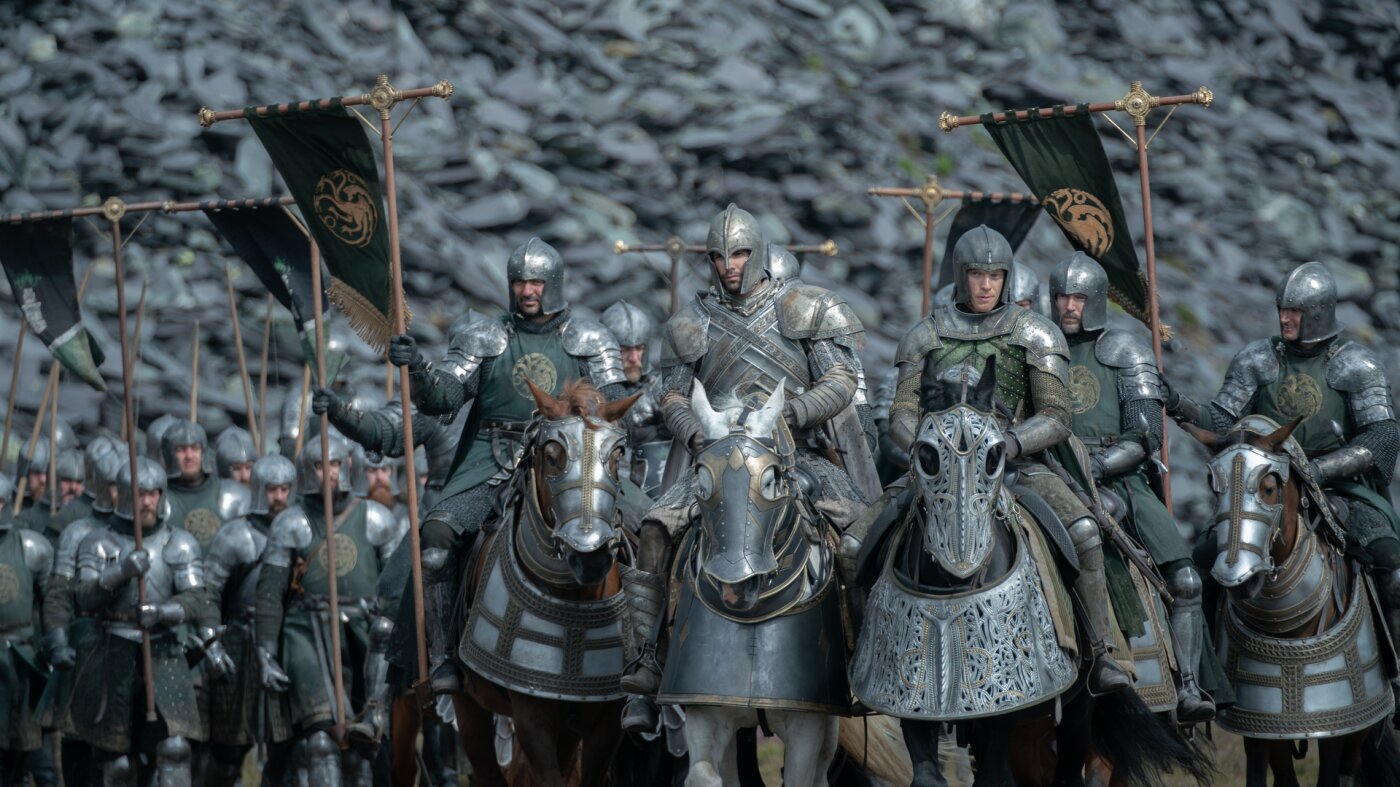
Sers Criston Cole (Fabien Frankel) and Gwayne Hightower (Freddie Fox) discuss their phalanx strategy. Heh.
Theo Whiteman/HBO
hide caption
toggle caption
Theo Whiteman/HBO
This is a recap of the most recent episode of HBO’s House of the Dragon. It contains spoilers. That’s what a recap is.
Credits! And the only addition to the Die, You! Tapestry we get this week is difficult to decipher at first. Looks to me like a woman whispering into the ear of a stout gentleman with a thin, John Waters mustache. Alys and Daemon? Alys and Aemond? Or — OK, no, wait, I see it now — it’s Aemond, murdering my sweet babboo Ser Simon Strong back in episode 2. Wow. Cold. Way to rub it in, you vindictive textile, you. Now I’m glad to see you get torn in half each week.
In the small merchant town of Tumbleton, the Hightower army is going house-to-house, forcibly quartering troops in private homes, ’cause Westeros don’t got a Third Amendment.
In the home of the local lord and lady, Ormund Hightower has set up shop — if we’re careful to define “shop” as “plopped his bathtub in the middle of their living room.” In a power move, he stands up from the bath he’s taking to show us his hindquarters (and show the nobles his frontquarters), while pompously instructing his young squire on the proper way to deal with “those beneath you.” Presumably he’s not referring to his frontquarters.
He receives some bad news — the Baratheons haven’t sent troops, and Aemond still hasn’t shown up to Harrenhal with Vhagar. (This last bit happened at the end of episode 2, but news-by-raven travels slow.) And that’s when we get the reveal the show’s been sitting on — this squire, the red-headed kid who’s been standing by Ormund’s side since the season began, is actually Daeron, youngest son of Alicent, brother to Aegon, Aemond and Helaena, and the rider of the dragon Tessarion.
RIP, spheres of the realm
At Rhaenyra’s Teeny Tiny Council chamber in the Red Keep, Orwyle suggests sending the riverlord army (which is currently marching to Kings Landing) to take Tumbleton back. It would cost fewer lives than raining down dragonfire, he argues. And with that suggestion, he’s back in the Queen’s good graces. (There’s a brief exchange where Orwyle reaches for one of those weird little billiard-ball token thingies to register his attendance or whatever, only to get shut down, and informed that they’re “relics of the old regime.” Too bad; I’ll miss those fetishistic, tactile bits of business, but I hope they find a place in a Kings Landing history museum. It was one of those tchotchkes, after all, that took out poor timorous Lord Beesbury, back in the day. Never forget.)
Mysaria reminds the Queen of their money troubles, and suggests appointing a Master of Coin to throw under the bus. Rhaenyra remembers meeting the toadyish Ser Torrhen Manderly last week; he’s about to fail upwards.
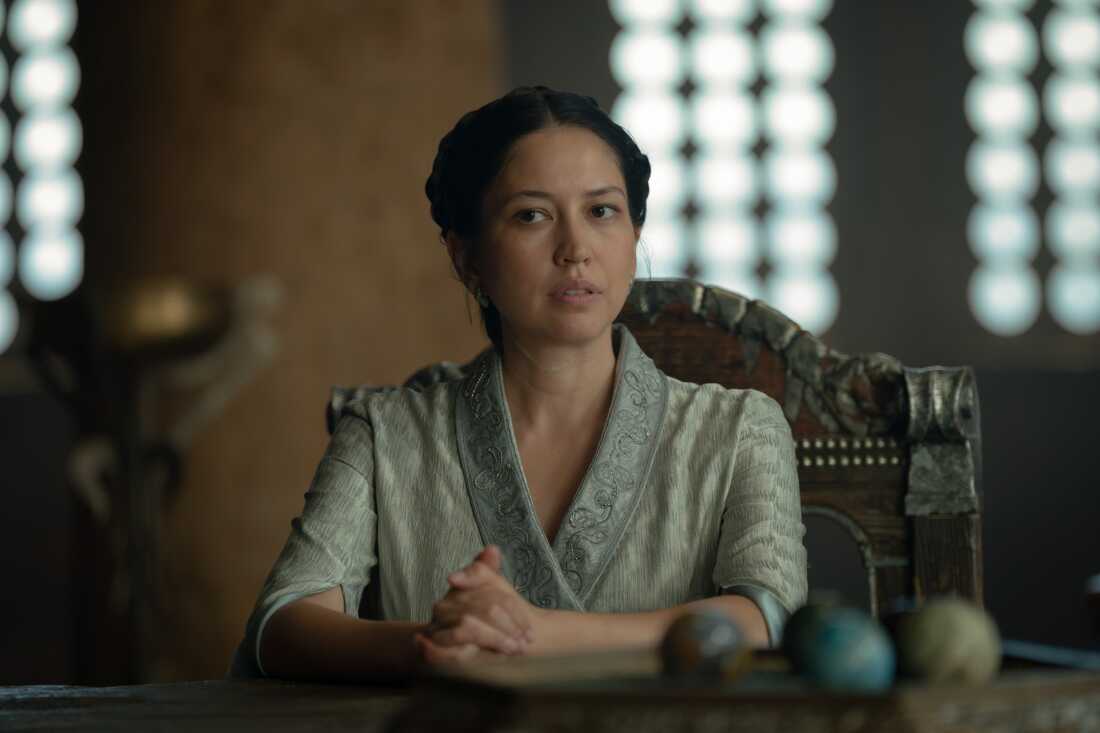
Mysaria (Sonoya Mizuno) is playing for all the marbles. Which are literally marble.
Ollie Upton/HBO
hide caption
toggle caption
Ollie Upton/HBO
We get a brief reunion between Rhaenyra and her prisoner Alicent (a Rhaeunion!) wherein Alicent explains that she sent Daeron away to Oldtown when he was a baby because she didn’t want him to grow up to be like his brothers. Which is all well and good, but if it means he instead grows up to be like the haughty Ormund Hightower, that’s one bullet that didn’t really get dodged so much as it missed vital organs as it passed through the torso.
As Rhaenyra leaves, Alicent tells her that Ormund has a strong sensitivity to odors. The show treats this information like he’s the Death Star and the smell thing is his tiny exhaust port, so it better come up later as the key to his undoing.
Corlys, still smarting from Rhaenyra’s snubbing of his sons, peaces out of the capital and back to his little island, telling Alyn to take over for him.
Don’t let the Sunfyre go down on me
Larys and Aegon make it back to Rook’s Rest, where they find the body of Aegon’s dragon Sunfyre. Aegon insists that the beast is still alive, while Larys counters that it is no more, it has ceased to be, it has expired and gone to meet its maker, it is a stiff, bereft of life it rests in peace, if you hadn’t nailed it to the perch it’d be pushing up the daisies, its metabolic processes are now history, it’s off the twig, it’s kicked the bucket, shuffled off its mortal coil, rung down the curtain and joined the bleedin’ choir invisible, this is an ex-dragon.
Or, you know. Words to that effect.
They head into the war-ravaged town, seeking food and shelter. Aegon is taken aback by the squalor — and by the decaying body of Meleys, the dragon he fought last season. They get jobs, despite Aegon totally beefing the interview with his imperious Aegonosity.
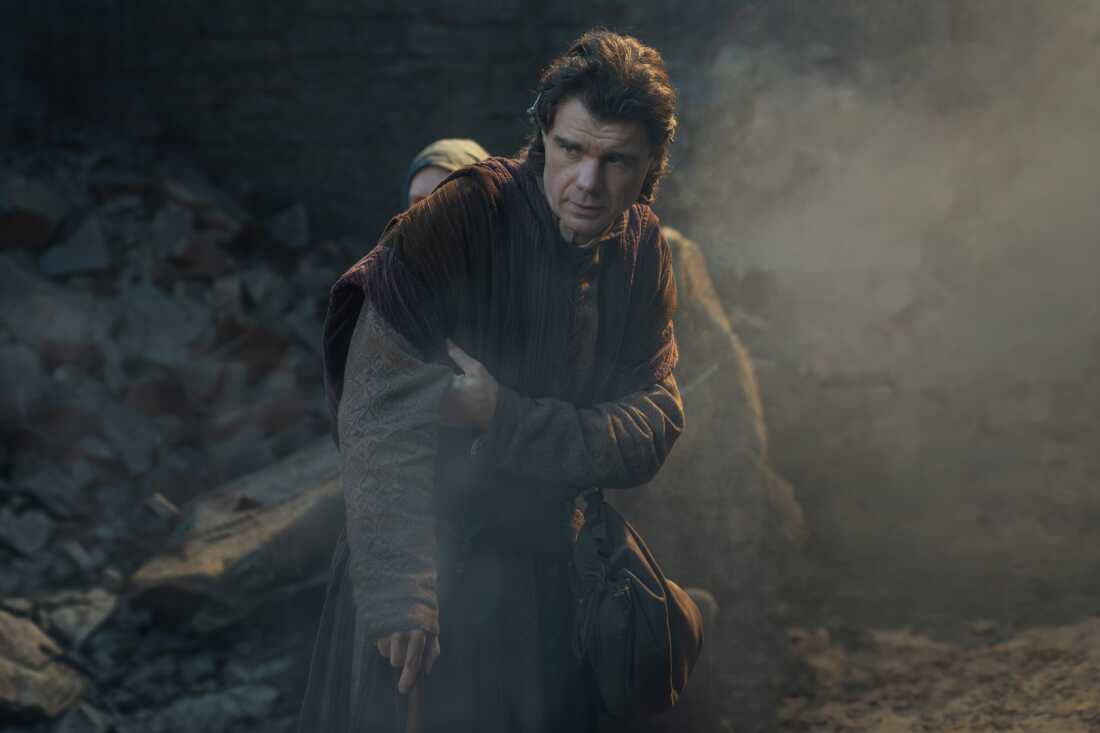
Have you seen Larys (Matthew Needham) do his Richard III? His discontent is hella wintry.
Theo Whiteman/HBO
hide caption
toggle caption
Theo Whiteman/HBO
Larys tries to convince him that Rhaenyra pronouncing him dead is a good thing, as it will make his eventual return to the throne a much better story. The ex-king then suffers a few more debasements at the hands (and feet) of the dude running the camp, and here’s where I started to worry that the writers are only subjecting him to all these indignities to set him on a redemption arc.
Will it all humble him? Will he suddenly realize how much the people are suffering, and will it move him to transform into a more just, caring, empathetic Aegon 2.0? I, for one, dearly hope not, because Shallow Jerkface Aegon is fun, and I have no confidence that some future Noble, Kind, Triumphed-Over-Adversity Aegon will be the same.
Criston Cole, Gwayne Hightower and the rest of their motley band of Team Green soldiers arrive at Harrenhal, expecting to celebrate the fact that Aemond and Vhagar have finally shown up. They do find the ashes of the small contingent of the Black garrison Daemon left behind, but are informed by Alys Rivers that Aemond hightailed it back to Kings Landing because Rhaenyra has seized the throne.
This news leaves Gwayne feeling wry and Criston feeling mopey. So, if you’re keeping notes, their respective statuses remain fully quo. Gwayne wants to head to Tumbleton to join Ormund, but Criston insists that they should take the few men they have and attack Daemon’s riverlords before they can reach Kings Landing. Because the riverlords (who were joined by the Winter Wolves back in Episode 1, remember) now so outnumber their army, Criston’s envisioning guerilla tactics, nighttime raids, anything to keep the battle man-to-man, instead of dragon-to-charcoal-briquette.
Back in Tumbleton, one of the Hightower soldiers assaults the family he’s billeted with. When the matter is taken before Ormund, he sides with the family, using the incident as another high-minded object lesson for young Daeron. Hey, maybe Ormund isn’t so bad! (Spoiler: Ormund is so, so bad you guys.)
Ulf claps (back)
Hugh asks Rhaenyra for permission to fly to the (Green-occupied) Tumbleton and keep watch, in case Aemond and Vhagar ever show up. His wife is living there now, you’ll remember; this will surely be important later. Rhaenyra agrees, but orders him to split his duty with Ulf, who’s spotted some anti-Rhaenyra graffiti on his way to Huzzah-it-up with his old drinking buddies in Kings Landing.
Later, Ulf goes to Rhaenyra to try and score some favors for those cronies, and we get a cute scene where Emma D’Arcy and Tom Bennett have a little fun bouncing off each other. Ulf is his usual Ulfish self, which Rhaenyra at first merely tolerates, but then she shuts him down, instructing him that he and his dragon are too valuable to the crown for him to be drinking in the streets.
Ulf is put out, and finds a typically obsequious, Ulfy way to needle Rhaenyra by mentioning the whole graffiti thing.
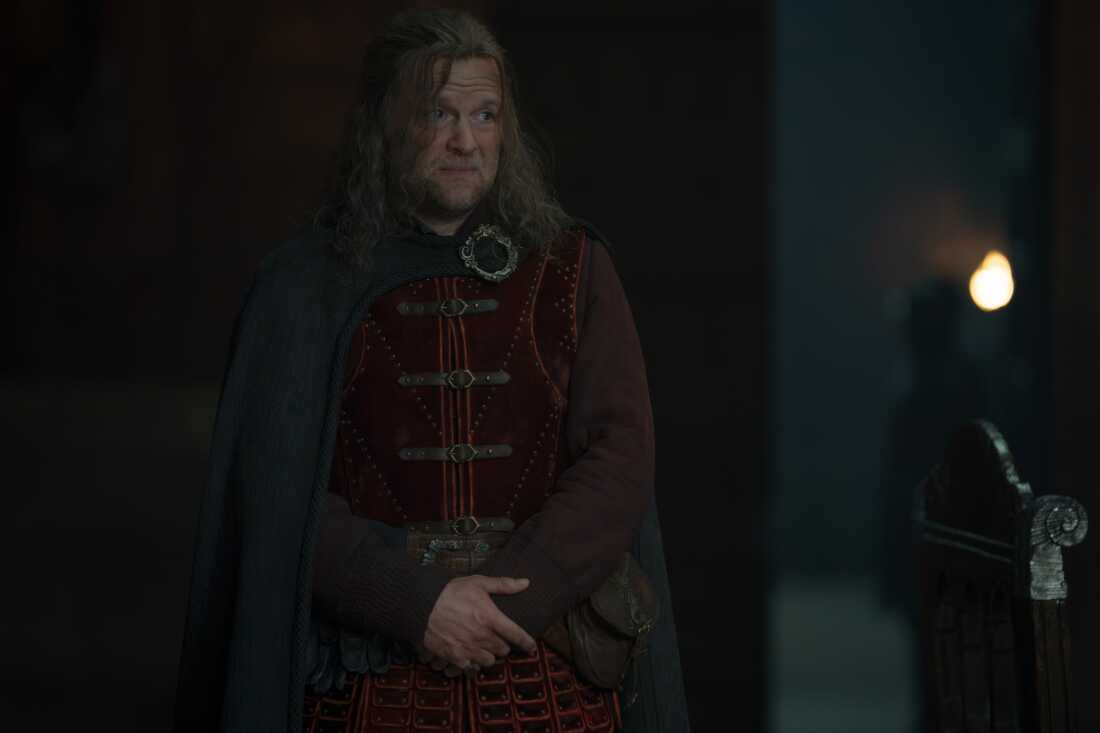
Ulf the White (Tom Bennett)? More like Oof the Slight, am I right, folks?
Theo Whiteman/HBO
hide caption
toggle caption
Theo Whiteman/HBO
Orwyle tries to convince Rhaenyra that it doesn’t matter if the High Septon refused to officially crown her — she’s got all the trappings of power already, and anyway she can’t move against the Faith of the Seven without having the faithful rise up in protest. There go the writers again, laying track, planting seeds.
Daemon heads to the Vale to ameliorate the crown’s solvency problem (read: to cadge some gold). Lady Jeyne Arryn, bless her stiff, haughty britches, manages to out-snooty Daemon Targaryen, the O.G. snoot himself. It’s really something to see. As they leave, Daemon’s dragon Caraxes smells something on the wind, and they find the cave where Rhaena’s holed up with Sheepstealer.
It’s Father-Daughter Day in the Vale, with Rhaena asking Daemon not tell Rhaenyra that he found her, or that Rhaena was involved in the death of Jacaerys. She points out his shortcomings as a dad, which are profound and varied and manifold. He agrees, and has Caraxes air-fry a poor sheepherder to pass off as the guy who rode Sheepstealer into the Battle of the Gullet, which I’m sure will have no ramifications whatsoever, because keeping secrets from one’s loved ones never does, in serialized fiction, and so this scene surely represents the end of this storyline forever.
Well, now it’s a drop-leaf table
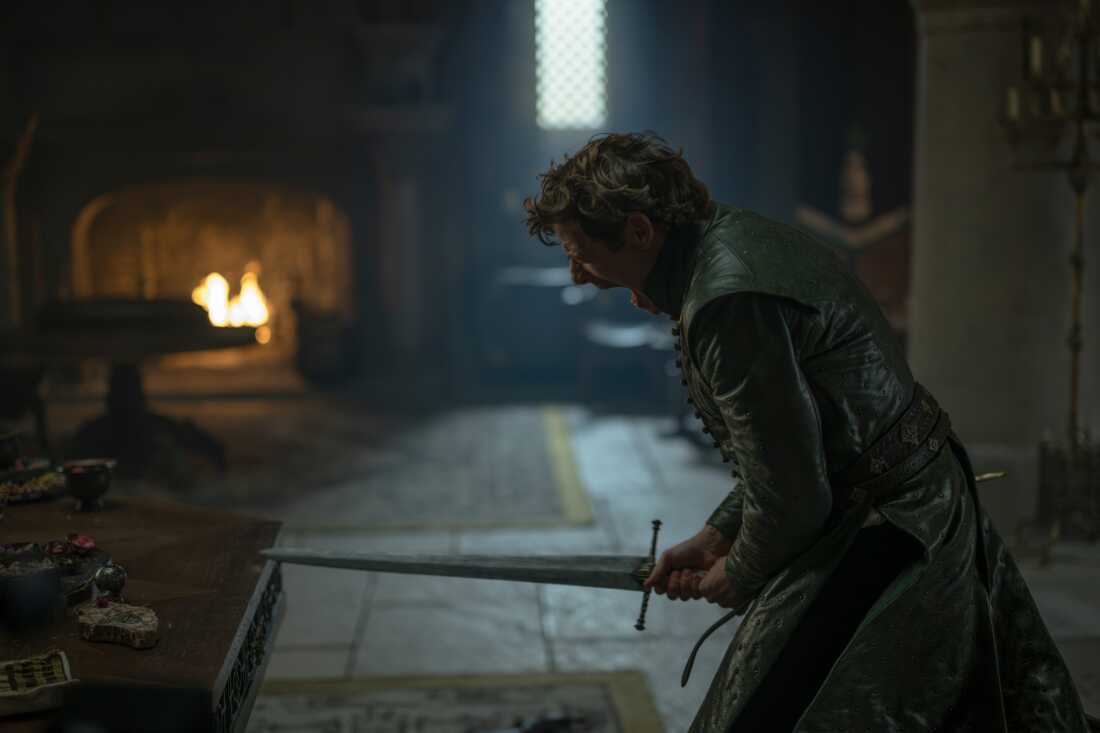
In Tumbleton, Ormund is mixing up a batch of personal potpourri when he gets news that Aemond has flown to Kings Landing and won’t be providing Ormund’s army any backup. He does not take it well, and there’s a nice characterizing moment in which we learn that Daeron is a highly observant little dude who can read Ormund like a book — he sends a servant away before Ormund’s tantrum can frighten or harm the kid. (The nicely appointed wooden pedestal table he’s sitting at doesn’t make it through unscathed, though — Ormund hacks away at it with his Valyrian steel blade, which is called Vigilance.) (Because calling it Petulance would be too on-the-nose.)
Back in Kings Landing, Rhaenyra’s council has added Ser Torrhen the Oleaginous, Master of Coin (and Lickspittling) so said council once again officially qualifies as Small. Daemon sweeps in with the flame-broiled head of the poor sheepherder and passes it off as some rando who managed to ride a wild dragon, which has now disappeared.
There is some squabbling, and Rhaenrya rebukes Daemon for killing someone so impulsively, which is a bit like rebuking the sun for shining.
Rhaenrya returns Otto’s signet ring to Alicent, and Alicent realizes that Helaena is pregnant with Aegon’s child. It’s a secret she has to keep if she wants to stay alive. If TV history is anything to go by, expect to see Helaena carrying around a big basket of laundry for the rest of the season.
Hugh arrives in Tumbleton and takes up a lonely vigil looking over the town, like a kind of hairy medieval Batman.
The Gold Cloaks scour the streets of Kings Landing, roughing up any potential taggers.
“Kill my boss? Do I Daeron live out the American dream?”
And in a small Tumbleton sept, Daeron is holed up with dragon Tessarion. Ormund shows up, dragging the citizen whose family got attacked by the Hightower soldier billeted with them.
And here’s where Ormund delivers a little monologue that explains his worldview — and explains why, even though he’s gotten a lot less screentime than other characters, James Norton is getting fourth billing in the credits.
Ormund Hightower (James Norton) very much does not love it at Levitz, thank you very much.
Kevin Baker/HBO
hide caption
toggle caption
Kevin Baker/HBO
Basically, Ormund is a Faith of the Seven guy, and as such he sees the Targaryens as evil, witchy, dragon-loving savages. He’s raised Daeron so that the kid will one day reject his family and claim the throne. To cement their bond, he bids Daeron kill the poor Tumbletonian, which Daeron does, following some — it has to be said — pretty feeble protests.
Tessarion fires up the grill, and Ormund intones, “And now we begin,” like he’s the clueless senior management guy who waltzes into the group project that the team’s been working on forever.
Which he … really kind of is, if you think about it.
Parting thoughts
- Earlier in the episode, Orwyle informed Rhaenyra that Ormund wasn’t in contact with Otto at all, so he must have been ruling Oldtown and the Reach like his own little kingdom. Feels like that’s a seed that could’ve been planted earlier in the season, cause it bore fruit really fast.
- With this episode, Operation: Daeronwatch definitively concludes. Some of you knew what was up with him all the way back in the first episode of the season. Yeah, okay, well spotted, but because the show wanted to fake viewers out with last episode’s Daeron decoy storyline, I didn’t want to spoil it.
- Aemond and Vhagar have been MIA for two episodes now — and it doesn’t take that long to fly from Harrenhal to King’s Landing. So he’s taken a detour — but to where?
- Ormund’s out here in these streets trying to stage a full-on coup when his real skillset lies elsewhere; Westeros is, after all, a famously a stinky place that could really use some Yankee Candle shops. We learned last week that there’s a candle shortage, so there’s your canonical demand in need of some supplyin’, and who better to do it than Oldtown’s own pompous pious perfumed pretty boy?

While uncertainty lingers over improvements and timetables at LAX, the county’s second-busiest airport is on the brink of big changes.
The Hollywood Burbank Airport is due to replace its two terminals with a larger new terminal on Oct. 13. The $1.3-billion project will include 14 gates — the same number the airport has now. But the new structure will be a single terminal that’s about 50% larger than the airport’s current two-terminal layout.
In moving to a 355,000-square-foot terminal, officials say, the airport can give passengers more room and better technology while meeting safety and accessibility standards.
A rendering shows how Hollywood Burbank Airport is designed to look when its new terminal opens in October.
(Hollywood Burbank Airport)
The airport, built in 1930 and run by the Burbank-Glendale-Pasadena Airport Authority, is favored by many local travelers as a simpler, faster alternative to Los Angeles International Airport. The Burbank airport’s site in the San Fernando Valley, however, has often put its leaders at odds with residents of surrounding suburban neighborhoods.
As it stands, the aged Burbank facility doesn’t meet current state seismic standards or Federal Aviation Administration design standards — which has prompted repeated safety warnings. Its nine resident airlines fly to about 30 nonstop destinations. The airport reported about 6.2 million arriving and departing passengers in 2025.
Airport officials say the new design increases the distance between the terminal and the nearest runway, currently as little as 257 feet, soon to be about 880 feet, bringing the airport into compliance with FAA standards.
Meanwhile at LAX, which reported 73.7 million passengers in 2025, the opening of a long-awaited SkyLink automated people mover (an electric train linking terminals to rail service and rental cars) has been delayed by technical and legal issues. In a June 15 report, the SkyLink contractor estimated that its public opening would need to wait until Oct. 6 or later. Asked for a revised timetable, an LAX spokesperson gave no dates, saying only that the airport is focused on “exhaustive testing of all tracks, signaling systems, and vehicles” to ensure safety and dependability.

A rendering shows how Hollywood Burbank Airport is expected to look after a new terminal opens in October.
(Hollywood Burbank Airport)
In Burbank, voters approved the airport terminal replacement project in 2016. Construction began in 2024. At the entrance, travelers will encounter a pair of 16-foot-tall sculptures, “The Two Electras,” by Cliff Garten; inside, a ceiling grid artwork by Glenn Kaino.
The new space is just north of the existing terminal, which is to be demolished. The new entrance will be at Winona Avenue and Hollywood Way. Airport officials say the change will not affect the number of flights or the airport’s operating hours, which are 7 a.m. to 10 p.m.
In the new terminal, airport officials say, the walk from the entrance to the farthest gate will be 1,285 feet, down from 1,600 feet now, with wider corridors and sidewalks and access to power plugs for devices from every seat. Baggage claim carousels will move from outdoors to indoors.

A July 7 photo shows work in progress at Hollywood Burbank Airport, where a new terminal is scheduled to open in October.
(Hollywood Burbank Airport)
The airport project, known as Elevate BUR, has been overseen by the project management company Jacobs. The Design-Build portion of the project is led by Holder, Pankow, TEC, Joint Venture. Corgan provided architectural services in association with CannonDesign.
As it does now, the airport will supply shuttle bus service between the new terminal and Burbank Airport-South Train Station (which connects with Amtrak’s Pacific Surfliner) and the Burbank Airport-North Station at San Fernando Road and Hollywood Way.
Another thing that won’t change: Passengers will continue to walk across the tarmac from terminal to stairs to planes, rather than using the enclosed jetways common in other airports, especially larger ones. It’s something travelers say they appreciate about the airport.
“The second I step onto the tarmac at Burbank, I start acting like I’m boarding a private jet,” wrote one Threads user. “And you’ll never convince me otherwise.”
Some other changes travelers can expect in Burbank:
- The new terminal’s 14 food service units are tentatively set to include a Flavor Town, Spring Chicken, Farm Table Bistro, Jones Coffee, Perry’s Joint, Poquito Mas, West Coast Smash Burger, Diane’s Pizzeria, Massis Kebab, Starbucks, Border Grill, Jet Tila’s Asian Table, Santa Canela bakery and a bar with picture-window views of the runways and Verdugo mountains.

The Grand Hall of the soon-to-open terminal at Hollywood Burbank Airport awaits finishing touches on July 7.
(Hollywood Burbank Airport)
- A new parking structure next to the new terminal will hold 2,007 parking spots, including 400 valet spots. (The airport’s total number of parking spaces will remain the same at 6,637.)
- The distance between the new terminal and the airport’s existing rental car facility and bus stop (Regional Intermodal Transit Center) will be slightly less than a mile by shuttle bus.

On-air challenge
Based on the clue, name two words that have the same number of letters and begin and end with the letters provided. (Ex. Rocks / five letters / S and E —> Slate, Shale)
1. European languages in 7 letters starting with S and ending with .
2. Ancient stringed instruments / 4 letters / L and E
3. Birds / 6 letters / P and N
4. Parts of the body / 5 letters / T and H
5. Things seen in a classroom / 5 letters / C and K
6. Newsstand magazines / 7 letters / E and E
7. Books of the Bible / 4 letters / A and S
8. Foods from Italy / 5 letters / P and A
Last week’s challenge
Next weekend will be the 186th convention of the National Puzzler League, in Bloomington, Ind., which I’ll be attending as always. Two other people who will be there are Henri Picciotto and Joshua Kosman, who created this week’s challenge. Name two words that are opposites. They share a single letter. Remove that shared letter from each word, put a hyphen between the two starting words, and you’ll get a term you sometimes see in food ads. What are the two words?
Challenge answer
Slow, fast –> low-fat
Winner
Debra Waller of Burlington, Kentucky
This week’s challenge
This week’s challenge comes from Steve Baggish, of Arlington, Mass. Take the 10-letter name of a popular TV series for which most of its seasons have been filmed in a foreign country. Remove the first and last letters, and the remaining letters can be rearranged to spell the name of a country. What are the two names?
If you know the answer to the challenge, submit it below by Thursday, July 16 at 3 p.m. ET. Listeners whose answers are selected win a chance to play the on-air puzzle.
-

 Nebraska5 minutes ago
Shawn Eichorst’s Nebraska tenure shows his Badgers return is disastrous for Luke Fickell
-
 Nevada11 minutes ago
Construction workers in Southern Nevada take precautions to stay safe in triple-digit heat
-

 New Hampshire17 minutes ago
Missing motorcyclist found dead after crash in Shelburne, NH
-

 New Jersey23 minutes ago
New NJ businesses include non-alcoholic liquor store, art school
-

 New Mexico29 minutes ago
As New Mexico’s opioid settlement funds tickle in, they are tough to track
-

 North Carolina35 minutes ago
Town of Pine Knoll Shores announces Ryan Thompson to depart after 18 years
-

 North Dakota41 minutes ago
Wrestling: Yates, Raper excel in North Dakota – Salisbury Post
-

 Ohio47 minutes ago
Can Ohio State Survive Its Own Schedule? Inside the Buckeyes’ 2026 Playoff Math

