Politics
As California water agency investigates top manager, some worry progress could be stymied

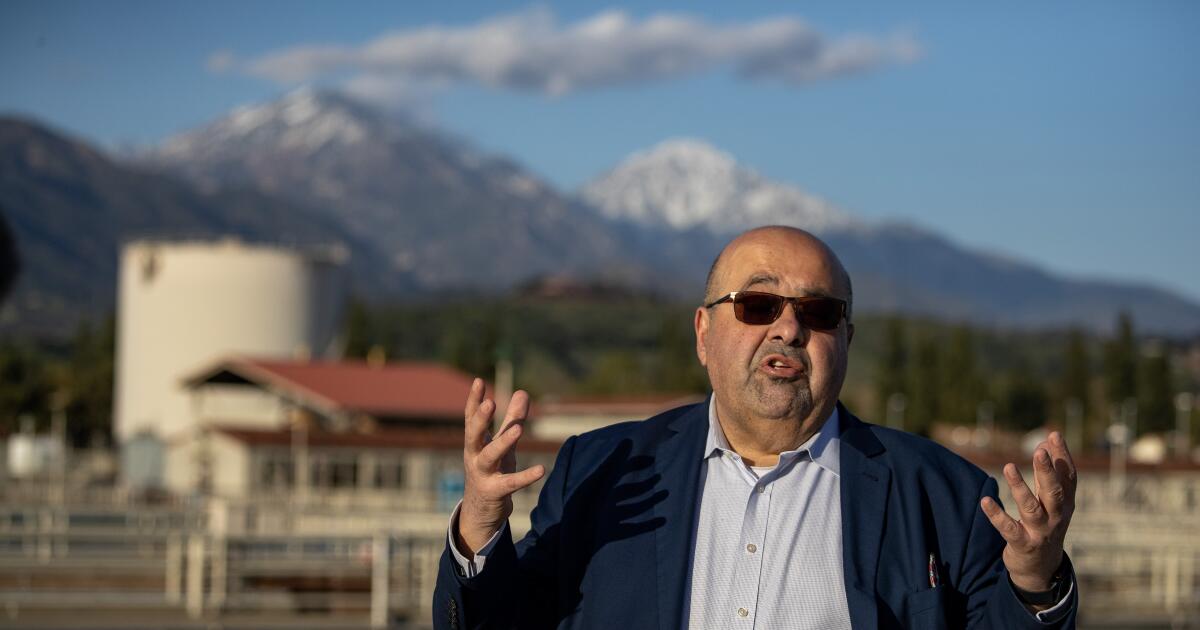
In the three years that Adel Hagekhalil has led California’s largest urban water supplier, the general manager has sought to focus on adaptation to climate change — in part by reducing reliance on water supplies from distant sources and investing in local water supplies.
His efforts to help shift priorities at the Metropolitan Water District of Southern California, which has traditionally focused largely on delivering imported water to the region, have won praise among environmental advocates who hope to reduce dependence on supplies from the Colorado River and Northern California.
However, now that Hagekhalil is under investigation for harassment allegations and has been placed on leave by the MWD board, some of his supporters say they’re concerned that his sidelining might interfere with the policies he has helped advance.
“I would hope this doesn’t mean that we undo the progress that’s been made since Adel came in,” said Conner Everts, executive director of the Southern California Watershed Alliance, who has supported Hagekhalil’s policies.
Aggressive and impactful reporting on climate change, the environment, health and science.
The accusations against Hagekhalil surfaced Thursday while he was traveling in Singapore for a water conference.
Chief Financial Officer Katano Kasaine made the allegations in a confidential letter to the board, which was leaked to the media. She said Hagekhalil has harassed, demeaned and sidelined her and created a hostile work environment.
Hagekhalil denied the accusations, saying he has always treated the staff with respect and professionalism, and that the claims amount to “disagreements on management decisions.”
The MWD board voted to place Hagekhalil on administrative leave for 90 days while Kasaine’s complaint and other allegations are investigated. In his place, the board temporarily appointed assistant general manager Deven Upadhyay, who has been at the agency for 29 years, as interim general manager.
Everts has for more than three decades been advocating for Southern California to reduce reliance on imported water supplies by boosting local supplies. He said he has been pleased to see Hagekhalil and MWD moving forward with plans for the country’s largest wastewater recycling facility in Carson, and working to develop a plan for adapting to climate change.
Everts said he hopes that whatever results emerge from the investigations, the agency doesn’t revert to an outmoded focus on imported water that he believes some “old guard” leaders of MWD still favor.
Everts, like many others who spoke at Thursday’s board meeting, said the accusations demand a fair and impartial investigation.
“Hopefully, Adel comes back and continues to lead in this direction. And if not, whoever would step in would do that,” Everts said. “Does the culture change of the agency continue to progress? That’s my question.”
MWD is the nation’s largest wholesale supplier of drinking water, serving cities and agencies that supply 19 million people across Southern California.
MWD Board Chair Adán Ortega Jr. said that while the board made “difficult decisions” regarding the allegations against Hagekhalil, “we maintain our commitment to the policies and direction of this organization.”
Ortega said he doesn’t expect any change in the district’s “current policy course.”
“Our task at hand is tackling climate change,” Ortega said in an interview with The Times. “Anybody that would challenge that is up against a pretty embedded policy framework for tackling climate change.”
Ortega was involved in selecting Hagekhalil, who previously worked for the city of Los Angeles and who was hired after a bitter struggle among board members in 2021. Ortega said his priorities as board chair have been the same priorities that Hagkhalil has been pursuing.
As for the accusations against Hagekhalil, Ortega said he was upset that someone leaked the confidential letter.
“I believe that whoever leaked it was trying to box in the board. But we’re not going to let them, and I don’t think it worked,” Ortega said.
He said all the initiatives that Hagekhalil was working on will continue under Upadhyay while the matters are investigated.
“The board drives the agenda,” he said. “I think the board has been united on things that Adel and I have both shared.”
Hagekhalil has led the agency at a time of major initiatives, including negotiations aimed at addressing water shortages on the Colorado River, plans for building the water recycling plant in Carson, and the MWD board’s consideration of Gov. Gavin Newsom’s plan to build a $20-billion water tunnel in the Sacramento-San Joaquin River Delta.
Some of Hagekhalil’s supporters questioned why the matter was brought to the board while he was traveling, and suggested the public airing of grievances appeared to be aimed at pushing aside a leading advocate for transforming the district’s focus.
But Ortega said any speculation that placing Hagekhalil on leave might derail the MWD’s current policy agenda is unfounded.
“The board is fully organized in support of that agenda,” Ortega said. “So I don’t feel any nervousness or doubt about our continued policy direction.”
“It’s a mistake to think that the fate of our policy agenda rests on one person,” he added. “Nothing is changing in terms of the board’s organization or the items that we’re considering in future months, or the composition of the committees. All of that is intact. And so nothing changes.”
Still, some environmental advocates have said they’re concerned about a potential link between the surfacing of allegations against Hagekhalil and efforts by some within the agency to push for the proposed Delta Conveyance Project, a 45-mile tunnel that would create a second route to draw water from the Sacramento River into the aqueducts of the State Water Project. They pointed out that Kasaine currently serves as treasurer of the Delta Conveyance Design and Construction Authority, the entity that was created to finance the tunnel project.
“I think it is a calculated ambush that is designed to get the tunnel approved, over the objections of other members of the Metropolitan board,” said Patricia Schifferle, director of Pacific Advocates, an environmental consulting firm.
During an MWD committee meeting on Monday, supporters and opponents of the proposed tunnel debated the costs and benefits of the project.
Karla Nemeth, director of the State Department of Water Resources, told board members that the project is essential to improving the reliability of water supplies in the face of climate change, sea-level rise and a major earthquake.
Other supporters made similar arguments, while opponents argued that building the tunnel would harm the delta’s deteriorating ecosystem and would be more expensive than other water-supply alternatives.
The costs would be paid for by urban and agricultural water districts that decide to participate. The state recently released a cost-benefit analysis that is intended to provide information for local water agencies to consider.
The MWD would receive a large share of the water, and the board’s eventual decision on whether to participate is expected to be pivotal in determining whether the state’s plan goes forward.
The MWD board in 2020 agreed to contribute $160.8 million toward planning and pre-construction costs. District officials say the board could consider whether to provide additional funding for planning and pre-construction costs at the end of this year, and it will likely be several years before there is a decision on long-term financial participation.
When the state’s cost-benefit analysis was released last month, Hagekhalil said: “The questions are, how can this project be implemented, what kind of assurances can we have in the resilience it provides to the Delta and our water supply future, and at what price?”
Leaders of several environmental groups said they were disappointed to see Hagekhalil placed on administrative leave before the accusations against him have been investigated.
“It is critically important and appropriate for MWD to take these allegations seriously and we applaud the agency’s decision to investigate the claims made, so that the board can have an accurate understanding of what has been happening among the organization’s senior leadership,” said Bruce Reznik, executive director of the group LA Waterkeeper. “That said, the public needs more information to ensure the complete independence of this review.”
He said any action against Hagekhalil should have come after an independent investigation.
Reznik called Hagekhalil a “visionary, inclusive and transparent leader” who is helping the agency reform its approach to adapt to the effects of climate change.
“He has been vocal about his vision and plans to transform the agency,” Reznik said. “That focus must continue at MWD.”


More than three dozen California legislators are calling for Gov. Gavin Newsom to exempt the state’s film and TV production incentive program from a recently approved cap on corporate tax credits, warning that without action it will be “significantly kneecapped.”
Though the state’s budget has already been approved, the legislators say a solution must be devised before the end of the year so that production companies do not lose the “full value of tax credits they earned in exchange for creating middle-class entertainment industry jobs,” according to a letter dated Friday and addressed to Newsom, State Senate President Pro Tempore Monique Limón and Assembly Speaker Robert Rivas.
“Tax credits earned for creating jobs in motion picture and television production are not the same as tax credits provided for research and development,” the letter states. The legislation “creates short-term budget savings by reneging on commitments made to the entertainment industry and the working families who depend upon it for their livelihoods.”
The letter comes shortly after Newsom signed his final state budget as California’s governor, a $351.7-billion spending plan that includes new limitations on corporate tax credits.
The budget includes a provision that restricts the maximum tax credit companies can claim in a given year to $5 million or 50% of a company’s tax state tax liability, whichever is greater.
Hollywood industry representatives had warned the governor’s office that the new restrictions could affect the state’s production incentive program, which was just bolstered last year to an annual cap of $750 million.
The film and TV industry in Southern California has struggled to rebound from the effects of the pandemic, the dual writers’ and actors’ strikes in 2023 and the exodus of production to other states and countries.
Members who voted for the budget bill had believed there was a carve-out for the film and TV tax credit program, said Assemblyman Rick Chavez Zbur (D-Los Angeles), chair of the Assembly Democratic Caucus.
“I don’t think that anyone understood what this cap was, what it did and that it effectively kneecapped and reverses the progress that we made last year,” Zbur, who co-authored last year’s bill, said in an interview. “We need to have people understand that these changes, which I think people believed were minor, are really significant and will result in significant job loss if we don’t fix them.”
The new changes to the state’s film and TV tax credit program, which included expanded eligibility for additional shows and films, came after intense lobbying from studios and industry workers, who argued that more funding was necessary to lure production back from other states and countries.
Last week, the California Film Commission said the expanded tax credit program was set to deliver $6.6 billion in direct production spending in-state and more than 34,000 cast and crew jobs across the 170 total film and TV shows that received production incentives this year.
Politics
Graham’s death ignites GOP scramble for Senate seat as Trump hints he already has a favorite

NEWYou can now listen to Fox News articles!
Sen. Lindsey Graham’s, R-S.C., sudden death from an undisclosed illness has triggered a two-pronged approach to replace him, and President Donald Trump will likely be a focal point in the process.
Graham’s passing overnight comes at a time when Republicans in the upper chamber need every vote they can get. The Senate GOP now holds a 52-seat majority, and with the timetable for Sen. Mitch McConnell’s, R-Ky., absence still unclear, that majority is now effectively 51 votes.
That will up the pressure, and drama, to find a replacement for the longtime South Carolina lawmaker.
LINDSEY GRAHAM, SOUTH CAROLINA SENATOR WHO ROSE FROM SMALL-TOWN ROOTS TO GOP POWER BROKER, DIES AT 71
Sen. Lindsey Graham speaks with reporters aboard Air Force One with President Donald Trump and Secretary of Commerce Howard Lutnick on the way back to Washington, D.C., on Jan. 4, 2026. (Jim Watson/AFP via Getty Images)
Trump, during an appearance on NBC’s “Meet the Press” on Sunday, said, “I have somebody that I think would be great.”
“But I don’t want to say it now because it’s just, it’s too soon with Lindsey,” Trump said. “I don’t wanna even talk about anybody, but I do have somebody that I think is really good.”
It’s a process guided by the Constitution and state law. The first step will require South Carolina Gov. Henry McMaster, a Republican, to appoint a replacement for Graham on a temporary basis.
McMaster, a close ally of Trump, can appoint a temporary replacement as soon as he wants. That pick will serve until the next special or general election.
MCCONNELL FACES FRESH CALLS TO COME CLEAN ABOUT HEALTH ISSUES
Fox News Digital did not immediately hear back from McMaster’s office on when he would make the announcement, or who he was considering for the seat.
Graham was already in-cycle running for a fifth term in the upper chamber, and he easily cruised to a primary victory early last month. That means that whoever McMaster taps would serve until the end of the year to finish off the remainder of Graham’s fourth term.
The second prong is finding his long-term successor.
The candidate filing period for that special election to win the GOP nomination opens July 21. The election is slated for Aug. 11, according to South Carolina law.
That race could see several familiar faces in South Carolina GOP politics jumping in, including McMaster himself, who is termed out as governor.
TRUMP’S ENDORSEMENT POWER FACES ANOTHER GOP TEST IN SOUTH CAROLINA AFTER ALAN WILSON ADVANCES
Rep. Nancy Mace, R-S.C., departs the U.S. Capitol after a series of House votes on funding for Homeland Security and a War Powers resolution on Iran on March 5, 2026, in Washington, D.C. (Andrew Harnik/Getty Images)
Trump heaped praise on McMaster, noting that he endorsed his first bid for the White House in 2016.
“Henry’s been a great governor, you know now he’s termed out, but he’s going to do the right thing,” Trump said. “I think Henry will be fantastic.”
There are six members of South Carolina’s GOP congressional delegation who could toss their hats into the mix. Rep. Nancy Mace, R-S.C., who recently lost a bid for the GOP gubernatorial nomination, is eyeing jumping into the special election.
A person familiar with Mace’s plans told Fox News Digital, “Congresswoman Mace is considering a bid to run.”
Then there’s Rep. Joe Wilson, R-S.C., the longest-serving Republican member of the Palmetto State’s delegation. He quickly snuffed speculation about whether he’d leap into the fray.
CLICK HERE TO DOWNLOAD THE FOX NEWS APP
“I was grateful to speak with President Trump today reminiscing about our mutual friend, Senator Lindsey Graham,” Wilson said on X. “I assured him my goal is to remain in the House to keep his two-vote majority for the American people!!!”
Then there’s the remaining four: South Carolina Republican Reps. Ralph Norman, who also lost out on scoring the GOP nomination for governor, Russell Fry, William Timmons and Sheri Biggs, none of whom, so far, have signaled that they would jump into the battle for Graham’s seat.
Meanwhile, South Carolina Lt. Gov. Pamela Evette could also be in the mix.
A source familiar told Fox News Digital that Evette is receiving “tons of encouragement from all across the state and from around the country” to serve as the temporary caretaker for Graham’s seat.
The source said that Evette is also being encouraged to run to seek a full six-year term in the Senate.
Evette, a top South Carolina ally of Trump’s and McMaster’s, was endorsed by both as she finished first in South Carolina’s Republican gubernatorial primary in this year’s race to succeed McMaster.
But after Trump also endorsed her GOP rival in the runoff, State Attorney General Alan Wilson, she was trounced by Wilson a few weeks ago in the runoff election
Fox News Digital did not immediately receive responses to requests for comment from possible contenders in the House.
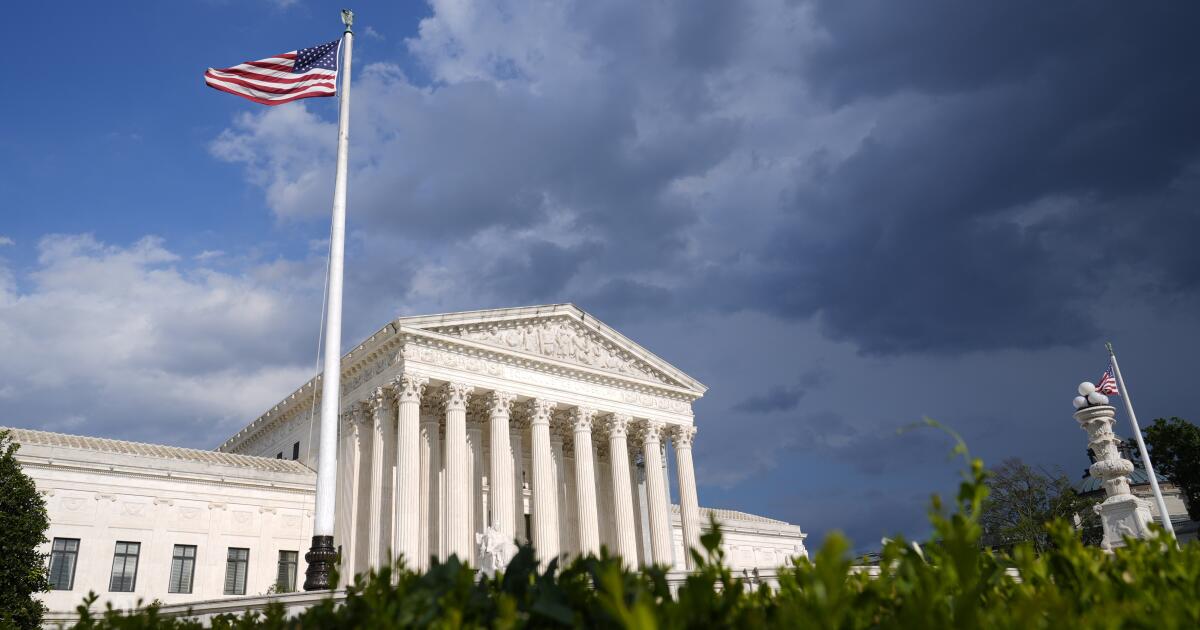
WASHINGTON — The Supreme Court’s conservative justices say they decide cases based on the words and original history of the Constitution — and not on their personal or political views.
Following the lead set by the late Justice Antonin Scalia, they say they see history and “originalism” as a guiding principle to prevent judges from changing the Constitution to adjust to new and changing times.
This text-and-history approach is said to contrast with an evolving or “living Constitution” favored by progressives and liberal activists.
But this year saw a flip of sorts on birthright citizenship.
The foremost conservatives agreed with President Trump that the surge of illegal immigration called for reconsidering the promise of citizenship at birth set out in the 14th Amendment of 1868.
“The number of illegal immigrants in this country exploded” in recent years, Justice Samuel A. Alito Jr. wrote in dissent. The rule of citizenship at birth provides “a powerful incentive to enter or remain in this country illegally,” he added.
“The Constitution is an enduring document,” wrote Justice Brett M. Kavanaugh, but its rules and meaning must adjust to “modern situations that were unknown or unanticipated by the Constitution’s Framers.”
In a concurring opinion, he said that “significant illegal immigration into the United States is a new circumstance that was largely unknown as of 1868.”
There were no federal immigration laws in the mid-19th century, but it was an era when a surge of Irish immigrants had settled on the East Coast and large numbers of Chinese immigrants came to California.
Under the law, their children were deemed to be citizens at birth.
Among the conservative originalists, only Justice Amy Coney Barrett signed the majority opinion that was written by Chief Justice John G. Roberts Jr. and joined by the three liberals.
The opening words of the 14th Amendment of 1868 say: “All persons born or naturalized in the United States and subject to the jurisdiction thereof are citizens of the United States.”
In 1898, the Supreme Court upheld the rule of citizenship at birth in the case of Wong Kim Ark, who was born in San Francisco to Chinese parents.
In an executive order, Trump proposed to end birthright citizenship for the newborns whose parents were in the country illegally or temporarily.
Writing for the court, the chief justice said the words of the 14th Amendment were clear and were clearly understood at the time. He dismissed the “dramatically revisionist view” that has been cited recently.
Kavanaugh voted with the majority to block Trump’s order from taking effect. He did so because Congress had adopted birthright citizenship in a 1952 law.
“Consistent with the 14th Amendment, Congress could … enact new legislation establishing exceptions to birthright citizenship,” he wrote.
Justices Clarence Thomas and Alito wrote long dissents arguing that the framers of the 14th Amendment did not or would not have favored birthright citizenship.
They pointed to recent scholarship by law professors that raised questions about the accepted understanding of the 14th Amendment and the citizenship rule.
Thomas said citizenship of the child should turn on whether the parents were “domiciled” in this country. Black people who were enslaved were undoubtedly domiciled here, but the same is not true of temporary visitors.
Justice Neil M. Gorsuch agreed in part with Thomas and questioned whether the newborns of temporary visitors should be deemed as citizens at birth.
Many court commentators were surprised by the close 5-4 divide on the constitutional issue.
“Given how clear the language was, I expected it to be 7 to 2,” said Melissa Murray, a New York University law professor. “I really gasped when I saw it was 5-4. This is not settled. We’re not done with this debate.”
Sarah Isgur, a podcaster and SCOTUSblog analyst, said that “originalism is getting more and more muddled. Either the history matters or it doesn’t.”
However, she agreed with Kavanaugh’s approach of leaving it to Congress to reconsider the issue.
Not all originalists are conservative.
Yale Law Professor Akhil Amar, a constitutional historian, argued that the history of birthright citizenship is clear and not subject to revisionist thinking. He said the Reconstruction Congress adopted this principle of citizenship at birth and stated their intent in clear words in the 14th Amendment.
“When a baby is born on American soil and an American flag flies above, that baby is a birthright citizen, as the Reconstruction Republicans across the land understood,” he wrote in February. This rule “has virtually nothing to do with the baby’s parents.”
Last week, he was mostly cheered by the court’s ruling.
“It’s a triumph, but it should have been 9-0,” Amar said on a review of the court term sponsored by SCOTUSblog. “Shame on the dissenters. They didn’t even the address the statute” and its wording.
But the majority led by Roberts “clearly affirmed the plain meaning of the constitutional text and its history. And that’s a win,” he said.
History has a recurring role at the Supreme Court.
Isgur noted the court will hear arguments in the fall on whether the 2nd Amendment of 1791 gives gun owners a right to have “assault weapons” like AR-15 rifles.
She said the court will decide then between history and changed circumstances.
At issue is whether these modern rapid-fire rifles fit within the history of the gun rights protected by the 2nd Amendment or instead represent a new and dangerous threat to public safety that was unknown in 1791.
Scalia’s opinion upholding gun rights in 2008 is often cited as a model of originalism, but it too emerged from a court divided 5-4.
The 2nd Amendment says, “A well-regulated Militia, being necessary to the security of a free state, the right of the people to keep and bears Arms, shall not be infringed.”
For decades, the Supreme Court had all but ignored the 2nd Amendment, viewing it as a somewhat outdated provision involving militias, akin to the 3rd Amendment. It forbids having soldiers “quartered in any house … in time of peace.”
Four liberal dissenters in 2008 said the court should stand by that understanding of history.
Justice John Paul Stevens said the 2nd Amendment was added to the Constitution to protect state militias from federal interference. Moreover, the reference to “bear arms” suggests it was about militias, he said.
But Scalia’s opinion stands as the landmark precedent, and he said the dissenters had the history all wrong.
The right to have guns for self-defense arose in England and came to the American colonies. “By the time of the founding, the right to have arms had become fundamental for English subjects,” he wrote.
The 2nd Amendment did not establish a new right, he said. Rather, it “codified a pre-existing right [of] having and using arms for self-preservation and [defense],” he wrote.
“There seems to us no doubt, on the basis of both text and history,” Scalia wrote, “that the 2nd Amendment conferred an individual right to keep and bear arms.”
-

 Technology5 minutes ago
Google may use your photos and voice to train AI
-
 Business11 minutes ago
‘Moana’ loses its way at the box office with a $43-million domestic opening
-
 Entertainment17 minutes ago
Academy Award-winning special effects pioneer Don Iwerks dies at 96
-
 Lifestyle22 minutes ago
Burbank’s airport to get new $1.3-billion terminal soon (but you’ll still walk on tarmac)
-
Politics29 minutes ago
State lawmakers cry foul over new cap placed on film tax credits
-
 Sports41 minutes ago
Dodgers swept by Diamondbacks in first winless series of season as they stagger into All-Star break
-

 World53 minutes ago
At least 27 dead as fire engulfs popular Bangkok pub near Chatuchak market
-
 News1 hour ago
Want to own a real T. rex? It could cost you $30 million

