Science
Too much screen time harms children, experts agree. So why do parents ignore them?


Parents are bombarded with a dizzying list of orders when it comes to screen time and young children: No screens for babies under 18 months. Limit screens to one hour for children under 5. Only “high-quality” programming. No fast-paced apps. Don’t use screens to calm a fussy child. “Co-view” with your kid to interact while watching.
The stakes are high. Every few months it seems, a distressing study comes out linking screen time with a growing list of concerns for young children: Obesity. Behavioral problems. Sleep issues. Speech and developmental delays.
Maya Valree, the mother of a 3-year-old girl in Los Angeles, understands the risks and constantly worries about them. But limiting her daughter’s screen time to one hour feels impossible as she juggles life as a working parent, she said.
Over the past few years, her child’s screen time has ranged up to 2-3 hours a day, more than double the limit recommended by pediatricians. Valree puts on educational programming whenever possible, but it doesn’t capture her child’s attention as well as her favorites, Meekah and “The Powerpuff Girls.”
“Screen time is in the top three or five things to feel guilty about as a mom,” she said. “I’ve used it to pacify my daughter while cooking or working or catching up on anything personal or professional.”
Maya Valree works while her 3-year-old daughter watches screen time on an iPhone on Saturday in Los Angeles.
(Zoe Cranfill / Los Angeles Times)
Valree is among the legions of parents who by choice or necessity allow their babies and preschoolers to watch several times more than the limit recommended by experts, creating a vast disconnect between the troubling predictions of harm and the reality of digital life for American families.
But her feelings of guilt may put Valree in the minority. Directives to limit the time young children spend on digital devices may not be taking root because many parents simply don’t believe their child’s screen time is a problem in the first place.
Parents need to have some type of distraction for their kids, and “screens tend to be the easiest option, the lowest hanging fruit,” said Dr. Whitney Casares, a Portland pediatrician and author of the book “Doing It All.” “I hear more people saying, ‘I know screen time is bad, I wish we had less of it in our family, but I feel helpless to change it.’”
Screen time use among older children made news last week, when the Los Angeles school board approved a cellphone ban all day on campus, and the U.S. surgeon general called for a warning on social media platforms advising parents that they can damage teenagers’ mental health.
Many families, however, support their children’s phone use for safety and education. For a generation of parents of who grew up with cellphones and computers, such sentiments appear to start with much younger children. A national survey of families with children 8 and younger found that the majority of parents believe screen time is a net positive — helping their children learn to read, boosting creativity and even improving their social skills.
Should children under 5 have screen time?
The American Academy of Pediatrics recommends families avoid screens for babies under 18 months, with the exception of video chatting. Parents who want to introduce digital media to toddlers ages 18-24 months should keep it very limited, choose high-quality educational programming, always watch alongside their children, and interact with their children both during and after watching.
For children ages 2-5, pediatricians recommend limiting screen time to one hour a day of high-quality programming that is educational, interactive and pro-social with few or no advertisements. Parents should avoid fast-paced programs, apps with distracting content and anything with violence. Whenever possible, they should co-view with their children to help them understand what they are seeing.
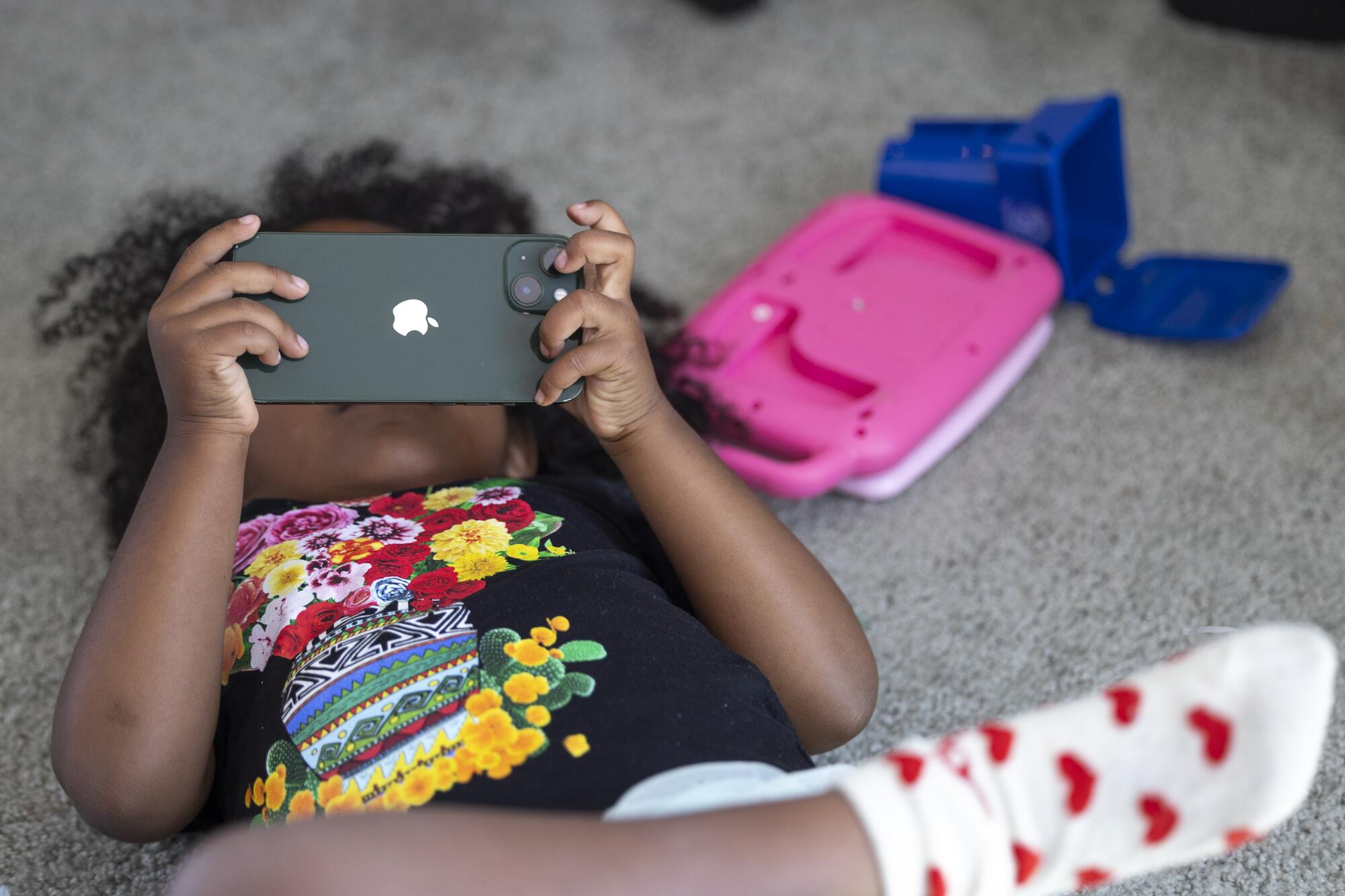
Maya Valree’s 3-year old daughter watches screen time on an iPhone while her mother works on Saturday, June 22, 2024 in Los Angeles, CA.
(Zoe Cranfill/Los Angeles Times)
Pediatricians also recommend that children avoid screens during mealtimes and at least one hour before bedtime. When no one is watching the TV, it should be turned off. And parents should avoid regularly using screens to calm their child, because it can make it difficult to set limits and teach children to regulate their own emotions.
“We don’t want to be the scolds. It’s our job to provide information to parents but to also say we understand the reality of everyone’s current lifestyle. It’s just a different world now,” said Dr. Nusheen Ameenuddin, one of the authors of the academy’s policy statement. “[Parents] aren’t going to be perfect 100% of the time.”
Jacqueline Nesi, an assistant professor of psychiatry at Brown University and author of Techno Sapiens, said screen time limits need to be a balance. While there is evidence that endless screen time — especially more than four hours a day — can be harmful, Nesi said there aren’t data to support a strict one-hour cutoff.
“As parents we know life isn’t always aligned with the recommendations. We don’t want to throw them away, but we also don’t want to be in a place where we’re demonizing all screen time.”
What percentage of parents limit their kids’ screen time?
The most recent data available come from a national survey of nearly 1,500 families with children ages 8 and younger conducted by Common Sense Media in 2020, just weeks before the pandemic closures began. The survey found that few families were coming anywhere close to pediatricians’ recommended limits.
- Children under 2 watch an average of 49 minutes of digital media a day, while the guidelines recommend avoiding screens for children under 2.
- Children ages 2-4 watch an average of 2.5 hours a day, more than twice the limit recommended.
- Children 5-8 watch just over three hours a day. The American Academy of Pediatricians does not provide strict time limits for school-aged children but advises parents to make sure screen time does not displace other activities.
The majority of parents surveyed reported that they’re not concerned about the amount of time their kids spend with screens, the impact screen media have on their child or the quality of the content available to them. The survey also asked about the reasons for children’s screen use: More than three-quarters of parents said “learning” was very or somewhat important, and more than half said parents need “time at home to get things done.”
For a generation of parents who grew up with cell phones and computers, letting kids indulge in a bit of phone or TV time doesn’t feel like a big deal.
Henja Flores, a mother of three in Fresno, said videos from YouTube sensation Ms. Rachel taught her toddler sign language and the ABC’s. “I use it as an educational thing, but also if I have to make lunch or dinner,” she said. She’s seen the headlines, but she lets her children watch two to three hours a day, as long as the shows don’t seem too overstimulating.
“I just don’t think it’s something parents need to stress about. Moms need breaks. Moms needs to get things done. As long as it’s helping, I don’t think there’s anything wrong with it at all,” said Flores.
The Common Sense survey found screen habits varied by income level, race and ethnicity. In lower-income families, for example, children were watching an average of two more hours each day than those in higher-income families.
“For lower-income families there are going to be bigger barriers to limiting screen time. It takes a lot of time and work. Higher-income families are more likely to have high quality child care, which is very expensive in our country,” said Nesi. “Sometimes screen time is serving as that thing that’s going to keep your kid occupied and safe.”
Black parents and those in lower-income households were also much more likely than their higher-income or white counterparts to perceive educational benefits to their children from screen media. Latino parents, meanwhile, had the highest level of concern about the possible negative effects of media in their children’s futures.
Why do pediatricians want to limit children’s screen time?
The strongest evidence for avoiding excessive screen times involves the “opportunity cost” — the valuable learning opportunities children miss out on during the hours they spend on digital devices.
In order to develop cognitive, language, motor and social-emotional skills, young children need to experience the world hands-on — playing with toys, exploring outside, experimenting with different materials, and having back-and-forth interactions with nurturing caregivers, said Ameenuddin. When they are watching digital media, they lose that time to grow and learn.
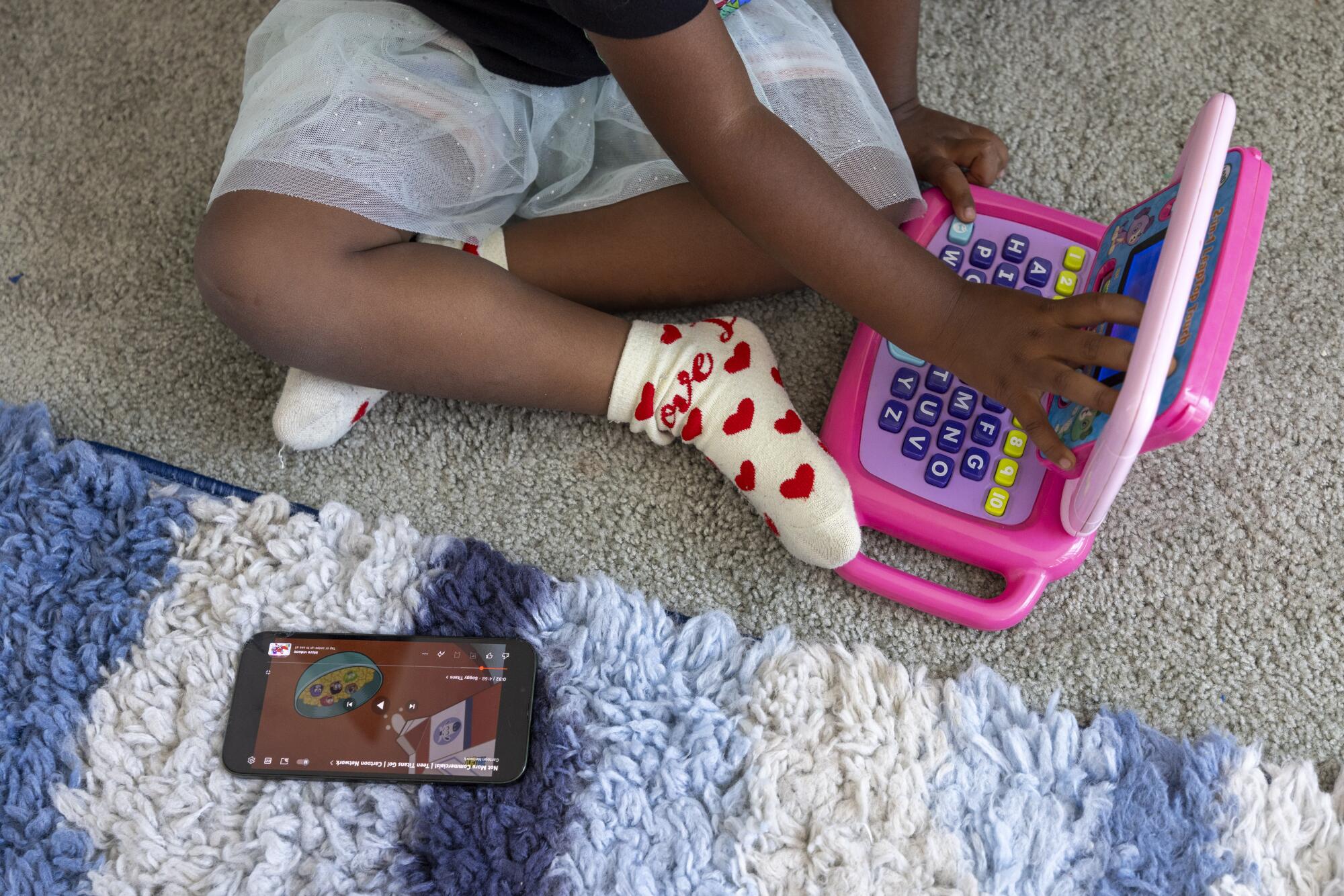
Maya Valree’s 3-year old daughter plays with a toy laptop and watches a video while her mother works on Saturday, June 22, 2024 in Los Angeles, CA.
(Zoe Cranfill/Los Angeles Times)
This is particularly true for babies and toddlers, because there isn’t much evidence that they can learn through screens.
For preschoolers, there’s more evidence that educational shows like “Sesame Street” can help improve literacy and social development, but only in limited amounts. Heavy media use in the early years has been linked to a greater risk of obesity because these children often miss out on physical activity and outdoor time. They’re also more like to see advertisements for sugary foods and drinks.
Children who are watching screens also have fewer valuable interactions with caregivers and hear fewer words during the course of their days, which is linked to cognitive, language and social delays. Some studies have found evidence linking excessive screen time with behavioral issues such as ADHD, though the research did not show that one was actually caused by the other.
A bigger question is whether the screen time is changing the wiring of babies’ and young children’s brains. A small MRI study of preschoolers found that children who watched more than the recommended one hour a day had lower development in the brain’s white matter that supports language and early literacy skills. But Ameenuddin says the evidence isn’t clear yet that screens themselves are affecting brain development.
Is screen time harmful for babies?
Babies should be playing and exploring the world, not watching screens, experts advise.
In the first three years of life, more than 1 million neural connections are formed every second, and key to this development are the “serve and return” interactions between children and their caregivers, according to Harvard’s Center for the Developing Child. Babies babble and make faces and gestures, and the people who love them respond in kind. Without these important interactions, the brain’s architecture can’t form the way it should.
These sorts of interactions don’t happen through screens.
A recent Japanese study found that the more time a baby spent watching screens at age 1, the more likely they were to have developmental delays in communication and problem-solving at ages 2-4 — particularly when they watched more than four hours a day.
But Nesi, the psychiatry professor, said there’s no need to shield a baby’s eyes when in a room with a television on. “There’s a lot of fear messaging around this, and there’s no evidence to suggest that your baby catching a glance of a screen every once in a while could do harm.”
How can I make the most of screen time?
“There is a lot of incredible, cool stuff for kids to watch and do on screens,” said Jill Murphy, chief content officer at Common Sense Media, which offers quality ratings and media reviewsfor children. In general, Murphy says it’s safer to stick with branded content from a production company that’s intended for young children, which often have child development staff or advisors.
YouTube Kids requires more parental guidance, she said, and parents need to evaluate videos in advance. If they can’t, they should create a profile with a child’s selected interests and a set number of videos coming into the feed.
“Anything violent is a hard no for young kids, even if it’s play slapping or hitting each other with a stick,” said Murphy. “They’re very quick to mimic that behavior.”

Are you a SoCal mom?
The L.A. Times early childhood team wants to connect with you! Find us in The Mamahood’s mom group on Facebook.
Share your perspective and ask us questions.
Researchers recommend age-appropriate programming that actively involves children by asking them questions, helps them make meaningful connections to their everyday lives, and includes “socially meaningful” characters they can get to know rather than a disembodied voice.
Murphy says parents should designate screen-free zones and times, and set clear limits around when screen time will end. And whenever possible, stick with high-quality educational content without commercials, like the kind found on PBS Kids, which has been found to lead to better behavioral outcomes and language skills.
Set boundaries, avoid screens around bedtime, and whenever possible, watch alongside your child.
This article is part of The Times’ early childhood education initiative, focusing on the learning and development of California children from birth to age 5. For more information about the initiative and its philanthropic funders, go to latimes.com/earlyed.


Last summer, a NASA-funded asteroid impact warning system detected a mysterious object speeding through the solar system.
Scientists determined the object had entered the solar system from deep space, making it the third known object to have come from another star system.
NASA called it Comet 3I/ATLAS and said it didn’t pose a threat. But its discovery in July led to wild speculation that the object was a piece of extraterrestrial technology — maybe even an alien spacecraft.
The SETI Institute, a nonprofit that explores the origins of life and searches for extraterrestrial intelligence, said this week that a team of scientists had used a radio telescope to try to detect signals that could indicate extraterrestrial life on the comet.
But they found none.
“While observations strongly indicate that 3I/ATLAS is a natural object, interstellar visitors are also compelling technosignature targets because an artificial object — however unlikely — could represent detectable extraterrestrial technology and potentially provide the first evidence of life beyond Earth,” the institute said in a news release.
SETI scientists said they used the Allen Telescope Array at the Hat Creek Radio Observatory in Northern California to scan the object for seven hours, covering a spectrum of 1 to 9 gigahertz.
“This broad range allows scientists to search for narrowband radio signals, which are not produced in nature and would be evidence of technology,” the news release said.
The institute said the team identified nearly 74 million narrowband signals, but ultimately traced them back to technology on the Earth’s surface or orbiting satellites.
“The results from 3I/ATLAS show how realistic it is to detect a signal with the technology we have today,” said Valeria Garcia Lopez, one of scientists on the SETI team. “That is why it is important to keep searching for technosignatures, even from objects we might not expect to have signals.”
The institute said the researchers also can learn more about the natural properties of interstellar objects as they travel through our solar system.
“As more interstellar objects are discovered, each offers a new opportunity to probe the cosmos for technosignatures, advancing our understanding of both natural and possible technological phenomena beyond our Solar System,” the SETI statement said.
Science
Emergency room visits during heat waves available to the public in ‘near-real time’ in L.A. County

For the first time, Los Angeles County residents can see how many people are ending up in emergency rooms, their bodies pushed past the limit, during heat waves.
The county Department of Public Health says its new Heat-Related Illness and Mortality Dashboard will provide heat illness counts in “near real time,” which means weekly. That might seem like a lag, but until now the data were only provided upon request and in ad hoc reports.
Heat is the leading cause of weather-related death in the United States and heat waves are only getting more frequent and intense as the climate changes.
Public health experts called the tracker a meaningful step toward assessing how well county programs are addressing heat risks.
“It’s showing the county’s commitment to reducing the burden of heat on people’s health,” said David Eisenman, director of UCLA’s Center for Public Health and Disasters. “As the county puts more resources into that, this is a metric that allows the public to judge the effectiveness of the work.”
“There’s a handful of other places that also do this, but they’re all relatively new,” said Bharat Venkat, director of the UCLA Heat Lab, noting as examples Imperial and Riverside counties in California, Harris County in Texas and Maricopa County in Arizona. “It is very much welcome.”
The tracker takes heat illness data from patient complaints and doctor diagnoses provided by a countywide monitoring project that was previously available only to public health officials. The website says that what it provides is an undercount. The records often fail to count people when heat exacerbates more obvious health problems.
“Heat piggybacks off of preexisting health conditions,” Venkat said. “Say you go to the ER and you’re experiencing an intense psychotic episode, or a heart attack or a stroke. It’s very likely that the doctor is going to diagnose that as a psychotic episode, heart attack or stroke, and less likely that they’ll note that heat is contributing to that.”
Heat-related deaths are counted from death certificates, which present similar issues for undercounting. Those numbers will be reported monthly on the dashboard.
L.A. County has a recently approved heat action plan that aims to educate the public and reduce indoor and outdoor temperatures with strategies such as opting for shade and air conditioning.
The new tracker breaks down daily heat-related emergency room visits and deaths by age group, geography, and race and ethnicity.
It shows that people over 65 are more vulnerable to heat illness. For Black residents, heat is disproportionately fatal. And people in the San Fernando, San Gabriel, and Antelope valleys see the most heat-related emergency room visits.
Kelly Turner, a professor of urban planning at UCLA, stressed that heat sickness tracks closely with social inequality and is preventable.
“A heat death or heat illness is dependent on who you are and what assets you have,” Turner said. “If you have air conditioning or not, if you work outside or you don’t, all of those factors factor in.”
She noted that there is more risk in the San Fernando and San Gabriel valleys because of the combination of hotter days and more people who are unprotected. “When you map those two things on top of each other, you get a hot spot of vulnerability,” she said.
California already has a tool called CalHeatScore that uses historical hospital records and temperatures to forecast risk for different ZIP Codes in the state during heat events.
Public health officials hope to use the new dashboard to target messaging and public outreach when extreme heat strikes.
“If we’re having an extended heat event we can show that, ‘Hey, we’re having heat impacts’ as they’re happening,” said Dr. Nicole Quick, chief science officer at the L.A. County Department of Public Health.
Venkat said he would like to see the tool become more robust, in line with Maricopa County’s dashboard, widely viewed as the current gold standard for heat illness and mortality tracking. He said the Arizona county, which includes Phoenix, dives deeper into health records and conditions surrounding hospitalizations and deaths to better reflect the role of heat.
“They do scene investigations and send someone out to take notes about where the body was found,” Venkat said. “What was going on? Did they have air conditioning? Were they outside? Did they have access to water? What medications were they taking? All those things provide important context.”
Eisenman said he would like to see the county train physicians on recording heat-related illness, as it has been “clear for a long time” that doctors don’t make the diagnosis enough.
“It would have to be more than just a handout or a few slides. You’d really have to have each institution make some effort to change physicians’ behaviors,” Eisenman said. He added that it probably hasn’t been done because of the costs involved.

Facing higher premiums and the loss of federal subsidies, 374,000 people with health insurance from the state marketplace known as Covered California canceled their coverage in the first three months of the year, according to government statistics.
The cancellations amount to 19% of those who had renewed their policies on the state marketplace during open enrollment, state officials said. Those cancellations are higher than in the past three years when they ranged from 13% to 15% of those who renewed.
Jessica Altman, executive director of Covered California, attributed the jump in cancellations to the expiration of enhanced federal subsidies that caused the cost of a plan to leap for most middle-class Californians.
“We expect coverage losses to increase through the year,” she said.
Overall, Covered California had 1.8 million enrollees in February, down from 1.94 million the year before — a decline of 7%.
Altman said monthly enrollment numbers are delayed because consumers have a three-month grace period to resume their premium payments before the insurance carriers end their coverage for nonpayment.
This year, many middle-class Californians who depend on the state-run insurance marketplace created under the Affordable Care Act faced annual costs that were hundreds of dollars higher than last year because of the end of enhanced federal subsidies that began during the COVID-19 pandemic.
In 2021, Congress voted to temporarily boost the amount of subsidies Americans could receive for an ACA plan.
The law also expanded the program to families who had more money. Before that 2021 vote, only Americans with incomes below 400% of the federal poverty level — currently $62,600 a year for a single person or $128,600 for a family of four — were eligible for ACA subsidies. The 2021 vote eliminated the income cap and limited the cost of premiums for those higher-earning families to no more than 8.5% of their income.
On top of the loss of the enhanced federal subsidies, the average premium charged by insurers this year for a Covered California plan rose by more than 10% because of fast-rising medical costs.
The decline in ACA plan enrollees, however, has been greater in some other states. California has tried to keep people insured by using state tax money to fill in the gap for lower-income families.
This year, the state budgeted $190 million for premium subsidies for people with incomes of up to 165% of the federal poverty level.
In his budget plan, Gov. Gavin Newsom proposed spending $300 million on those state subsidies in 2027. That would expand the subsidies to enrollees with incomes up to 200% of the federal poverty level, or $31,920 for an individual or $66,000 for a family of four.
“We may actually see a number of Covered California enrollees paying less in 2027” because of the additional state subsidies, Altman said.
In May, Newsom also proposed in his budget that an additional $27 million in state money be used to help enrollees pay for the cost of gender-affirming care. That amount is an increase to the $30 million that he earlier proposed be spent this year and next to defray those costs for Covered California enrollees, according to state officials.
Last year, federal health officials enacted a rule that said the federally subsidized ACA plans could no longer cover gender-affirming care because it was no longer considered an “essential health benefit.”
Newsom’s proposed budget still faces debate in Sacramento and approval by the state Legislature.
The state marketplaces, created by the Affordable Care Act, also known as Obamacare, were meant to help those who don’t have access to an employer’s health insurance plan and have incomes too high to qualify for Medi-Cal, the government-paid insurance for the poor and disabled.
Because of the higher cost this year, more people are choosing the lower-priced Bronze plans. Those plans have higher co-pays and deductibles than the more expensive plans.
“We’re very concerned with the large shift to Bronze,” Altman said. “When you have higher cost-sharing, you’re more likely to defer care.”
-

 Virginia2 minutes ago
Virginia Lottery Mega Millions, Pick 3 Night results for June 5, 2026
-

 Washington7 minutes ago
Storm Team4 Forecast: More highs in the 90s, rain chances later
-

 Wisconsin14 minutes ago
Wisconsin Lottery Mega Millions, Pick 3 results for June 5, 2026
-

 West Virginia16 minutes ago
West Virginia Rep. Riley Moore secures $13M, including $6M for Oglebay Grow Center
-
 Wyoming22 minutes ago
As immigrants self-deport from Wyoming, small towns could get ‘hollowed out’
-

 Crypto29 minutes ago
Nevada attorney general warns of cryptocurrency kiosk scams
-

 Finance31 minutes ago
Trump says he wants Pulte to further slash staffing at national intelligence office
-

 Fitness37 minutes ago
The simple 20-minute workout Rivals star Nafessa Williams uses when she can’t be bothered to exercise

