Science
These scientists think an 'awe'-some eclipse could help unite Americans in troubled times

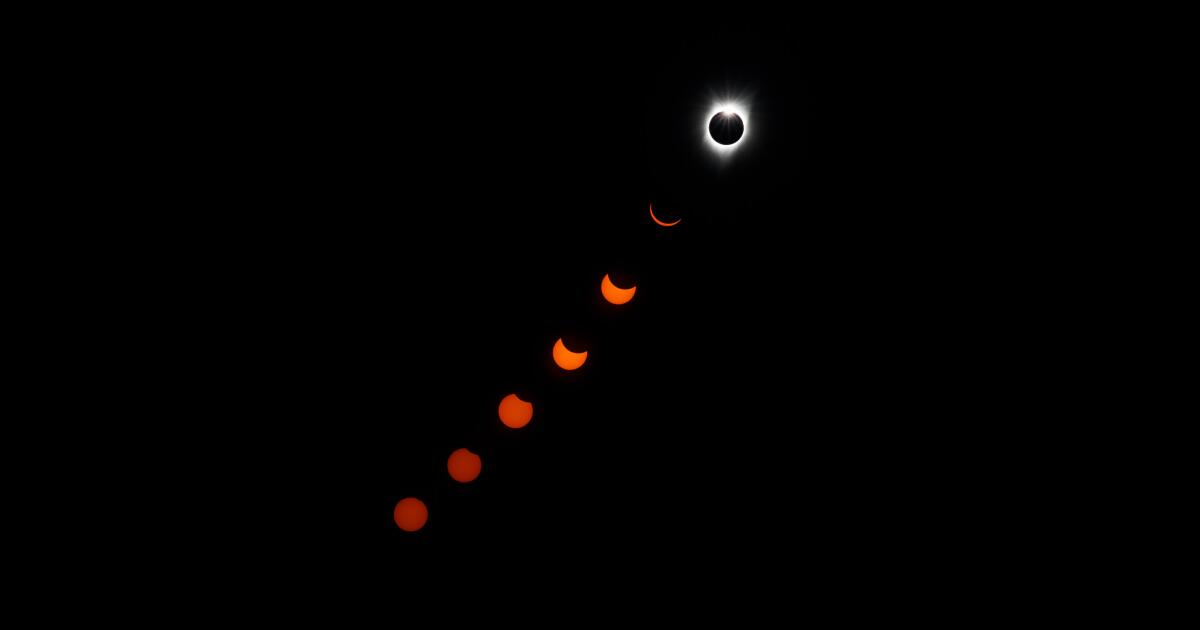
To hear Herodotus tell it, a total solar eclipse in 585 BC ended a five-year war between ancient kingdoms in present-day Turkey.
Could another total eclipse on Monday bring an end to the partisan wars in America?
The idea may sound far-fetched — until you talk with Paul Piff. The UC Irvine professor of psychology and social behavior has spent the better part of two decades researching what triggers us to set our personal needs aside and shift our focus to the greater good.
One of them, he and other scholars have found, is awe: the feeling you get when you contemplate something that is so vast and so mysterious that it forces you to reevaluate your understanding of the world.
And few things generate awe like watching the moon blot out the sun and plunge a sunny day into erie darkness.
“People talk about eclipses as one of the coolest or most mind-blowing things they’ve ever seen,” Piff said.
Paul Piff, a psychology professor at UC Irvine who studies awe, poses in Long Beach last week. He used the 2017 total solar eclipse to conduct research on what makes people feel awe and how it changes their emotional state. He’s planning another experiment based on the Monday eclipse.
(Allen J. Schaben/Los Angeles Times)
For the Great American Eclipse of 2017, Piff launched a research study that showed people engulfed by the moon’s shadow experienced more awe than their counterparts who didn’t see the sun disappear. What’s more, that sense of awe seemed to make them feel more in touch with others, more open to differing points of view, and more inclined to put someone else’s needs ahead of their own.
Piff is of the opinion that the country could use more of those sentiments this year, as a contentious presidential race threatens to turn political opponents into sworn enemies.
Awe “gives you a sense of feeling connected to something bigger than yourself, like your community, your society or your world,” he said. “Getting people to feel that way is totally vital to our species’ survival and longevity.”
Monday’s eclipse offers a fresh opportunity to assess the emotional states of the tens of millions of Americans who are expected to gather in the path of totality. Piff plans to focus on whether the celestial event will make those who experience it feel more allied with their fellow Americans who belong to a rival political party.
On Aug. 18, 2017, Poureal Long, a fourth-grader at Clardy Elementary School in Kansas City, Mo., practices the proper use of eclipse glasses in anticipation of an eclipse Aug. 21.
(Charlie Riedel / Associated Press)
Jennifer Stellar, a social psychologist who studies emotions at the University of Toronto, sees reason for optimism. She said awe is an ideal tool for trying to reduce political polarization.
Emotions like gratitude and compassion tend to pull one’s focus outward, but in those cases it’s usually redirected toward a single person, she said. Awe is unique in that “it creates a sense of interconnection, of common humanity, of collective interest.”
The community-oriented mind-set documented in the wake of the 2017 eclipse wore off within six weeks, Piff and his collaborators found.
What would it take to make it last?
If you’ve ever found yourself mired in an anger spiral, paralyzed with fear or overwhelmed by debilitating grief, you may have wondered what emotions are good for. Experts assure they serve a useful purpose.
“Negative emotions narrow your attention, get you to focus on threats. Positive emotions broaden your mind,” said psychologist Dacher Keltner, faculty director of the Greater Good Science Center at UC Berkeley.
Keltner’s lab has studied positive feelings like amusement, compassion, gratitude and love. But his favorite emotion is awe. (He even wrote a book about it called “Awe: The New Science of Everyday Wonder and How It Can Transform Your Life.”)
“Awe is destabilizing,” Keltner said. “It makes you realize your knowledge can’t explain everything.”
A person watches the moon pass between Earth and the sun during an eclipse Oct. 14, 2023, in Bryce Canyon National Park, Utah.
(Rick Bowmer / Associated Press)
Awe is also a universal emotion, expressed by people across countries and continents. No matter where we’re from, awe makes us widen our eyes and open our mouths.
The fact that it emerged in so many disparate cultures around the world is one indication of awe’s usefulness, Piff said. What’s more, societies have ritualized ways to get regular hits of awe, whether it’s walking into a majestic church or visiting the Grand Canyon.
When Piff investigates the effects of awe, he prompts study subjects to feel it by asking them to look up into the canopy of a stand of towering eucalyptus trees or by watching a slow-motion video of dye dropping into a glass of milk.
Such research by Piff and many others has found that awe makes us feel breathless, affects our heart rate, and causes goosebumps to rise on our skin. It also reduces physiological signs of stress and suppresses the brain’s default mode network, which plays a role in certain forms of self-focus.
“In all sorts of ways, individuals who experience awe experience a whole bunch of different benefits — better health, better meaning, more happiness, a greater sense of purpose in life,” Piff said.
It also fuels discovery and exploration, Keltner said.
“Awe provides the engine by which you update your knowledge,” he said. “It animates the testing of new ideas. And we need that — we need to always be updating our understanding of the world.”
Keltner has gathered stories about awe from 26 countries to look for common triggers. Nature was one of the broad categories that came up repeatedly, he said, and “big ideas” was another.
A total solar eclipse ticks both of those boxes.
A crowd looks up at the time of the solar eclipse in Salem, Ore., on Aug. 21, 2017.
(Marcus Yam / Los Angeles Times)
There’s nothing inherently mysterious about the cause of a total solar eclipse.
The moon travels around the Earth as the Earth travels around the sun, though the planes of those orbits are slightly askew. Nonetheless, at least twice a year the moon comes directly between the Earth and the sun, blocking it from view in the daytime sky. And about once every 18 months or so, this celestial alignment occurs while the moon is close enough to Earth to cover the sun completely — in other words, to totally eclipse it.
That seems like a frequent occurrence, but any particular spot on the planet will find itself in the path of totality just once every 375 years, on average. To find oneself in just the right place at just the right time may be awe-inducing all by itself.
The idea of using an eclipse as a natural experiment to study awe came to Piff in 2016, when he attended an “awe summit” and heard a UC Berkeley astronomer mention that the Great American Eclipse of Aug. 21, 2017, would be the first in nearly a century to produce a coast-to-coast path of totality.
The idea of using an eclipse as a natural experiment to study awe came to Paul Piff in 2016, when he attended an “awe summit.”
(Allen J. Schaben/Los Angeles Times)
It wasn’t immediately clear how to capitalize on the event. He could have dispatched researchers to places along the eclipse’s path so they could observe the crowds or conduct interviews. He could have distributed a survey to people who said they’d witnessed the eclipse and hoped that they would fill it out.
“None of the ideas really stuck,” Piff said.
Ultimately, he turned to Twitter.
Nickolas M. Jones, who was a graduate student at the time, had devised a way to identify Twitter users in a particular community based on the accounts they followed. That allowed him to create a sample of more than 1.5 million tweets shared over a 12-week period by more than 22,000 people in select cities along the path of totality.
Meanwhile, another graduate student named Sean Goldy took the lead in creating a custom dictionary of words that expressed awe — it included “transcendent,” “mind-blowing” and “unreal” — along with terms indicative of the community-focused outlook that awe often inspires. The dictionary was used to assess the emotional subtext of the tweets Jones amassed, as well as a sample of 6 million tweets posted on the day of the eclipse.
The researchers found that Twitter users who were positioned to witness the eclipse were more than twice as likely to use words from the awe dictionary than people who missed out on the big event.
To a lesser degree, they were also more likely to use words that expressed a collective mind-set, recognized the limits of their knowledge, and gave credence to the views of others. The research team’s statistical analysis suggested that these feelings were driven in part by the awe they felt.
In addition, the tweets gathered by Jones showed that people who injected more awe-related words into their eclipse day tweets also used language infused with outward-looking, community-minded sentiments — although the effect was short-lived.
The findings were published in the journal Psychological Science.
The moon covers the sun during the total solar eclipse in the skies over Cerulean, Ky., on Aug. 21, 2017.
(Timothy D. Easley / Associated Press)
Jones, who is now a senior postdoctoral researcher at UC Irvine, said he developed his method of geolocating Twitter users in order to gauge the effect of mass shootings.
“The effect that we find when we study negative events is pretty powerful,” he said. “I was not expecting things to pan out really well for something positive, but … it worked!”
Posts on X, as Twitter is now known, are no longer freely available to researchers. So Piff and a new set of collaborators are devising another way to gather data related to Monday’s eclipse.
They’ve already found people who said they are planning to experience totality somewhere between Mazatlan, Mexico, and Newfoundland and Labrador, Canada. They hope to entice them to answer a few questions on their phones while the world is temporarily dark, and to follow up with them for several weeks afterward.
In other experiments, Piff has had volunteers invest five minutes in a “daily intervention of awe.” Early results suggest it extends the benefits of an initial awesome experience, he said.
People gather near Redmond, Ore., to view the sun as it nears a total eclipse by the moon Aug. 21, 2017.
(Ted S. Warren / Associated Press)
“If people become a little more attentive to the awe-inspiring things around them, you would very likely get more persistent effects,” Piff said.
He said he hopes that would include the kind of mind-set shift that could help bridge the country’s increasingly toxic partisan divide.
There’s no reason why an event like the eclipse would cause people to change their party identity, Piff said, but it could make them more willing to compromise with their political opponents for the sake of a collective goal.
“Awe seems to trigger more kind, compassionate and empathic behavior,” he said. “It reminds you of the bigger things that we’re a part of.”


new video loaded: NASA Announces Artemis III Crew
transcript
transcript
NASA Announces Artemis III Crew
NASA announced the crew of Artemis III mission, which will fly to low-Earth orbit to test rendezvous and docking maneuvers with one or two lunar landers.
-
“I am excited to welcome you as the next crew in the Artemis journey to successfully return to the moon — this time to stay.” “I’m honored by the role that I’ve been given. I’m also very humbled by the task in front of us. But first and foremost, I’m grateful.” “So with that, the Artemis II crew, comrade, hands you the baton. You got the controls.” “As you know, we had a significant anomaly at our Launch Complex 36A on May 28. We’ve redoubled our efforts and are moving forward.”
By Alisa Shodiyev Kaff
June 9, 2026
Science
Santa Monica Mountains’ last steelhead trout survived the Palisades fire — and even had babies

Scientists feared the Santa Monica Mountains’ last remaining steelhead trout were dead, smothered by debris flows unleashed by the Palisades fire.
But the endangered fish surprised them: A team of biologists recently spotted 30 of the rare trout — and 21 babies — in Topanga Creek.
“There was a lot of happy dancing in the creek,” said Rosi Dagit, principal conservation biologist for the Resource Conservation District of the Santa Monica Mountains, which works with public and private landowners to conserve natural resources.
That’s because the steelhead here are endangered, at both the state and federal levels. Once, they swam in most streams of the Santa Monicas, but their numbers plummeted amid overfishing and coastal development. Increasingly frequent wildfire has further stressed their habitat. Topanga Creek, a biodiversity hot spot, is home to their last known population in the mountains that stretch from the Hollywood Hills to Point Mugu in Ventura County.
The trout that were spotted, including this one, are part of a distinct Southern California population that’s listed as endangered at the state and federal levels.
(RCDSMM Stream Team)
The California Department of Fish and Wildlife spearheaded a complex mission to rescue trout threatened by the Palisades fire that sparked in January 2025.
Time was of the essence. The fire hadn’t yet been fully contained. But rain was on the way, which would sweep massive amounts of sediment from the denuded hillsides into the water. Fish are often killed this way.
Crews stunned the fish with electricity, scooped them up in buckets, trucked them to a hatchery and ultimately moved them to Arroyo Hondo Creek in Santa Barbara County.
Within days, Topanga Creek was choked with mud. Some assumed the fish left behind were goners.
But in March, the conservation district’s team found four. The following month, when water conditions were clearer, they saw more.
“These fish continue to amaze me,” said Kyle Evans, environmental program manager for the state Department of Fish and Wildlife, who had seen the damage to the creek. “I had seen populations get wiped out in similar situations. So when I heard, I was thrilled.”
Evans surmises the fish that survived were in an area of the creek where less charred material and sediment were swept in.
“These fish likely hunkered down, were hiding under some rocks or places to try to get away from the main concentration of flow,” he said. “And luckily they weren’t buried.”
The ones that were spotted were fairly small, around 6 to 14 inches. Rainbow trout and steelhead trout are the same species, but with different lifestyles. If the fish remain in freshwater, they’ll be considered rainbows. However, they can migrate to the ocean and become steelhead, where they typically grow larger before returning to their natal waters to spawn.
Topanga Creek hasn’t fully recovered from the damage it sustained, but scientists say it’s looking better. Surveys last year were “so depressing,” Dagit said, with very few animals, and stretches that were essentially transformed into flat roads from all the sediment buildup. Some of the riparian canopy burned right down to the creek.
Then came 32 inches of rain over the last nine months, scouring out and moving sediment, creating deeper pools. Dagit said they recently found newt egg masses for the first time in years, as well as a few adult newts and many frogs. Plants that provide cover are starting to recover.
She provided photos comparing certain pools last year and this year, some dramatically transformed. In September 2025, the Shrine Pool could have been an overgrown hiking trail. This April, it was filled with shallow water.

The Shrine Pool in September 2025, left, and the same location in April 2026, right, with RCDSMM’s Isaac Yelchin donning a wetsuit.
(RCDSMM Stream Team)
Topanga Creek is home to another endangered fish, the small but hardy northern tidewater goby, often described as cute. Not long before the trout operation, Dagit led a rescue of hundreds of these fish too. Many were repatriated to the lagoon at the mouth of the creek in a moving ceremony last June.
There’s still the matter of what to do with the trout that were moved to Santa Barbara County last year. Evans would like to bring them home to the Santa Monicas at some point, but isn’t sure if it will happen. On one hand, they could bolster the small, genetically isolated surviving population. On the other, they might inadvertently bring in a disease or bacteria. There is some time to decide. Evans estimates the creek still needs to recover for two to three more years.
For now, the fish are functioning fine in their adopted creek. Experts worried the trauma wrought by the move would disrupt their spawning process, but they had babies that spring. This year, they spawned again.

The Pacifica Municipal Pier was shut down and taped off Thursday after city workers noticed cracks running through the landmark structure and concrete chunks falling into the ocean.
It’s just one of many coastal California structures that have recently crumbled under pressure from a rising and relentless ocean.
Officials from the small, beach city south of San Francisco said the pier was closed due to “cracking, separation, and displacement of the concrete walkway and structural elements.”
It will stay closed while structural engineers asses its safety.
Photos taken by city employees show a wide crack that runs from top to bottom and across the structure as well. Other photos show a large horizontal crack under the foundation of a small restaurant on the pier, the Chit Chat Cafe.
The cafe was also shut down.
This is not the first time the 53-year-old pier has shown signs of stress. In 2021, part of it was shut down after handrails along the edge collapsed. And in 2023, after a series of storms pummeled the Central California coast, damaging parts of the pier, the structure was partially closed for more than year.
Those same storms caused extensive damage in Aptos and Capitola, 70 miles south, where piers and waterfront infrastructure were swept away or damaged.
In 2024, a 150- to 180- foot section of the Santa Cruz wharf was ripped off by powerful waves.
At least 10 of the state’s dozens of coastal public piers were closed for part or all of 2024 due to structural damage sustained in winter storms since 2022. At least five others have longer-term upgrades planned to address structural issues.
“These things are costly to maintain,” said Zach Plopper, senior environmental director at Surfrider. “They are a part of our California coastal culture in many ways, but we’re going to need to reckon with, one, the state that they’re in, and two, the continuous and worsening threats they’re going to experience,”
He said most of the piers were constructed in the early 1900s, and they weren’t built to withstand decades of rough seas, storms and rising sea level.
“With this incoming El Niño, which is forecasted to be significant, and this marine heat wave we’re in the midst of, we’re kind of in uncharted waters as far as what this winter could bring in terms of storms and swells to the California coast, and we’re likely going to see a lot more damage,” he said. “Not just piers, but roads and other coastal infrastructure up and down the state.”
There was no storm in Pacifica earlier this week, so no single event could be blamed for the destruction.
However, a 2025 report from an outside engineering firm, GHD, found that several sections of the pier were in “poor” or “serious” condition, and they recommended closure before anticipated storms or events that could “subject the piles to high winds, swells and large waves.”
The firm found several areas of the pier where concrete was missing and rebar was exposed and corroding.
“The pier has continued to experience high winds and large waves in a harsh marine environment,” the engineers wrote in the report, noting that continuous exposure to seawater or marine spray was “detrimental” to the structure.
A 2023 city report estimated it would cost $19 million to repair.
That same year, a state law was enacted to require local governments along the California coast to plan for sea level rise in the coming decades.
Sea level has risen some 8 inches, on average, along the coast in the past 150 years, Plopper said, and researchers anticipate another foot in the next 25 years.
“We’re going to see profound shifts on our coastline, none that we have ever experienced before, and building static structures on the coast just doesn’t work all that well,” he said. “We’re going to have to make some really hard decisions.”
-
 Sports2 minutes ago
USC freshman linebacker Talanoa Ili joins lawsuit seeking to upend new NIL system
-

 World10 minutes ago
Who has the most and fewest judges in the EU?
-
 News30 minutes ago
In Nevada, Trump’s policies are making things tough for Republican Gov. Joe Lombardo
-

 New York2 hours ago
This Parking Spot Is Free. Should It Be?
-

 Los Angeles, Ca2 hours ago
O.C. Uber customer says driver asleep in Tesla on 405 Freeway
-

 Detroit, MI2 hours ago
One person dead, another in custody following shooting in Detroit, police say
-

 San Francisco, CA3 hours ago
Bay Area artists celebrate Wong Kim Ark’s legacy in San Francisco’s Chinatown
-

 Dallas, TX3 hours ago
Plano’s new tax increment reinvestment zone could allocate $700M for Dallas Stars arena

