Science
Sea urchins made to order: Scripps scientists make transgenic breakthrough

Consider the sea urchin. Specifically, the painted urchin: Lytechinus pictus, a prickly Ping-Pong ball from the eastern Pacific Ocean.
The species is a smaller and shorter-spined cousin of the purple urchins devouring kelp forests. They produce massive numbers of sperm and eggs that fertilize outside of their bodies, allowing scientists to watch the process of urchin creation up close and at scale. One generation gives rise to the next in four to six months. They share more genetic material with humans than fruit flies do and can’t fly away — in short, an ideal lab animal for the developmental biologist.
Scientists have been using sea urchins to study cell development for roughly 150 years. Despite urchins’ status as super reproducers, practical concerns often compel scientists to focus their work on more easily accessible animals: mice, fruit flies, worms.
Scientists working with mice, for example, can order animals online with the specific genetic properties they are hoping to study — transgenic animals, whose genes have been artificially tinkered with to express or repress certain traits.
Researchers working with urchins typically have to spend part of their year collecting them from the ocean.
“Can you imagine if mouse researchers were setting a mousetrap every night, and whatever it is they caught is what they studied?” said Amro Hamdoun, a professor at UC San Diego’s Scripps Institution of Oceanography.
UC San Diego professor Amro Hamdoun holds a painted urchin. His breakthrough creating the creatures could lead to developments in science and medicine.
(Sandy Huffaker / For The Times)
Marine invertebrates represent about 40% of the animal world’s biological diversity yet appear in a scant fraction of a percentage of animal-based studies. What if researchers could access sea urchins as easily as mice? What if it were possible to make and raise lines of transgenic urchins?
How much more could we learn about how life works?
“You know how during the pandemic, everyone was making sourdough? I’m not good at making sourdough,” Hamdoun said recently at his office in Scripps’ Hubbs Hall. He set his sights instead on a project of a different sort: a new transgenic lab animal, “a fruit fly from the sea.”
In March, Hamdoun’s lab published a paper on the bioRxiv preprint server demonstrating the successful insertion of a piece of foreign DNA — specifically, a fluorescent protein from a jellyfish — into the genome of a painted urchin that passed the change down to its offspring.
The result is the first transgenic sea urchin, one that happens to glow like a Christmas bulb under a fluorescent light. (The paper has been submitted for peer review.)
The animals are the first transgenic echinoderms, the phylum that includes starfish, sea cucumbers and other marine animals. Hamdoun’s mission is to make genetically modified urchins available to researchers anywhere, not just those who happen to work in research facilities at the edge of the Pacific Ocean.
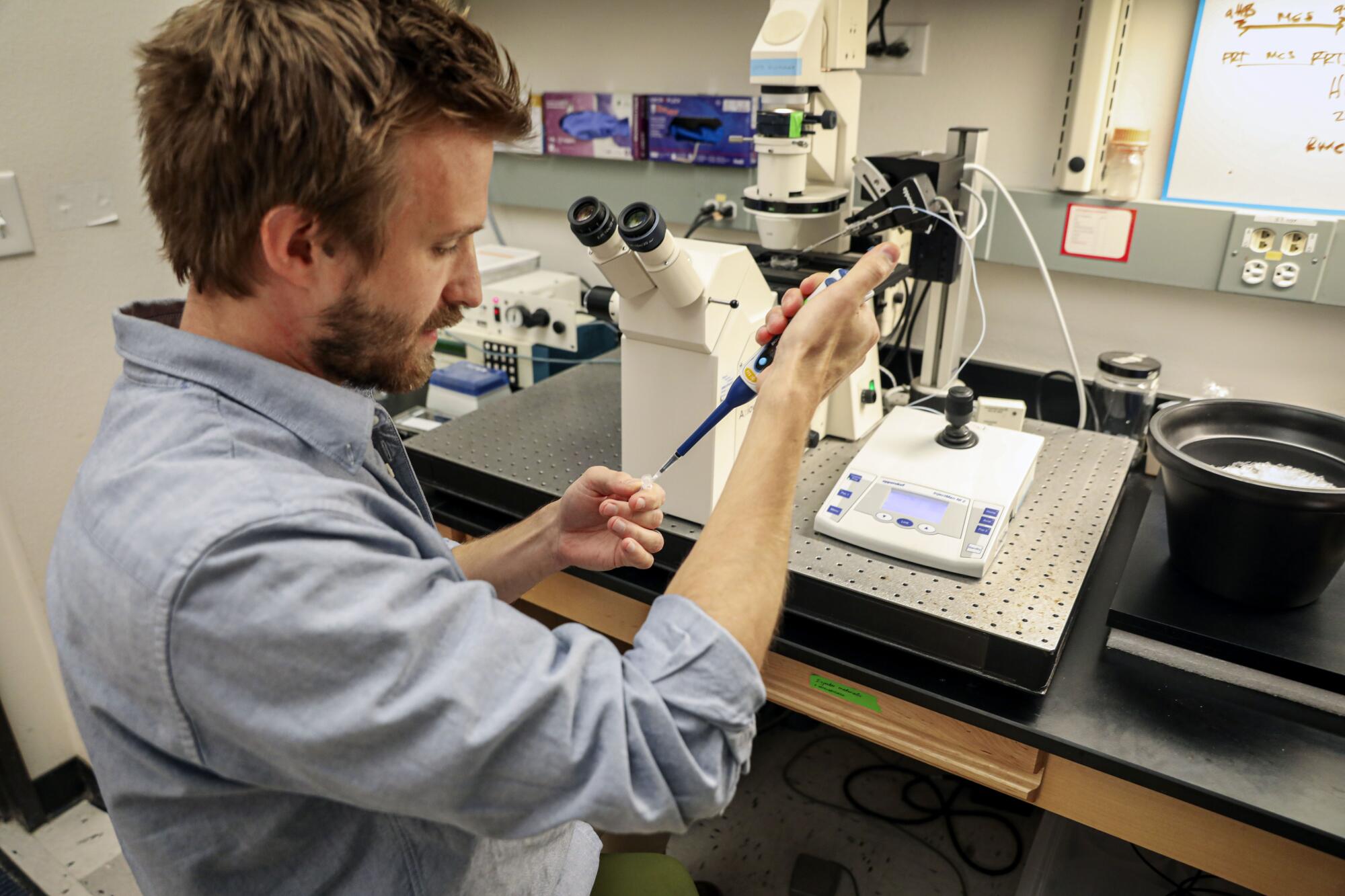
Postdoctoral researcher Elliot Jackson works with sea urchin eggs in a lab at Scripps.
(Sandy Huffaker / For The Times)
“If you look at some of the other model organisms, like Drosophila [fruit flies], zebrafish and mouse, there are well-established resource centers,” said Elliot Jackson, a postdoctoral researcher at Scripps and lead author of the paper. “If you want a transgenic line that labels the nervous system, you could probably get that. You could order it. And that’s what we hope we can be for sea urchins.”
Being able to genetically modify an animal supercharges what scientists can learn from it, with implications far beyond any individual species.
“It will transform sea urchins as a model for understanding neurobiology, for understanding developmental biology, for understanding toxicology,” said Christopher Lowe, a Stanford professor of biology who was not involved in the research.
The lab’s breakthrough, and its focus on making the animals freely available to fellow scientists, will “allow us to explore how evolution has solved a lot of really complicated life problems,” he said.
Researchers tend to study mice, flies and the like not because the animals’ biology is best suited to answer their questions but because “all the tools that were necessary to get at your questions were built up in just a few species,” said Deirdre Lyons, an associate professor of biology at Scripps who worked with Hamdoun on early research related to the project.
Expanding the range of animals available for sophisticated lab work is like adding colors to an artist’s palette, Lyons said: “Now you can go get the color that you really want, that best fits your vision, rather than being stuck with a few models.”
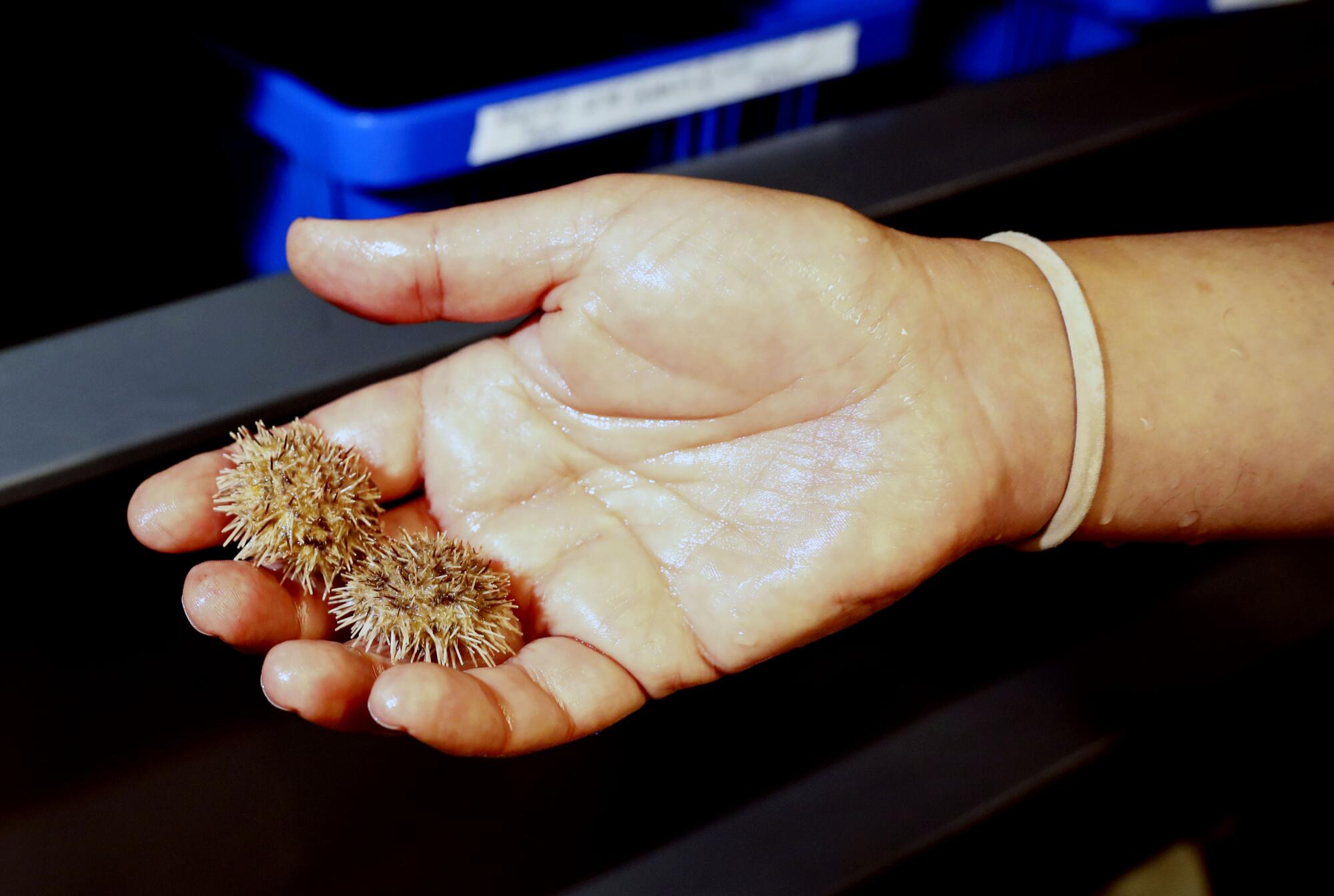
Painted urchins and humans live vastly different lives but genetically are quite similar.
(Sandy Huffaker / For The Times)
On the ground floor of Hamdoun’s office building is the Hubbs Hall experimental aquarium, a garage-like space crammed with tanks full of recirculating seawater and a motley assortment of marine life.
On a recent visit, Hamdoun reached into a tank and gently dislodged a painted urchin. It scooched with surprising speed across an outstretched palm, as if exploring alien terrain.
The last common ancestor of L. pictus and Homo sapiens lived at least 550 million years ago. Despite the different evolutionary paths we’ve since traveled, our genomes reveal a shared biological heritage.
The genetic instructions that drive the transformation of a single zygote into a living body are strikingly similar in our two species. Specialized systems differentiating from a single fertilized egg and the translation of a jumble of proteins into a singular living thing — on the cellular level, all of that proceeds in much the same way for urchins and people.
These animals are “really fundamental to our understanding of all of life,” Hamdoun said, placing the urchin back in its tank. “And historically, very inaccessible genetically.”
The experimental aquarium was built in the 1970s, when scooping life from the sea was the only way to acquire research specimens. A few floors up in Hubbs Hall, Hamdoun led the way into the urchin nursery — the first large-scale effort to raise successive generations of the animals in a laboratory. At any given moment, the team has 1,000 to 2,000 sea urchins in various stages of development.
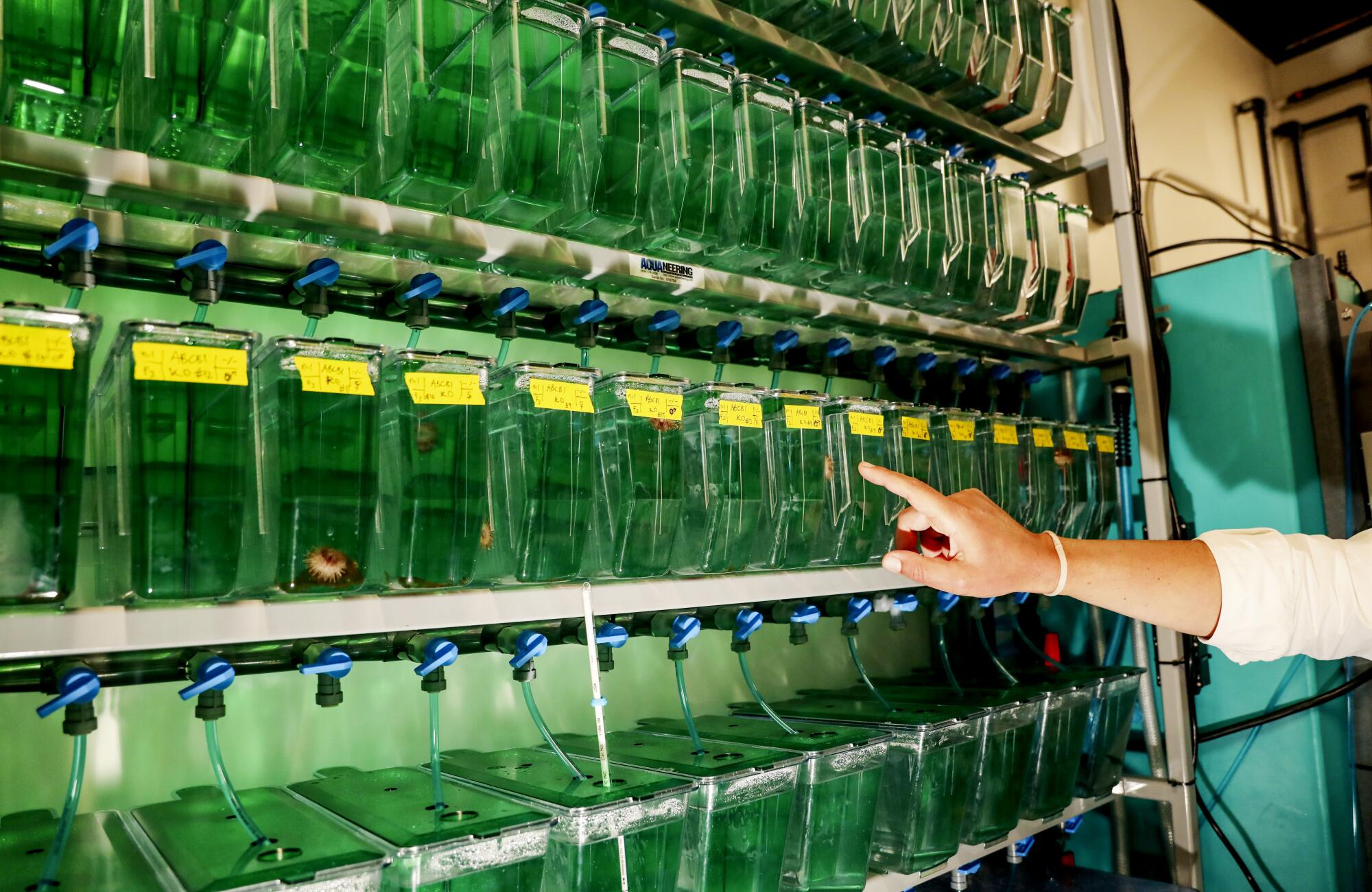
Hamdoun points to transgenic sea urchins his lab is raising at Scripps.
(Sandy Huffaker / For The Times)
Row upon row of tiny plastic tanks stood against a wall, each containing a lentil-size juvenile urchin. A strip of tape on each tank noted the animal’s genetic modification and date of fertilization. On some, a second bit of tape indicated animals that had the modification in their sex cells’ DNA, meaning it could be passed down to offspring. (For this reason, the lab keeps its urchins scrupulously separate from the wild population.)
“One of the big questions in all of biology is to understand how the series of instructions in the genome gives you whatever phenotype you want to study,” Hamdoun said — essentially, how the string of amino acids that is an animal’s genetic code gives rise to the characteristics of the living, respiring creature. “One of the fundamental things you have to do is be able to modify that genome, and then study what the outcome is.”
He pointed to a tank containing a tiny urchin from whose genetic code the protein ABCD1 has been snipped.
ABCD1 acts like a bouncer, Hamdoun explained, parking along the cell membrane and ejecting foreign molecules. The protein’s action can preserve the cell from harmful substances but can sometimes work against an organism’s best interest, as when it prevents the cell from absorbing a necessary medication.
Researchers using urchins in which that protein no longer works can study the movement of a molecule through an organism — DDT, for example — and measure how much of the substance ends up in the cell without the confounding interference of ABCD1. They can reverse-engineer how big a role ABCD1 plays in preventing a cell from absorbing a drug.
One biology professor said Scripps’ work will transform sea urchins as a model for research.
(Sandy Huffaker / For The Times)
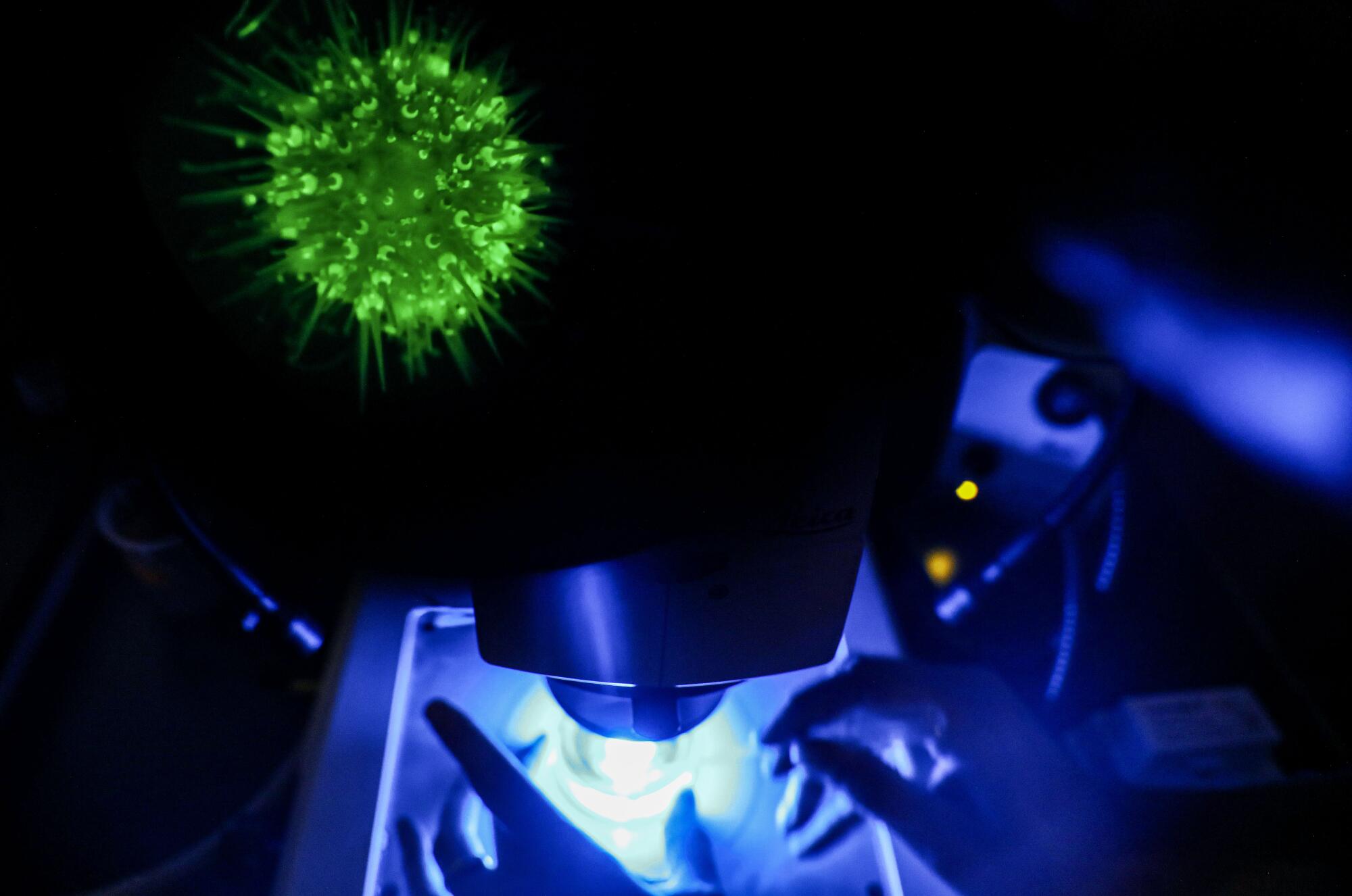
And then there are the fluorescent urchins.
“The magic happens in this room,” Jackson said, walking into a narrow office with $1 million worth of microscopes at one end and a decades-old hand-cranked centrifuge bolted to a table at another.
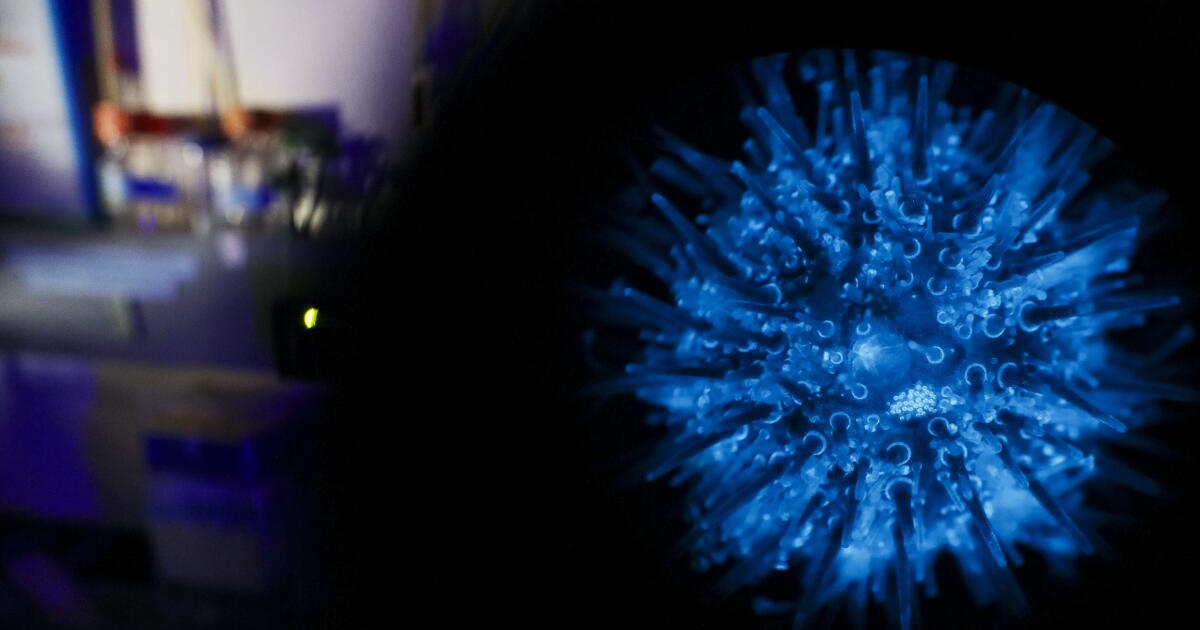
He placed a petri dish containing three pencil-eraser-size transgenic urchins under a microscope. At 120 times its size, each looked like the Times Square New Year’s Eve ball come to life — a glowing, wiggling creature of pentamerous radial symmetry.
Fluorescence is not just an echinoderm party trick. Lighting up the cells makes it easier for researchers to track their movement in a developing organism. Researchers can watch as the early cells of a blastula divide and reorganize into neural or cardiac tissue. Eventually, scientists will be able to turn off individual genes and see how that affects development. It will help us understand how our own species develops, and why that development doesn’t always proceed according to plan.
The lab has “done a great job. It’s really been welcomed by the community,” said Marko Horb, senior scientist and director of the National Xenopus Resource at the University of Chicago’s Marine Biological Laboratory.
Horb runs the national clearinghouse for genetically modified species of Xenopus, a clawed frog used in lab research. Funded in part by the National Institutes of Health, the center develops lines of transgenic frogs for scientific use and distributes them to researchers.
Hamdoun envisions a similar resource center for his lab’s urchins. They’ve already started sending tiny vials of transgenic urchin sperm to interested scientists, who can grow bespoke urchins with eggs acquired from Hamdoun’s lab or another source.
Hamdoun vividly recalls the time he spent earlier in his career trying to track down random snippets of DNA necessary for his research, the disappointment and frustration of writing to professors and former postdocs only to find that the material had long been lost. He’d rather future generations of scientists spend their time on discovery.
“Biology is really interesting,” he said. “The more people can get access to it, the more we’re going to learn.”
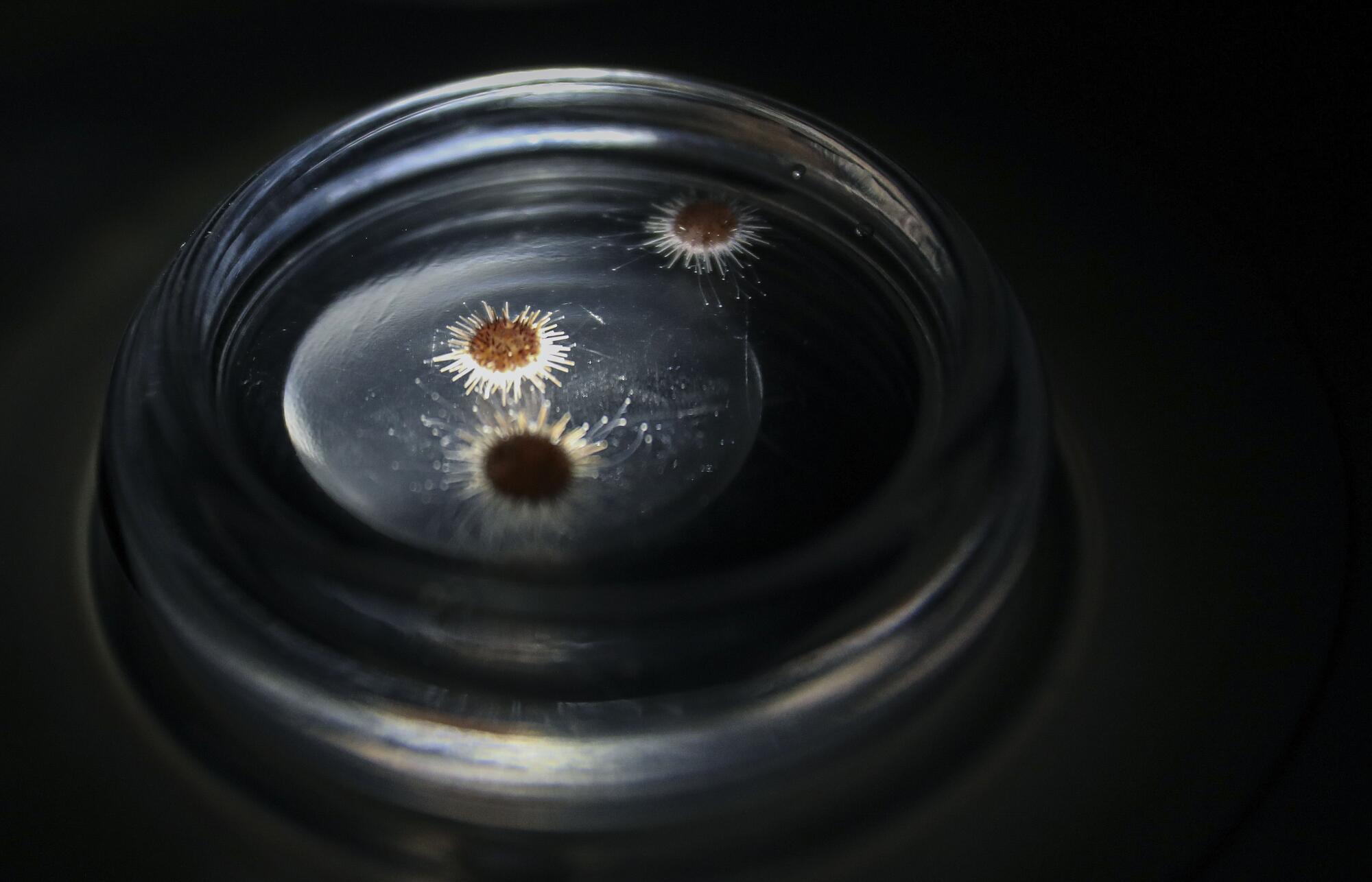
Three transgenic sea urchins in a petri dish.
(Sandy Huffaker / For The Times)



Few substances are as deeply woven into everyday life as alcohol. It is a fixture at holiday celebrations, work-related social gatherings, sporting events, airports, and brunch or dinner tables. All demonstrate how deeply alcohol has become embedded in social customs and cultural traditions.
Yet alcohol contributes to millions of deaths globally each year and is linked to cancer, liver disease, unintentional accidents, violence and, importantly, dependence and addiction. Despite this, the disconnect between alcohol’s cultural role and its serious health burden is striking. An estimated 2.3 billion people worldwide consume alcohol.
As a physician working in addiction medicine, I regularly care for patients whose alcohol use affects nearly every organ system. It is often not until these patients end up admitted to the hospital that they learn the effects of alcohol on various parts of their body besides their liver.
Newer evidence challenges assumptions about what was long considered “safe drinking.” Even moderate drinking carries risk and is not as harmless as people, including experts, once thought.
Many people associate alcohol risk primarily with addiction or dangerous behaviors such as driving while intoxicated. However, its effects extend far beyond this, into nearly every aspect of a person’s well-being.
While alcohol may transiently improve mood and ease social anxiety, long-term alcohol use can lead to a worsening of mood, cognition and sleep, which can further compound use.
A 2021 literature review found that consuming approximately two standard drinks roughly doubles the odds of sustaining injuries — with or without a vehicle involved. The review also found that heavy episodic (binge) drinking can increase the risk of injury by 50-fold, depending on the amount of alcohol consumed and the type of injury. While alcohol’s effects on the liver are well known, it can also lead to gastrointestinal complications and heart disease
The World Health Organization estimates that 2.6 million deaths each year are attributable to alcohol, accounting for nearly 1 in every 20 deaths worldwide.
While many people recognize the risks of alcohol addiction, people are generally much less aware of the links between alcohol use and cancer risk.
The World Health Organization classifies alcohol as a Group 1 carcinogen — the same category as tobacco and asbestos. In 2025, the U.S. surgeon general emphasized that alcohol increases the risk of at least seven cancers, including cancers of the breast, colorectal, liver, oral, esophagus and larynx. An advisory called for updated warning labels.
Yet fewer than half of Americans recognize alcohol as a risk factor for cancer, particularly for cancers such as breast cancer that are not commonly associated with alcohol use.
Throughout the 1990s and early 2000s, observational studies suggested that moderate alcohol consumption might offer cardiovascular benefits. Over the past decade, however, higher-quality studies have challenged these findings, suggesting that much of the apparent benefit may have reflected differences in the health and lifestyles of moderate drinkers rather than a protective effect of alcohol itself.
Current evidence increasingly suggests that even low levels of alcohol may increase cancer risk.
Federal guidelines acknowledge that adults should “consume less alcohol for better overall health.” However, the most recent version of the “Dietary Guidelines for Americans,” updated in January, removed the previous recommendation to limit intake to no more than one drink per day for women and two for men. It also omitted explicit discussion of alcohol’s links to cancer.
These changes have drawn criticism from public health experts, who argue that the revised language plays down the growing evidence of alcohol-related harms and provides less specific guidance to consumers. The current administrator of the Centers for Medicare & Medicaid Services characterized alcohol as a “social lubricant” that brings people together, rather than emphasizing its well-established health risks.
This may be true physiologically, at least temporarily, but obscures the fact that relying on it as a social lubricant can lead to chemical and psychological dependency. In my view, statements to that effect are shortsighted, prioritizing short-term social effects over more insidious and long-term issues, including addiction.
While many dangerous mind-altering substances are hidden from public perception, alcohol is often placed at the center of it – a trend that shows no sign of changing imminently.
Further, large companies often profit from ads that appeal to young people.
Looking back at the history of tobacco smoking provides some helpful insights. In 1965, 42.4% of the U.S. population smoked. By 2022, that figure had dropped to 11.6%.
This steep decline did not happen because of a single intervention, but through decades of accumulating scientific evidence, public education campaigns, warning labels, restrictions on advertising, smoke-free policies, higher tobacco taxes and shifts in social norms. Together, these efforts transformed smoking from a widely accepted social behavior into one broadly recognized as a major health risk and correspondingly, less socially accepted.
Although alcohol consumption has modestly declined in recent years, it remains deeply embedded in social life in ways cigarette smoking no longer is.
People often assume that if a substance is legal, common and widely socially accepted — even encouraged — it must also be safe. But public health history suggests those assumptions can and should change.
Emma Fenske is an addiction medicine fellow and internal medicine physician at Oregon Health & Science University. This article was produced in partnership with the Conversation.

The air near the Lineage refrigerated warehouse fire in Boyle Heights carried astronomically high levels of smoke and soot, surpassing some of the worst air pollution during the Los Angeles County fires in January 2025, according to preliminary data from air officials.
The fire spewed thick black smoke for days. From downtown Los Angeles to the San Gabriel Valley, tens of thousands were enveloped in unhealthful levels of smoke, even as some local officials told residents that the air posed no danger.
As the days wore on, worst off were communities nearest the blaze. On June 19, three days after the facility ignited, a temporary air quality monitoring station at Eastman Elementary in unincorporated East Los Angeles measured an extremely hazardous 755 micrograms per cubic meter of fine particles for more than an hour, according to the South Coast Air Quality Management District.
For comparison, a Caltech air monitor in Pasadena recorded about 650 micrograms per cubic meter during the Eaton fire.
These high levels of fine particles, known as PM 2.5, probably resulted in the surge of residents into local emergency rooms during the fire, according to local health officials. But even now with the smoke gone, people still have not been told what chemicals they were breathing in during the weeklong ordeal.
Michael Jerrett, an environmental health professor at the UCLA Fielding School of Public Health, said his concern is the composition of materials emitted when the building burned.
“These contain many particularly toxic components,” Jerrett said, “and we know little about how these mixtures affect health.”
There is no completely safe level of fine particulate pollution, he noted, meaning higher concentrations are always worse.
During the 2025 L.A. County fires, local air officials announced that several monitors downwind had detected elevated levels of brain-damaging lead and cancer-causing arsenic from toxic paint and construction materials used in older homes.
The Lineage warehouse, built in 2018, is likely to contain different materials of concern. Thick insulation foam required for a massive refrigeration operation, solar panels and refrigerants were burned, leaving many residents on edge.
Even though three public agencies conducted air monitoring, the picture is still murky.
“[Public officials] are speaking with a lot of confidence but not a lot of information,” said mark! Lopez, a community organizer with East Yard Communities for Environmental Justice. “We’ve gotten in the room with folks to discuss where the gaps lie and where assumptions are being made. And I think they are realizing these agencies supposed to protect our air and our health aren’t as reliable as they thought they were.”
In response to the Boyle Heights fire, the South Coast air district deployed a mobile monitoring vehicle to screen for toxic substances in the community near the fire, according to Nahal Mogharabi, a spokesperson for the air district. It found increased levels of bromine, a chemical commonly found in fire retardant, and chlorine, often released from burning plastic. Both were below short-term health-based exposure thresholds.
Toxic metals, including lead and arsenic, were not elevated, according to air district data.
“That was the reassuring piece, that they were not picking up any of the metals,” said Dr. Nichole Quick, chief medical advisor for the Los Angeles County Department of Public Health. “But … that smoke is unhealthy. “You don’t want to be breathing it, regardless.”
The U.S. Environmental Protection Agency set up air monitors around the perimeter of the facility to test for toxic air contaminants, has the results and has not made them public. Julia Giarmoleo, an EPA spokesperson, said the monitors did not detect elevated metals, but would not provide a copy of the data without a federal records request.
The Los Angeles Fire Department’s hazardous material team also tested for ammonia, which is used in refrigeration, and hydrogen fluoride, a toxic chemical that could be released by burning lithium-ion batteries and solar panels.
Fire officials previously said they measured low levels of hydrogen fluoride on the second day of the fire. But the department would not answer questions about its air monitoring. It also told a reporter to submit a public records request.
It remains unclear whether any agency has tested for hydrogen cyanide or isocyanates, highly toxic gases that could be released from burning chemical-laden insulating foam inside the building.
“The real issue is what monitoring has not been done to protect the fence-line community from the air toxics,” said Jane Williams, executive director of California Communities Against Toxics.
Without the EPA or LAFD data, what is known of the smoke’s toxicity rests on the air district’s mobile monitoring.
Jerrett, the UCLA researcher, said that is not ideal for understanding the kind of plume released by the Boyle Heights fire, which rapidly changed direction with the wind.
“This can in some instances lead to levels that look low, but they are resulting from a mismatch between the location of the vehicle and the plume,” he said.
The Boyle Heights blaze, similar to the Eaton and Palisades fires, has revealed the region’s air monitoring can’t always tell people what they’ve been exposed to in a disaster.
“We do need a better monitoring system in place,” he said.
Local officials are now shifting their focus to the rancid odors from millions of pounds of rotting food in the ruined wing of the warehouse. Decomposing food can release hydrogen sulfide, a toxic gas synonymous with landfills and garbage. Lineage hired contractors who are measuring this noxious gas and other pollution. Their data indicate they have not detected hydrogen sulfide.
As Lineage workers haul the rotting food to local landfills, they are using deodorizing mist and have discussed using shrink wrapping to suppress the stench and minimize issues for nearby homes.
At this point, the odors are believed to be an inconvenience rather than a public health threat, according to Quick, the county medical advisor. She said running air purifiers may help to reduce odors indoors.
“It’s very important for folks to understand that the odors themselves do not indicate any dangerous levels of toxins, mold, bacteria, and so forth,” Quick said. “But the odors are a public nuisance.”
The air district is still encouraging residents to report odors to its online complaint system or by calling (800) 288-7664.

Federal employees who were axed during waves of cuts by the Trump administration have fought back against the dismantling of a key climate science website, Climate.gov, and put up a new site, Climate.us, that can now do everything the original did.
The site, with millions of users each year, was known for colorful charts that anyone could freely download and that simplified giant sets of data, such as temperature readings. Now it refers to another page and is no longer being updated.
Daniel Swain, a UC Agriculture & Natural Resources climate scientist, called the resources available at Climate.gov “the most efficacious dollars spent by NOAA on public-facing science, possibly ever.” He has used graphics from the former website on his popular weather blog.
“I am a terrible artist or illustrator. It would be very bad if I had to create those on my own.” Swain said. The website didn’t just make graphics that were beautiful, he said, they were accurate and reliable because of the network of researchers who fact-checked them.
Rebecca Lindsey was the editorial lead and program manager for Climate.gov until February 2025, when her position at the National Oceanic and Atmospheric Administration was eliminated by the Elon Musk-led Department of Government Efficiency, or DOGE. She explained that the online resource was “a bridge between scientists, data and the public.”
Lindsey and her team have now rebuilt the bridge piece by piece, if just a bit further downstream.
The team is made of the same editorial and technical staff that ran Climate.gov. It’s paid for through a crowdfunding campaign and one large, anonymous donation.
The group has raised some $380,000, about $100,000 of which came in the last week. They also have recruited 80 scientists who are willing to volunteer as subject matter experts and fact checkers. It’s enough to keep the work going through February while they seek more long-term funding.
The first iteration of Climate.us went online in 2025 to keep the last 15 years of work from the government website available. The newest version restores the full function of the previous website.
For Californians, the timing could be important.
“We’re headed for a very strong El Niño event that will have significant implications for Southern California,” Swain said. “Climate.gov and the scientists behind it did a great job walking people through the last one, and I would expect that’s the case this time as well.”
Climate.gov excelled at tapping into a pool of academic experts to explain what was happening in nearly real time. This allowed the public to see how events such as wildfire, drought or large weather patterns such as El Niño were shaping their lives when they needed the information most. Research from academic institutions, by contrast, can take years to publish results from major natural disasters.
Swain emphasized that cuts to resources that give context to hard-to-interpret data is not just a loss for the research community.
“It’s getting more and more difficult for the American public to access the science and the scientists that their tax dollars have supported for over half a century,” he said.
With the revival of Climate.us, Swain said he plans to directly use the site and its graphics to keep Californians connected to the world of climate science.
-

 Augusta, GA17 seconds ago
As temps rise, Augusta officials open May Park cooling center
-

 Washington, D.C2 minutes ago
What’s that noise? What you need to know about D.C. flyovers Friday and Saturday – WTOP News
-

 Cleveland, OH8 minutes ago
Extreme heat warning ends Friday evening: What to expect
-

 Austin, TX15 minutes ago
Texas May Have the Best Defensive Back Class in America
-

 Alabama18 minutes ago
American Village to host Alabama’s official America 250 celebration in Montevallo
-
Alaska23 minutes ago
How the Trump-Putin summit in Alaska spawned the Kremlin’s myth of the ‘spirit of Anchorage’ — and why it collapsed — Meduza
-

 Arizona30 minutes ago
Your language, your news, sign up for La Voz newsletter
-

 Arkansas33 minutes ago
Boating expert shares lessons from fatal crash as Fourth of July crowds hit Arkansas lakes

