Science
Next to Joshua Tree National Park, a mining company is staking its claim for rare earth minerals


An Australian company has launched a rare earths mining project just outside Joshua Tree National Park in critical desert tortoise habitat, an area the company’s director refers to as an “emerging heavy rare earth district.”
The company, Dateline Resources Ltd., says that historical sampling of the area in the Pinto Mountains south of Twentynine Palms found enrichment in elements key to powering electric vehicles, wind turbines and defense systems.
The United States depends heavily on China for its supply of these critical minerals, a major national security vulnerability the Trump administration has sought to address through a series of regulatory changes and financial incentives aimed at shoring up domestic production.
The desert tortoise, as seen in Music Valley in the Pinto Mountains, is listed as threatened under the Endangered Species Act due to habitat loss and predation.
(Gary Coronado / For The Times)
The project is in its early stages, and it’s unclear whether further testing will confirm the presence of rare earth elements across a broad enough area to warrant extracting them. The site is roughly 100 miles southwest of the nation’s only fully functional rare earths mine — Mountain Pass operated by MP Materials, in which the U.S. Department of Defense holds a 15% stake.

It’s also steps from Joshua Tree National Park, one of the nation’s most beloved desert getaways where about 3 million people visit annually. The 1,200-square-mile park and the public lands that surround it are home to sensitive plants and wildlife that environmentalists say would be harmed by a major mining project that could deplete water supplies, draw traffic and generate toxic waste.
“This is truly one of the most iconic landscapes in America,” said Chance Wilcox, California desert program manager for the National Parks Conservation Assn., as he stood atop a rocky slope within the project footprint on Friday.
Beside him, a wooden stake marked the corner of a mining claim. About 100 feet away, a metal post denoted the park’s boundary. In the valley below sat the fee booth for the east entrance.
If mining were to go ahead here, visitors would likely be able to see the activity while driving into the park, Wilcox pointed out. “It just emphasizes this company’s blatant disregard for our nation’s crown jewels,” he said.
Dateline did not return messages seeking comment on the project. The company also operates the Colosseum Mine in the nearby Mojave National Preserve, which the Trump administration has touted as pivotal to its efforts to develop a homegrown critical minerals supply chain.
Dateline first announced the venture — the Music Valley heavy rare earths project — late last month, saying it had acquired 57 claims totaling 1,140 acres and had also invested $1 million in Fermi Critical Minerals Inc., an American company that holds uranium and rare-earths projects in multiple western states. Dateline later broadened the footprint by staking an additional 969 claims covering 19,380 acres, a subsequent release states.

Twentynine Palms Highway looking west runs through downtown on Friday in Twentynine Palms, Calif.
(Gary Coronado / For The Times)
The company now holds claims over a roughly 32-square-mile area, the vast majority within the Bureau of Land Management’s jurisdiction.
U.S. Geological Survey geologists first identified rare earth mineralization in the Music Valley area in 1954, with sampling reporting enrichment in dysprosium, terbium, yttrium and ytterbium, Dateline Resources said in a press release. The company is now training modern exploration techniques on outcroppings of a 1.8-billion-year-old type of metamorphic rock called Pinto gneiss.
While rare earths will be the primary focus, exploration will also assess the potential for gold mining — the area is dotted with old, small-scale adits and shafts.
The project is located in what’s known as an area of critical environmental concern. The U.S. Fish and Wildlife Service has deemed the sweeping landscape to be crucial to the survival of the Mojave desert tortoise, which is endangered in California thanks to a stew of threats including development, disease, raven predation and climate change.
The land abutting the Pinto Mountains Wilderness is also home to badgers, bighorn sheep and Mojave fringe-toed lizards. Massive yuccas and barrel cacti stud its steep slopes.

A chuckwalla lizard suns itself on a rock in the Pinto Mountains.
(Gary Coronado/For The Times)
On Friday, desert iguanas and whiptails scampered across an access road, portions of which wind through the national park. A chuckwalla sunned itself on a boulder. Nearby, a desert tortoise had emerged from its burrow to munch on some grass — a rare sight that elicited a whoop of joy from Wilcox. “This is a really special place,” he said.
If the area proves to be a valuable source of heavy rare earth elements, it would be significant as the U.S. has none, said Daniel O’Connor, co-founder and chief executive of Rare Earth Exchanges, a website that covers the global rare earths market. Mountain Pass primarily produces light rare earth elements, which are typically more abundant.
“Our entire war machinery — missiles, radar, fighter jets — all need these heavy rare earths,” O’Connor said.
Still, he said, even if the U.S. were to start producing heavy rare earths, the country would likely remain reliant on China to process them — a complex, multi-stage undertaking that involves chemically separating the elements from ore. Companies controlled by the Chinese treasury currently separate and refine an estimated 90% of the world’s supply of rare earth elements, and about 90% of the specialized magnets they are used to create are also manufactured in China, he said.

A mural illustrating miners in the Dirty Sock Camp is painted on a wall in downtown Twentynine Palms, Calif.
(Gary Coronado / For The Times)
O’Connor described the Music Valley project as early-stage and speculative, pointing to a mining tradition dating back to the Wild West in which prospectors tout samples that show heavy concentrations of minerals in a bid to loosen investors’ wallets. There’s no way to know how widespread or systematic those concentrations are without technical reports disclosing a project’s mineral contents and quality, he said. Dateline does not yet appear to have released any such report, which are industry standard, he said.
Rare earths mining typically involves pulling out ore with jackhammers or dynamite and grinding it down before chemically treating it — processes that consume a lot of energy, generate toxic waste and can unleash radiation that’s often present in the ore, he said.
“It’s hard to think of a worse place for a massive industrial project than sensitive desert tortoise habitat on the very edge of Joshua Tree National Park,” wrote Brendan Cummings, conservation director for the Center for Biological Diversity, in an email.
A buildout of the claims could end public access to the area and permanently scar the landscape, drawing traffic and light pollution and harming springs and groundwater stores, he said. Given those potential impacts, he is skeptical that the developers could lawfully be granted the necessary federal, state, and local approvals to proceed.
Conservationists also point to Dateline’s history operating the Colosseum Mine as a source of concern, saying the company flouted National Park Service rules and damaged the surrounding landscape.
“They don’t respect public lands, national parks or the law, so there’s every reason to be deeply concerned about this proposal,” said Rep. Jared Huffman (D-San Rafael), the ranking member on the House natural resource committee who said the project “has red flags waving in every way.”
“We do need domestic and critical minerals sourced from friendly countries and responsible actors,” he added, “but it doesn’t mean we need them everywhere or at any cost.”

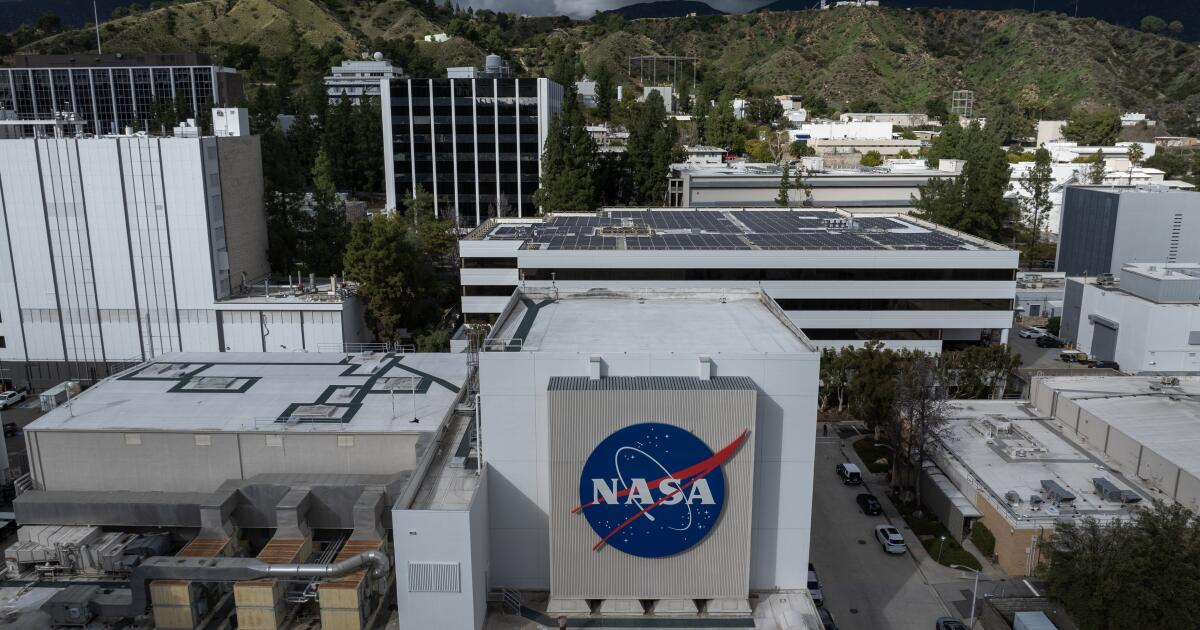
The contract for management and operation of NASA’s Jet Propulsion Laboratory will be opened up to a competitive bidding process for the first time in its history, the space agency announced on Friday.
The action forces Caltech to compete for control of the La Cañada Flintridge institution it has managed since NASA’s inception in 1958.
“The rapid growth of the U.S. space economy indicates there may now be a viable competitive market for programmatic and institutional elements,” NASA said in a statement. “This decision is part of a broader governmentwide and agency effort to find efficiencies, strengthen performance, and drive mission outcomes faster and more affordably.”
In a joint statement, Caltech President Thomas F. Rosenbaum and JPL Director Dave Gallagher said that the announcement came as “no surprise” and that it already had a team in place “to ensure we are positioned for success” in the bidding process.
“Over the course of our nearly seven-decade-long partnership with NASA, Caltech and JPL have led humanity’s exploration and understanding of the universe — and our place within it,” the Pasadena university said. “The ambitions ahead — no less bold than those we have already realized— are ones we are fully prepared to meet.”
The competition for the contract is part of a slate of changes NASA Administrator Jared Isaacman announced on Friday, including a massive reorganization of the space agency intended “to concentrate resources towards the highest priority objectives in the National Space Policy and liberate the best and brightest from needless bureaucracy and obstacles that impede progress,” Isaacman wrote in a letter to the agency’s roughly 18,000 employees.
JPL was founded by Caltech researchers in 1936, and became part of NASA when the space agency was formed in 1958. Its current 10-year contract with NASA, which is valued at up to $30 billion, runs through Sept. 30, 2028.
Times staff writer Noah Haggerty contributed to this report.

Despite finding nearly one in five homes had excessive levels of lead, the U.S. Environmental Protection Agency this week claimed that recent soil testing in Altadena proved that expedited federal cleanup efforts had effectively removed toxic ash and debris from homes destroyed by the deadly Eaton fire.
Earlier this year, the EPA announced it would perform a limited soil sampling at 100 destroyed homes across the burn zone in order to verify that contractors had thoroughly mitigated toxic substances. In a recent news release, the EPA said that testing revealed median lead concentrations below federal standards, and “confirmed that cleanup methods successfully addressed contamination and verified cleanup protocols.”
The EPA soil sampling comes amid mounting pressure from residents and environmentalists who claim that a hasty federal cleanup effort had left behind or spread hazardous fire debris. Internal government reports also raised questions about the thoroughness of the cleanup.
The EPA did not release its report to the public, but it said 95 of 100 soil samples collected near the surface of the home’s building footprint were below the federal lead screening level.
“I think for the folks in Altadena who maybe had some concerns about the adequacy of the work that was performed by the federal government in removing ash and debris — I think they should feel confident that those areas of their property are safe to use now,” said Mike Montgomery, EPA Superfund and emergency management director.
In announcing its findings, the EPA cited federal lead standards only, and not California’s more stringent thresholds. Of the 100 homes sampled, 17 had lead levels above 80 milligrams per kilogram, California’s benchmark for residential properties. The highest concentration of lead was 705 milligrams per kilogram — nearly nine times higher than the state standard and triple the federal threshold, according to a copy of the report that was reviewed by The Times.
The results unnerved some Altadena residents, who see more and more fire-destroyed homes being rebuilt. Joy Chen, executive director of Eaton Fire Survivors Network, called on federal officials to release the full report and provide additional resources to address elevated contamination.
“From the beginning, people have been very worried that they [federal workers] did not thoroughly clear these sites. Now 16 months later, people are taking it upon themselves to test or bioremediate to ensure it’s safe to rebuild. Most of us don’t have the resources to make those decisions,” Chen said.
“It would’ve been much easier if homes had been cleared to safe levels the first time around.”
EPA officials said the agency had notified Altadena property owners of their soil test results and encouraged them to review local public health guidance. Montgomery said EPA officials would proactively reach out to property owners whose lots had lead levels above the federal benchmark of 200 milligrams per kilogram.
Federal disaster officials say that some toxic substances within the burn zone could have been deposited there long before the fire — the result perhaps of decades of burning leaded gasoline or lead paint.
The Federal Emergency Management Agency had refused repeatedly to pay for post-cleanup soil testing and broke from long-standing California fire recovery protocols that are intended to protect returning residents from toxic substances. FEMA, along with the U.S. Army Corps of Engineers and the EPA, had touted the fire recovery as the fastest in modern history.
Disaster crews removed millions of tons of fire debris from nearly 9,700 properties affected by the Eaton and Palisades fires in roughly eight months.
But hundreds of disaster victims had complained about substandard work from federal cleanup workers, and internal government reports said crews had left debris behind and, in at least one instance, dumped ash on a neighbor’s property.
In January — shortly after the one-year anniversary of the fires — the EPA announced that it would perform soil testing for lead at 100 randomly-selected homes that were destroyed in the Eaton fire and later cleared of debris by federal contractors. The announcement followed months of criticism that federal cleanup workers had mishandled debris — including dumping fire debris and contaminated pool water on neighboring properties.
The Los Angeles Times collected soil samples in March 2025 and published the first evidence that already-remediated home sites retained elevated levels of toxic substances. Los Angeles County, UCLA, USC and several other organizations launched their own soil testing efforts, and all found elevated levels of lead at homes that had already been remediated by federal cleanup crews.
Lead is a potent neurotoxin that can stunt the brain development and lead to behavioral issues in young children that inhale or ingest it. When the Eaton fire burned through Altadena’s historic neighborhoods, it destroyed many homes that were coated in toxic lead paint. Plumes of smoke and ash then deposited the heavy metal across the burn zone.
Dr. Nichole Quick, chief medical advisor for the Los Angeles County Department of Public Health, encouraged property owners to seek further testing if they have concerns about contamination, including free testing services provided by local universities.
Quick said residents can take steps to limit their exposure, such as washing dusty equipment and keeping cleaning floors and other surfaces clean.
“Guidance is really geared towards how you interrupt that ingestion exposure, so we’re talking about a high-risk group, our kids with developing brains, pregnant women,” Quick said. “Kids also happen to be the ones that crawl around on all sorts of stuff and hands directly into mouth, so a lot of what we’re talking about is stopping that sort of exposure.”
Environmental experts quickly questioned the EPA’s soil sampling approach, which drastically differed from soil testing procedures from California environmental agencies. Andrew Whelton, a Purdue University researcher who has studied environmental risk following disaster, said the EPA sampling — which only tested one mixed sample — would likely mask heavily polluted areas of the home. The agency also only tested for lead — one of 17 toxic metals typically tested for following wildfires.
“It’s apples and oranges,” Whelton said. “They [the EPA] only looked for lead and didn’t look for hot spots. The approach that EPA differs from everything that California has done for fire cleanup for the last 15 years.
“My advice to property owners who haven’t tested soil or are adjacent to the fire area is conduct soil testing as it has always been done.”
The EPA and L.A. County health department are expected to discuss the soil testing results at the Altadena town council meeting on June 16.

One of NASA’s most valuable assets is a Southern Californian.
Following the space agency’s successful Artemis II mission around the moon last month, Victor Glover — who grew up primarily in the Inland Empire and has spent much of his career at Southern California’s many military and aerospace hubs — is now the only pilot to have flown NASA’s Orion capsule.
As the crew finishes its international victory lap before the media, Glover is preparing to put his head down and get to work training the Artemis generation of moon-faring astronauts.
-
Share via
“I think Artemis is going to demand us to change the paradigm,” he told The Times.
The International Space Station, which has been continuously inhabited by a revolving crew of astronauts in low Earth orbit for over 25 years, has a “very well-worn” training program, he said. But developing a new instructional regimen for complex high-stakes moon missions as the agency tries to aggressively ramp up Artemis launches from once every 3 1/2 years to every six months is a different beast.
“Until we get really ramped up and have a solid training program, I think astronauts need to take more ownership of the training and be involved so we can share this experience,” Glover said.
As of today, the list of Artemis astronauts is only four people long. And the list of Artemis pilots has only one name: Victor Glover.
Glover, 50, was born in Pomona, graduated from Ontario High School and lived “all over” Southern California’s urban sprawl, including Baldwin Village (which he instinctively referred to by its pre-1988 name, “The Jungle”). He completed his undergraduate studies at Cal Poly San Luis Obispo and received graduate degrees (plural) from the Naval Postgraduate School in Monterey and the Air Force Test Pilot School at Edwards Air Force Base.
He cut his teeth as a test pilot at Naval Air Weapons Station China Lake, in the Mojave. After NASA selected him as an astronaut, he learned to fly SpaceX’s Dragon capsule at the company’s then-headquarters in Hawthorne before riding it to the ISS.
Glover particularly misses those test pilot days, when he was pushing the limits of the F/A-18 Hornet and Super Hornet in China Lake while completing a master’s degree on the side.
“That was actually maybe one of the best times of my career. We had our fourth daughter while we lived in China Lake,” he said. “I was … working really hard but having a ton of fun at a house full of kids.”
In one of Glover’s favorite pictures, snapped by his wife, he is sitting at his desk in his tan desert flight suit, focused on graduate school work while holding one of his daughters.
Glover sees himself as just one example of how the Golden State’s deserts and coastal cities have left a lasting mark on America’s space program.
“Southern California is very uniquely postured to help NASA,” Glover said. “Southern California has the combination of culture and technology — and it doesn’t hurt to have Hollywood” to help share NASA’s mission and values.
(Glover fondly recalled his joy seeing the “Iron Man” production crew, including actor and rapper Terrence Howard, roll through Edwards Air Force Base during his tenure.)
Glover, who now lives in Texas near NASA’s Johnson Space Center, is focused on bringing that SoCal sensibility and invaluable experience piloting the Orion capsule to the agency’s astronaut training program.
When asked if he hopes to fly again on an Artemis mission, he gave a simple answer: “No.”
There was one other thing on his to-do list, though.
“Tell L.A. I love them and all of Southern California — and I can’t wait to get back out there and visit my home state and my hometown.”
-
 Entertainment2 minutes ago
‘Housewives’ star Erika Girardi settles $25-million lawsuit over money from husband’s firm
-

 Lifestyle8 minutes ago
The BoF Podcast | Leena Nair and Matthieu Blazy on Creativity and the Power of the Human Hand
-
 Politics14 minutes ago
‘A bridge too far?’: As GOP senators revolt, Trump defends fund and attacks defectors
-
Science20 minutes ago
Caltech could lose control of JPL for the first time
-
 Sports26 minutes ago
City Section baseball finals: Friday scores, Saturday schedule
-
World38 minutes ago
China ‘won’t win anything’ if it ‘destroys’ Europe’s industry, French minister tells Euronews
-
 News1 hour ago
Garden Grove gas leak: Live evacuation maps, closures and updates
-

 Los Angeles, Ca3 hours ago
Firefighters make progress on wildfires burning across Southern California

