Science
How a water scientist hopes to save California habitats that could be pumped dry

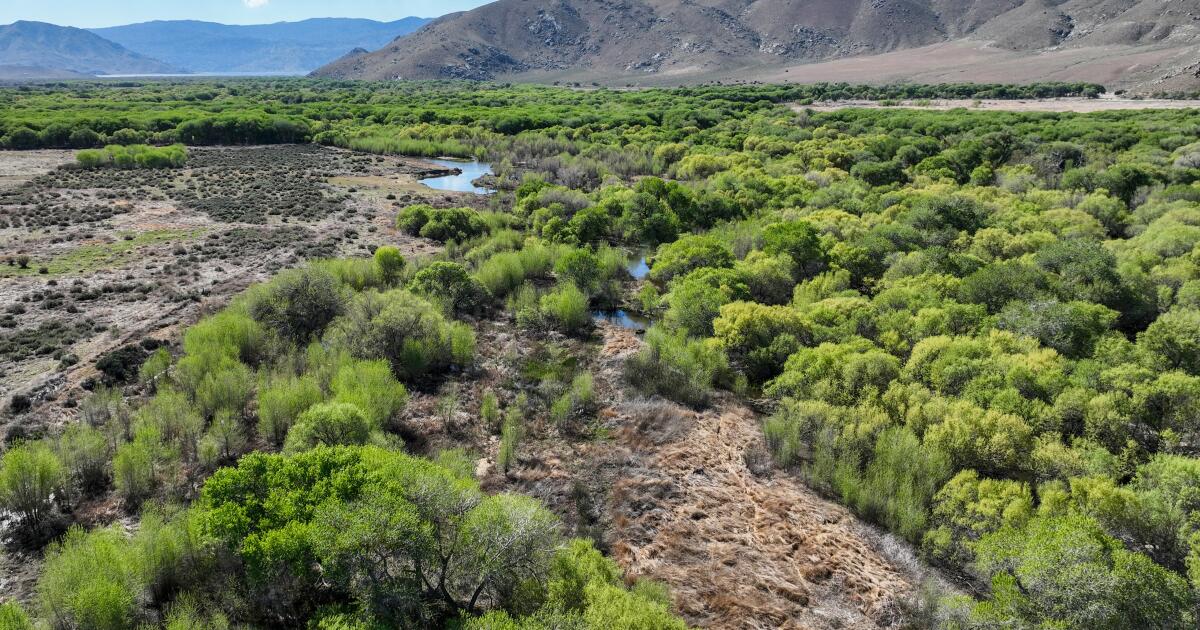
California is recognized as one of the world’s hotspots of biodiversity, with more species of plants and animals than any other state. And a significant number of the state’s species, from frogs to birds, live in habitats that depend on groundwater.
These rich ecosystems — including spring-fed streams, wetlands, riparian forests and oak woodlands — are vulnerable to declines in groundwater levels. In areas where unchecked pumping from wells severely depletes aquifers, once-thriving wetlands and forests can dry up and die.
Spotting threats to vulnerable natural areas has become a mission for Melissa Rohde, a hydrologist who has spent years analyzing satellite data and water levels in wells to come up with strategies for preventing ecosystems from being left high and dry.
“Nature has been getting the short end of the stick. It basically gets whatever is left behind, which oftentimes is not enough,” Rohde said. “How do we ensure that these ecosystems are protected?”
More than 300 species of birds have been seen at Kern River Preserve.
(Robert Gauthier / Los Angeles Times)
California is the only state with a groundwater law that includes provisions intended to protect groundwater-dependent ecosystems. But the law, adopted in 2014, gives considerable leeway to local agencies in developing water management plans that prevent “significant and unreasonable adverse impacts.”
When Rohde and other scientists examined the local plans for parts of the state that fall under regulation, they found only about 9% of groundwater-dependent ecosystems are adequately protected, while the remaining 91% are vulnerable.
When they looked at the entire state, they determined only 1% of the ecosystems are sufficiently protected under measures adopted to date.

Aggressive and impactful reporting on climate change, the environment, health and science.
Rohde has been focusing on finding ways to change that, in California and around the world.
Often working at home, she has pored over satellite data to spot decreases in vegetation greenness during drought, a telltale sign of die-off caused by declining aquifer levels. And she has analyzed how different types of trees, including willows, cottonwoods and oaks, fare when water levels fall depending on the depth of their roots.
Rohde and other researchers recently published a study outlining how California can set targets for maintaining groundwater levels — based on a formula including the type of vegetation, local water data and satellite imagery — to ensure the plants that anchor each ecosystem will be able to reach water and survive during dry times.
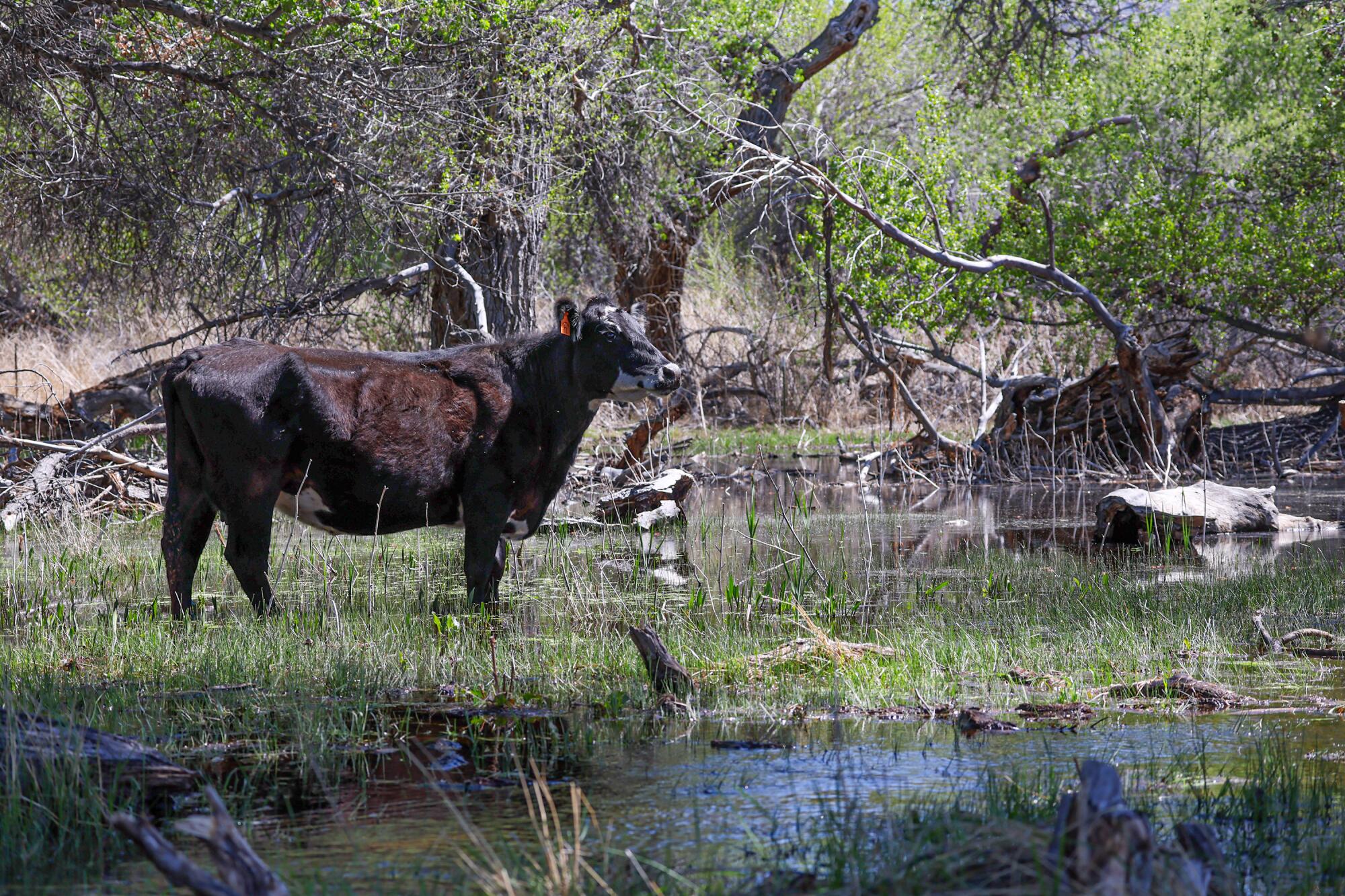
Cattle graze at the Kern River Preserve.
(Robert Gauthier / Los Angeles Times)
“If we don’t have groundwater levels that are able to support these diverse native vegetation ecosystems, then basically we run the risk of losing that important habitat for a lot of our threatened and endangered species,” Rohde said. “When you play around with keeping groundwater levels too deep to support the habitat, then you could lose species, and then that’s irreversible. The consequences can be severe.”
In California’s Mediterranean climate, trees, shrubs and the species they support are naturally adapted to drought. But excessive pumping from wells can push habitats beyond ecological limits by depleting the sources that sustain them.
With humanity’s heating of the planet intensifying droughts, the strains affecting these ecosystems continue to grow.
Already, California has lost the vast majority of its original wetlands to development, water diversions and agriculture. To avoid losing what remains, Rohde said, the state needs “a precautionary and preventative approach that can ensure that these ecosystems can withstand the intensification of droughts in climate change.”
During a recent visit to Kern County, Rohde and several conservation specialists walked in the shade through a lush forest of cottonwood trees near the south fork of the Kern River, visiting a nature preserve she had previously seen only in satellite images.
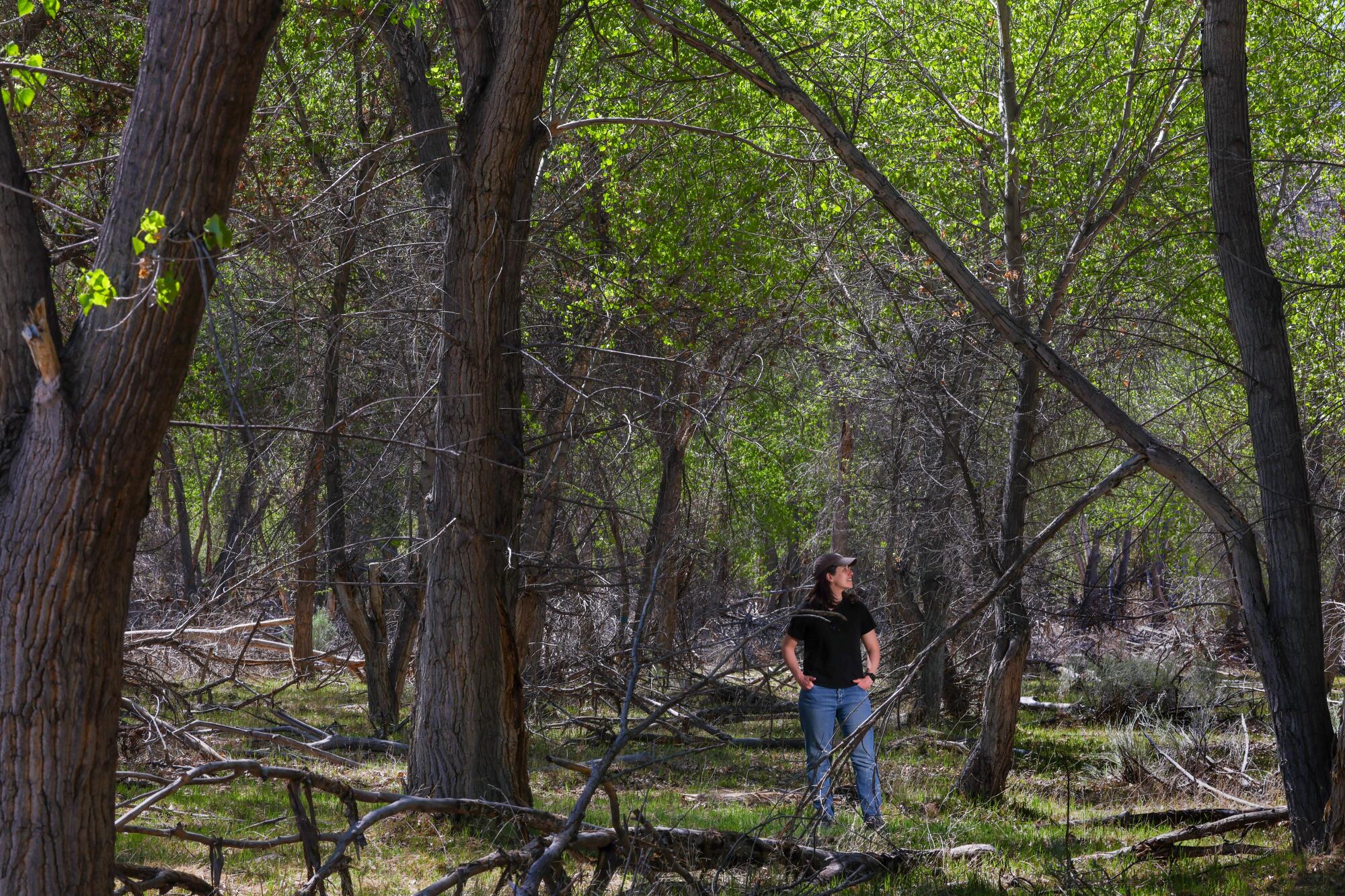
Scientist Melissa Rohde visits a riparian forest at the Kern River Preserve.
(Robert Gauthier / Los Angeles Times)
At the edge of a clearing, she came upon the bare, sunbleached skeletons of dead trees.
She said satellite data had revealed that parts of the forest died along this part of the Kern River during the drought between 2012 and 2016.
“That’s because the groundwater levels rapidly declined,” Rohde said.
After that die-off, she said, groundwater levels rebounded in the area, and the native vegetation has been growing back.
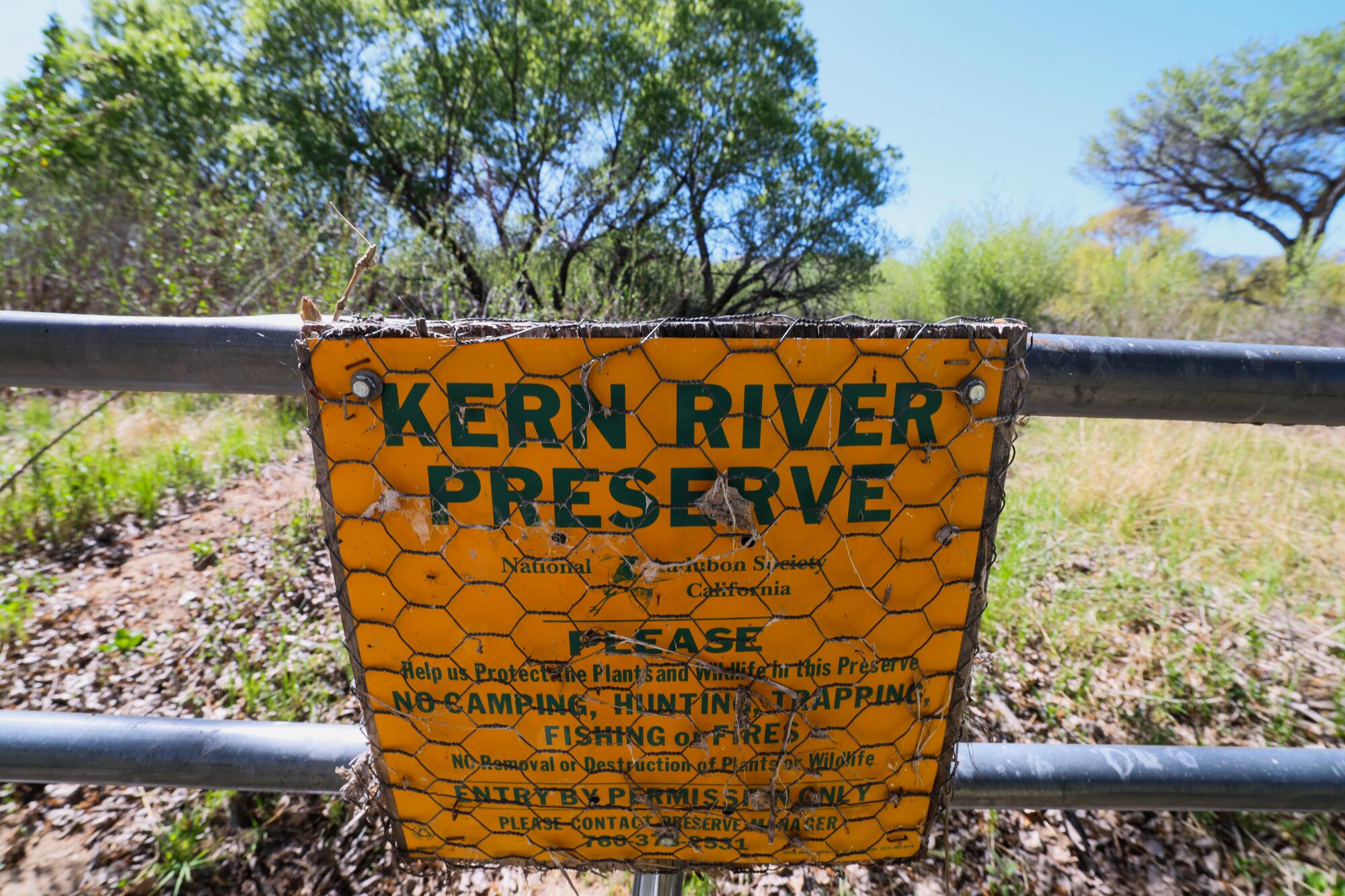
The Kern River Preserve protects the riparian ecosystem along the south fork of the Kern River.
(Robert Gauthier / Los Angeles Times)
It helps that this forest is protected as part of the Kern River Preserve, which is managed by the National Audubon Society, and that some nearby farmlands have been retired and converted to conservation lands over the years.
The preserve’s managers, working with the organization Ducks Unlimited, have also restored an expanded wetland by diverting water from the river and flooding a section of pastureland where cattle used to graze.
The wetland attracts birds, such as coots and tricolored blackbirds, and also recharges the aquifer that the roots of cottonwoods and willows tap into.
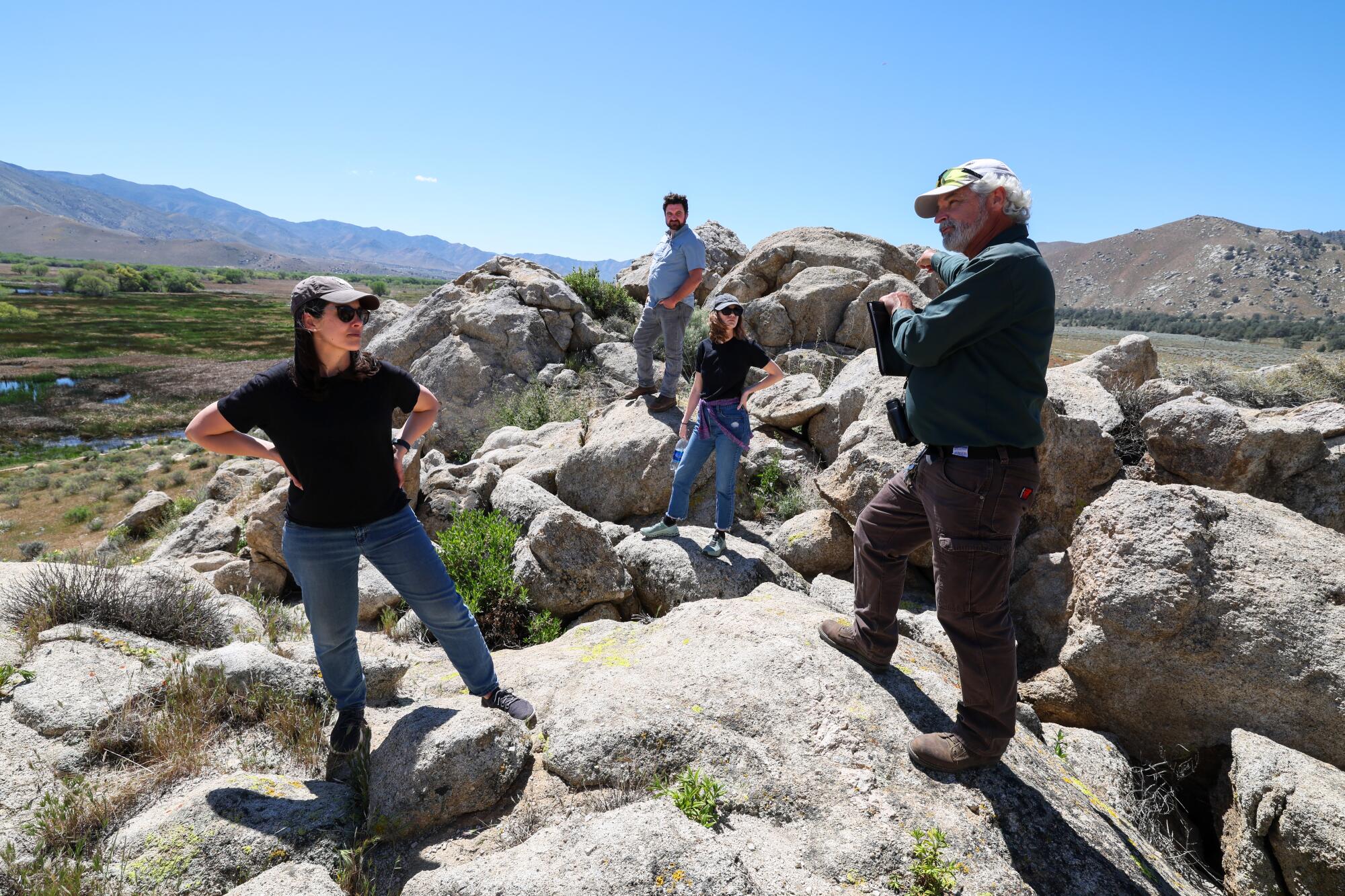
Scientist Melissa Rohde, left, and conservation specialists from Ducks Unlimited and the Audubon Society, including Reed Tollefson, right, stand on rocks overlooking a wetland at the Kern River Preserve.
(Robert Gauthier / Los Angeles Times)
The 3,300-acre preserve has expanded as adjacent alfalfa fields have been purchased and agricultural wells have been shut down, said Reed Tollefson, the preserve’s manager. These efforts have helped protect a refuge for birds including willow flycatchers and yellow-billed cuckoos.
As he pointed to several dead trees poking from the living cottonwoods, he said protecting the forest from groundwater pumping and climate change will require additional effort.
“I think it’s tenuous,” he said. “We’ve got more work to do to try and really sustain this.”
The dead trees that have appeared here and elsewhere in California over the past decade represent the sort of die-off that water managers need to focus on preventing, Rohde said.
“It has to be an intentional practice of setting thresholds, monitoring, using satellite data or other scalable means to measure the impacts, in order to make sure that we are not allowing this to happen on a wider scale,” she said. “From a biodiversity perspective, it’s absolutely critical.”
Rohde said she felt hopeful seeing the forest rebounding and much greener than it was several years ago, with many young trees coming up.
Some other parts of California haven’t fared nearly as well.
One rainy day last month, Rohde visited an area along the Santa Clara River in Ventura County where several hundred acres of willows and cottonwoods dried up and died during the drought in the mid-2010s.
When groundwater pumping by farms and communities caused aquifer levels to fall, many trees died along the river near the city of Fillmore.
“We saw this catastrophic drop in groundwater at this site,” Rohde said.
She visited the area with a research colleague and two managers from The Nature Conservancy. They stood on a gravel road next to a lemon grove, checking on what remained of the forest.
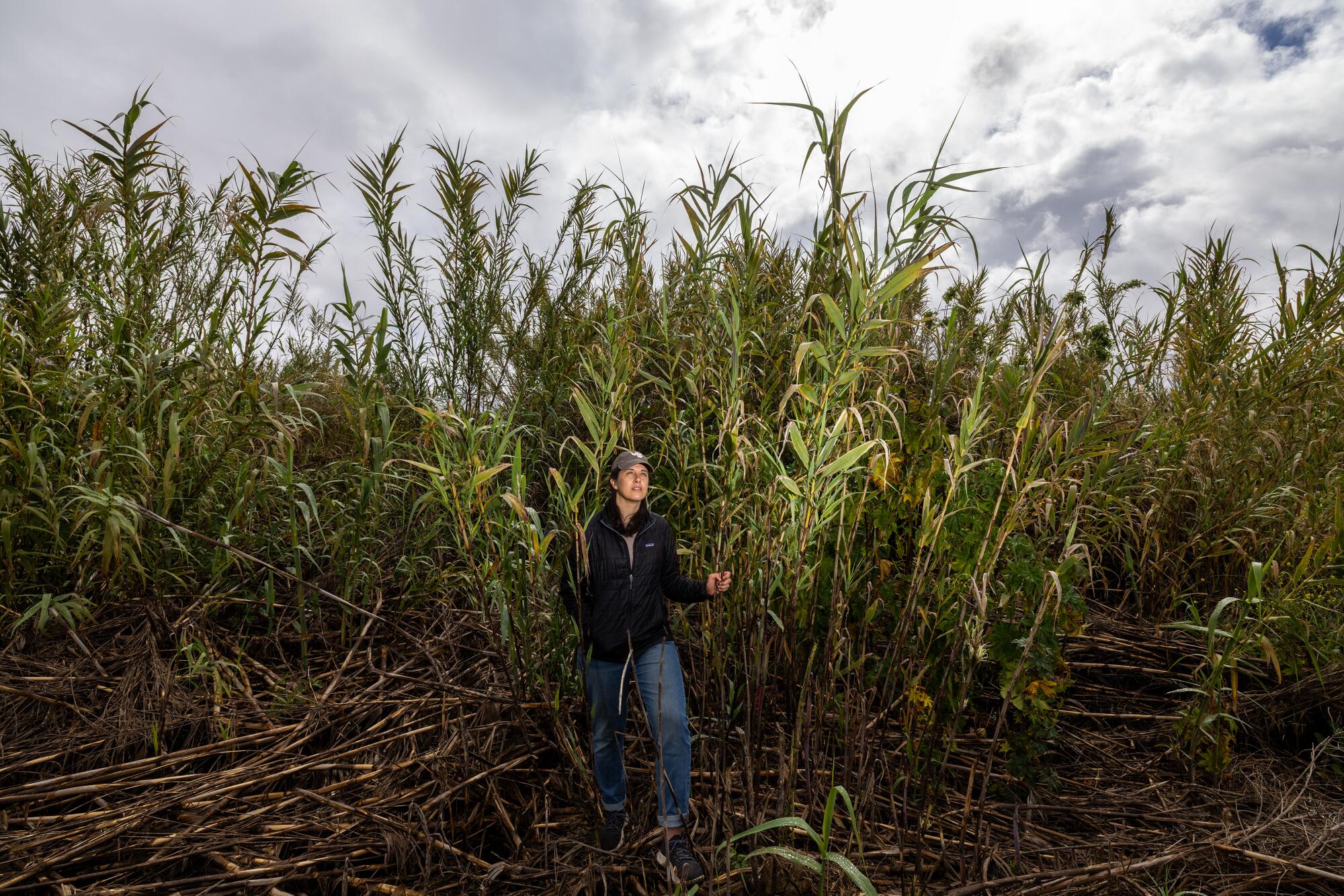
Scientist Melissa Rohde stands in a thicket of arundo, an invasive reed that has proliferated along parts of the Santa Clara River in Ventura County. There are ongoing efforts to remove the nonnative reeds in the area.
(Brian van der Brug / Los Angeles Times)
Where native trees died, an explosion of invasive reeds has taken over. The nonnative reeds, called arundo, have grown into thickets more than 20 feet tall. And unlike willows, Rohde said, arundo offers little value as habitat for birds.
“When we had that massive die-off, and the groundwater levels remained deep, there was no way for the native vegetation to regenerate,” she said. “But arundo is extremely efficient at extracting soil moisture. And so it was able to outcompete the native vegetation.”
She said efforts to prevent this sort of habitat degradation should be prioritized.
When managers of local agencies set goals for maintaining groundwater levels, she said, they can tailor targets to the type of vegetation — whether there are cottonwood trees, with roots averaging about 9 feet long, or oaks, with roots that average nearly 30 feet but can grow much deeper.
Her colleague Michael Bliss Singer said when native trees are ravaged by multiple years of low water levels, they will start losing leaves and then dropping branches.
In one study, Singer and others documented a “brown wave” of trees drying along the Santa Clara River between 2012 and 2016 — a loss they saw in satellite images.
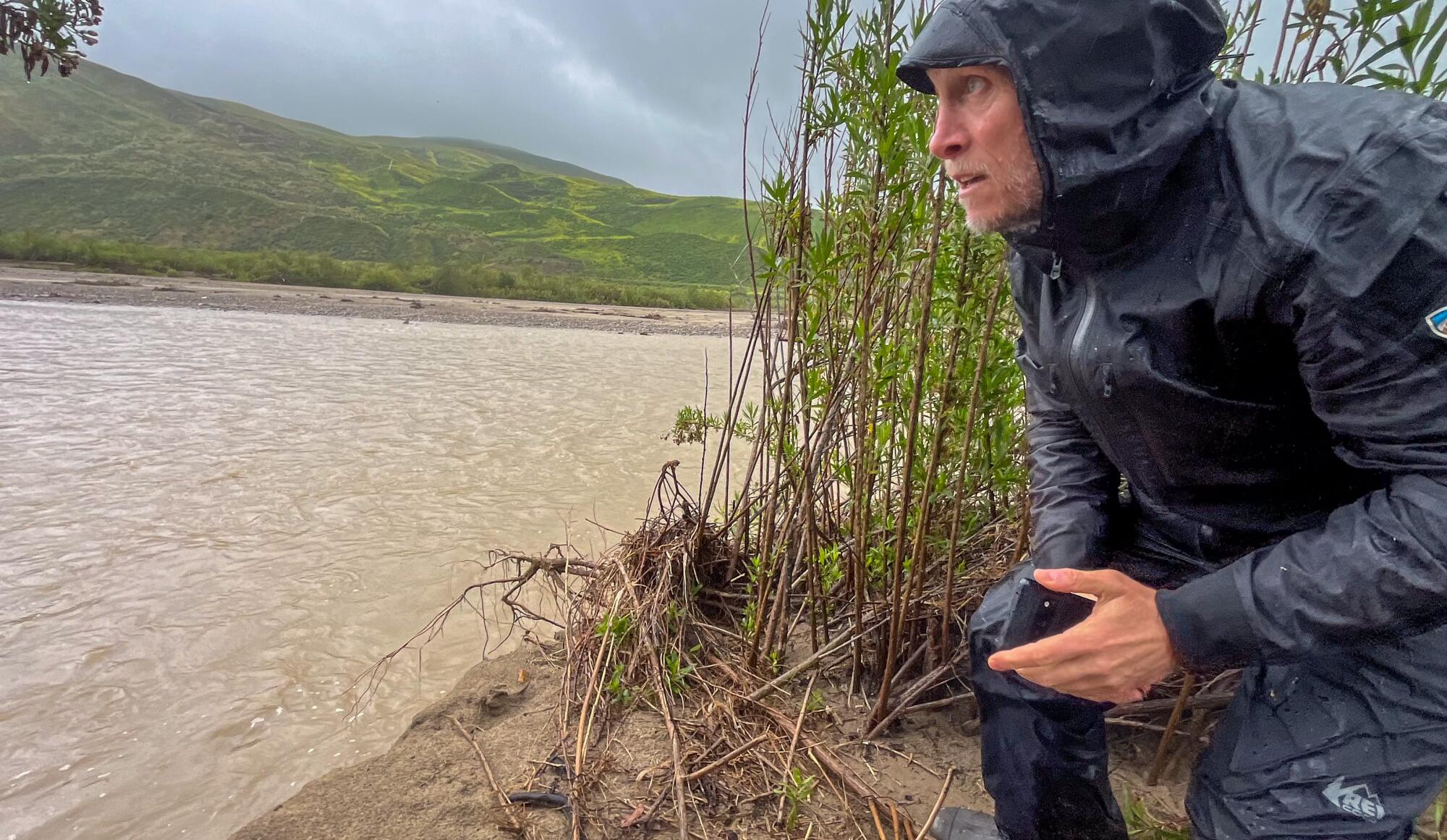
Scientist Michael Bliss Singer looks out over the Santa Clara River in Ventura County.
(Brian van der Brug / Los Angeles Times)
“It’s completely transformed the ecosystem here,” said Singer, a professor at Cardiff University in Wales who is also a researcher at UC Santa Barbara.
When plants die off like this and don’t recover, it’s a symptom of an ecosystem in decline. To prevent more of these losses in an era when climate change is driving more severe droughts, Singer said, it’s crucial to “come up with creative solutions for the worst-case scenario.”
Rohde has found in her research, however, that most local groundwater plans in California haven’t adequately accounted for climate projections.
Previously, Rohde did other types of climate research, including a stint in Antarctica in 2010, where she was part of a drilling team collecting ice cores. From that experience, Rohde said she realized that “I didn’t want to spend my career convincing people that climate change was an issue; I wanted to do something about it.”
She wore a faded cap with an Antarctica map, a memento of that trip. Rohde said her recent work is motivated by concerns about the climate crisis and biodiversity, as well as a conviction that proactive steps to protect ecosystems can make a difference.
“I have two young kids. I really want to make sure that I’m doing the best thing that I can to ensure a sustainable future for them, where they can access nature,” Rohde said.
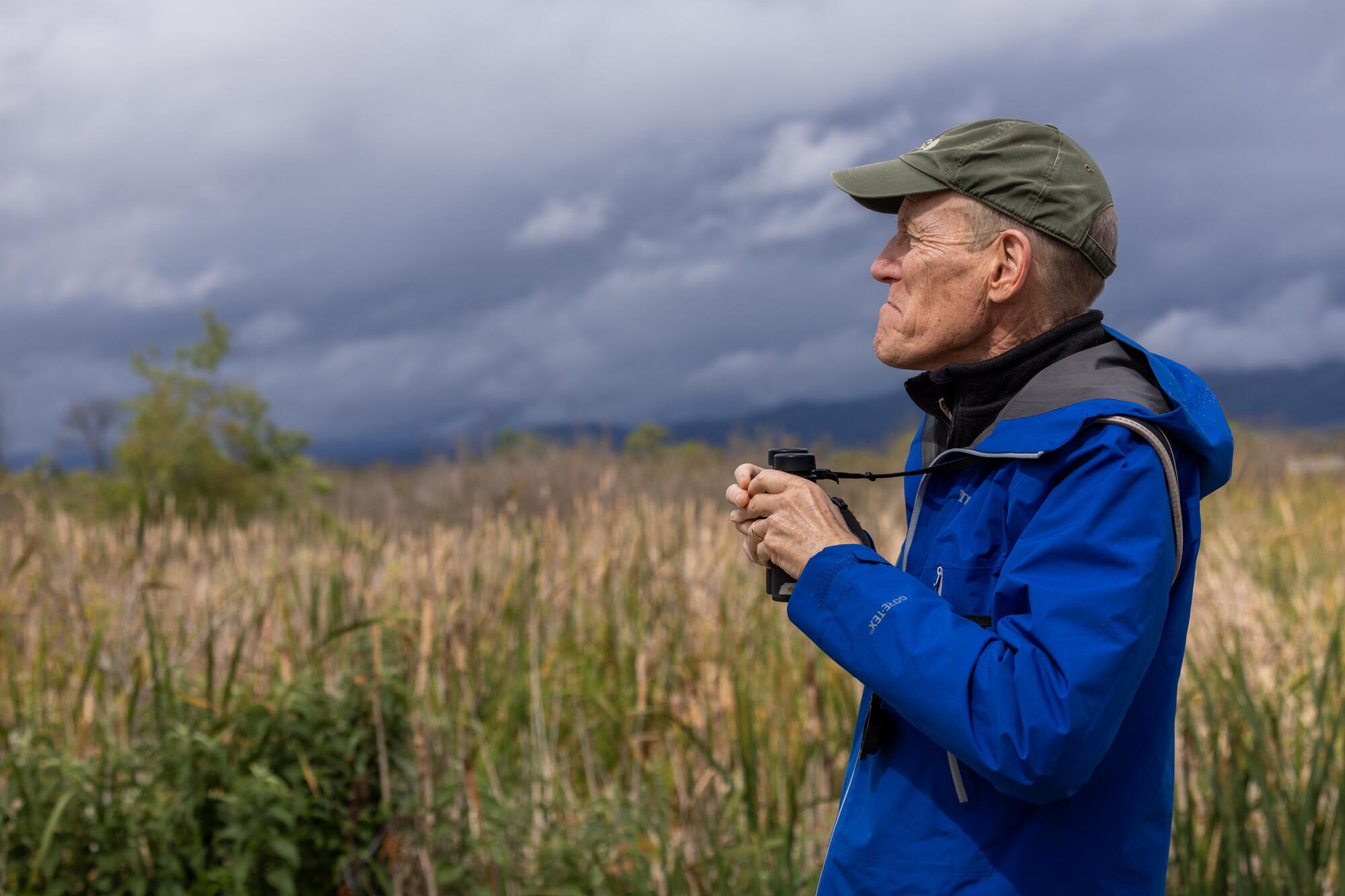
E.J. Remson, a senior project director for The Nature Conservancy, surveys a wetland along the Santa Clara River in Ventura County.
(Brian van der Brug / Los Angeles Times)
“Often groundwater is out of sight, out of mind,” she said. “We don’t measure it, we don’t understand it and we misuse it. And we need to make sure that we are managing groundwater so that it is supporting us, and making sure that we have a sustainable future.”
Rohde now works as an independent scientist. Previously, as a researcher for The Nature Conservancy, she helped write an atlas of threatened and endangered species that rely on groundwater.
California’s groundwater-dependent ecosystems lie not only along streams, but also in habitats such as mountain meadows, coastal redwood forests and mesquite bushes among desert sand dunes. The species they support range from tiger salamanders to desert pupfish, and from songbirds to mammals such as ground squirrels and bighorn sheep.
“The risks are high when species are on the verge of extinction,” Rohde said.
Rohde and other scientists have found that ecosystems sustained by groundwater are under threat worldwide. Some of the few regions that have measures intended to protect them, she said, include Australia, the European Union and California.
Still, even with California’s groundwater regulations and endangered species laws, Rohde said, “we continue to miss the mark in actually protecting them.”
Rohde said state officials should give local water agencies clear direction to ensure they’re using science-based methods to safeguard ecosystems in their state-mandated plans. She said agencies can now use the approaches scientists have outlined to map strongholds of biodiversity and set targets for maintaining aquifer levels.
“It’s very attainable,” she said. “Now, it’s just basically up to political will, or enforcement by the Department of Water Resources, to ensure that that happens.”
Walking in the rain at the Santa Clara River Preserve, Rohde followed her former Nature Conservancy colleagues Peter Dixon and E.J. Remson on a trail through a stand of healthy trees.
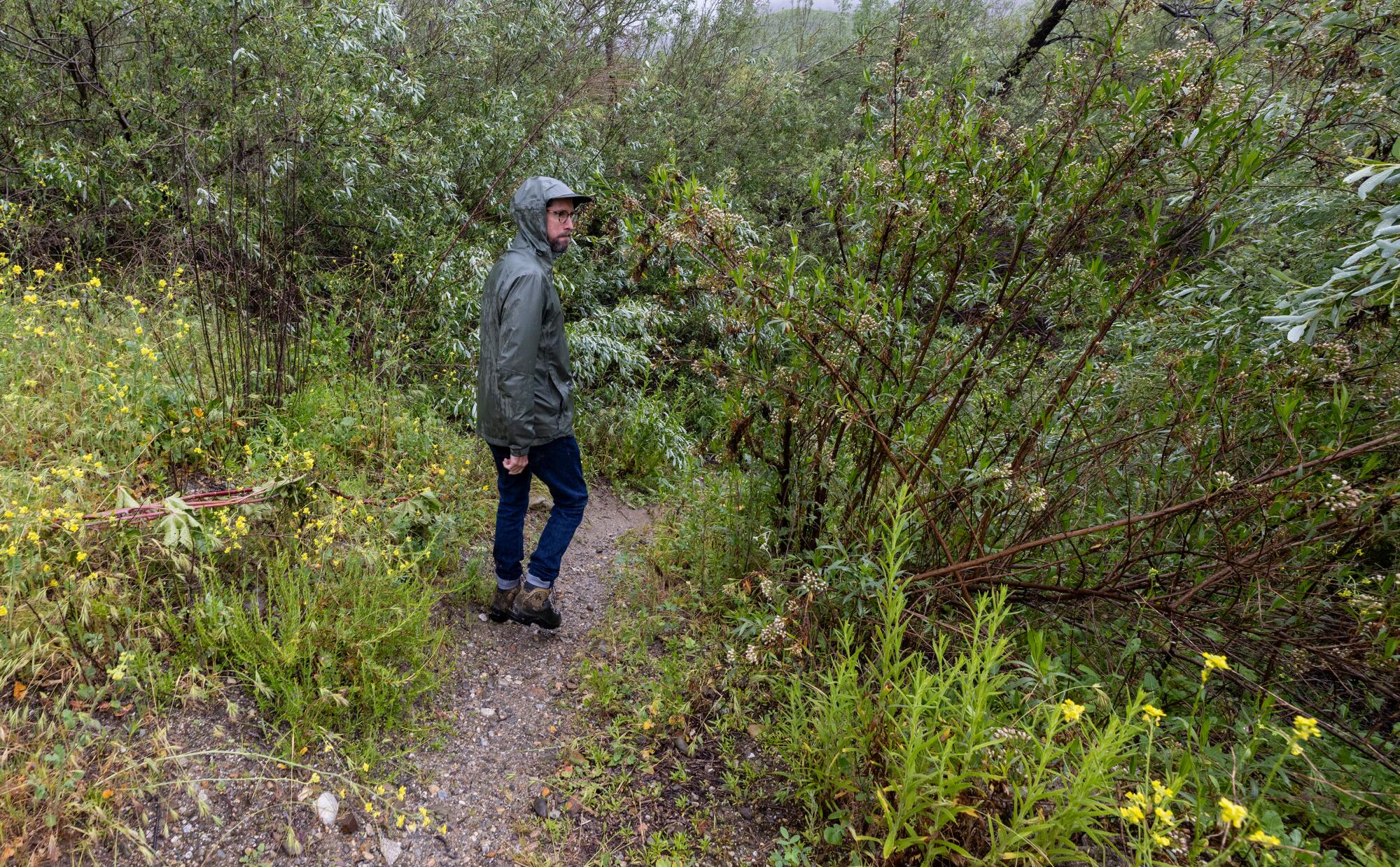
Peter Dixon, a project manager with The Nature Conservancy, walks on a trail through the riparian forest at the Santa Clara River Preserve.
(Brian van der Brug / Los Angeles Times)
They stood on the banks of the fast-flowing river, watching the muddy water churn past.
In the summer and fall, this part of the river usually dwindles to a trickle.
And during the next drought, when the river dries up, the forest will depend on the same groundwater that nearby communities and farms also use.
If the water needs of this and other ecosystems aren’t prioritized, Rohde said, vital habitats will suffer.
“We need to be deliberate about the planning, and ensuring that they get their fair share,” she said. “Their existence is potentially imperiled if we don’t act.”


new video loaded: NASA Announces Artemis III Crew
transcript
transcript
NASA Announces Artemis III Crew
NASA announced the crew of Artemis III mission, which will fly to low-Earth orbit to test rendezvous and docking maneuvers with one or two lunar landers.
-
“I am excited to welcome you as the next crew in the Artemis journey to successfully return to the moon — this time to stay.” “I’m honored by the role that I’ve been given. I’m also very humbled by the task in front of us. But first and foremost, I’m grateful.” “So with that, the Artemis II crew, comrade, hands you the baton. You got the controls.” “As you know, we had a significant anomaly at our Launch Complex 36A on May 28. We’ve redoubled our efforts and are moving forward.”
By Alisa Shodiyev Kaff
June 9, 2026
Science
Santa Monica Mountains’ last steelhead trout survived the Palisades fire — and even had babies

Scientists feared the Santa Monica Mountains’ last remaining steelhead trout were dead, smothered by debris flows unleashed by the Palisades fire.
But the endangered fish surprised them: A team of biologists recently spotted 30 of the rare trout — and 21 babies — in Topanga Creek.
“There was a lot of happy dancing in the creek,” said Rosi Dagit, principal conservation biologist for the Resource Conservation District of the Santa Monica Mountains, which works with public and private landowners to conserve natural resources.
That’s because the steelhead here are endangered, at both the state and federal levels. Once, they swam in most streams of the Santa Monicas, but their numbers plummeted amid overfishing and coastal development. Increasingly frequent wildfire has further stressed their habitat. Topanga Creek, a biodiversity hot spot, is home to their last known population in the mountains that stretch from the Hollywood Hills to Point Mugu in Ventura County.
The trout that were spotted, including this one, are part of a distinct Southern California population that’s listed as endangered at the state and federal levels.
(RCDSMM Stream Team)
The California Department of Fish and Wildlife spearheaded a complex mission to rescue trout threatened by the Palisades fire that sparked in January 2025.
Time was of the essence. The fire hadn’t yet been fully contained. But rain was on the way, which would sweep massive amounts of sediment from the denuded hillsides into the water. Fish are often killed this way.
Crews stunned the fish with electricity, scooped them up in buckets, trucked them to a hatchery and ultimately moved them to Arroyo Hondo Creek in Santa Barbara County.
Within days, Topanga Creek was choked with mud. Some assumed the fish left behind were goners.
But in March, the conservation district’s team found four. The following month, when water conditions were clearer, they saw more.
“These fish continue to amaze me,” said Kyle Evans, environmental program manager for the state Department of Fish and Wildlife, who had seen the damage to the creek. “I had seen populations get wiped out in similar situations. So when I heard, I was thrilled.”
Evans surmises the fish that survived were in an area of the creek where less charred material and sediment were swept in.
“These fish likely hunkered down, were hiding under some rocks or places to try to get away from the main concentration of flow,” he said. “And luckily they weren’t buried.”
The ones that were spotted were fairly small, around 6 to 14 inches. Rainbow trout and steelhead trout are the same species, but with different lifestyles. If the fish remain in freshwater, they’ll be considered rainbows. However, they can migrate to the ocean and become steelhead, where they typically grow larger before returning to their natal waters to spawn.
Topanga Creek hasn’t fully recovered from the damage it sustained, but scientists say it’s looking better. Surveys last year were “so depressing,” Dagit said, with very few animals, and stretches that were essentially transformed into flat roads from all the sediment buildup. Some of the riparian canopy burned right down to the creek.
Then came 32 inches of rain over the last nine months, scouring out and moving sediment, creating deeper pools. Dagit said they recently found newt egg masses for the first time in years, as well as a few adult newts and many frogs. Plants that provide cover are starting to recover.
She provided photos comparing certain pools last year and this year, some dramatically transformed. In September 2025, the Shrine Pool could have been an overgrown hiking trail. This April, it was filled with shallow water.

The Shrine Pool in September 2025, left, and the same location in April 2026, right, with RCDSMM’s Isaac Yelchin donning a wetsuit.
(RCDSMM Stream Team)
Topanga Creek is home to another endangered fish, the small but hardy northern tidewater goby, often described as cute. Not long before the trout operation, Dagit led a rescue of hundreds of these fish too. Many were repatriated to the lagoon at the mouth of the creek in a moving ceremony last June.
There’s still the matter of what to do with the trout that were moved to Santa Barbara County last year. Evans would like to bring them home to the Santa Monicas at some point, but isn’t sure if it will happen. On one hand, they could bolster the small, genetically isolated surviving population. On the other, they might inadvertently bring in a disease or bacteria. There is some time to decide. Evans estimates the creek still needs to recover for two to three more years.
For now, the fish are functioning fine in their adopted creek. Experts worried the trauma wrought by the move would disrupt their spawning process, but they had babies that spring. This year, they spawned again.

The Pacifica Municipal Pier was shut down and taped off Thursday after city workers noticed cracks running through the landmark structure and concrete chunks falling into the ocean.
It’s just one of many coastal California structures that have recently crumbled under pressure from a rising and relentless ocean.
Officials from the small, beach city south of San Francisco said the pier was closed due to “cracking, separation, and displacement of the concrete walkway and structural elements.”
It will stay closed while structural engineers asses its safety.
Photos taken by city employees show a wide crack that runs from top to bottom and across the structure as well. Other photos show a large horizontal crack under the foundation of a small restaurant on the pier, the Chit Chat Cafe.
The cafe was also shut down.
This is not the first time the 53-year-old pier has shown signs of stress. In 2021, part of it was shut down after handrails along the edge collapsed. And in 2023, after a series of storms pummeled the Central California coast, damaging parts of the pier, the structure was partially closed for more than year.
Those same storms caused extensive damage in Aptos and Capitola, 70 miles south, where piers and waterfront infrastructure were swept away or damaged.
In 2024, a 150- to 180- foot section of the Santa Cruz wharf was ripped off by powerful waves.
At least 10 of the state’s dozens of coastal public piers were closed for part or all of 2024 due to structural damage sustained in winter storms since 2022. At least five others have longer-term upgrades planned to address structural issues.
“These things are costly to maintain,” said Zach Plopper, senior environmental director at Surfrider. “They are a part of our California coastal culture in many ways, but we’re going to need to reckon with, one, the state that they’re in, and two, the continuous and worsening threats they’re going to experience,”
He said most of the piers were constructed in the early 1900s, and they weren’t built to withstand decades of rough seas, storms and rising sea level.
“With this incoming El Niño, which is forecasted to be significant, and this marine heat wave we’re in the midst of, we’re kind of in uncharted waters as far as what this winter could bring in terms of storms and swells to the California coast, and we’re likely going to see a lot more damage,” he said. “Not just piers, but roads and other coastal infrastructure up and down the state.”
There was no storm in Pacifica earlier this week, so no single event could be blamed for the destruction.
However, a 2025 report from an outside engineering firm, GHD, found that several sections of the pier were in “poor” or “serious” condition, and they recommended closure before anticipated storms or events that could “subject the piles to high winds, swells and large waves.”
The firm found several areas of the pier where concrete was missing and rebar was exposed and corroding.
“The pier has continued to experience high winds and large waves in a harsh marine environment,” the engineers wrote in the report, noting that continuous exposure to seawater or marine spray was “detrimental” to the structure.
A 2023 city report estimated it would cost $19 million to repair.
That same year, a state law was enacted to require local governments along the California coast to plan for sea level rise in the coming decades.
Sea level has risen some 8 inches, on average, along the coast in the past 150 years, Plopper said, and researchers anticipate another foot in the next 25 years.
“We’re going to see profound shifts on our coastline, none that we have ever experienced before, and building static structures on the coast just doesn’t work all that well,” he said. “We’re going to have to make some really hard decisions.”
-

 South Dakota5 minutes ago
What to know about the SD’s first gubernatorial runoff
-

 Tennessee12 minutes ago
Comparing Tennessee’s Neyland Entertainment District to others in college sports
-

 Texas15 minutes ago
Where to watch Texas Rangers vs Kansas City Royals: TV channel, start time, streaming for June 10
-

 Utah20 minutes ago
New NBA Draft Intel: AJ Dybantsa, Darryn Peterson and Utah
-

 Vermont27 minutes ago
Vermont Green FC plays Canada’s national soccer team in World Cup tuneup – VTDigger
-

 Virginia30 minutes ago
Navy sailor sentenced to 44 years for killing fellow service member Angelina Resendiz in his Virginia barracks room
-
Washington35 minutes ago
Where to watch Washington Nationals vs San Francisco Giants: TV channel, start time, streaming for June 10
-

 Wisconsin42 minutes ago
Chris Borland heads back to Wisconsin as Hall of Fame inductee

