Science
Contributor: Factory farming of fish is brewing pathogens

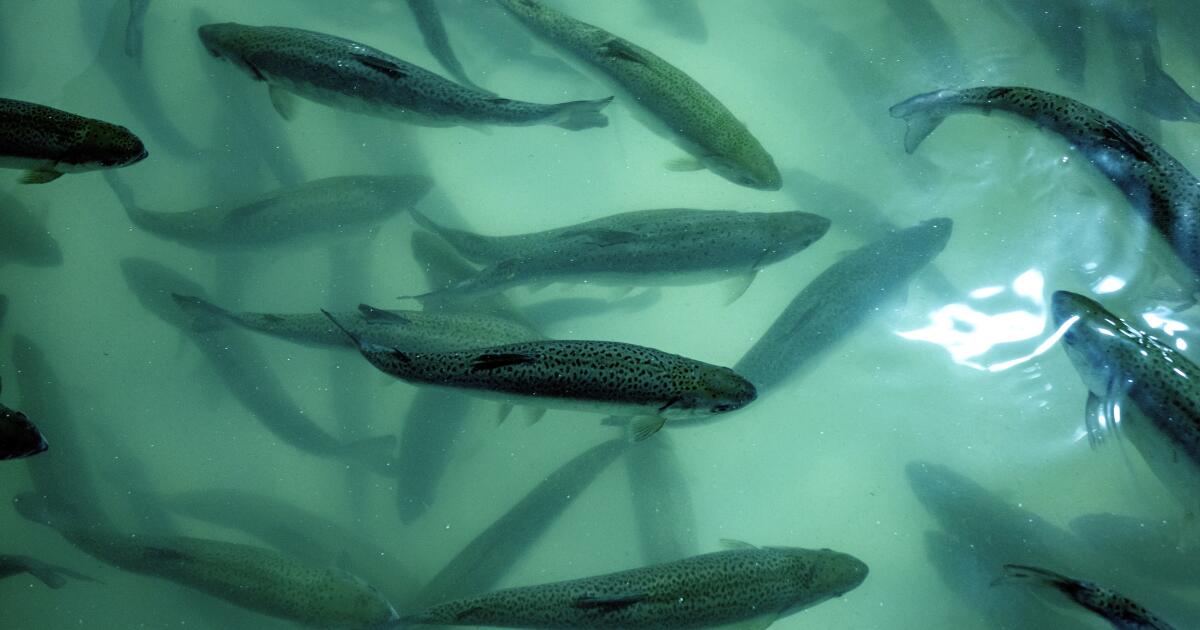
The federal government recently released new dietary guidelines aimed at “ending the war on protein” and steering Americans toward “real foods” — those with few ingredients and no additives. Seafood plays a starring role. But the fish that health advocates envision appearing on our plates probably won’t be caught in the crystal blue waters we’d like to imagine.
Over the past few decades, the seafood industry has completely revolutionized how it feeds the world. As many wild fish populations have plummeted, hunted to oblivion by commercial fleets, fish farming has become all the rage, and captive-breeding facilities have continually expanded to satiate humanity’s ravenous appetite. Today, the aquaculture sector is a $300-billion juggernaut, accounting for nearly 60% of aquatic animal products used for direct human consumption.
Proponents of aquaculture argue that it helps feed a growing human population, reduces pressure on wild fish populations, lowers costs for consumers and creates new jobs on land. Much of that may be correct. But there is a hidden crisis brewing beneath the surface: Many aquaculture facilities are breeding grounds for pathogens. They’re also a blind spot for public health authorities.
On dry land, factory farming of cows, pigs and chickens is widely reviled, and for good reason: The unsanitary and inhumane conditions inside these facilities contribute to outbreaks of disease, including some that can leap from animals to humans. In many countries, aquaculture facilities aren’t all that different. Most are situated in marine and coastal areas, where fish can be exposed to a sinister brew of human sewage, industrial waste and agricultural runoff. Fish are kept in close quarters — imagine hundreds of adult salmon stuffed into a backyard swimming pool — and inbreeding compromises immune strength. Thus, when one fish invariably falls ill, pathogens spread far and wide throughout the brood — and potentially to people.
Right now, there are only a handful of known pathogens — mostly bacteria, rather than viruses — that can jump from aquatic species to humans. Every year, these pathogens contribute to the 260,000 illnesses in the United States from contaminated fish; fortunately, these fish-borne illnesses aren’t particularly transmissible between people. It’s far more likely that the next pandemic will come from a bat or chicken than a rainbow trout. But that doesn’t put me at ease. The ocean is a vast, poorly understood and largely unmonitored reservoir of microbial species, most of which remain unknown to science. In the last 15 years, infectious diseases — including ones that we’ve known about for decades such as Ebola and Zika — have routinely caught humanity by surprise. We shouldn’t write off the risks of marine microbes too quickly.
My most immediate concern, the one that really makes me sweat, is the emergence of drug-resistant bacteria among farmed fish. Aquaculturists are well aware that their fish often live in a festering cesspool, and so many growers will mix antibiotics — including ones that the World Health Organization considers medically important for people — into fish feed, or dump them straight into water, to avoid the consequences of crowded conditions and prevent rampant illness. It would be more appropriate to use antibiotics in animals only when they are sick.
Because of this overuse for prevention purposes, more antibiotics are used in seafood raised by aquaculture than are used in humans or for other farmed animals per kilogram. Many of these molecules will end up settling in the water or nearby sediment, where they can linger for weeks. In turn, the 1 million individual bacteria found in every drop of seawater will be put to the evolutionary test, and the most antibiotic-resistant will endure.
Numerous researchers have found that drug-resistant strains of bacteria are alarmingly common in the water surrounding aquaculture facilities. In one study, evidence of antibiotic resistance was found in over 80% of species of bacteria isolated from shrimp sold in multiple countries by multiple brands.
Many drug-resistant strains in aquatic animals won’t be capable of infecting humans, but their genes still pose a threat through a process known as horizontal transfer. Bacteria are genetic hoarders. They collect DNA from their environment and store it away in their own genome. Sometimes, they’ll participate in swap meets, trading genes with other bacteria to expand their collections. Beginning in 1991, for example, a wave of cholera infected nearly a million people across Latin America, exacerbated by a strain that may have picked up drug-resistant adaptations while circulating through shrimp farms in Ecuador.
Today, drug-resistant bacteria kill over a million people every year, more than HIV/AIDS. I’ve seen this with my own eyes as a practicing tuberculosis doctor. I am deeply fearful of a future in which the global supply of fish — a major protein source for billions of people — also becomes a source of untreatable salmonella, campylobacter and vibrio. We need safer seafood, and the solutions are already at our fingertips.
Governments need to lead by cracking down on indiscriminate antibiotic use. It is estimated that 70% of all antibiotics used globally are given to farm animals, and usage could increase by nearly 30% over the next 15 years. Regulation to promote prudent use of antibiotics in animals, however, has proven effective in Europe, and sales of veterinary antibiotics decreased by more than 50% across 25 European countries from 2011 to 2022. In the United States, the use of medically important antibiotics in food animals — including aquatic ones — is already tightly regulated. Most seafood eaten in the U.S., however, is imported and therefore beyond the reach of these rules. Indeed, antibiotic-resistance genes have already been identified in seafood imported into the United States. Addressing this threat should be an area of shared interest between traditional public health voices and the “Make America Healthy Again” movement, which has expressed serious concerns about the health effects of toxins.
Public health institutions also need to build stronger surveillance infrastructure — for both disease and antibiotic use — in potential hotspots. Surveillance is the backbone of public health, because good decision-making is impossible without good data. Unfortunately, many countries — including resource-rich countries — don’t robustly track outbreaks of antibiotic-resistant pathogens in farmed animals, nor do they share data on antibiotic use in farmed animals. By developing early warning systems for detecting antibiotic resistance in aquatic environments, rapid response efforts involving ecologists, veterinarians and epidemiologists can be mobilized as threats arise to avert public health disasters.
Meanwhile, the aquaculture industry should continue to innovate. Genetic technologies and new vaccines can help prevent rampant infections, while also improving growth efficiency that could allow for more humane conditions.
For consumers, the best way to stay healthy is simple: Seek out antibiotic-free seafood at the supermarket, and cook your fish (sorry, sushi lovers).
There’s no doubt that aquaculture is critical for feeding a hungry planet. But it must be done responsibly.
Neil M. Vora is a practicing physician and the executive director of the Preventing Pandemics at the Source Coalition.



Science
Owners of fire-destroyed Palisades mobile home park seek to displace residents for development deal

For months, former residents of the Pacific Palisades Bowl Mobile Estates have feared the uncommunicative owners of the property would seek to displace them in favor of a more lucrative development deal after the Palisades fire destroyed the rent-controlled, roughly 170-unit mobile home park.
A confidential memorandum listing the Bowl for sale indicates the owners intend to do exactly that.
The memorandum, quietly posted on a website associated with the global commercial real estate company CBRE, says that the Palisades fire created a “blank canvas for redevelopment” at a site “ideally positioned for a transformative residential or mixed-use project.”
“I just thought, oh my god, this is so much propaganda and false advertising,” said Lisa Ross, a 33-year resident of the Bowl and a Realtor. “How can they even get away with printing this?”
Neither the current owners of the Bowl nor the real estate companies listed on the memorandum responded to requests for comment.
The memorandum describes the current single-family residential zoning as “favorable” for developers; however, the city and mobile housing law experts have painted a different picture.
Fire debris at Pacific Palisades Bowl in January 2026.
(Myung J. Chun / Los Angeles Times)
“Multifamily and mixed-use development on this site is not allowed by existing zoning and land use regulations,” Mayor Karen Bass’s office said in a statement Wednesday, adding only low density single-family housing or reconstructing the mobile home park are currently allowed. “Mayor Bass will continue taking action and [work] with residents to restore the Palisades community.”
City Councilmember Traci Park also reiterated her focus on getting the mobile home park rebuilt and allowing residents to return, with a spokesperson noting she is not entertaining the potential for any rezoning efforts from a developer.
Zoning changes typically require a city council vote and are subject to the mayor’s approval or veto.
Beyond the zoning laws, the site is also currently governed by a state law requiring cities to preserve affordable housing along the coast and a city ordinance protecting mobile home residents against sudden displacement.
Spencer Pratt, a resident of the Palisades and an outspoken supporter of the neighborhood’s mobile home community, criticized the mayor and the owners in a statement to The Times. “It’s unfortunate that Karen Bass has not advocated for mobile home residents impacted by the fire,” he said, “and that the current owner of the Bowl is ignoring good faith offers from residents to buy the property.”
The mayor’s office disputed this, noting Bass recently led a delegation of Palisadians, including mobile home owners, to Sacramento to advocate for recovery. “Mayor Bass’ priority is getting every Palisadian home — single-family homeowners, town home owners, renters, mobile home owners.”

Los Angeles Mayor Karen Bass speaks during a private ceremony outside City Hall with faith leaders, LAPD officers and city officials to commemorate the one-year anniversary of the Eaton and Palisades fires on Jan. 7, 2026.
(Allen J. Schaben / Los Angeles Times)
Bass also advocated for the federal government to include the Bowl in its debris cleanup efforts; however, the Federal Emergency Management Agency ultimately refused to include it, unlike other mobile home parks impacted by the Palisades fire. Its reasoning: It could not trust the owners to rebuild the park as affordable housing.
Court rulings over the years found the owners routinely failed to maintain the infrastructure and worked to replace the park with an “upscale resort community.” Residents also accused the owners of attempting to circumvent rent control regulations.
After the fire, it ultimately took more than 13 months to begin cleaning up the debris.
Ross said she approached the owners with independent mobile home park developers who were interested in buying the fire-destroyed lot and letting residents rebuild within months. She also approached the owners with a proposition that the former residents band together to buy the park. She heard nothing back.
“They don’t communicate,” Ross said. “It’s a feuding family. That’s also why we had so many problems with maintenance and with upgrades in the park.”
Pratt, who is running for mayor against Bass, also called on private developers like Rick Caruso to step in and save the Bowl. (Caruso’s team noted his rebuilding nonprofit is looking into how to help residents of the Bowl.)
Ross is a fan of Pratt’s proposition. “We need those kinds of people — we need Rick Caruso. That would be great,” Ross said. To sweeten the deal: “I’ll cook for him. I would make him all his favorite dishes.”

A respiratory virus that doesn’t have a vaccine or a specific treatment regimen is spreading in some parts of California — but there’s no need to sound the alarm just yet, public health officials say.
A majority of Northern California communities have seen high concentrations of human metapneumovirus, or HMPV, detected in their wastewater, according to data from the WastewaterScan Dashboard, a public database that monitors sewage to track the presence of infectious diseases.
A Los Angeles Times data analysis found the communities of Merced in the San Joaquin Valley, and Novato and Sunnyvale in the San Francisco Bay Area have seen increases in HMPV levels in their wastewater between mid-December and the end of February.
HMPV has also been detected in L.A. County, though at levels considered low to moderate at this point, data show.
While HMPV may not necessarily ring a bell, it isn’t a new virus. Its typical pattern of seasonal spread was upended by the COVID-19 pandemic, and its resurgence could signal a return to a more typical pre-coronavirus respiratory disease landscape.
Here’s what you need to know.
What is HMPV?
HMPV was first detected in 2001, according to the U.S. Centers for Disease Control and Prevention. It’s transmitted by close contact with someone who is infected or by touching a contaminated surface, said Dr. Neha Nanda, chief of infectious diseases and hospital epidemiologist for Keck Medicine of USC.
Like other respiratory illnesses, such as influenza, HMPV spreads and is more durable in colder temperatures, infectious-disease experts say.
Human metapneumovirus cases commonly start showing up in January before peaking in March or April and then tailing off in June, said Dr. Jessica August, chief of infectious diseases at Kaiser Permanente Santa Rosa.
However, as was the case with many respiratory viruses, COVID disrupted that seasonal trend.
Why are we talking about HMPV now?
Before the pandemic hit in 2020, Americans were regularly exposed to seasonal viruses like HMPV and developed a degree of natural immunity, August said.
That protection waned during the pandemic, as people stayed home or kept their distance from others. So when people resumed normal activities, they were more vulnerable to the virus. Unlike other viruses, there isn’t a vaccine for human metapneumovirus.
“That’s why after the pandemic we saw record-breaking childhood viral illnesses because we lacked the usual immunity that we had, just from lack of exposure,” August said. “All of that also led to longer viral seasons, more severe illness. But all of these things have settled down in many respects.”
In 2024, the national test positivity for HMPV peaked at 11.7% at the end of March, according to the National Respiratory and Enteric Virus Surveillance System. The following year’s peak was 7.15% in late April.
So far this year, the highest test positivity rate documented was 6.1%, reported on Feb. 21 — the most recent date for which complete data are available.
While the seasonal spread of viruses like HMPV is nothing new, people became more aware of infectious diseases and how to prevent them during the pandemic, and they’ve remained part of the public consciousness in the years since, August and Nanda said.
What are the symptoms of HMPV?
Most people won’t go to the doctor if they have HMPV because it typically causes mild, cold-like symptoms that include cough, fever, nasal congestion and sore throat.
HMPV infection can progress to:
- An asthma attack and reactive airway disease (wheezing and difficulty breathing)
- Middle ear infections behind the ear drum
- Croup, also known as “barking” cough — an infection of the vocal cords, windpipe and sometimes the larger airways in the lungs
- Bronchitis
- Fever
Anyone can contract human metapneumovirus, but those who are immunocompromised or have other underlying medical conditions are at particular risk of developing severe disease — including pneumonia. Young children and older adults are also considered higher-risk groups, Nanda said.
What is the treatment for HMPV?
There is no specified treatment protocol or antiviral medication for HMPV. However, it’s common for an infection to clear up on its own and treatment is mostly geared toward soothing symptoms, according to the American Lung Assn.
A doctor will likely send you home and tell you to rest and drink plenty of fluids, Nanda said.
If symptoms worsen, experts say you should contact your healthcare provider.
How to avoid contracting HMPV
Infectious-disease experts said the best way to avoid contracting HMPV is similar to preventing other respiratory illnesses.
The American Lung Assn.’s recommendations include:
- Wash your hands often with soap and water. If that’s not available, clean your hands with an alcohol-based hand sanitizer.
- Clean frequently touched surfaces.
- Crack open a window to improve air flow in crowded spaces.
- Avoid being around sick people if you can.
- Avoid touching your eyes, nose and mouth.
Assistant data and graphics editor Vanessa Martínez contributed to this report.
Science
After rash of overdose deaths, L.A. banned sales of kratom. Some say they lost lifeline for pain and opioid withdrawal

Nearly four months ago, Los Angeles County banned the sale of kratom, as well as 7-OH, the synthetic version of the alkaloid that is its active ingredient. The idea was to put an end to what at the time seemed like a rash of overdose deaths related to the drug.
It’s too soon to tell whether kratom-related deaths have dissipated as a result — or, really, whether there was ever actually an epidemic to begin with. But many L.A. residents had become reliant on kratom as something of a panacea for debilitating pain and opioid withdrawal symptoms, and the new rules have made it harder for them to find what they say has been a lifesaving drug.
Robert Wallace started using kratom a few years ago for his knees. For decades he had been in pain, which he says stems from his days as a physical education teacher for the Glendale Unified School District between 1989 and 1998, when he and his students primarily exercised on asphalt.
In 2004, he had arthroscopic surgery on his right knee, followed by varicose vein surgery on both legs. Over the next couple of decades, he saw pain-management specialists regularly. But the primary outcome was a growing dependence on opioid-based painkillers. “I found myself seeking doctors who would prescribe it,” he said.
He leaned on opioids when he could get them and alcohol when he couldn’t, resulting in a strain on his marriage.
When Wallace was scheduled for his first knee replacement in 2021 (he had his other knee replaced a few years later), his brother recommended he take kratom for the post-surgery pain.
It seemed to work: Wallace said he takes a quarter of a teaspoon of powdered kratom twice a day, and it lets him take charge of managing his pain without prescription painkillers and eases harsh opiate-withdrawal symptoms.
He’s one of many Angelenos frustrated by recent efforts by the county health department to limit access to the drug. “Kratom has impacted my life in only positive ways,” Wallace told The Times.
For now, Wallace is still able to get his kratom powder, called Red Bali, by ordering from a company in Florida.
However, advocates say that the county crackdown on kratom could significantly affect the ability of many Angelenos to access what they say is an affordable, safer alternative to prescription painkillers.
Kratom comes from the leaves of a tree native to Southeast Asia called Mitragyna speciosa. It has been used for hundreds of years to treat chronic pain, coughing and diarrhea as well as to boost energy — in low doses, kratom appears to act as a stimulant, though in higher doses, it can have effects more like opioids.
Though advocates note that kratom has been used in the U.S. for more than 50 years for all sorts of health applications, there is limited research that suggests kratom could have therapeutic value, and there is no scientific consensus.
Then there’s 7-OH, or 7-Hydroxymitragynine, a synthetic alkaloid derived from kratom that has similar effects and has been on the U.S. market for only about three years. However, because of its ability to bind to opioid receptors in the body, it has a higher potential for abuse than kratom.
Public health officials and advocates are divided on kratom. Some say it should be heavily regulated — and 7-OH banned altogether — while others say both should be accessible, as long as there are age limitations and proper labeling, such as with alcohol or cannabis.
In the U.S., kratom and 7-OH can be found in all sorts of forms, including powder, capsules and liquids — though it depends on exactly where you are in the country. Though the Food and Drug Administration has recommended that 7-OH be included as a Schedule 1 controlled substance under the Controlled Substances Act, that hasn’t been made official. And the plant itself remains unscheduled on the federal level.
That has left states, counties and cities to decide how to regulate the substances.
California failed to approve an Assembly bill in 2024 that would have required kratom products to be registered with the state, have labeling and warnings, and be prohibited from being sold to anyone younger than 21.
It would also have banned products containing synthetic versions of kratom alkaloids. The state Legislature is now considering another bill that basically does the same without banning 7-OH — while also limiting the amount of synthetic alkaloids in kratom and 7-OH products sold in the state.
“Until kratom and its pharmacologically active key ingredients mitragynine and 7-OH are approved for use, they will remain classified as adulterants in drugs, dietary supplements and foods,” a California Department of Public Health spokesperson previously told The Times.
On Tuesday, California Gov. Gavin Newsom announced that the state’s efforts to crack down on kratom products has resulted in the removal of more than 3,300 kratom and 7-OH products from retail stores. According to a news release from the governor’s office, there has been a 95% compliance rate from businesses in removing the products.
(Los Angeles Times photo illustration; source photos by Getty Images)
Newsom has equated these actions to the state’s efforts in 2024 to quash the sale of hemp products containing cannabinoids such as THC. Under emergency state regulations two years ago, California banned these specific hemp products and agents with the state Department of Alcoholic Beverage Control seized thousands of products statewide.
Since the beginning of 2026, there have been no reported violations of the ban on sales of such products.
“We’ve shown with illegal hemp products that when the state sets clear expectations and partners with businesses, compliance follows,” Newsom said in a statement. “This effort builds on that model — education first, enforcement where necessary — to protect Californians.”
Despite the state’s actions, the Los Angeles County Board of Supervisors is still considering whether to regulate kratom, or ban it altogether.
The county Public Health Department’s decision to ban the sale of kratom didn’t come out of nowhere. As Maral Farsi, deputy director of the California Department of Public Health, noted during a Feb. 18 state Senate hearing, the agency “identified 362 kratom-related overdose deaths in California between 2019 and 2023, with a steady increase from 38 in 2019 up to 92 in 2023.”
However, some experts say those numbers aren’t as clear-cut as they seem.
For example, a Los Angeles Times investigation found that in a number of recent L.A. County deaths that were initially thought to be caused by kratom or 7-OH, there wasn’t enough evidence to say those drugs alone caused the deaths; it might be the case that the danger is in mixing them with other substances.
Meanwhile, the actual application of this new policy seems to be piecemeal at best.
The county Public Health Department told The Times it conducted 2,696 kratom-related inspections between Nov. 10 and Jan. 27, and found 352 locations selling kratom products. The health department said the majority stopped selling kratom after those inspections; there were nine locations that ignored the warnings, and in those cases, inspectors impounded their kratom products.
But the reality is that people who need kratom will buy it on the black market, drive far enough so they get to where it’s sold legally or, like Wallace, order it online from a different state.
For now, retailers who sell kratom products are simply carrying on until they’re investigated by county health inspectors.
Ari Agalopol, a decorated pianist and piano teacher, saw her performances and classes abruptly come to a halt in 2012 after a car accident resulted in severe spinal and knee injuries.
“I tried my best to do traditional acupuncture, physical therapy and hydrocortisone shots in my spine and everything,” she said. “Finally, after nothing was working, I relegated myself to being a pain-management patient.”
She was prescribed oxycodone, and while on the medication, battled depression, anhedonia and suicidal ideation. She felt as though she were in a fog when taking oxycodone, and when it ran out, ”the pain would rear its ugly head.” Agalopol struggled to get out of bed daily and could manage teaching only five students a week.
Then, looking for alternatives to opioids, she found a Reddit thread in which people were talking up the benefits of kratom.
“I was kind of hesitant at first because there’re so many horror stories about 7-OH, but then I researched and I realized that the natural plant is not the same as 7-OH,” she said.
She went to a local shop, Authentic Kratom in Woodland Hills, and spoke to a sales associate who helped her decide which of the 47 strains of kratom it sold would best suit her needs.
Agalopol currently takes a 75-milligram dose of mitragynine, the primary alkaloid in kratom, when necessary. It has enabled her to get back to where she was before her injury: teaching 40 students a week and performing every weekend.
Agalopol believes the county hasn’t done its homework on kratom. “They’re just taking these actions because of public pressure, and public pressure is happening because of ignorance,” she said.
During the course of reporting this story, Authentic Kratom has shut down its three locations; it’s unclear if the closures are temporary. The owner of the business declined to comment on the matter.
When she heard the news of the recent closures, Agalopol was seething. She told The Times she has enough capsules of kratom for now, but when she runs out, her option will have to be Tylenol and ibuprofen, “which will slowly kill my liver.”
“Prohibition is not a public health strategy,” said Jackie Subeck, executive director of 7-Hope Alliance, a nonprofit that promotes safe and responsible access to 7-OH for consumers, at the Feb. 18 Senate hearing. “[It’s] only going to make things worse, likely resulting in an entirely new health crisis for Californians.”

GLP-1 Drugs Linked to Osteoporosis and Gout: Here’s How To Stay Safe

No matter what happens at the Oscars, Delroy Lindo embraces ‘the joy of this moment’

Amazon.com says things are fixed after some issues with logging in and checking out

Private flights account for 30% of departures from Oman airport as wealthy evacuate Middle East

DOJ continues Biden autopen probe despite former president unlikely to face charges

Florida High School Football Rankings: Top 25 teams – Oct. 21

Cleary's 21 help Le Moyne down Central Connecticut State 69-64 in OT

How old is Bo Nix? What to know about Oregon quarterback ahead of 2024 NFL Draft

99th annual Pony Swim held in Virginia

Indiana Members Credit Union announced as new anchor tenant at Bottleworks District
DOJ continues Biden autopen probe despite former president unlikely to face charges
Fact check: Did French border guards mock influencers returning from Dubai amid Iran war?

Iran’s fight for survival / The widening war / Trump’s nebulous goals : Sources & Methods

Map: 4.9-Magnitude Earthquake Shakes Louisiana

Paxton vows he’s ‘staying in this race’ even if Trump backs Cornyn in Texas GOP clash
-

 World1 week ago
Exclusive: DeepSeek withholds latest AI model from US chipmakers including Nvidia, sources say
-

 Wisconsin4 days ago
Setting sail on iceboats across a frozen lake in Wisconsin
-

 Massachusetts1 week ago
Mother and daughter injured in Taunton house explosion
-

 Maryland5 days ago
AM showers Sunday in Maryland
-

 Massachusetts3 days ago
Massachusetts man awaits word from family in Iran after attacks
-

 Florida5 days ago
Florida man rescued after being stuck in shoulder-deep mud for days
-

 Denver, CO1 week ago
10 acres charred, 5 injured in Thornton grass fire, evacuation orders lifted
-

 Oregon6 days ago
2026 OSAA Oregon Wrestling State Championship Results And Brackets – FloWrestling