Science
Column: How the GOP — with Democratic Party connivance — has undermined a crucial effort to avert the next pandemic

We’ve all come to recognize that committee hearings conducted by the Republican House majority are almost invariably clown shows featuring spittle-flecked posturing by members intent on displaying their ignorance to an appreciative crowd.
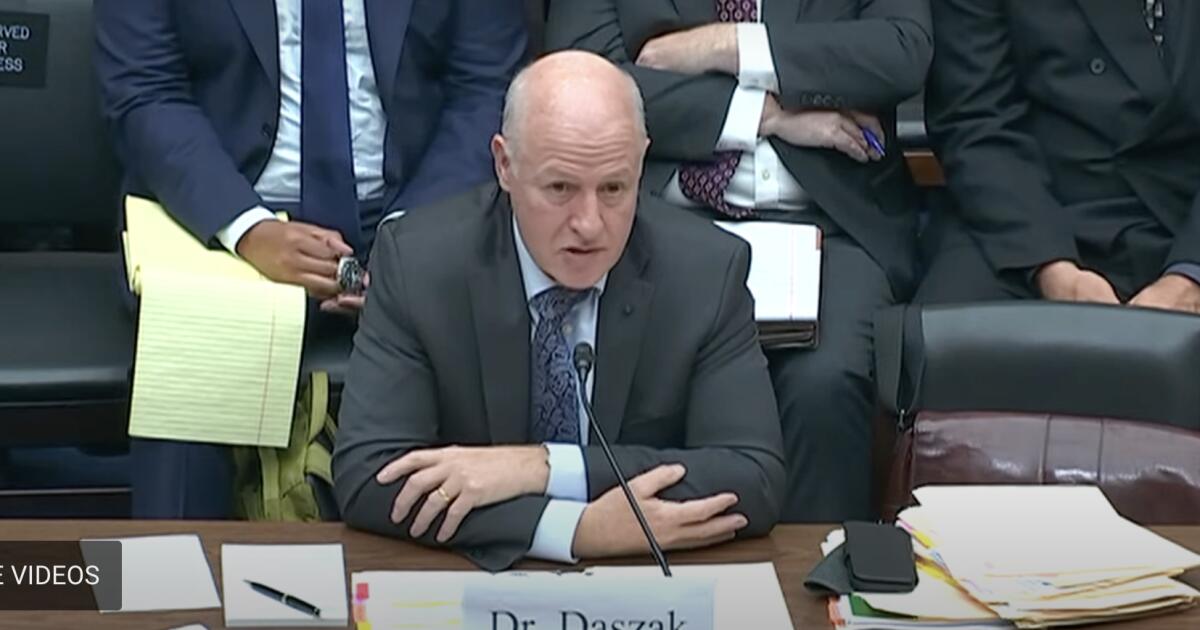
Wednesday’s hearing by the Select Subcommittee on the Coronavirus Pandemic was a crystalline example of the genre. It was designed around the grilling of Peter Daszak, the head of EcoHealth Alliance, which oversees international virus research funded by federal agencies.
The members scraped along rock-bottom, but the most telling moment may have been this exchange between Rep. Morgan Griffith (R-Va.) and Daszak. Asked to explain an apparent (but not real) discrepancy in a progress report EcoHealth submitted to the government, Daszak started to answer, but a theatrically fulminating Griffith cut him off.
Our organization, staff, and even my own family were often targeted with false allegations, death threats, break-ins, media harassment, and other damaging acts.
— Peter Daszak, EcoHealth Alliance
“I can give you the answer to your question,” Daszak said.
“I’m going to answer it for you!” Griffith shot back, then outrageously accused Daszak of lying. Daszak didn’t get a chance to reply.
The whole session, more than three hours, went that way. The members kept peppering Daszak with questions about abstruse matters of science and the grant-making process, only to rudely cut him off when he tried to respond. They misquoted him to his face, misrepresented his work, and spouted cocksure inanities showing with every word that, scientifically speaking, they have no idea what they’re talking about.
Ideally, congressional hearings should be fact-finding efforts. This was nothing of the kind. It was an opportunity for posturing by politicians intent only on smearing Daszak and EcoHealth on the pretext of getting to the bottom of the pandemic’s cause.
How do we know this? From the fact that hours before the hearing even began, the subcommittee released a report calling on the National Institutes of Health and the Department of Health and Human Services to “immediately commence suspension and debarment proceedings against both EcoHealth and Dr. Daszak” — in other words, permanently cut them off from federal funding.
One more thing about this ludicrious cabaret act: The Democratic committee members, who should have been standing up for science and scientists, did the opposite by throwing Daszak under the bus.
In his opening statement, Ranking Member Raul Ruiz (D-Indio), attacked the GOP majority’s preposterous position that the U.S. government funded research that created the virus responsible for COVID-19. But he accepted its position that Daszak “sought to deliberately mislead” government regulators.
Ruiz’s statement was echoed by other Democrats, including Rep. Debbie Dingell (D-Mich.). Perhaps they hoped that by allowing Daszak to be drawn and quartered, they might persuade the Republicans to climb down from their evidence-free claims about government complicity in the pandemic’s origins.
Their hearts didn’t seem to be in it, though; they talked as though their main concern was that EcoHealth was spending government funds. They all seemed to be reading from the same ChatGPT script, the key phrase of which was: “poor steward of the taxpayers’ dollars.” Nothing about EcoHealth’s significant achievements in public health.
That makes the Democrats’ performance all the more shameful and cowardly. They’re knowingly participating in a flagrantly fictitious smear campaign.
Let’s examine the background of this display of partisan grandstanding.
Fundamentally, it’s part of a disreputable campaign to demonize responsible scientists such as Anthony Fauci, who retired in 2022 as director of the National Institute of Allergy and Infectious Diseases and was one of the most respected virologists and public health professionals in the world.
Republican leaders and the right wing have tried to turn Fauci into a sinister figure by advancing the absurd proposition that he somehow played a role in creating COVID-19 and spreading it worldwide, and that he masterminded the nation’s anti-pandemic policies, even though he had zero authority to do so.
This is no innocent game; it has subjected Fauci, who was a top pandemic advisor to Donald Trump until his resistance to Trump’s unhinged takes on the pandemic led to his being sidelined at the White House, to death threats and unending vilification on social media.
Daszak has come in for more than his share of character assassination. Social media posts referring to him have included the image of a guillotine. As the pandemic developed, Daszak told the committee in his opening statement Wednesday, “Our organization, staff, and even my own family were often targeted with false allegations, death threats, break-ins, media harassment, and other damaging acts.”
One recent post on X (formerly Twitter) said “the Daszak family should be shot down.” Daszak says he has asked X to cancel the abusive, anonymous account, without success.
What’s the purpose of this campaign? The attack on the credibility of science and scientists has arisen because validated scientific findings about global warming and the origins of COVID-19 cause economic and political discomfort to Big Business and know-nothings who believe that undermining science will advance their political careers. (I’m looking at you, Robert F. Kennedy Jr.)
An essential tenet of the right-wing position on COVID-19 is that the virus escaped from a Chinese laboratory, specifically the Wuhan Institute of Virology. Superficially this is an alluring theory, since the initial outbreak occurred at a wildlife market in that city. But there is absolutely not a speck of evidence for that theory, and scientific research overwhelmingly indicates that the virus reached humans via a spillover from infected wildlife — the path followed by countless viral outbreaks over human history.
Lab leak advocates love to point to a statement FBI Director Christopher Wray made in an interview with Fox News in March 2023 — that the bureau had concluded with “moderate confidence” that the virus had escaped from the Chinese lab. But he cited no evidence; the FBI’s assessment, which had been previously disclosed, had been part of a survey of all U.S. intelligence agencies that largely contradicted the FBI’s position. And in June, a report from the Office of the Director of National Intelligence refuted claims that the Chinese lab had played any role in the pandemic.
Anyway, the WIV isn’t exactly near the market — it’s miles away on the far side of the Yangtze River, in a city as densely populated as Los Angeles, with almost three times L.A.’s population, and a huge regional transportation and commercial hub.
That brings us back to EcoHealth, which was founded in 1971 and has long been an essential clearinghouse for funding for research into “emerging disease threats to the U.S.,” as Daszak said in his opening statement.
That has included providing funds for the WIV and other research in China, where viruses capable of jumping into the human population — as did SARS-CoV-2, the virus behind COVID-19 — are commonly found in bats, and where a vigorous, illicit trade in wildlife brings millions of humans into direct contact with potential disease carriers.
EcoHealth’s relationship with Chinese research institutions was open and aboveboard, and its funnelling U.S. grants to those institutions explicitly approved by the NIH and HHS.
EcoHealth was long considered a gold-plated research organization. “Their grants, when reviewed scientifically, scored at the highest levels in the scientific community,” says Gerald T. Keusch, a former associate director of international research at NIH. “The work they proposed was absolutely stunningly good.”
An internal memo prepared at NIH for a Fauci news conference in January 2020 described EcoHealth as one of “the biggest players in coronavirus work” and Daszak as one of “the world’s experts in … non-human coronaviruses” such as SARS-CoV-2.
As I’ve reported, EcoHealth’s useful and productive role in virological research began to unravel at a news conference April 17, 2020 when a reporter from a right-wing organization mentioned to then-President Trump that NIH had given a $3.7-million grant to the Wuhan Institute of Virology. (Actually, the WIV grant, which was channeled from a larger EcoHealth grant, was only $600,000).
Trump, sensing an opportunity to show a strong hand against China and advance his effort to blame the Chinese for the pandemic, responded: “We will end that grant very quickly.” The NIH terminated the full EcoHealth grant one week later prompting a backlash from the scientific community, including an open letter signed by 77 Nobel laureates who saw the action as a flagrantly partisan interference in government funding of scientific research.
The HHS inspector general found the termination to be “improper.” NIH reinstated the grant, but immediately suspended it until EcoHealth met several conditions that were manifestly beyond its capability, as they involved its demanding information from the Chinese government that it had no right to receive.
The EcoHealth grant was finally restored in May 2023. By then, EcoHealth no longer had a relationship with WIV, which had been barred from receiving any NIH funds. Still, at the time I celebrated the end of a Trump-inspired three-year shutdown of field work to examine how viruses move from rural wildlife to humans. Unfortunately, that was premature.
Since then, Daszak told me, NIH has continued to erect bureaucratic barriers preventing EcoHealth from accessing funds under the grant, in effect freezing its ability to work.
At Wednesday’s hearing, the GOP tried to pretend that the decision to terminate the grant was all NIH’s idea. “This was not ended by the president of the United States,” declared Mitchell Benzine, counsel to the subcommittee’s Republican majority.
Benzine has a suspiciously short memory. According to documents that the subcommittee itself made public, on Jan. 5 this year, Benzine himself elicited closed-door testimony from Lawrence Tabak, a top NIH official, that after that 2020 news conference “[Trump Chief of Staff] Mark Meadows called the Office of General Counsel at HHS, who then called Dr. Tabak, who then called Dr. [Michael] Lauer, who was instructed to cancel the grant.” Can’t get a much more direct line from Trump to NIH than that.
(Lauer is an NIH functionary who has been a key figure placing the bureaucreatic obstacle course before EcoHealth; my request for comment from him and Tabak was met with a no-comment from NIH.)
Wednesday’s hearing largely recapitulated the attacks on EcoHealth that have been floating in the right-wing fever swamp for four years now. They include a litany of minor bureaucratic snafus, such as a grant progress report that missed a deadline (Daszak said the problem was a glitch in an NIH web portal that prevented it from being submitted on time).
One key assertion is that EcoHealth was funding “gain of function” research at the Wuhan Institute. “Gain of function” is a widely misunderstood term that has become a shibboleth for proponents of the lab-leak hypothesis, who use it as an all-purpose symbol of sinister behavior, like “critical race theory” or “DEI” (diversity, equity and inclusion).
Technically speaking, gain-of-function is a method of modifying a pathogen in the lab to gauge its infectiousness in humans, the better to develop countermeasures such as vaccines. The right-wing claims that such research in China funded by NIH and EcoHealth created SARS-CoV-2, which then escaped into the wild.
There’s no evidence that the Wuhan lab did anything like that, and experienced virologists have questioned whether it’s even technically possible to have created the SARS2 virus given today’s level of knowledge. The U.S. government placed a moratorium on gain-of-function research from 2014 through 2017 to allow for the development of best-practice protocols.
NIH explicitly confirmed to EcoHealth that the studies it was funding didn’t qualify as gain-of-function under its own definition. That didn’t stop the committee members from wasting long swaths of their session accusing Daszak of secretly funding such experiments.
The attacks on EcoHealth appall scientists and public health experts who know that the organization’s work in identifying potential pandemic sources and crafting responses has never been more important. Agricultural authorities are dealing with the spread of a bird flu virus into cattle herds, another case of species-to-species, or zoonotic, viral transmission.
Given the bipartisan attacks against it, whether EcoHealth can avoid being cut off from all government funding is an open question. But that only underscores the supine irresponsibility with which Democrats have bought into the right wing’s attack on the organization and its crucial work.
“We now have zoonotic threats emerging at an accelerating cadence,” says Peter Hotez, a molecular virologist who is dean of the National School of Tropical Medicine at Baylor College of Medicine in Houston.
“This is a time when we need to be doubling down and expanding our global virus surveillance networks,” Hotez told me. “By making up allegations, they’re undermining the work of EcoHealth and other organizations committed to understanding how viruses are jumping from animals to humans. We’re creating incredible vulnerability for ourselves. They’re damaging our national security. That to me is unforgivable — that they’re willing to jeopardize national security for political expedience.”


new video loaded: NASA Announces Artemis III Crew
transcript
transcript
NASA Announces Artemis III Crew
NASA announced the crew of Artemis III mission, which will fly to low-Earth orbit to test rendezvous and docking maneuvers with one or two lunar landers.
-
“I am excited to welcome you as the next crew in the Artemis journey to successfully return to the moon — this time to stay.” “I’m honored by the role that I’ve been given. I’m also very humbled by the task in front of us. But first and foremost, I’m grateful.” “So with that, the Artemis II crew, comrade, hands you the baton. You got the controls.” “As you know, we had a significant anomaly at our Launch Complex 36A on May 28. We’ve redoubled our efforts and are moving forward.”
By Alisa Shodiyev Kaff
June 9, 2026
Science
Santa Monica Mountains’ last steelhead trout survived the Palisades fire — and even had babies

Scientists feared the Santa Monica Mountains’ last remaining steelhead trout were dead, smothered by debris flows unleashed by the Palisades fire.
But the endangered fish surprised them: A team of biologists recently spotted 30 of the rare trout — and 21 babies — in Topanga Creek.
“There was a lot of happy dancing in the creek,” said Rosi Dagit, principal conservation biologist for the Resource Conservation District of the Santa Monica Mountains, which works with public and private landowners to conserve natural resources.
That’s because the steelhead here are endangered, at both the state and federal levels. Once, they swam in most streams of the Santa Monicas, but their numbers plummeted amid overfishing and coastal development. Increasingly frequent wildfire has further stressed their habitat. Topanga Creek, a biodiversity hot spot, is home to their last known population in the mountains that stretch from the Hollywood Hills to Point Mugu in Ventura County.
The trout that were spotted, including this one, are part of a distinct Southern California population that’s listed as endangered at the state and federal levels.
(RCDSMM Stream Team)
The California Department of Fish and Wildlife spearheaded a complex mission to rescue trout threatened by the Palisades fire that sparked in January 2025.
Time was of the essence. The fire hadn’t yet been fully contained. But rain was on the way, which would sweep massive amounts of sediment from the denuded hillsides into the water. Fish are often killed this way.
Crews stunned the fish with electricity, scooped them up in buckets, trucked them to a hatchery and ultimately moved them to Arroyo Hondo Creek in Santa Barbara County.
Within days, Topanga Creek was choked with mud. Some assumed the fish left behind were goners.
But in March, the conservation district’s team found four. The following month, when water conditions were clearer, they saw more.
“These fish continue to amaze me,” said Kyle Evans, environmental program manager for the state Department of Fish and Wildlife, who had seen the damage to the creek. “I had seen populations get wiped out in similar situations. So when I heard, I was thrilled.”
Evans surmises the fish that survived were in an area of the creek where less charred material and sediment were swept in.
“These fish likely hunkered down, were hiding under some rocks or places to try to get away from the main concentration of flow,” he said. “And luckily they weren’t buried.”
The ones that were spotted were fairly small, around 6 to 14 inches. Rainbow trout and steelhead trout are the same species, but with different lifestyles. If the fish remain in freshwater, they’ll be considered rainbows. However, they can migrate to the ocean and become steelhead, where they typically grow larger before returning to their natal waters to spawn.
Topanga Creek hasn’t fully recovered from the damage it sustained, but scientists say it’s looking better. Surveys last year were “so depressing,” Dagit said, with very few animals, and stretches that were essentially transformed into flat roads from all the sediment buildup. Some of the riparian canopy burned right down to the creek.
Then came 32 inches of rain over the last nine months, scouring out and moving sediment, creating deeper pools. Dagit said they recently found newt egg masses for the first time in years, as well as a few adult newts and many frogs. Plants that provide cover are starting to recover.
She provided photos comparing certain pools last year and this year, some dramatically transformed. In September 2025, the Shrine Pool could have been an overgrown hiking trail. This April, it was filled with shallow water.

The Shrine Pool in September 2025, left, and the same location in April 2026, right, with RCDSMM’s Isaac Yelchin donning a wetsuit.
(RCDSMM Stream Team)
Topanga Creek is home to another endangered fish, the small but hardy northern tidewater goby, often described as cute. Not long before the trout operation, Dagit led a rescue of hundreds of these fish too. Many were repatriated to the lagoon at the mouth of the creek in a moving ceremony last June.
There’s still the matter of what to do with the trout that were moved to Santa Barbara County last year. Evans would like to bring them home to the Santa Monicas at some point, but isn’t sure if it will happen. On one hand, they could bolster the small, genetically isolated surviving population. On the other, they might inadvertently bring in a disease or bacteria. There is some time to decide. Evans estimates the creek still needs to recover for two to three more years.
For now, the fish are functioning fine in their adopted creek. Experts worried the trauma wrought by the move would disrupt their spawning process, but they had babies that spring. This year, they spawned again.

The Pacifica Municipal Pier was shut down and taped off Thursday after city workers noticed cracks running through the landmark structure and concrete chunks falling into the ocean.
It’s just one of many coastal California structures that have recently crumbled under pressure from a rising and relentless ocean.
Officials from the small, beach city south of San Francisco said the pier was closed due to “cracking, separation, and displacement of the concrete walkway and structural elements.”
It will stay closed while structural engineers asses its safety.
Photos taken by city employees show a wide crack that runs from top to bottom and across the structure as well. Other photos show a large horizontal crack under the foundation of a small restaurant on the pier, the Chit Chat Cafe.
The cafe was also shut down.
This is not the first time the 53-year-old pier has shown signs of stress. In 2021, part of it was shut down after handrails along the edge collapsed. And in 2023, after a series of storms pummeled the Central California coast, damaging parts of the pier, the structure was partially closed for more than year.
Those same storms caused extensive damage in Aptos and Capitola, 70 miles south, where piers and waterfront infrastructure were swept away or damaged.
In 2024, a 150- to 180- foot section of the Santa Cruz wharf was ripped off by powerful waves.
At least 10 of the state’s dozens of coastal public piers were closed for part or all of 2024 due to structural damage sustained in winter storms since 2022. At least five others have longer-term upgrades planned to address structural issues.
“These things are costly to maintain,” said Zach Plopper, senior environmental director at Surfrider. “They are a part of our California coastal culture in many ways, but we’re going to need to reckon with, one, the state that they’re in, and two, the continuous and worsening threats they’re going to experience,”
He said most of the piers were constructed in the early 1900s, and they weren’t built to withstand decades of rough seas, storms and rising sea level.
“With this incoming El Niño, which is forecasted to be significant, and this marine heat wave we’re in the midst of, we’re kind of in uncharted waters as far as what this winter could bring in terms of storms and swells to the California coast, and we’re likely going to see a lot more damage,” he said. “Not just piers, but roads and other coastal infrastructure up and down the state.”
There was no storm in Pacifica earlier this week, so no single event could be blamed for the destruction.
However, a 2025 report from an outside engineering firm, GHD, found that several sections of the pier were in “poor” or “serious” condition, and they recommended closure before anticipated storms or events that could “subject the piles to high winds, swells and large waves.”
The firm found several areas of the pier where concrete was missing and rebar was exposed and corroding.
“The pier has continued to experience high winds and large waves in a harsh marine environment,” the engineers wrote in the report, noting that continuous exposure to seawater or marine spray was “detrimental” to the structure.
A 2023 city report estimated it would cost $19 million to repair.
That same year, a state law was enacted to require local governments along the California coast to plan for sea level rise in the coming decades.
Sea level has risen some 8 inches, on average, along the coast in the past 150 years, Plopper said, and researchers anticipate another foot in the next 25 years.
“We’re going to see profound shifts on our coastline, none that we have ever experienced before, and building static structures on the coast just doesn’t work all that well,” he said. “We’re going to have to make some really hard decisions.”
-

 South Dakota5 minutes ago
What to know about the SD’s first gubernatorial runoff
-

 Tennessee12 minutes ago
Comparing Tennessee’s Neyland Entertainment District to others in college sports
-

 Texas15 minutes ago
Where to watch Texas Rangers vs Kansas City Royals: TV channel, start time, streaming for June 10
-

 Utah20 minutes ago
New NBA Draft Intel: AJ Dybantsa, Darryn Peterson and Utah
-

 Vermont27 minutes ago
Vermont Green FC plays Canada’s national soccer team in World Cup tuneup – VTDigger
-

 Virginia30 minutes ago
Navy sailor sentenced to 44 years for killing fellow service member Angelina Resendiz in his Virginia barracks room
-
Washington35 minutes ago
Where to watch Washington Nationals vs San Francisco Giants: TV channel, start time, streaming for June 10
-

 Wisconsin42 minutes ago
Chris Borland heads back to Wisconsin as Hall of Fame inductee

