Science
California effort to confront implicit bias among doctors faces 1st Amendment challenge


Los Angeles anesthesiologist Dr. Marilyn Singleton was outraged about a California requirement that every continuing medical education course include training in implicit bias — the ways in which physicians’ unconscious attitudes might contribute to racial and ethnic disparities in healthcare.
Singleton, who is Black and has practiced for 50 years, sees calling doctors out for implicit bias as divisive, and argues that the state cannot legally require her to teach the idea in her continuing education classes. She has sued the Medical Board of California, asserting a constitutional right not to teach something she doesn’t believe.
The way to address healthcare disparities is to target low-income people for better access to care, rather than “shaking your finger” at white doctors and crying “racist,” she said. “I find it an insult to my colleagues to imply that they won’t be a good doctor if a racially divergent patient is in front of them.”
The litigation is part of a national crusade by right-leaning advocacy and legal groups against diversity, equity and inclusion, or DEI, initiatives in healthcare. The resistance is inspired in part by last year’s U.S. Supreme Court ruling barring affirmative action in higher education.
The California lawsuit does not dispute the state’s authority to require implicit-bias training. It questions only whether the state can require all teachers to discuss implicit bias in their continuing medical education courses. The suit’s outcome, however, could influence obligatory implicit-bias training for all licensed professionals.
Leading the charge is the Pacific Legal Foundation, a Sacramento-based organization that describes itself as a “national public interest law firm that defends Americans from government overreach and abuse.” Its clients include the activist group Do No Harm, founded in 2022 to fight affirmative action in medicine. The two groups have also joined forces to sue the Louisiana medical board and the Tennessee podiatry board for reserving board seats exclusively for racial minorities.
In their complaint against the California Medical Board, Singleton and Do No Harm, along with Los Angeles ophthalmologist Dr. Azadeh Khatibi, argue that the implicit-bias training requirement violates the 1st Amendment rights of doctors who teach continuing medical education courses by requiring them to discuss how unconscious bias based on race, ethnicity, gender identity, sexual orientation, age, socioeconomic status or disability can alter treatment.
“It’s the government saying doctors must say things, and that’s not what our free nation stands for,” said Khatibi, who immigrated to the U.S. from Iran as a child. Unlike Singleton, Khatibi does believe implicit bias can unintentionally result in substandard care. But, she said, “on principle, I don’t believe in the government compelling speech.”
The lawsuit challenges the evidence of implicit bias in healthcare, saying there is no proof that efforts to reduce bias are effective. Interventions have thus far not demonstrated lasting effects, studies have found.
In December, U.S. District Judge Dale S. Fischer dismissed the suit but allowed the Pacific Legal Foundation to file an amended complaint. A hearing is scheduled for March 11 in federal court in Los Angeles.
In enacting the training requirement, the California Legislature found that physicians’ biased attitudes unconsciously contribute to healthcare disparities. It also found that racial and ethnic disparities in healthcare outcomes are “remarkably consistent” across a range of illnesses and persist even after adjusting for socioeconomic differences, whether patients are insured and other factors influencing care.
Black women are three to four times as likely as white women to die of pregnancy-related causes, are often prescribed less pain medication than white patients with the same complaints, and are referred less frequently for advanced cardiovascular procedures, the Legislature found.
It also noted that women treated by female doctors were more likely to survive heart attacks than those treated by men. This month, the Legislature’s Black Caucus unveiled a bill requiring implicit-bias training for all maternal care providers in the state.
Dr. Khama Ennis, who teaches an implicit-bias class for Massachusetts doctors, sees only the best intentions in her fellow physicians. “But we’re also human,” she said in an interview. “And to not acknowledge that we are just as susceptible to bias as anybody else in any other field is unfair to patients.”
Ennis offered an example of her own bias in a training session. Preparing to treat a patient in a hospital emergency room, she noticed a Confederate flag tattoo on his forearm.
“As a Black woman, I had to have a quick chat with myself,” she said. “I needed to ensure that I provided the same standard of care for him that I would for anyone else.”
Ennis’ class meets the requirements of a Massachusetts law that physicians earn two hours of instruction in implicit bias to obtain or renew their licenses, as of 2022.
That same year, California began requiring that all accredited continuing medical education courses involving direct patient care include discussion of implicit bias. The state mandates 50 hours of continuing education every two years for doctors to maintain their licenses. Private institutions offer courses on an array of topics, and physicians generally teach them.
Teachers may tell students they do not believe implicit bias drives healthcare disparities, Fischer wrote in her December ruling. But the state, which licenses doctors, has the right to decide what must be included in the classes, the judge wrote.
Professionals who elect to teach courses “must communicate the information that the legislature requires medical practitioners to have,” the judge wrote. “When they do so, they do not speak for themselves, but for the state.”
Whether they speak for themselves or for the state is a pivotal question. While the 1st Amendment protects private citizens’ right to free speech, that protection does not extend to government speech. The content of public school curricula, for example, is the speech of state government, not the speech of teachers, parents or students, courts have said.
The Pacific Legal Foundation’s amended complaint aims to convince the judge that its clients teach as private citizens with 1st Amendment rights. If the judge again rules otherwise, lead attorney Caleb Trotter said, he plans to appeal the decision to the U.S. Court of Appeals for the 9th Circuit, and, if necessary, the Supreme Court.
“This is not government speech at all,” he said. “It’s private speech, and the 1st Amendment should apply.”
“Plaintiffs are plainly wrong,” lawyers for Rob Bonta, the state attorney general, responded in court papers. “There can be no dispute that the State shapes or controls the content of continuing medical education courses.”
The medical board declined to comment on the pending litigation.
From 2019 through July 2022, in addition to California and Massachusetts, four states enacted legislation requiring healthcare providers to be trained in implicit bias.
A landmark 2003 Institute of Medicine report, “Unequal Treatment,” found that limited access to care and other socioeconomic differences explain only part of racial and ethnic disparities in treatment outcomes. The expert panel concluded that clinicians’ prejudices could also contribute.
In the two decades since the report’s release, studies have documented that bias does influence clinical care and contribute to racial disparities, a 2022 report said.
But implicit-bias training might have no impact and might even worsen discriminatory care, the report found.
“There’s not really evidence that it works,” Khatibi said. “To me, addressing healthcare disparities is really important because lives are at stake. The question is, how do you want to achieve these ends?”
KFF Health News, formerly known as Kaiser Health News, is a national newsroom that produces in-depth journalism about health issues.


new video loaded: NASA Announces Artemis III Crew
transcript
transcript
NASA Announces Artemis III Crew
NASA announced the crew of Artemis III mission, which will fly to low-Earth orbit to test rendezvous and docking maneuvers with one or two lunar landers.
-
“I am excited to welcome you as the next crew in the Artemis journey to successfully return to the moon — this time to stay.” “I’m honored by the role that I’ve been given. I’m also very humbled by the task in front of us. But first and foremost, I’m grateful.” “So with that, the Artemis II crew, comrade, hands you the baton. You got the controls.” “As you know, we had a significant anomaly at our Launch Complex 36A on May 28. We’ve redoubled our efforts and are moving forward.”
By Alisa Shodiyev Kaff
June 9, 2026
Science
Santa Monica Mountains’ last steelhead trout survived the Palisades fire — and even had babies

Scientists feared the Santa Monica Mountains’ last remaining steelhead trout were dead, smothered by debris flows unleashed by the Palisades fire.
But the endangered fish surprised them: A team of biologists recently spotted 30 of the rare trout — and 21 babies — in Topanga Creek.
“There was a lot of happy dancing in the creek,” said Rosi Dagit, principal conservation biologist for the Resource Conservation District of the Santa Monica Mountains, which works with public and private landowners to conserve natural resources.
That’s because the steelhead here are endangered, at both the state and federal levels. Once, they swam in most streams of the Santa Monicas, but their numbers plummeted amid overfishing and coastal development. Increasingly frequent wildfire has further stressed their habitat. Topanga Creek, a biodiversity hot spot, is home to their last known population in the mountains that stretch from the Hollywood Hills to Point Mugu in Ventura County.
The trout that were spotted, including this one, are part of a distinct Southern California population that’s listed as endangered at the state and federal levels.
(RCDSMM Stream Team)
The California Department of Fish and Wildlife spearheaded a complex mission to rescue trout threatened by the Palisades fire that sparked in January 2025.
Time was of the essence. The fire hadn’t yet been fully contained. But rain was on the way, which would sweep massive amounts of sediment from the denuded hillsides into the water. Fish are often killed this way.
Crews stunned the fish with electricity, scooped them up in buckets, trucked them to a hatchery and ultimately moved them to Arroyo Hondo Creek in Santa Barbara County.
Within days, Topanga Creek was choked with mud. Some assumed the fish left behind were goners.
But in March, the conservation district’s team found four. The following month, when water conditions were clearer, they saw more.
“These fish continue to amaze me,” said Kyle Evans, environmental program manager for the state Department of Fish and Wildlife, who had seen the damage to the creek. “I had seen populations get wiped out in similar situations. So when I heard, I was thrilled.”
Evans surmises the fish that survived were in an area of the creek where less charred material and sediment were swept in.
“These fish likely hunkered down, were hiding under some rocks or places to try to get away from the main concentration of flow,” he said. “And luckily they weren’t buried.”
The ones that were spotted were fairly small, around 6 to 14 inches. Rainbow trout and steelhead trout are the same species, but with different lifestyles. If the fish remain in freshwater, they’ll be considered rainbows. However, they can migrate to the ocean and become steelhead, where they typically grow larger before returning to their natal waters to spawn.
Topanga Creek hasn’t fully recovered from the damage it sustained, but scientists say it’s looking better. Surveys last year were “so depressing,” Dagit said, with very few animals, and stretches that were essentially transformed into flat roads from all the sediment buildup. Some of the riparian canopy burned right down to the creek.
Then came 32 inches of rain over the last nine months, scouring out and moving sediment, creating deeper pools. Dagit said they recently found newt egg masses for the first time in years, as well as a few adult newts and many frogs. Plants that provide cover are starting to recover.
She provided photos comparing certain pools last year and this year, some dramatically transformed. In September 2025, the Shrine Pool could have been an overgrown hiking trail. This April, it was filled with shallow water.

The Shrine Pool in September 2025, left, and the same location in April 2026, right, with RCDSMM’s Isaac Yelchin donning a wetsuit.
(RCDSMM Stream Team)
Topanga Creek is home to another endangered fish, the small but hardy northern tidewater goby, often described as cute. Not long before the trout operation, Dagit led a rescue of hundreds of these fish too. Many were repatriated to the lagoon at the mouth of the creek in a moving ceremony last June.
There’s still the matter of what to do with the trout that were moved to Santa Barbara County last year. Evans would like to bring them home to the Santa Monicas at some point, but isn’t sure if it will happen. On one hand, they could bolster the small, genetically isolated surviving population. On the other, they might inadvertently bring in a disease or bacteria. There is some time to decide. Evans estimates the creek still needs to recover for two to three more years.
For now, the fish are functioning fine in their adopted creek. Experts worried the trauma wrought by the move would disrupt their spawning process, but they had babies that spring. This year, they spawned again.

The Pacifica Municipal Pier was shut down and taped off Thursday after city workers noticed cracks running through the landmark structure and concrete chunks falling into the ocean.
It’s just one of many coastal California structures that have recently crumbled under pressure from a rising and relentless ocean.
Officials from the small, beach city south of San Francisco said the pier was closed due to “cracking, separation, and displacement of the concrete walkway and structural elements.”
It will stay closed while structural engineers asses its safety.
Photos taken by city employees show a wide crack that runs from top to bottom and across the structure as well. Other photos show a large horizontal crack under the foundation of a small restaurant on the pier, the Chit Chat Cafe.
The cafe was also shut down.
This is not the first time the 53-year-old pier has shown signs of stress. In 2021, part of it was shut down after handrails along the edge collapsed. And in 2023, after a series of storms pummeled the Central California coast, damaging parts of the pier, the structure was partially closed for more than year.
Those same storms caused extensive damage in Aptos and Capitola, 70 miles south, where piers and waterfront infrastructure were swept away or damaged.
In 2024, a 150- to 180- foot section of the Santa Cruz wharf was ripped off by powerful waves.
At least 10 of the state’s dozens of coastal public piers were closed for part or all of 2024 due to structural damage sustained in winter storms since 2022. At least five others have longer-term upgrades planned to address structural issues.
“These things are costly to maintain,” said Zach Plopper, senior environmental director at Surfrider. “They are a part of our California coastal culture in many ways, but we’re going to need to reckon with, one, the state that they’re in, and two, the continuous and worsening threats they’re going to experience,”
He said most of the piers were constructed in the early 1900s, and they weren’t built to withstand decades of rough seas, storms and rising sea level.
“With this incoming El Niño, which is forecasted to be significant, and this marine heat wave we’re in the midst of, we’re kind of in uncharted waters as far as what this winter could bring in terms of storms and swells to the California coast, and we’re likely going to see a lot more damage,” he said. “Not just piers, but roads and other coastal infrastructure up and down the state.”
There was no storm in Pacifica earlier this week, so no single event could be blamed for the destruction.
However, a 2025 report from an outside engineering firm, GHD, found that several sections of the pier were in “poor” or “serious” condition, and they recommended closure before anticipated storms or events that could “subject the piles to high winds, swells and large waves.”
The firm found several areas of the pier where concrete was missing and rebar was exposed and corroding.
“The pier has continued to experience high winds and large waves in a harsh marine environment,” the engineers wrote in the report, noting that continuous exposure to seawater or marine spray was “detrimental” to the structure.
A 2023 city report estimated it would cost $19 million to repair.
That same year, a state law was enacted to require local governments along the California coast to plan for sea level rise in the coming decades.
Sea level has risen some 8 inches, on average, along the coast in the past 150 years, Plopper said, and researchers anticipate another foot in the next 25 years.
“We’re going to see profound shifts on our coastline, none that we have ever experienced before, and building static structures on the coast just doesn’t work all that well,” he said. “We’re going to have to make some really hard decisions.”
-
 Politics7 minutes ago
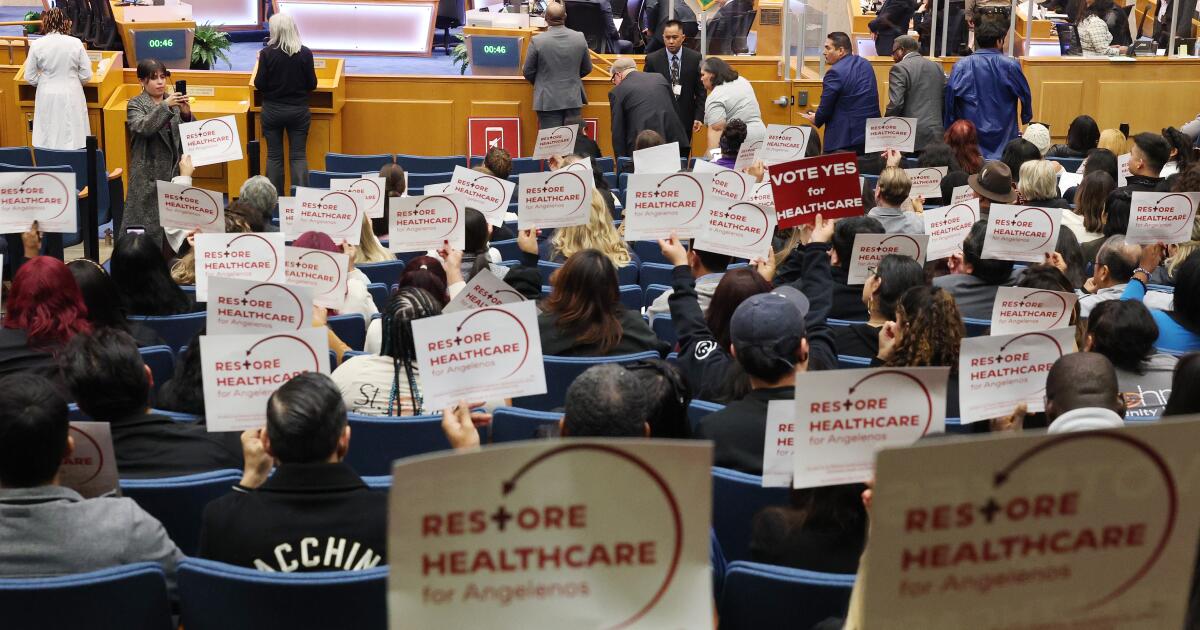
Supporters of L.A. County healthcare sales tax declare victory
-
 Sports19 minutes ago
USC freshman linebacker Talanoa Ili joins lawsuit seeking to upend new NIL system
-

 World27 minutes ago
Who has the most and fewest judges in the EU?
-
 News47 minutes ago
In Nevada, Trump’s policies are making things tough for Republican Gov. Joe Lombardo
-

 New York2 hours ago
This Parking Spot Is Free. Should It Be?
-

 Los Angeles, Ca2 hours ago
O.C. Uber customer says driver asleep in Tesla on 405 Freeway
-

 Detroit, MI3 hours ago
One person dead, another in custody following shooting in Detroit, police say
-

 San Francisco, CA3 hours ago
Bay Area artists celebrate Wong Kim Ark’s legacy in San Francisco’s Chinatown

