Science
A new coronavirus variant may be behind California's COVID rise

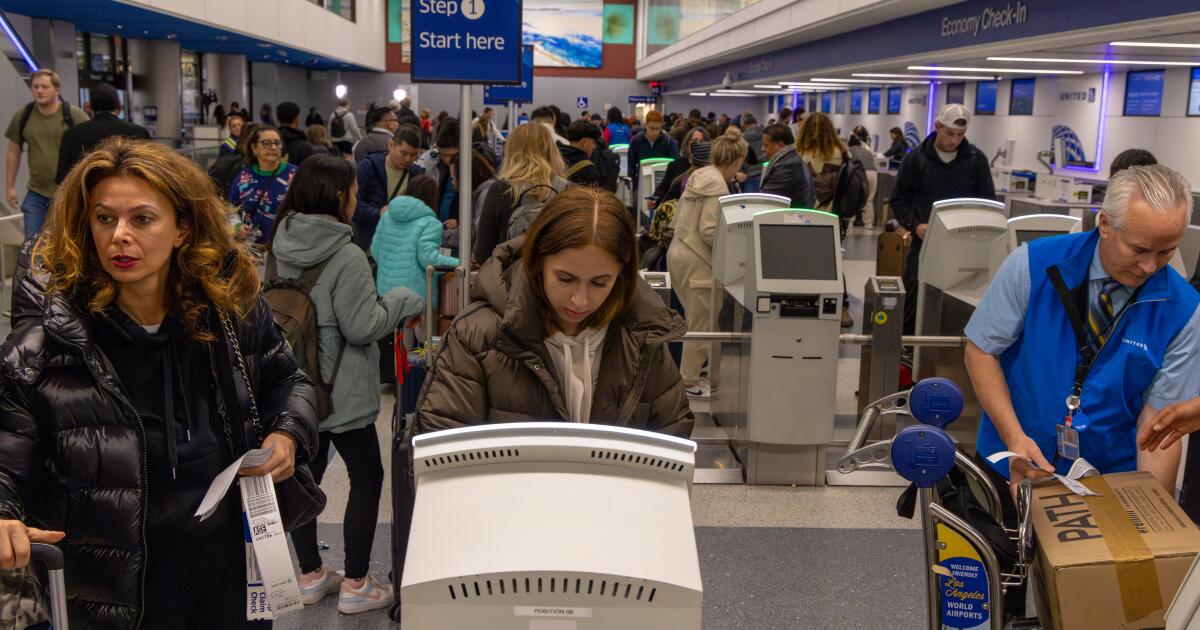
Coronavirus transmission is once again spiking in California entering the winter holiday season — and a new subvariant may be partly to blame, officials say.
This latest subvariant, JN.1, is now estimated to account for roughly 44% of COVID-19 cases nationally, according to the latest data from the U.S. Centers for Disease Control and Prevention.
That share is twice as high as any other identified subvariant, and a startling rise from the prior estimate of 21% for the two-week period that ended Dec. 9.
“We’re also seeing an increasing share of infections caused by JN.1 in travelers, wastewater and most regions around the globe,” the CDC said in a statement. “JN.1’s continued growth suggests that the variant is either more transmissible or better at evading our immune systems than other circulating variants.”
The World Health Organization this week classified JN.1 as a “variant of interest,” meaning it has potentially concerning characteristics — such as an ability to more easily infect individuals or avoid the protection afforded by vaccines and therapeutics.
Current vaccines, anti-COVID drugs and tests continue to work well against JN.1, the CDC said.
JN.1 is an offshoot of another Omicron subvariant, BA.2.86, which was unofficially nicknamed Pirola.
Pirola was already deemed worrisome because of its unusually high number of mutations, which might empower it to more easily infect those who haven’t received a recent COVID-19 vaccination. JN.1 has an additional mutation.
Experts say all those mutations mean it’s likely that people who have been relying on older vaccinations received more than a year ago, or a previous infection earlier this year, may not be protected enough to avoid a new run-in with the coronavirus this winter.
“It is possible that at least part of the local increase in transmission is driven by new COVID-19 strains gaining dominance in Los Angeles County, including JN.1,” the county Department of Public Health said in a statement.
Doctors say the rise of JN.1 is another reason why people — especially those who are older — should get the latest COVID-19 vaccination that became available in September.
Coronavirus transmission and COVID-19 hospitalizations, though undoubtedly on the rise, aren’t at the levels seen at this same time last year.
But the increase has been sharp. For the week ending Dec. 16, there were 2,924 new coronavirus-positive hospital admissions in California, up nearly 50% from a month earlier.
And it’s not just COVID-19. Clinics in Southern California report being busy with other viral illnesses, too — namely flu and respiratory syncytial virus, or RSV.
“Definitely, we’re seeing more people that are coming through the door, especially the younger and the older,” said Dr. Daisy Dodd, an infectious disease specialist with Kaiser Permanente Orange County. People with underlying medical issues, such as diabetes and asthma, she added, are “much more symptomatic.”
In L.A. County, about 18% of specimens tested at sentinel labs are coming back positive for flu, as are 12% of specimens tested for RSV and 11% tested for the coronavirus. The test positive rates of flu and the coronavirus are continuing to grow, while the rate for RSV has plateaued at a high level.
Coronavirus levels recorded in L.A. County’s wastewater have doubled over the last month. For the week ending Dec. 9, the most recent data available, viral levels in sewage were at 39% of the peak seen last winter, the most recent major spike for the region.
But the increase in infections, to this point, has not translated into a surge of people needing intensive care, Dodd said.
At UC San Francisco, there are now 27 coronavirus-positive patients who are currently hospitalized, up from around 20 a few weeks ago. Earlier in November, that census was in the 10s, said Dr. Peter Chin-Hong, an infectious disease specialist there.
“That is probably fueled by this new variant, JN.1,” Chin-Hong said. “It’s not that the variant causes people to be sicker. It’s just that if a lot of people are infected, a proportion of them will go to the hospital. And the more people that get infected, that number is higher.”
Notably, COVID-19, flu and RSV seem to be all “colliding this year,” Chin-Hong said. “Last year, RSV would have gone down by now.”
Other factors in the spread of COVID-19, which have been seen consistently this time of year since the pandemic began, are holiday travel and gatherings indoors. And in the first holiday season since the end of COVID’s emergency phase, people are perhaps not being as cautious as they once were in terms of testing or staying at home if they are sick.
Dr. Rafael Montalvo — chair of the urgent care department for the Facey Medical Group, which oversees clinics in Burbank, Mission Hills and Valencia — said some patients who are sick have been fairly nonchalant about their illness and are eager to work or remain out and about. Healthcare workers, he said, take care to try to convince patients to stay home when they’re ill.
“They’re actually pretty surprised when they [found out they’ve] come down with COVID,” Montalvo said. Unlike before, when people might have known where they picked up the coronavirus, “now, they’re not aware of any direct exposures.”
For the week ending Dec. 16, there were an average of 601 coronavirus-positive people in L.A. County’s hospitals, up about 66% from the prior month.
The burden COVID is posing on L.A. County’s health system is still relatively low, however. For the week that ended Dec. 9, L.A. County was reporting 6.5 new coronavirus-positive hospital admissions for every 100,000 residents, which is considered a low level as defined by the CDC.
Still, there may be some warning signs. There were 24 new COVID outbreaks in skilled nursing facilities for the week that ended Tuesday, which represents a medium level of concern in the county’s established rubric. And for the week that ended Sunday, 5% of emergency department encounters in L.A. County were classified as related to the coronavirus, also enough to warrant a medium level of concern.
In Santa Clara County, Northern California’s most populous, coronavirus levels in the San Jose area’s sewage are at 62% of last winter’s peak.
Hospital conditions are worse elsewhere. Fresno County, which like the wider Central Valley has been particularly hard hit throughout the pandemic, said its hospitals are reporting “severely impacted conditions … due to a historic number of admitted patients and people accessing the emergency department with non-urgent medical problems.”
Fresno County’s hospitals are operating at least 20% to 40% over capacity, and “are holding admitted patients in their emergency department for up to four days and are using conference rooms and non-patient areas to hold patients,” the local Department of Public Health said in a statement. Emergency room waiting times are now routinely exceeding 10 hours for some patients.
“We need everyone’s help to slow down the number of people using the emergency room for non-emergency medical issues,” Dan Lynch, the county’s emergency medical services director, said in a statement.
The CDC recommends that virtually everyone age 6 months and older get a fresh COVID-19 and flu vaccination this winter. RSV vaccinations are also available for babies, those age 60 and older, and those who are pregnant.
Uptake of the most recent COVID-19 vaccination has been lackluster, however. Across California as of Nov. 30, 27% of seniors age 65 and up have received the latest shot. That rate is 21% in L.A. County, 25% in Orange County, and 27% in San Diego and Ventura counties; but less than 20% in the Inland Empire.
In the San Francisco Bay Area’s most populous counties, around 40% of seniors have received the latest COVID-19 vaccination.
As of Dec. 9, just 42% of adults nationwide had received a flu shot, 18% had received an updated COVID-19 vaccine, and 17% of those age 60 and up had received an RSV vaccine, according to reports published this week by the CDC. Notably, just one in three nursing home residents were up to date with their COVID-19 vaccinations.
“Many adults who had not received the vaccines reported being open to vaccination,” one of the reports said.
The public health risk posed by JN.1 is similar to other subvariants in the sprawling Omicron family, the first version of which emerged a little more than two years ago. While these variants don’t pose the same threat as years prior, given a degree of immunity from past infections and immunizations, people who haven’t received a recent COVID-19 vaccination — particularly the new formula — are at greater risk.
“JN.1 [and other coronavirus variants] continue to cause disease and too many are falling ill, requiring hospitalizations or advanced clinical care, are dying, and developing long COVID,” Maria Van Kerkhove, WHO’s technical lead on COVID-19, wrote in a social media post. Nationally, about 1,000 coronavirus-infected people a week are dying.
Health officials have also urged people and healthcare providers to utilize anti-COVID drugs like Paxlovid when possible.
Some have been reluctant to take or prescribe the drug after reading last year of a purported “post-Paxlovid rebound,” in which COVID-19 symptoms reappear after having seemingly resolved. However, doctors have also long noted that COVID rebound can happen without taking Paxlovid. And a new study published this week by the CDC reaffirmed that COVID rebound can happen regardless of whether one takes anti-COVID drugs like Paxlovid or molnupiravir.
“Rebound should not deter providers from prescribing lifesaving antiviral treatments when indicated to prevent morbidity and mortality from COVID-19,” the report said.
CDC Director Dr. Mandy Cohen and others have urged people to take non-pharmaceutical precautions, such as wearing a mask in public settings, moving gatherings outdoors and improving ventilation, staying home when sick and avoiding people who are ill.
Other now-familiar measures include using hand sanitizer or regularly washing your hands, especially before eating, after sneezing or coughing, or while in public, the L.A. County Department of Public Health said.
“Consider talking with friends and family so they know to be cautious about gathering if they show signs of infection,” such as having a sore throat or a fever, the agency said. “Event hosts may want to consider asking their guests to test for COVID-19 before celebrations, especially if older or immunocompromised people will be present.”
California continues to require most insurers to reimburse covered people for the costs of up to eight at-home COVID tests per month, although people may need to obtain the tests through an “in-network” provider for the tests to remain free.
People who test positive for the coronavirus should isolate for at least five days following onset of symptoms or their first positive test result, whichever came first. The day a person starts having symptoms or had their first positive test is considered Day Zero, and the earliest a patient can exit isolation is by the end of Day 5.
According to the L.A. County Department of Public Health, infected people can end isolation after Day 5 if they have been fever free for 24 hours without using fever-reducing medications, and don’t have any other symptoms, or their symptoms are mild and improving.
The agency strongly recommends people get a negative rapid test result before ending isolation between Days 6 and 10. Isolation can generally end after Day 10 without needing a negative test result, unless you still have a fever.
Infected people are encouraged to wear a mask around others for a full 10 day-period following onset of symptoms or their first positive test. But the agency says that people who meet the criteria to end isolation after Day 5 can stop wearing a mask, too, if they have two consecutive negative coronavirus test results taken at least one day apart.


new video loaded: NASA Announces Artemis III Crew
transcript
transcript
NASA Announces Artemis III Crew
NASA announced the crew of Artemis III mission, which will fly to low-Earth orbit to test rendezvous and docking maneuvers with one or two lunar landers.
-
“I am excited to welcome you as the next crew in the Artemis journey to successfully return to the moon — this time to stay.” “I’m honored by the role that I’ve been given. I’m also very humbled by the task in front of us. But first and foremost, I’m grateful.” “So with that, the Artemis II crew, comrade, hands you the baton. You got the controls.” “As you know, we had a significant anomaly at our Launch Complex 36A on May 28. We’ve redoubled our efforts and are moving forward.”
By Alisa Shodiyev Kaff
June 9, 2026
Science
Santa Monica Mountains’ last steelhead trout survived the Palisades fire — and even had babies

Scientists feared the Santa Monica Mountains’ last remaining steelhead trout were dead, smothered by debris flows unleashed by the Palisades fire.
But the endangered fish surprised them: A team of biologists recently spotted 30 of the rare trout — and 21 babies — in Topanga Creek.
“There was a lot of happy dancing in the creek,” said Rosi Dagit, principal conservation biologist for the Resource Conservation District of the Santa Monica Mountains, which works with public and private landowners to conserve natural resources.
That’s because the steelhead here are endangered, at both the state and federal levels. Once, they swam in most streams of the Santa Monicas, but their numbers plummeted amid overfishing and coastal development. Increasingly frequent wildfire has further stressed their habitat. Topanga Creek, a biodiversity hot spot, is home to their last known population in the mountains that stretch from the Hollywood Hills to Point Mugu in Ventura County.
The trout that were spotted, including this one, are part of a distinct Southern California population that’s listed as endangered at the state and federal levels.
(RCDSMM Stream Team)
The California Department of Fish and Wildlife spearheaded a complex mission to rescue trout threatened by the Palisades fire that sparked in January 2025.
Time was of the essence. The fire hadn’t yet been fully contained. But rain was on the way, which would sweep massive amounts of sediment from the denuded hillsides into the water. Fish are often killed this way.
Crews stunned the fish with electricity, scooped them up in buckets, trucked them to a hatchery and ultimately moved them to Arroyo Hondo Creek in Santa Barbara County.
Within days, Topanga Creek was choked with mud. Some assumed the fish left behind were goners.
But in March, the conservation district’s team found four. The following month, when water conditions were clearer, they saw more.
“These fish continue to amaze me,” said Kyle Evans, environmental program manager for the state Department of Fish and Wildlife, who had seen the damage to the creek. “I had seen populations get wiped out in similar situations. So when I heard, I was thrilled.”
Evans surmises the fish that survived were in an area of the creek where less charred material and sediment were swept in.
“These fish likely hunkered down, were hiding under some rocks or places to try to get away from the main concentration of flow,” he said. “And luckily they weren’t buried.”
The ones that were spotted were fairly small, around 6 to 14 inches. Rainbow trout and steelhead trout are the same species, but with different lifestyles. If the fish remain in freshwater, they’ll be considered rainbows. However, they can migrate to the ocean and become steelhead, where they typically grow larger before returning to their natal waters to spawn.
Topanga Creek hasn’t fully recovered from the damage it sustained, but scientists say it’s looking better. Surveys last year were “so depressing,” Dagit said, with very few animals, and stretches that were essentially transformed into flat roads from all the sediment buildup. Some of the riparian canopy burned right down to the creek.
Then came 32 inches of rain over the last nine months, scouring out and moving sediment, creating deeper pools. Dagit said they recently found newt egg masses for the first time in years, as well as a few adult newts and many frogs. Plants that provide cover are starting to recover.
She provided photos comparing certain pools last year and this year, some dramatically transformed. In September 2025, the Shrine Pool could have been an overgrown hiking trail. This April, it was filled with shallow water.

The Shrine Pool in September 2025, left, and the same location in April 2026, right, with RCDSMM’s Isaac Yelchin donning a wetsuit.
(RCDSMM Stream Team)
Topanga Creek is home to another endangered fish, the small but hardy northern tidewater goby, often described as cute. Not long before the trout operation, Dagit led a rescue of hundreds of these fish too. Many were repatriated to the lagoon at the mouth of the creek in a moving ceremony last June.
There’s still the matter of what to do with the trout that were moved to Santa Barbara County last year. Evans would like to bring them home to the Santa Monicas at some point, but isn’t sure if it will happen. On one hand, they could bolster the small, genetically isolated surviving population. On the other, they might inadvertently bring in a disease or bacteria. There is some time to decide. Evans estimates the creek still needs to recover for two to three more years.
For now, the fish are functioning fine in their adopted creek. Experts worried the trauma wrought by the move would disrupt their spawning process, but they had babies that spring. This year, they spawned again.

The Pacifica Municipal Pier was shut down and taped off Thursday after city workers noticed cracks running through the landmark structure and concrete chunks falling into the ocean.
It’s just one of many coastal California structures that have recently crumbled under pressure from a rising and relentless ocean.
Officials from the small, beach city south of San Francisco said the pier was closed due to “cracking, separation, and displacement of the concrete walkway and structural elements.”
It will stay closed while structural engineers asses its safety.
Photos taken by city employees show a wide crack that runs from top to bottom and across the structure as well. Other photos show a large horizontal crack under the foundation of a small restaurant on the pier, the Chit Chat Cafe.
The cafe was also shut down.
This is not the first time the 53-year-old pier has shown signs of stress. In 2021, part of it was shut down after handrails along the edge collapsed. And in 2023, after a series of storms pummeled the Central California coast, damaging parts of the pier, the structure was partially closed for more than year.
Those same storms caused extensive damage in Aptos and Capitola, 70 miles south, where piers and waterfront infrastructure were swept away or damaged.
In 2024, a 150- to 180- foot section of the Santa Cruz wharf was ripped off by powerful waves.
At least 10 of the state’s dozens of coastal public piers were closed for part or all of 2024 due to structural damage sustained in winter storms since 2022. At least five others have longer-term upgrades planned to address structural issues.
“These things are costly to maintain,” said Zach Plopper, senior environmental director at Surfrider. “They are a part of our California coastal culture in many ways, but we’re going to need to reckon with, one, the state that they’re in, and two, the continuous and worsening threats they’re going to experience,”
He said most of the piers were constructed in the early 1900s, and they weren’t built to withstand decades of rough seas, storms and rising sea level.
“With this incoming El Niño, which is forecasted to be significant, and this marine heat wave we’re in the midst of, we’re kind of in uncharted waters as far as what this winter could bring in terms of storms and swells to the California coast, and we’re likely going to see a lot more damage,” he said. “Not just piers, but roads and other coastal infrastructure up and down the state.”
There was no storm in Pacifica earlier this week, so no single event could be blamed for the destruction.
However, a 2025 report from an outside engineering firm, GHD, found that several sections of the pier were in “poor” or “serious” condition, and they recommended closure before anticipated storms or events that could “subject the piles to high winds, swells and large waves.”
The firm found several areas of the pier where concrete was missing and rebar was exposed and corroding.
“The pier has continued to experience high winds and large waves in a harsh marine environment,” the engineers wrote in the report, noting that continuous exposure to seawater or marine spray was “detrimental” to the structure.
A 2023 city report estimated it would cost $19 million to repair.
That same year, a state law was enacted to require local governments along the California coast to plan for sea level rise in the coming decades.
Sea level has risen some 8 inches, on average, along the coast in the past 150 years, Plopper said, and researchers anticipate another foot in the next 25 years.
“We’re going to see profound shifts on our coastline, none that we have ever experienced before, and building static structures on the coast just doesn’t work all that well,” he said. “We’re going to have to make some really hard decisions.”
-

 San Francisco, CA2 minutes ago
Bay Area artists celebrate Wong Kim Ark’s legacy in San Francisco’s Chinatown
-

 Dallas, TX5 minutes ago
Plano’s new tax increment reinvestment zone could allocate $700M for Dallas Stars arena
-

 Miami, FL10 minutes ago
Home intruder shot and killed in Miami Gardens
-

 Boston, MA17 minutes ago
Rays hold on to beat Tolle, Red Sox 4-3
-

 Denver, CO19 minutes ago
The steep price the Denver Nuggets must pay to get off Zeke Nnaji’s contract
-

 Seattle, WA25 minutes ago
Baltimore Orioles fall to Seattle Mariners 6-5 for their fourth loss in a row
-

 San Diego, CA32 minutes ago
San Diego City Council OKs compromise spending plan, capping a contentious budget season
-

 Milwaukee, WI34 minutes ago
Milwaukee apartment theft; woman says puppy, sister’s ashes stolen

