Politics
What Iowa can teach us about courting Latino votes in 2024


Set among rolling hills about an hour from the Nebraska border, this picturesque farm town is filled with brick buildings exuding 19th century charm. It also happens to be the most Latino town in the state, with Latinos making up at least half the population.
But when 385 people filtered into the theater at Denison High School for the Republican caucus this week, they mostly resembled caucusgoers found elsewhere in Iowa: farmers with long beards, retirees wearing smiles and heavy coats. Almost all were non-Latino whites.
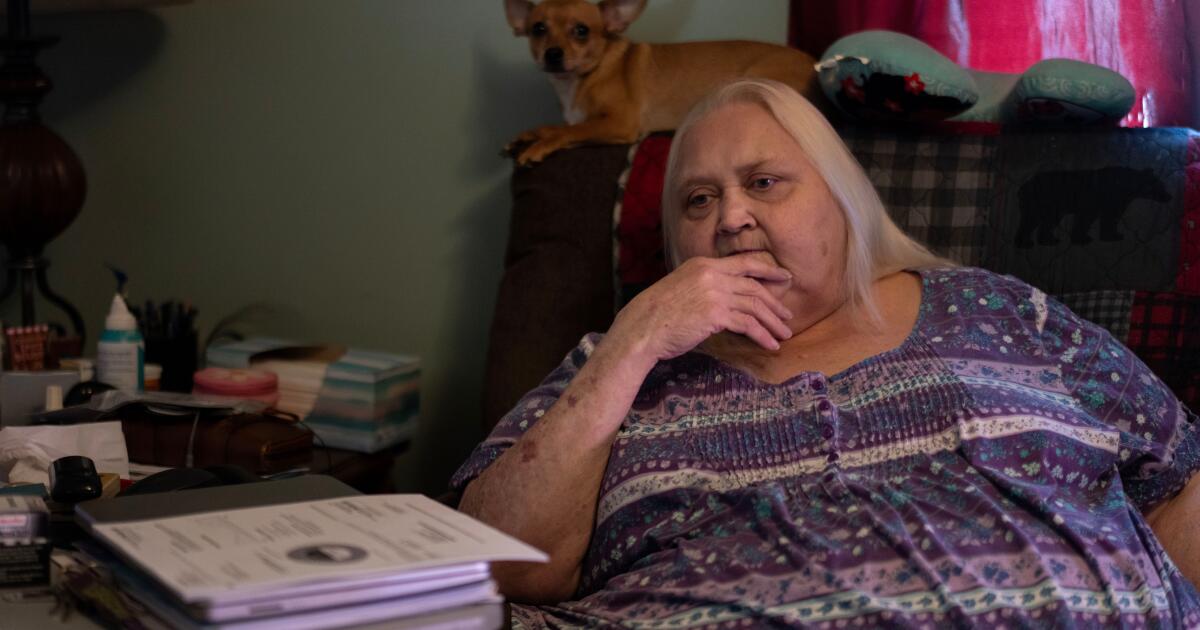
Near the front of the theater, Vicenta Lira Cardenas and her husband, Ismael Cardenas, were two of the rare exceptions. They smiled politely when they made eye contact with other caucusgoers, and, as local GOP leaders began the proceedings, Vicenta whispered the occasional translations to Ismael.
Vicenta Lira Cardenas, a custodian at Denison High School, rolls out basketballs for a game at the school gym in Denison, Iowa.
(Gina Ferazzi / Los Angeles Times)
Since 2020, when then-President Trump made double-digit gains with Latino voters across the country, Republicans have bragged that a major realignment is underway. Democrats have long relied on winning about 65% of the Latino vote. If Republicans can get that number closer to 50%, they could keep the Democrats out of the White House for a generation.
While Iowa may not be a center of Latino life like California or Texas, the dismal Latino turnout at the caucus in Denison did not bode well for the Republican Party’s efforts to expand its ranks.
Even so, conversations with people in town show the GOP has a real opportunity and that many Latinos are deeply unsatisfied with President Biden.
Workers leave after their shift at a Smithfield meatpacking plant in Denison, Iowa. Meatpacking plants employ thousands and are one of the main reasons Latinos have come to Denison.
(Gina Ferazzi / Los Angeles Times)
This was Vicenta’s first caucus since she immigrated from Michoacán, Mexico, in 1995. But she’s voted in plenty of general elections. In 2008, she enthusiastically supported Barack Obama, believing in his pledge to normalize status for millions of undocumented people in his first 100 days. She voted for him again in 2012, but by 2016 when that had not been achieved, she turned away from the Democrats.
“What Trump says is what Trump does. If he promises something, he is going to do it,” Ismael, soft-spoken, said in Spanish after the caucus had ended.
“That’s it, exactly,” said Vicenta. “Democrats talk so eloquently, but their actions are not good. The way Trump talks may not be nice. I think, at times, he has said racist things. But his actions, his policies are good. And he keeps his promises.”
A water tower marks the town of Denison, population about 8,000, in western Iowa.
(Gina Ferazzi / Los Angeles Times)
Denison is not a perfect sample of how Latinos across the county will vote in 2024 for the same reason Portland, Ore., is not a perfect sample of how white voters will vote. Local industry, culture and even ecology shape political inclinations. Expecting Venezuelan Americans in Tampa, Fla., and Salvadoran Americans in Oxnard to vote the same way is as wrongheaded as expecting white voters in Portland to cast ballots the same as white voters in a Texas oil town like Midland.
But some factors that predict how Latinos might vote are unique to Latinos, and they strongly influence life in Denison. Here are some questions to ask to begin to understand politics in a Latino community: How recently did families here immigrate? What industries employ them? Do they face intolerance in their daily lives?
In Denison, jobs at the meatpacking plants have brought immigrants, like Ismael, from across Latin America. The town’s Latino population is young, working-class, and made up mostly of immigrants.
Patricia Ritchie, originally from Mira Loma, Calif., was one the first Latinas in Denison when her family moved there in 2004,
(Gina Ferazzi / Los Angeles Times)
When Patricia Ritchie moved to Denison in 2004 after a childhood in Mira Loma, Calif., and two combat tours in the Army, she was one of the first Latinas in town.
“Are you here to work at the plant?” the front-desk person at Denison High asked when Ritchie stopped by to promote her services as a professional English-Spanish interpreter. Ritchie, who had moved with her husband to his family farm, felt profiled. “Back then, I didn’t even know what a plant was,” she said.
Since 1990, the Latino population of Iowa has grown more than sixfold, and Crawford County, of which Denison is the county seat, is at least 30% Latino, making it the most Latino county in the state.
The county is working-class and the sort of place where Democrats have struggled in recent years. Obama narrowly won Crawford, once a swing county, in 2008, but then it sprinted to the right. In 2020, Trump won almost 68% of the vote.
An image of Donald Trump in the front window of a home in Denison.
(Gina Ferazzi / Los Angeles Times)
Trump’s appeals to working-class voters and his ability to channel class resentment won him enthusiastic fans in many Latino communities. Latinos are overrepresented among manual laborers and service professionals, and in majority-Latino oil towns in south Texas and farm counties in California, Trump significantly improved his numbers between 2016 and 2020.
That didn’t happen for him in Denison. Though Denison still went for Trump in 2020, it shifted a bit to the left. In the most Latino precincts in Denison, Biden improved on Democratic 2016 results by as much as 10 percentage points.
Ritchie — who says she’s “blue through and through” — said Democrats have had success organizing in Denison’s Latino community because Latinos here still face challenges with immigration status and racism — issues that don’t dominate Latino life the way they once did in some other parts of the country.
Polling has found that, nationwide, immigration is not even a top-five issue for Latinos, ranking far behind the economy (No. 1), healthcare and education. Issues of race and ethnicity rank even lower.
But the situation is different in Denison. The Latino population has grown rapidly, and some white residents — who tend to be older — have reacted with unfriendliness or racism.
“We say that, when it comes to Latinos, Iowa is 20 years behind the rest of the country,” said Ritchie, who for years has worked with the local government to provide bilingual services, including as a victim advocate for the police. She and others have tried to organize the community and educate Latino Iowans about their rights. She said that this organizing often takes place under the Democrat banner.
But Democrats may be losing their lead.
Downtown Denison, Iowa.
(Gina Ferazzi / Los Angeles Times)
Lorena López came to Iowa in 1992 from Nicaragua on an exchange program for Nicaraguan journalists — she and other news broadcasters were hoping to learn how to use teleprompters.
López said she was one of three Latinos in town when she arrived. Now, she’s a pillar of the community: the editor of La Prensa, a successful Spanish-language newspaper for western Iowa. She’s been a frequent advisor to local and state government, and she’s well known around town. When townspeople address her in Spanish, they call her “Doña Lorena.”
But she still doesn’t always feel welcome.
“I still get that look from people. When you walk into the room, and they’re just like, ‘guácala’” — gross. “They give you a look of someone who wishes you weren’t there, that you didn’t exist,” she said.
Lorena López is the editor of La Prensa, a successful Spanish-language newspaper for western Iowa.
(Gina Ferazzi / Los Angeles Times)
That brand of xenophobia, coupled with the constant fear of loved ones getting deported, has traditionally pushed Denison Latino voters toward the Democrats, she said. (Though, like Latino communities nationwide, voter turnout here is low.)
When asked how she thinks her community will vote in November, she shook her head slowly.
“I think they’re going to vote for Trump. I really do,” she said.
She gave three main reasons: First, voters like Vicenta are not rare. “Latinos have a long memory,” she said. They hold a grudge for Obama’s unrealized goals on immigration — which were complicated by Republican opposition in Congress — and the fact that his administration deported more people, at a faster rate, than any other.
Under Biden, she added, a new anger has flourished. Families with undocumented members are furious that many recent border-crossers have been offered official — though temporary — parole status, and some, who made it into the asylum system, have gotten work permits.
“They have a lot of resentment for the broken system,” López said. “When I talk with them or I see them in church, they ask me, ‘How come they’re giving out employment authorization to people who just came here? Even though we’ve been here for so many years, we work, we have houses, we don’t have criminal records, and yet we still don’t have work permits.’”
Because Democrats have alienated some of their once-strong supporters, Republicans have a real opportunity, López said. Trump’s vision of conservatism — built around culture war issues, Christian nationalism and strongman politics — maps onto Latin American conservatism extremely well.
As an example, consider Yovan Cardenas. The son of Ismael and Vicenta, he had to grow up fast in Denison. By age 8, he was serving as an interpreter for his parents, helping with bank loans, checks for school field trips and bill payments.
Denison Police Officer Yovan Cardenas is running for county sheriff.
(Gina Ferazzi / Los Angeles Times)
Like his mother, Yovan Cardenas voted for Obama twice. But slowly, as his mother shared what she had read on the news and Yovan talked about what he’d learned studying criminal justice the University of Iowa, the two came to agree that the values they had immigrated with from Michoacán fit in better within the Republican Party.
Vicenta was strongly against abortion and the legalization of gay marriage. The younger Cardenas admired Republicans’ strong rhetoric in support of law enforcement. Today, he’s a police officer in Denison.
“Republicans have the same values as Hispanics: God, family and country,” he said.
Yovan Cardenas said he believes that, armed with more complete information, other Latinos in Denison might make the same decision. But he acknowledges that Republicans in western Iowa have done little to nothing to share their message with Latino voters. There’s no door-knocking in their neighborhoods or multilingual campaign events.
According to López, that’s not an accident. In the last 20 years, she’s covered how Republicans have campaigned against the growth of the Latino population in this part of Iowa. Denison was long represented by the far-right Republican Rep. Steve King, a full-throated opponent of multiculturalism. “We can’t restore our civilization with somebody else’s babies,” he said in 2017, drawing praise from the Ku Klux Klan.
“This is my own opinion,” López said. “Republicans in Crawford County are very conservative, and they’re scared of other Republicans seeing them associating with immigrants.”
Yovan Cardenas has evidence to the contrary: A leader in the county Republican Party — who he said asked not to be named — recruited him to run for sheriff this year. If he wins, he’ll become the only Latino sheriff in Iowa.
“Me winning would be a 2-for-1 special: They would get a Spanish sheriff, and they could also get more members from the Hispanic community to become Republicans,” he said.
Cardenas understands that building those bridges will be hard. When he started supporting Trump, some other Latinos accused him of selling out the culture, of trying to be white.
Cardenas says he believes that attitude might come from an emotional place, one that has less to do with policies and platforms and more to do with hometown peer pressure. He’s heard a lot of things called “white” that have nothing to do with a political position, he said. In high school, he said, other Mexican Americans would call him “pocho,” a derogotary term, for doing things as innocuous as playing baseball, which he said other Latinos called a “white sport.”
How Latinos in Iowa vote will not decide the election in November. But Latino voters in six key swing states — Michigan, Georgia, Arizona, Pennsylvania, Wisconsin and Nevada — could help determine who takes the White House.
In Michigan, Wisconsin, Pennsylvania and Georgia, many Latino communities are similar to the one in Denison: more recent, working-class immigrants who are interested in messaging on immigration and multiculturalism.
In Nevada and Arizona, some Latino families have lived there since those lands were part of Mexico, and many constitute the ethnic majority in their neighborhoods and towns. These sorts of communities will probably prioritize issues such as the economy, inflation and border control.
Ismael Cardenas, seated next to two of his younger children, watches his daughter Gaby play basketball in Denison.
(Gina Ferazzi / Los Angeles Times)
But for now, with Monday’s caucuses just a memory, residents of Denison, Latino and non-Latino, got back to life in a small town.
On Tuesday night, back at Denison High for a basketball game, Vicenta looked on proudly as her daughter Gaby played on the varsity team. “She’s easy to spot,” Vicenta explained. “She’s the only Latina on the team.”
Vicenta, a custodian at the school, said she’s raising her kids to be ambitious, to be useful in their communities. Gaby is studying to go to college to become a doctor.
And Vicenta and her husband hope they’re setting an example by showing up to use their voices at local political events. By the end of the evening at the Denison caucus, Ismael had cast his vote for Trump, and Vicenta for Vivek Ramaswamy.



Senate
Democrats
Senate
DAY
White House
House
Senate
White House
House
1
1
4
11
32
39
42
48
47
57
20
The White House proposed narrow restrictions on ICE that Senate Democrats said were not enough.
House Republicans, backed by Trump, rejected it. Then Congress began a two-week recess.
Senate Democrats blocked another vote on the bill without new ICE restrictions. Then they proposed funding D.H.S. minus ICE, Customs and Border Protection and the Office of the Secretary, which Republicans rejected.
The House passed a separate bill to fund D.H.S. without ICE restrictions. Without Democratic support in the Senate, the bill could not progress.
Senate Democrats sent the White House a proposal to fund D.H.S., with new restrictions on ICE.
The White House
rejected it.
Senate Republicans put up for a vote a bill to fund D.H.S. without new restrictions on ICE. Democrats blocked it.
Senate Republicans and Democrats agreed to fund D.H.S., minus parts of ICE and C.B.P., through Sept. 30.
Senate Republicans proposed funding D.H.S., minus parts of ICE, through Sept. 30. Democrats rejected this.
On Day 47, Trump changed his mind and agreed to the deal to fund the D.H.S., minus parts of ICE and C.B.P. Republican leadership
in both houses, with support from Democrats, announced the deal.
On Day 48, after the Senate passed the bill, hard-right House Republicans revolted and the bill was not put up for a vote.
The stalemate continues.
DAY
DAY

Senate
DAY
White House
House
1
1
4
11
32
39
42
48
47
57
20
The White House proposed narrow restrictions on ICE that Senate Democrats said were not enough.
House Republicans, backed by Trump, rejected it. Then Congress began a two-week recess.
Senate Democrats blocked another vote on the bill without new ICE restrictions. Then they proposed funding D.H.S. minus ICE, Customs and Border Protection and the Office of the Secretary, which Republicans rejected.
The House passed a separate bill to fund D.H.S. without ICE restrictions. Without Democratic support in the Senate, the bill could not progress.
Senate Democrats sent the White House a proposal to fund D.H.S., with new restrictions on ICE.
The White House rejected it.
Senate Republicans put up for a vote a bill to fund D.H.S. without restrictions on ICE. Democrats blocked it.
Senate Republicans and Democrats agreed to fund D.H.S., minus parts of ICE and C.B.P., through Sept. 30.
Senate Republicans proposed funding D.H.S., minus parts of ICE, through Sept. 30. Democrats rejected this.
The stalemate continues.
DAY
Senate
White House
House
DAY
On Day 47, Trump changed his mind and agreed to the deal to fund the D.H.S., minus parts of ICE and C.B.P. Republican leadership in both houses, with support from Democrats, announced the deal.
On Day 48, after the Senate passed the bill, hard-right House Republicans revolted and the bill was not put up for a vote.

NEWYou can now listen to Fox News articles!
One of President Donald Trump’s top Democratic foes running for the Senate is taking a page from his and conservatives’ playbook in their pitch to reform the filibuster.
Democratic Maine Gov. Janet Mills, who is running to unseat longtime Sen. Susan Collins, R-Maine, released her policy platform in recent days. Among several pitches to voters is a call to reform the filibuster.
Mills, if elected, said in the 19-page document that she would require “Senators to remain on the Senate floor and actually speak, rather than simply threatening a filibuster to delay action.”
The filibuster has become a flashpoint in the Senate, particularly for Republicans, given that its current 60-vote threshold requires legislation to be bipartisan in nature. And Mills’ position, which has been previously supported by Democrats, is one Trump and some in the GOP are pushing for to pass a massive election integrity bill.
GRAHAM EYES ‘DOWN PAYMENT’ ON TRUMP-BACKED SAVE ACT WITHOUT DEMOCRATIC SUPPORT
Democratic Maine Gov. Janet Mills, who is running to unseat longtime Sen. Susan Collins, R-Maine, released her policy platform in recent days. (Getty Images)
Her desire to change the filibuster echoes one made by Trump and conservatives, both in Congress and online, that have demanded Senate Majority Leader John Thune, R-S.D., launch a talking filibuster to pass the Safeguard American Voter Eligibility (SAVE) America Act.
“Washington is broken, and Maine people are paying the price,” Mills said in a statement introducing the platform. “Donald Trump and Washington Republicans are undermining our fundamental rights and driving up costs, all while Congress fails to solve the big problems facing Maine people. Enough is enough. Maine people deserve better than what D.C. is giving them.”
Mills and Trump have an adversarial relationship that reached a chaotic crescendo in 2025 when, during a meeting of governors at the White House, she declared, “We’ll see you in court,” over the president’s executive order to deny federal funding to states that allowed transgender athletes to participate in sports.
THUNE ACCUSES CRITICS OF ‘CREATING FALSE EXPECTATIONS’ AMID BACKLASH OVER STALLED SAVE AMERICA ACT
Maine Gov. Janet Mills and President Donald Trump have an adversarial relationship that reached a chaotic crescendo in 2025. (Nathan Howard/Getty Images)
The National Republican Senatorial Committee (NRSC), the Senate GOP’s main campaign arm, warned that Mills’ desired change to the filibuster was a dog whistle for Democrats’ plan to slow-walk Trump’s agenda.
“Janet Mills is saying the quiet part out loud: If she goes to Washington, she will use every tool at her disposal to push her radical anti-Trump agenda on Americans,” NRSC spokesperson Samantha Cantrell told Fox News Digital.
Trump has asked Republicans to go a step further and nuke the filibuster altogether — an unlikely scenario in the Senate, given the lack of support to do away with the guardrail in its current form.
MAINE SENATE CANDIDATE CITES COMBAT TRAUMA WHEN CONFRONTED ON ‘TERRIBLE’ POSTS ABOUT SEXUAL ASSAULT
Senate candidate Graham Platner of Maine, left, and two-term Gov. Janet Mills are facing off in the state’s Democratic Senate primary. (Sophie Park/Getty Images; Scott Eisen/Getty Images)
A talking filibuster, as Mills suggested, would require senators to debate a bill rather than falling back on the typical 60-vote threshold.
The Senate is currently doing a version of the talking filibuster in the GOP’s bid to shine a light on Senate Democrats’ refusal to support the SAVE America Act. But it won’t lead to the legislation passing because the GOP isn’t unified to block Democratic amendments that could drastically alter the bill.
Senate Minority Leader Chuck Schumer, D-N.Y., who handpicked Mills to run in Maine against Collins, has dubbed the legislation “Jim Crow 2.0” and rallied his caucus behind defeating the measure.
CLICK HERE TO DOWNLOAD THE FOX NEWS APP
Before Mills has a chance to square off against Collins, she’ll first have to survive a tough primary battle against insurgent candidate Graham Platner, an oyster farmer who has the backing of Schumer’s left flank.
Fox News Digital reached out for comment from Mills, Platner and Collins, but did not hear back by publication.

A few years ago, some were predicting the demise of Spanish-language television.
Most of the Latino population growth over two decades has come from U.S. births, outpacing the arrival of immigrants. The thinking was that because most U.S.-born Latinos speak English and can consume a wide array of media, Spanish-language TV would recede in relevance.
But Telemundo has defied such forecasts to become one of the nation’s hottest news outlets.
The NBCUniversal-owned, Spanish-language network, a longtime underdog, has been notching viewership gains in advance of its highly anticipated coverage of this summer’s FIFA World Cup championships.
Last year, Telemundo increased its audience for its evening news, anchored by Julio Vaqueiro, by 11% over the previous year, according to Nielsen data. Its Los Angeles station, KVEA Channel 52, has surpassed entrenched giants Walt Disney Co.’s KABC and Univision’s KMEX, attracting more viewers for its local evening and late-night newscasts.
The Miami-based division has a strong social media presence. Its Telemundo Noticias (News) account boasts 16 million followers on TikTok, topping ABC News, CNN and Fox News.
Cultural and demographic shifts have helped fuel Telemundo’s rise. After more than a decade of immigration declines, border crossings surged during President Biden’s tenure — a tide that turned with President Trump’s return to the White House. Instead, Trump brought a torrent of significant news events, including immigration raids that reverberated through Latino communities.
“We are growing because we are telling the stories that are important to our audience,” Gemma Garcia, Telemundo’s executive vice president for news, said. “We are very audience-driven.”
When U.S. military forces seized Venezuela’s then-president Nicolás Maduro in January, Telemundo quickly flew its main news anchor, Vaqueiro, to report from Colombia, which borders Venezuela. The network interrupted its usual Sunday night fare for a news special that scored solid ratings.
Vaqueiro, 38, has become the fresh face of Spanish-language news after Jorge Ramos, who achieved prominence as a forceful advocate for Latino immigrants during his 40 years on the air, signed off from rival Univision in late 2024.
The younger journalist brings a softer tone to his reports. He was promoted to Telemundo’s main news anchor in 2021 after several assignments, including working at KVEA in L.A. He loves stepping out from behind the anchor desk in Miami to cover big stories.
Telemundo news anchor Julio Vaquiero
(Telemundo)
Vaqueiro traveled to frigid Minneapolis earlier this year after the deadly Immigration and Customs Enforcement shootings. He broadcast from anti-ICE protests and stopped by a church to interview a pastor and volunteers organizing a food drive for immigrants too afraid to go outside.
“We’re very focused on being out there and reporting on the ground,” Vaqueiro said in an interview. “Being close to our audience, that’s a big part of what we are doing at Noticias Telemundo.”
Another key to Telemundo’s momentum has been its commitment to the Spanish language.
Media companies a decade ago raced to engage young, bilingual Latinos by launching start-ups, including a joint venture between ABC News and Univision called Fusion that flopped.
Now Telemundo is the one with cool cred.
Call it the Bad Bunny effect: While the Puerto Rican artist’s Super Bowl halftime show in Spanish befuddled scores of viewers, millions of other fans, deeply proud of their Latino roots, were thrilled by his performance celebrating everyday workers.
“With Bad Bunny’s rise and the Super Bowl, it felt like a shift in values towards the Spanish language,” said Mark Hugo Lopez, Pew Research Center’s director of race and ethnicity research. “It has become a source of cultural pride … and it seems to be impacting the ways in which English-speaking Latinos also think about their identity.”

Bad Bunny performed the Super Bowl halftime show in Spanish in February.
(Eric Thayer / Los Angeles Times)
That increased affinity suggests that Spanish isn’t going away anytime soon.
“Our data has shown that Latinos say it’s important that Latinos in the future speak Spanish here in the United States,” Lopez said.
A slow build to a news leader
Telemundo’s rise was a slow build, coming nearly a quarter-century after NBC bought the network for nearly $2 billion.
Years of effort took root after NBCUniversal agreed in 2011 to spend big for the U.S. Spanish-language media rights to the FIFA World Cup, dethroning Univision, which had long televised the prestigious soccer event. This year, Telemundo is poised “to deliver the largest coverage in Spanish-language media history,” the network said in a statement.
It will provide live coverage for all 104 matches, including on the Telemundo and Peacock streaming apps.
Being part of NBCUniversal has brought other benefits, too, particularly as Telemundo’s main competitor, Univision, has struggled under a succession of ownership groups.
NBCUniversal integrated its English and Spanish-language news units at its television stations. In Los Angeles, KVEA’s newsroom is in the same building on the Universal lot as KNBC-TV Channel 4. The same managers run both divisions.
“All of these things have evolved,” said Millie Carrasquillo, a Hispanic media consultant and former Telemundo research senior vice president. “It’s an alignment of the audiences, an alignment of how technology is evolving — and also the way that news is being delivered.”
Telemundo’s national newscast, anchored by Vaqueiro, averages 1.2 million viewers, its largest audience in years.
But audiences, particularly younger ones, are less likely to watch TV news, so network executives have tapped the potential of TikTok, Instagram and YouTube to boost their reach.
On TikTok, Telemundo reporters broadcast live from outside the U.S. Supreme Court last week as justices heard oral arguments on Trump’s push to end birthright citizenship for babies born to parents who are in the country unlawfully. Telemundo featured live coverage of the traditional Easter egg roll at “La Casa Blanca” (the White House) and frequent reports about NASA’s Artemis II mission, which scored millions of views.
“Radio and television hasn’t gone away,” said Mari Castañeda, University of Massachusetts Amherst’s Commonwealth Honors College dean. “But Telemundo has recognized that [cellphones] are where most of their audience is located and they leaned into that.”
Social media posts are easy to share, serving as a viral expansion of the network’s audience.
“Telemundo has emerged as a leader because it has modernized,” added Castañeda, a native of La Puente in Los Angeles County.
The U.S. Latino population nearly doubled between 2000 and 2024, rising from 35 million to 68 million, according to the Pew Research Center. Since the Great Recession, the growth has largely come from U.S. births, and the median age of U.S.-born Latinos is about 21.
The trend line bent during the Biden years as U.S. births roughly equaled the arrival of immigrants, Lopez said.
“Immigrants are still a very large part of the Latino story,” he said.

Noticias Telemundo anchor Julio Vaqueiro talks to a child living in a makeshift migrant camp along the Rio Grande near the Ciudad Juarez-El Paso border on Feb. 28, 2024.
(Telemundo)
‘This is a country we really love’
Telemundo’s brightest star — Vaqueiro — was born in San Juan del Río, north of Mexico City and came to the U.S. when he was 26 with his wife, who was also born in Mexico.
“We have three American kids,” Vaqueiro said. “All we know as a family is the U.S. This is a country that we really love and we’re grateful to it.”
In many ways, Vaqueiro’s journey is the story of U.S. Latinos.
“He’s Mexican but he’s also a U.S. Latino and he understands the context and issues that communities are feeling,” said Castañeda. “There’s a sense of authenticity and care that comes through.”
Vaqueiro wrote a book, “Río Bravo. México, Estados Unidos y el regreso de Trump, (Rio Grande: Mexico, the United States, and the Return of Trump),” to explore the political mood during a period of tumult and often tense relations between the countries.
Telemundo strives to stay out of the political fray, Garcia said.
“We don’t think about politics,” Garcia said. “We cover what is happening within our community, and now more than ever, we are on top of our community’s stories.”
Vaqueiro added: “We have to be very careful reporting the facts and verifying every information that comes to us.”
Political divisions course through Latino communities, including in South Florida where Telemundo is headquartered.
“We’ve always known that Latinos are not a monolith,” Vaqueiro said. “This is a complex community that is constantly growing. It’s diverse: geographically, culturally and generationally.”
Interest in news has swelled since Trump began his second term. Ratings are also up for ABC’s “World News Tonight with David Muir,” which is drawing 8.4 million viewers per telecast this season, outpacing NBC, Fox News and CBS.
In national news, Univision still tops Telemundo. In local news, Telemundo’s KVEA has continued to build on its lead this year, although KMEX remains competitive and Disney’s KABC remains dominant among English-language stations.
“I just hope that we meet the moment,” Vaquerio said. “This is a critical moment for Latinos who are navigating very difficult times under a lot of pressure.”
He has another goal, too.
“I want to lift Latino voices who are moving forward — opening new businesses and graduating from college,” Vaqueiro said. “I want to talk about the positive side of this community that brings huge contributions to the United States.”

Jazz lose by winning in the ‘Tanking Super Bowl’ — but optimism reigns as team imagines possibilities for next season
VT Lottery Mega Millions, Gimme 5 results for April 10, 2026

‘Don’t Fairfax Me’: How Virginia’s largest county became center of antiredistricting campaign – WTOP News

Report: Wisconsin transfer John Blackwell down to six schools, not two
Trump promised to cut electric costs in half. In energy-rich West Virginia, bills now top mortgages

Florida High School Football Rankings: Top 25 teams – Oct. 21

How old is Bo Nix? What to know about Oregon quarterback ahead of 2024 NFL Draft

Cleary's 21 help Le Moyne down Central Connecticut State 69-64 in OT

99th annual Pony Swim held in Virginia

Indiana Members Credit Union announced as new anchor tenant at Bottleworks District

Trump adversary running for Senate borrows his filibuster playbook

Russian propaganda unit targets Hungary’s elections

WATCH: Artemis II astronauts splash down on Earth

Swalwell’s former female staffer drops bombshell allegations of sexual assault, exposing himself: report

NASA’s Artemis II prepares for splashdown on Earth
-

 Atlanta, GA6 days ago
1 teenage girl killed, another injured in shooting at Piedmont Park, police say
-

 Education1 week ago
Video: Toy Testing with a Discerning Bodega Cat
-

 Movie Reviews1 week ago
Vaazha 2 first half review: Hashir anchors a lively, chaos-filled teen tale
-

 Georgia4 days ago
Georgia House Special Runoff Election 2026 Live Results
-

 Pennsylvania5 days ago
Parents charged after toddler injured by wolf at Pennsylvania zoo
-

 Arkansas20 hours ago
Arkansas TV meteorologist Melinda Mayo retires after nearly four decades on air
-
 Milwaukee, WI5 days ago
Potawatomi Casino Hotel evacuated after fire breaks out in rooftop HVAC system
-
 Entertainment1 week ago
Inside Ye’s first comeback show at SoFi Stadium