Politics
Trump Says Pakistan Captured Man Tied to Kabul Airport Attack


President Trump announced the capture of a top leader of the Islamic State in Afghanistan and Pakistan who helped plan the 2021 attack on the Kabul airport that killed 13 American service members and dozens of other people.
“We have just apprehended the top terrorist responsible for that atrocity, and he is right now on his way here to face the swift sword of American justice,” Mr. Trump said during his address to Congress on Tuesday.
Current and former officials said the United States had provided intelligence to Pakistan that led to its capture of the leader, Mohmmad Sharifullah, who helped plot the attack on the Abbey Gate entrance to the Kabul airport.
Prime Minister Shahbaz Sharif of Pakistan said that Mr. Sharifullah, an Afghan national, had been arrested by Pakistani security forces in the border region with Afghanistan. Axios first reported details of Mr. Sharifullah’s arrest.
The Abbey Gate attack became a symbol of the chaos of the U.S. withdrawal from Afghanistan in the opening months of the Biden administration. The military had been warned about the possibility of terror attacks at the airport, where thousands of Afghans were converging, hoping to flee as the Taliban took hold of the country.
Although he did not name Mr. Biden during his remarks on the attack, Mr. Trump lamented the withdrawal from Afghanistan as “disastrous and incompetent.” He called the Abbey Gate attack “perhaps the most embarrassing moment in the history of our country.”
Since taking office, Mr. Trump’s C.I.A. director, John Ratcliffe, has spoken with Pakistan’s intelligence chief, Lt. Gen. Asim Malik, about Mr. Sharifullah, current and former officials said. Mr. Sharifullah is a leader of the group known as Islamic State Khorasan Province, or ISIS-K.
Cliff Sims, an informal adviser to Mr. Ratcliffe, wrote in a social media post that one of Mr. Trump’s first orders to the agency was to prioritize the hunt for those responsible for the Abbey Gate attack.
“On his second day in office, Ratcliffe raised the issue during his first call with the Pakistani spy chief and reiterated it during their meeting at the Munich security conference,” Mr. Sims wrote. “This cooperation led to a huge counterterrorism win for the United States and progress toward justice for the families of the American heroes we lost that day.”
In another social media post, Kash Patel, the F.B.I. director, said Mr. Sharifullah had been extradited to the United States. “One step closer to justice for these American heroes and their families,” Mr. Patel wrote.
A U.S. official said that the C.I.A. and the F.B.I. were notified 10 days ago that Pakistan had captured Mr. Sharifullah and that he was expected to arrive in the United States on Wednesday, developments reported earlier by Axios.



Politics
Scathing report claims nation’s oldest labor union ‘betrayed’ MAGA members through ‘shocking’ spending

NEWYou can now listen to Fox News articles!
FIRST ON FOX: One of the nation’s most prominent railroad unions is facing new scrutiny after a watchdog report alleged its leadership is quietly working against the political views of its members who support President Donald Trump’s agenda.
The report, released by the American Accountability Foundation (AAF), claims the Brotherhood of Locomotive Engineers and Trainmen (BLET), one of the nation’s oldest labor unions, is run by leaders who are endorsing and promoting Democratic policies and candidates despite a membership base that data suggests largely supports the president.
The report, which alleges the union “betrayed” its MAGA members, points to the union’s endorsement of the Harris-Walz ticket in the 2024 election cycle, as well as its ties to prominent Democrats, including Sen. Bernie Sanders, I-Vt., and former Ohio Sen. Sherrod Brown, who is running for Senate again.
While BLET has touted Republicans in recent years, including earlier this year when it applauded Vice President JD Vance and the bipartisan reintroduction of the Railway Safety Act (RSA), the report highlights repeated criticism of Trump-era policies, including transportation regulations, immigration enforcement and the conservative-backed Project 2025 agenda, alongside praise for the policies of the Biden administration.
WORKERS SAY ‘I LIKE UNIONS, I JUST DON’T LIKE MY UNION’ — HERE’S WHAT THEY’RE DISCOVERING
President Donald Trump attends a ceremony to rename a four-mile stretch of Southern Boulevard in Palm Beach County, Florida, to “President Donald J. Trump Boulevard” on Jan. 16, 2026. (Julia Demaree Nikhinson/AP Photo)
A review of the union’s social media account by AAF shows numerous examples of the union opposing various moves by the first Trump administration during his presidential campaign against incumbent Joe Biden, which the report describes as evidence of “woke leadership.”
“In the lead-up to the 2024 election, BLET issued 14 tweets that criticized the actions of the first Trump administration while praising the Biden administration’s railroad policies,” the report says. “The messaging was clearly intended to skew union members toward the Democratic presidential ticket. In these tweets, they attacked nearly every major Trump-era rail policy decision while framing the Biden administration’s actions positively.”
The union’s public support of Democrats had a financial angle as well, as the report states that the organization spent more than $26 million on political activity in recent years, with the vast majority supporting Democratic candidates and causes to a degree that AAF referred to as “shocking.”
According to the report, 99% of the union’s party committee donations went to Democrats.
“For example, in the 2016 cycle, BLET donated $15,000 to the DNC when they were the nexus for GOTV for the Hillary Clinton campaign but never donated a dollar to the RNC,” the report says. “In 2024, long after it had become clear that industrial union membership was strongly behind President Trump, the BLET leadership still hadn’t gotten the message, making 24 different donations to Democrat party committees for a total of $53,400 and a mere two donations to Republican committees for a spare $2000.”
LEAKED TEACHERS’ UNION K-12 TRAINING PRESENTATION RAILS AGAINST TRUMP ADMINISTRATION, RED STATES
According to the report, the divide reflects a broader shift in American politics, with blue-collar workers increasingly backing Trump while union leadership remains entrenched in traditional left-leaning positions.
The report goes beyond the union’s spending on politics and delves into what it calls “waste and abuse” in the form of millions of dollars of member dues being shelled out for travel, hotels and “swag.”
“While it’s bad enough that BLET spent over $5,000,000 on hotels and conferences, even more concerning is the fact that the union spent over $2,000,000 on casinos and resorts alone,” the report says. “The union appears more concerned with staying at entertaining destination resorts than they do being thrifty with their members’ dues.”
Recent polling shows that labor unions like BLET consist of a large number of workers who support Trump, including Teamsters polling that shows a 60/40 breakdown in favor of Trump and exit polling from the 2024 election that shows working-class voters without a college degree went 56% for Trump and 42% for Harris.
The report also points to leadership compensation as part of the disconnect, noting multiple top officials earning over $200,000 annually, with the union president and vice president each making more than $300,000.
CLICK HERE TO DOWNLOAD THE FOX NEWS APP
Members of the Brotherhood of Locomotive Engineers and Trainmen take part in a strike outside New Jersey Transit’s headquarters on May 16, 2025, in Newark. (Kena Betancur/Getty Images)
“The men pulling America’s freight voted for President Trump because they believe in secure borders and putting American workers first,” AAF President Tom Jones said in a statement to Fox News Digital.
“But their union bosses are busy living large on member dues and carrying water for the Left. They’ve turned a blue-collar brotherhood into a woke political machine that’s doing everything it can against the Trump-Vance agenda, and likewise, against everyday railroad workers. Every BLET member should be asking where their hard-earned dollars are really going.”
In a statement to Fox News Digital, a BLET spokesperson said: “We do not comment on false press releases by dark money groups who have no accountability to the truth.”
Politics
Trump’s approval ratings just hit a new low. A Latino voter shift could reshape the midterms
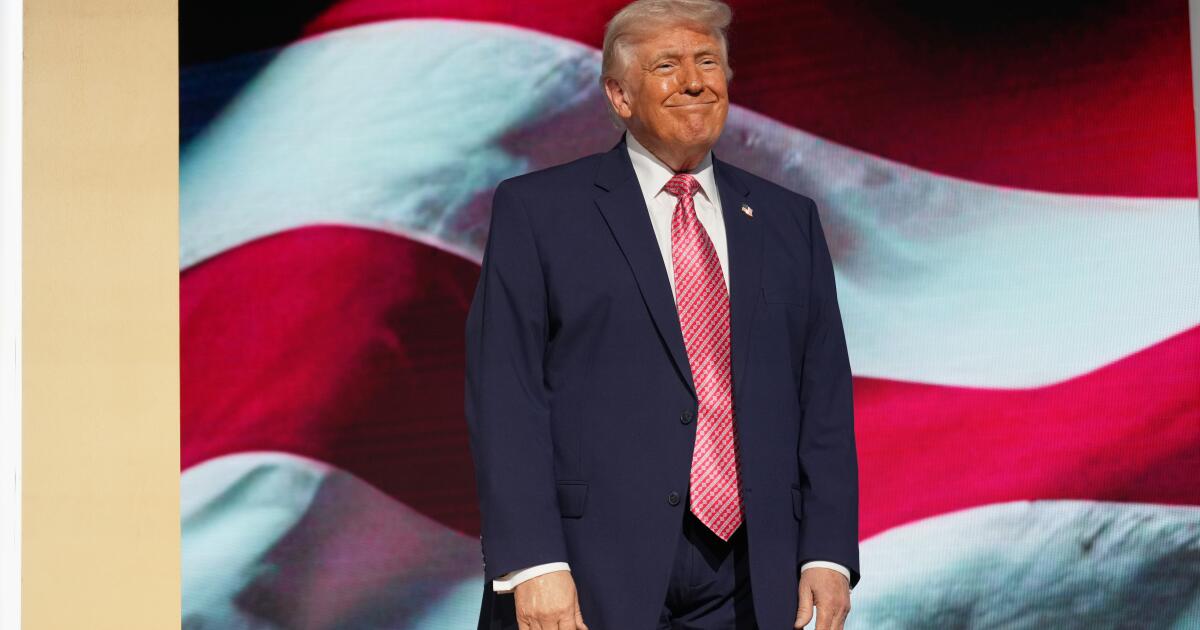
WASHINGTON — With the Iran war in its fifth week, support for President Trump is at its lowest point ever, with a growing body of recent polling showing him losing ground with key voting blocs that helped power his 2024 victory.
While public dissatisfaction is evident among many groups surveyed, the decline in support for the president has been most pronounced among Latino voters.
A Reuters/Ipsos poll released March 24 found 36% of voters approve of the president’s job performance, the lowest it has been during his second term. The poll found 62% disapproved.
Other polls, such as the AP-NORC poll, placed the figure at 38%.
In all, the president is underwater on almost every single public policy issue. With the exception of crime, which sits around 47% approval, he has recorded no gains in any polled category, according to experts.
On immigration, the president’s marquee issue, approval fell from roughly 45% in late 2025 to 39% in February, according to Reuters.
About 1 in 4 respondents approved of Trump’s handling of the economy, Reuters found, as domestic gas prices surged by more than $1 per gallon after fighting commenced last month. The share of Republicans who disapprove of his handling of cost-of-living issues rose 7 points in one week to 34%.
The shift comes amid growing economic unease and amplified backlash over the war in Iran. About 1 in 3 Americans approve of the military operation, according to a Reuters survey.
And a growing divide among prominent conservatives has emerged over the U.S. involvement in the Middle East.
The clashes have played out in public and are exposing tensions within the Republican Party, with conservative commentators such as Megyn Kelly openly questioning whether the war is in America’s best interest.
“This is not a foreign policy that makes sense and it is not what Trump ran on. It is, in many ways, a betrayal of his campaign promises, what he sold himself as and of his MAGA base,” Kelly said earlier this month.
Other conservative pundits, including Candace Owens, Tucker Carlson and Nick Fuentes, are also opposed.
But the real damage is showing up in the one place Trump can’t afford to lose: his base.
Trump entered his second term buoyed by historic gains with Latino voters. Exit polls indicated he improved his standing with them by more than 20 percentage points in 2024 compared with his 2016 victory, fueling widespread narratives that the demographic was undergoing a durable shift toward Republicans. In all, 48% of Latinos gave him their support in the last election.
Since then, his approval among Latino voters has plummeted to 22%, according to a March 2026 analysis by the Economist.
In a bipartisan poll by UnidosUS released in November, 14% of Latino voters said their lives were better after Trump took office, while 39% said they had gotten worse.
The president’s rapport with Latinos reflects a deep dissatisfaction with economic conditions, according to Mike Madrid, a veteran California Republican political consultant and expert on Latino voting trends.
“Overwhelmingly, this is a function of the economy and affordability,” he said. “Latino voters moved away from Biden-Harris for the exact same reasons that they’re moving away from Donald Trump right now.”
Research and polling suggests Latino voters prioritize cost-of-living issues — such as housing, wages and inflation — over immigration, a topic often emphasized in national messaging.
“It’s not even close,” Madrid said. “Immigration is not even a top 5 issue for Latino voters.”
Madrid suggested the demographic rallying is less a “reversion” and more a reflection of a rapidly changing electorate.
“Latinos have emerged as the only true swing vote in America,” he said. “And they’re rejecting whichever party is in power.”
These volatile, double-digit voting shifts directly contrast more stable voting patterns among other major demographic groups, including the Black and white electorates, where shifts from cycle to cycle tend to be just a few points.
The reason: dramatic turnout fluctuations. Who decides to show out or stay home on election day tends to change by the year. It’s compounded by the fact that there are far more first-time Latino voters than in any other category.
Polling this month suggests Trump is also losing ground among young voters, another group that contributed to his 2024 gains.
More than half of men under the age of 30 supported Trump in that election, helping him turn several swing states.
In just a year, that demographic has cratered by 20 points.
“Trump won in 2024 because of men. They are abandoning him right now,” CNN senior data analyst Harry Enten said Tuesday.
The reversals could have massive implications for the November midterm elections, particularly in competitive congressional districts where small swings could determine control of the House.
Republicans have warned that if they lose hold of their narrow congressional majority, Trump is likely to face a third impeachment.
UCLA political scientist Matt Barreto said movement away from Republicans is already visible in real-world election outcomes, not just polling.
“We’ve already seen in the Virginia and New Jersey legislative and gubernatorial elections really large shifts in the Latino vote, 25 points back to the Democratic Party,” Barreto said. He added that similar patterns have emerged in places such as Miami and Texas, where Democratic candidates have outperformed expectations with strong Latino support.
Latino Democrats who sat out the 2024 election are returning to the electorate, while some Latino Republicans are disengaging, he said.
That dynamic could prove decisive in November. There are more than 40 congressional districts where the number of registered Latino voters exceeds the margin of victory in 2024, Barreto said. Many of them are closely divided between the parties.
“At the district level, the Latino vote is going to make a huge impact,” he said.

The National Capital Planning Commission is scheduled on Thursday to take a final vote approving President Trump’s ballroom, clearing the last review for a major addition to the White House that was publicly unveiled in detail only in January. Last month, another panel led by the president’s allies, the Commission of Fine Arts, discussed the ballroom for 12 minutes before unanimously approving it.
The hurried reviews, with construction cranes already swiveling above the White House grounds, are an abrupt departure from how new monuments, museums and even modest renovations have been designed and refined in the capital for decades. And the ballroom will be worse off for it, architects warn.
Take the White House fence, a far more modest part of the complex that received more probing attention from both commissions when it was rebuilt during Mr. Trump’s first term.
Such details affect how people passing by experience these iconic places, and how each structure fits into a capital city that has been planned around civic symbols and sightlines since the 1790s. The deliberation is also an expression of democracy, said Carol Quillen, the president and chief executive of the National Trust for Historic Preservation, which has sued the administration over the ballroom.
“Even if we are slow and we make mistakes and we fight, that process has meaning to us,” Ms. Quillen said. No project belonging to the public should be the vision of just one man, she said.
That is, however, how the ballroom has often been described.
“President Trump is the best builder and developer in the entire world, and the American people can rest well knowing that this project is in his hands,” Davis Ingle, a White House spokesman, said in a statement. Past administrations and presidents have wanted a ballroom for more than 150 years, he said, and Mr. Trump will accomplish it.
But in the sprint to complete it before the end of his term, the addition appears to have compressed the normal design evolution for any project.
As recently as October, the president was still increasing the ballroom’s capacity, the kind of decision needed at the concept stage. And the White House has said it plans to begin building in the spring, a timeline that would mean construction documents would have to be prepared even as the design was still under review. (Before a judge demanded in December that the project seek review by these two commissions, the administration appeared poised to skip them entirely.)
“The timeline never made any sense to me,” said Thomas Gallas, a former member of the planning commission and an architect. A building on this scale might take its architects and engineers 18 months to two years from initial concept to completed construction documents, he said.
Reviews by the planning commission generally follow similar steps, with major projects seeking feedback on initial concepts, then approval of preliminary plans, and then final approval. The public process for the Fed renovations took two years, the African American history museum even longer:
Planning Reviews Typically Require Many Months and Meetings
For the ballroom, the planning commission never had a say on the concept design. And this week, it will vote on a combined preliminary and final review, a move more common for antenna replacements or new security bollards. The Commission of Fine Arts did something similar in February.
Rodney Mims Cook Jr., the Trump-appointed chair of the arts panel, countered that the group had significant input, including in unofficial meetings with Mr. Trump and in feedback objecting to a large pediment previously planned for the top of the ballroom’s south portico. “We asked him to tone down the porch,” he said. “We asked him to remove the pediments. We asked him for landscape. All of that he did.”
Will Scharf, the chair of the planning commission and the White House staff secretary, said his commission had handled the ballroom with the same deliberative pace it has other analogous projects, like an overhaul of the Capital One Arena and the plan for a new R.F.K. Stadium. Those projects, he said, share the ballroom’s sense of urgency and ready funding (characteristics a memorial or museum may not have).
“If not for President Trump, his desire to move quickly, and his raising the money to fund this, a project like this could languish for years with no decision or action,” Mr. Scharf said. “And we could still be debating it at N.C.P.C. meetings 20 years from now.”
Some big projects in Washington have been bogged down for years. And it’s certainly possible that the White House fence would have been just fine with five inches between the pickets, and that the African American history museum would have looked nice with a Custom Artisan #4 finish instead.
But it’s harder to argue that a major addition to the White House needs swifter public scrutiny than its fence (these commissions have meanwhile continued to push back on projects that are not the president’s personal priorities). Many concerns about the ballroom are also not minor ones. And without further work, the details provoking those concerns will become lasting features of the capital.
For starters, the ballroom is set to become the dominant anchor at the end of Pennsylvania Avenue, a link planned by Pierre Charles L’Enfant to connect the Capitol and the White House.
“The ballroom is literally an imposition between two branches of our government,” said David Scott Parker, an architect on the board of the National Trust for Historic Preservation, and one of more than 30,000 people who wrote to the planning commission objecting to the building.
The proposed East Wing is about 60 percent larger than the White House residence by floor area. But by cubic volume, and including the porticos, it’s more than three times as large because of the ballroom’s vast ceiling height. Viewed from the south, the ballroom’s size will make it the dominant building of the White House complex, with a portico bigger than that of the residence and a lopsided appearance disrupting any symmetry with the West Wing.
The south portico, which was not part of the addition’s initial design, also has no doors into the ballroom. And all of the columns will block views and daylight from inside.
During the planning commission review earlier this month, the project’s architect, Shalom Baranes, acknowledged that the south portico was more ornamental than functional.
“Is it an absolutely essential part of the program? I would say no, it’s not,” he said. “Really it’s an aesthetic decision to have it there.”
That decision, however, is part of the reason the White House driveway planned by the famed landscape architect Frederick Law Olmsted must be rerouted, breaking its symmetry (the kind of detail the planning commission might have dwelled on in the past).
Inside the East Wing, the ballroom itself is far larger than industry standards suggest is necessary for 1,000 guests (by that standard, it might fit 1,500 people). Mr. Baranes said the extra space was needed to accommodate TV cameras, journalists, security and ceremonial processions. But one result is that events with fewer than 1,000 people could feel empty.
The commercial kitchen and first lady’s office suite on the lower level are likewise supersized. And on the second-floor colonnade connecting the ballroom to the executive residence, a blank wall of faux windows will face the north (the direction from which most tourists get a glimpse of the White House). Behind them is a row of bathroom stalls.
Many criticisms of the building, Mr. Scharf said, fail to acknowledge that the White House has continually evolved since its beginning. “As our country’s developed, so too has the White House complex,” he said, adding that he would vote on the project this week after having read every one of the letters the commission received. “I see the ballroom project as a natural extension of that history.”
Most of the concerns that have been raised touch not on how the building will be used inside, but on how it will face the public. That makes seemingly prosaic matters — the height of the roofline, the jog in the road, the square footage of the ballroom — also symbolic ones.
“This is the People’s House, this is not Donald Trump’s, or Joe Biden’s or the next president’s,” said Phil Mendelson, who sits on the planning commission in his role as the chairman of the D.C. Council. He has been a lone objector trying to raise these questions before the commission.
Now, barring intervention by the courts, time is apparently up to resolve them.
“I still don’t understand,” Mr. Mendelson said, “why the ceiling height has to be 40 feet.”

Wolverines make Frozen Four

Bay Area residents hold rally in SF as war with Iran enters 2nd month

Dallas Jenkins says he is the ‘evangelical mascot of the LDS church’ and talks Easter celebrations

New video shows aftermath of police shooting in Downtown Miami

Boston Celtics Star Jayson Tatum Made History In Hornets Game

Florida High School Football Rankings: Top 25 teams – Oct. 21

How old is Bo Nix? What to know about Oregon quarterback ahead of 2024 NFL Draft

Cleary's 21 help Le Moyne down Central Connecticut State 69-64 in OT

99th annual Pony Swim held in Virginia

Indiana Members Credit Union announced as new anchor tenant at Bottleworks District

Scathing report claims nation’s oldest labor union ‘betrayed’ MAGA members through ‘shocking’ spending

Republican US lawmaker demands Congress vote on any Iran troop deployment

So you went to a No Kings protest. Now what?

JD Vance says he was ‘obsessed’ with UFOs, believes aliens are actually ‘demons’
The EU's recipe for trade deals : easy on beef, tough on wine
-

 Sports1 week ago
IOC addresses execution of 19-year-old Iranian wrestler Saleh Mohammadi
-

 New Mexico1 week ago
Clovis shooting leaves one dead, four injured
-

 Miami, FL4 days ago
Jannik Sinner’s Girlfriend Laila Hasanovic Stuns in Ab-Revealing Post Amid Miami Open
-

 Tennessee6 days ago
Tennessee Police Investigating Alleged Assault Involving ‘Reacher’ Star Alan Ritchson
-

 Minneapolis, MN4 days ago
Boy who shielded classmate during school shooting receives Medal of Honor
-

 Politics1 week ago
Schumer gambit fails as DHS shutdown hits 36 days and airport lines grow
-

 Science1 week ago
Record Heat Meets a Major Snow Drought Across the West
-

 Technology1 week ago
YouTube job scam text: How to spot it fast