Politics
Silicon Valley billionaires put plans for new California city on hold


The tech billionaires backing a proposal to raise a brand-new city on the rolling prairie northeast of San Francisco Bay have agreed to pull their measure off the November ballot and will first fund a full environmental review of the project, officials announced Monday.
The pause — announced in a joint statement from a Solano County supervisor and the chief executive of California Forever, the group backing the development — marks a dramatic shift in what had been a relentless push to build a city from scratch in rural Solano County. Until recently, California Forever, whose roster includes tech giants such as LinkedIn co-founder Reid Hoffman and venture capitalist Marc Andreessen, appeared set on taking the proposal directly to local voters this fall.
In June, after the group spent millions of dollars on a signature-gathering campaign, the county registrar announced the measure had qualified for the November ballot, despite opposition from many local elected officials. At the time, Jan Sramek, the former Goldman Sachs trader who is leading the effort, said the measure was nothing less than “a referendum on what do we want the future of California to be.”
Then, on Monday morning, an about-face: California Forever announced it would withdraw the measure. Instead, the group will follow the normal county process for zoning changes for the nearly 18,000-acre swath of land proposed for development. That includes funding a full environmental impact review and reimbursing the county for staff time and consultants related to the venture, according to the joint statement issued by Sramek and Mitch Mashburn, chair of the Solano County Board of Supervisors.
While “the need for more affordable housing and good paying jobs has merit, the timing has been unrealistic,” Mashburn said in the statement. California Forever’s rush to the ballot without an environmental review and negotiated development agreement “was a mistake,” he added. “This politicized the entire project, made it difficult for us and our staff to work with them, and forced everyone in our community to take sides.”
In his portion of the statement, Sramek, CEO of California Forever, stressed that his investment group remains committed to the project and feels an urgency to get it done. “For every year we delay, thousands of Solano parents miss more mornings, recitals, and bedtime stories because they’re commuting two hours for work. They cannot get those magical moments back.”
“We want to show that it’s possible to move faster in California,” Sramek said. “But we recognize now that it’s possible to reorder these steps without impacting our ambitious timeline.”
He said his group would work with the county to complete an environmental review and development agreement over the next two years, then bring the package back to local voters for approval in 2026.
In an interview with The Times, Sramek said the decision to pull the ballot measure was made after it became clear that Solano County residents wanted a thorough environmental review process. He said he was confident the decision to “invert the order of the steps” — putting the environmental review and development agreement before taking the question to voters — would lead to a better outcome.
“It’s not going to affect the timeline,” he said. “In fact, it might accelerate it.”
The shift also gives California Forever time to reset with local residents after the group’s rocky introduction to Solano County politics.
The effort, launched under a cloak of secrecy, became ensnared in controversy last year amid unfounded speculation that the land buyers were foreign agents intent on espionage.
That’s because for years before proponents revealed their plans, they used a limited liability company called Flannery Associates to buy up land from farmers in a vast swath of the county, stretching from Rio Vista west toward Travis Air Force Base, without telling anyone why. News of the mysterious land sales, in an area so close to a crucial military installation, led some people to speculate it might be part of an effort by foreign spies to gain military secrets.
Last year, it was revealed instead as a bold plan to build a model city from the ground up and reinvent how housing is built in California.
In January, Sramek unveiled blueprints of the new community that call for tens of thousands of homes surrounded by open space and trails. California Forever showcased the community’s proximity to the San Francisco Bay Area, vowing the project would convert unused farmland into “middle-class neighborhoods with homes we can afford.” The city would be walkable, socioeconomically integrated and fueled by clean energy.
But the proposal garnered fierce early opposition from some local leaders, concerned the group was making an end run around the planning process, as well as environmental groups concerned about the loss of natural habitat.
Mashburn said his agreement with Sramek came after tough conversations about how the process had gone so far.
“We talked about Solano County, and we talked about the initiative, and we talked about the future, and the way things were going to look, and the processes that we would have to go through, and whether we wanted to do that amicably and have a county where neighbors weren’t fighting with neighbors,” Mashburn said.
“Much to his credit and to their credit, they agreed with that. That’s not an easy thing to do, for a leader to admit that you may have been wrong about something.”
The decision to pull the ballot measure came a day before the Board of Supervisors was scheduled to discuss a consultant’s report, commissioned by the county, on the potential fiscal impacts of the development and to vote on whether to put the initiative before voters in November.
The report, prepared by Stantec Consulting Services in Walnut Creek, questioned the financial viability of the proposed new city and predicted construction challenges that could lead to hefty deficits for the county. It estimated the price tag for constructing schools, roads, sewer systems and other infrastructure to support the new community at tens of billions of dollars.
In announcing the new timeline, Mashburn issued a challenge to the California Forever investors, calling on them to show how they would provide water, solve transportation challenges and navigate the “financial engineering that makes it possible to pay for billions of dollars of infrastructure” without increasing taxes.
Asked if he believed Sramek and his backers would eventually build their dream city in his county, Mashburn said he was skeptical it would turn out exactly as the tech titans envisioned.
“We’re starting over from scratch,” he said. “There are some incredible obstacles that have to be overcome.”



WASHINGTON — California’s two Democratic senators on Thursday criticized the Trump administration after it requested $87.6 billion from Congress to address some of the nation’s most “urgent needs” but omitted funding for victims of last year’s Los Angeles wildfires.
“Donald Trump’s desire to punish Los Angeles and the state of California for not voting for him, means once again that thousands of Angelinos are left watching this administration fight for anything but them, their businesses, and their communities,” Sens. Alex Padilla and Adam Schiff said in a joint statement.
“These fires did not discriminate based on party or political preference. Neither should this administration,” they added.
The omission is the latest strain in a yearlong standoff between California leaders and the Trump administration over federal disaster aid, and it comes after Los Angeles Mayor Karen Bass and Los Angeles County Supervisor Kathryn Barger met with President Trump at the Oval Office in April to request the funding.
At the meeting, Trump signaled his commitment to working with local officials to help with disaster recovery efforts. The officials asked for $16 billion that would be split between the city and county. The money would consist primarily of disbursements from the Federal Emergency Management Agency flagged for communities hit by the fires, part of a $33.9-billion wildfire relief funding request made by Gov. Gavin Newsom.
Two months later, those talks have yet to yield results sought by local leaders.
The budget request, submitted by the Office of Management and Budget on Wednesday, mostly seeks funding for the Pentagon to address costs related to the Iran war. It also includes $11.1 billion in economic assistance for American farmers, $1.4 billion to address the Ebola virus outbreak in Central Africa, $500 million to support “ongoing efforts to complete restorations and construction projects” across the nation’s capital and $1 billion to boost the pensions of workers at General Motors that were cut as a result of the automaker’s bankruptcy.
“I urge the Congress to take action on these important and urgent requests as soon as possible,” White House budget director Russell Vought wrote in a letter addressed to House Speaker Mike Johnson (R-La.).
Vought said the administration was open to discussing “additional relief for other urgent matters.” The White House did not immediately respond when asked why the budget request did not mention the Eaton and Palisades disaster relief funds.
State leaders, including Newsom, have repeatedly accused the Trump administration of stonewalling billions in wildfire aid. The governor visited Washington in December to meet with lawmakers, including three who serve on the Senate and House appropriations committees, to push for the funding.
The governor also attempted to meet with FEMA about the matter, but said his request was denied. Newsom, a political foe of Trump’s, would not say whether he had attempted to meet with Trump to talk about the recovery efforts.
Politics
Trump administration pledges $150M in aid, deploys Navy warships after deadly Venezuela earthquakes

Secretary Rubio details US aid to Venezuela after earthquakes
Secretary Rubio, in Manama, Bahrain, outlines the comprehensive U.S. government response to the devastating back-to-back earthquakes in Venezuela. He confirms immediate deployment of search and rescue teams, medical resources and humanitarian assistance, emphasizing the urgency to save lives. Rubio reiterates President Donald Trump’s commitment to supporting Venezuela and collaborating with international partners on recovery efforts and long-term stability.
NEWYou can now listen to Fox News articles!
Following a catastrophic set of earthquakes that left at least 235 people dead in Venezuela, the Trump administration has activated a government-wide humanitarian response, pledging $150 million in aid and deploying U.S. Navy warships to assist in life-saving rescue operations.
The rapid mobilization Thursday comes after back-to-back magnitude 7.2 and 7.5 earthquakes rocked northern Venezuela roughly 120 miles west of Caracas Wednesday night.
The rare earthquake “doublet” injured more than 940 people and turned the state of La Guaira into a disaster zone, while forcing the closure of the damaged Simón Bolívar International Airport, according to Venezuela’s Health Ministry.
US RESCUE TEAMS TO DESCEND ON HARD-HIT CARIBBEAN AFTER CATASTROPHIC HURRICANE MELISSA’S IMPACT
Rescuers search for victims in a collapsed building following an earthquake in Caracas on June 24, 2026. (Manaure Quintero / AFP via Getty Images)
The U.S. Department of State announced on Thursday it is mobilizing $150 million in aid, which includes $50 million in new bilateral awards for relief partners on the ground — such as Samaritan’s Purse, Catholic Relief Services and World Vision — along with a $100 million contribution to a United Nations humanitarian pooled fund.
To spearhead efforts on the ground, the State Department has deployed a regional Disaster Assistance Response Team alongside two highly specialized urban search-and-rescue teams from fire departments in Fairfax County, Virginia, and Los Angeles County, California.
U.S. WARSHIPS TO PATROL INTERNATIONAL WATERS AROUND VENEZUELA AS TRUMP VOWS TO STOP CARTELS
Members of the County of Los Angeles Fire Department’s international urban search and rescue team (USA-2) prepare to leave for Venezuela, in Pacoima, Calif., Thursday. (Blake Fagan/AFP via Getty Images)
U.S. Southern Command (SOUTHCOM) said it is surging assigned U.S. military forces to the region, directing the USS Fort Lauderdale and the USS Billings to Venezuela to back the State Department-led operations.
The USS Fort Lauderdale will serve as a “floating command center” with a flight deck to support heavy-lift helicopters and a well deck to launch landing craft, according to SOUTHCOM.
Meanwhile, the agile USS Billings will provide critical support close to the shorelines to accelerate the disaster response missions.
U.S. SOUTHCOM said it has directed USS Fort Lauderdale (LPD 28) and USS Billings (LCS 15) to Venezuela to support State Department-led U.S. government relief operations in Venezuela. (@Southcom/X)
SOUTHCOM said it is also sending rotary-wing aircraft, which will provide critical life-saving airlift support, transporting U.S. government response personnel, search and rescue teams and partners during relief operations.
Amid the crisis, the State Department emphasized that the safety of U.S. citizens remains the administration’s highest priority.
“The Trump Administration has no higher priority than the safety and security of Americans. The Department of State is working tirelessly to provide consular assistance to U.S. citizens and their families in the affected areas,” officials wrote in a statement. “The United States remains steadfast in its commitment to helping Venezuela recover from this devastating disaster and will continue to explore additional ways to provide meaningful assistance during this critical time.”
CLICK HERE TO DOWNLOAD THE FOX NEWS APP
U.S. citizens in Venezuela are urged to enroll in the Smart Traveler Enrollment Program (STEP) and can contact the State Department 24/7 at 202-501-4444 for emergency assistance.
Family members in the U.S. seeking information on loved ones can call toll-free at 888-407-4747.
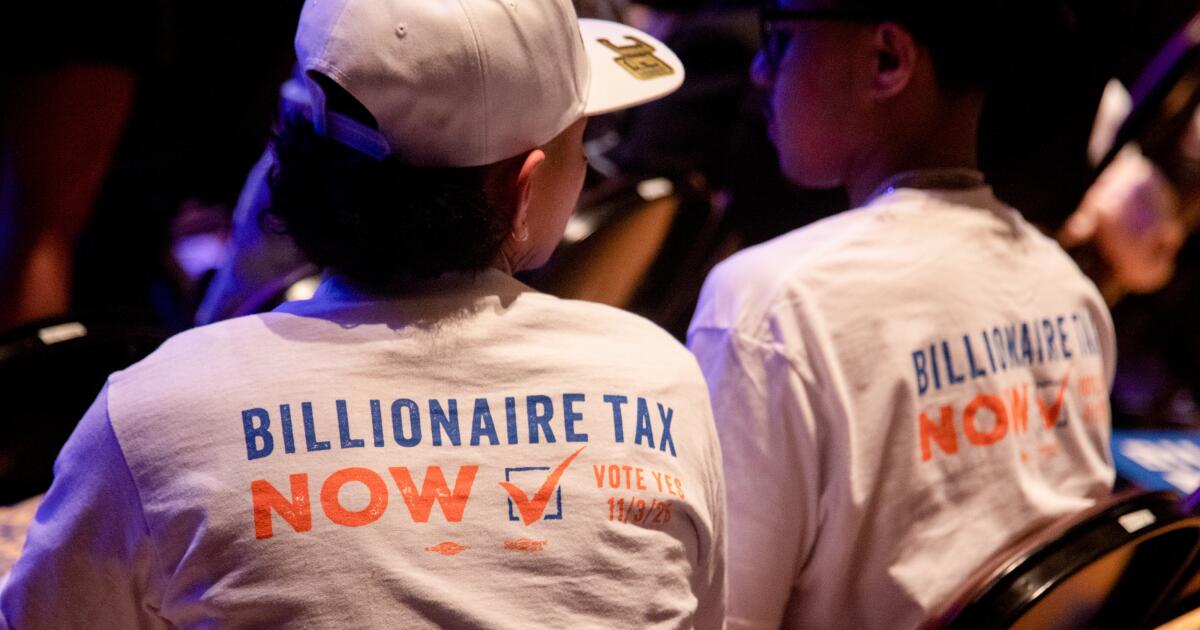
Proponents of a tax on California billionaires vowed on Thursday to move forward with their November ballot measure despite mounting opposition from many of the state’s most powerful political forces.
A labor union spent $31 million gathering signatures to qualify the measure for the ballot in an effort to offset federal healthcare funding cuts that will affect millions of California’s most vulnerable residents. A representative for the campaign supporting the ballot measure pushed back at opposition to the effort as self-entitled wealthy Californians and entrenched Sacramento interests.
“While a few morally bankrupt billionaires and their buddies in Sacramento want to see California’s hospitals close, and tax breaks for billionaires protected — I assure you, the vast majority of voters do not,” said Debru Carthan, a spokesperson for the Billionaire Tax Now Coalition, which is funded by the Service Employees International Union-United Healthcare Workers West, the sponsor of the proposal.
California Secretary of State Shirley Weber is expected to officially certify the measure to appear on the Nov. 3 ballot on Thursday evening.
Carthan said their effort has support in public opinion polls, and from lawmakers, unions, community organizations and volunteers across the state, “something the billionaires and their buddies will never have.” And she criticized Gov. Gavin Newsom for opposing the measure, saying that he is in “lock-step” with President Trump and billionaires.
“Gov. Newsom has no plan,” Carthan said during a Thursday evening news conference. “He has no plan to stop emergency rooms from closing. He has no plan for your healthcare costs. He has no plan to make sure that your family doesn’t have to drive further and wait longer to get medical care. Gov. Newsom has no plan to fix one of Trump’s deadliest domestic policy blunders.”
Rep. Ro Khanna (D-Fremont) also attacked the governor, though not by name.
“If you’re opposed to this tax, you’re on the side of trickle-down economics,” Khanna said. “You’re protecting the very, very rich, as opposed to standing up for the working class.”
Both Khanna and Newsom are considering running for president in 2028.
The Newsom administration did not respond to a request for comment Thursday evening.
A coalition of healthcare, education, public safety, housing, business and labor leaders opposed to the proposal warned that it would make the state’s notoriously unstable budget even more unpredictable.
“The dangerous wealth tax directly threatens vital funding for education and schools, healthcare and clinics, public safety, and infrastructure projects by making California’s revenue even more volatile,” the leaders of the California Medical Assn., the California Primary Care Assn. and the California School Boards Assn. said in a statement. “That’s why so many leaders – both Democrats and Republicans – are joining us and saying NO. We look forward to ensuring voters have the facts, know the stakes, and resoundingly reject this reckless experiment in November.”
Supporters of the one-time proposed 5% tax on the assets of the state’s wealthiest residents pitched the effort as a stop-gap measure to offset devastating federal healthcare funding cuts passed by the GOP-led Congress and signed by President Trump nearly one year ago. The federal legislation is expected to result in $100 billion in cuts that would affect California’s most vulnerable residents.
The proposed tax, which would be retroactive to billionaires who lived in the state as of Jan. 1, drew predictable opposition from the wealthy, notably Silicon Valley tech leaders.
But it notably divided liberals. While Sen. Bernie Sanders (I-Vt.) and Khanna supported the proposal, Newsom was among the Democrats who opposed it because of fears about the potential impact on the state’s volatile budget.
Despite being the fourth largest economy in the world — the home of Hollywood and Silicon Valley — California’s budget is extremely dependent on the state’s most prosperous residents.
Newsom and others who generally support increasing taxes on the wealthiest Americans also argued that the proposed billionaire tax in California was poorly crafted and that any such levies ought to be enacted nationally, because varying state policies would be ineffective.
Opponents also argued that the political priority in the 2026 midterm election should be squarely focused on efforts to make sure Democrats regain control of Congress to serve as a counter balance during the final two years of Trump’s presidency.
“It’s disappointing. This is a critical election where we need to concentrate on flipping the house and undoing the damage that was done” by Trump’s legislation that led to the healthcare funding cuts, said Jodi Hicks, chief executive and president of Planned Parenthood Affiliates of California. The wealth tax “is short term and doesn’t address what is the long-term problem. And I’m not even sure the policy is a viable solution. It’s so critical to be sending the right message — holding Congress accountable and how we need to find long-term solutions to make sure Californians have access to healthcare.”
Dave Regan, the president of SEIU-United Healthcare Workers West, lashed out at the leadership of Planned Parenthood as “out of touch” with their workers and their patients.
Rob Lapsley, co-chair of Californians Against Tax Increases and president of the California Business Roundtable, argued that the proposed wealth tax would ultimately affect every Californian.
“Strip away the spin, and this measure forces every California taxpayer, not just billionaires, to file a sworn declaration of their net worth with the Franchise Tax Board under penalty of perjury,” Lapsley said in a statement. “And it hands the Legislature the power to extend the wealth tax to all Californians and every kind of property, including home equity, retirement savings without ever returning to the voters – effectively gutting” voter-approved caps on property tax increases.
Supporters of the tax submitted nearly 1.6 million signatures in April to qualify the proposal for the ballot, roughly double the number required. However, support for the effort has grown increasingly shaky. Newsom’s team created a broad coalition of opponents, including healthcare and education activists, that undercut the foundational argument for the tax.
The union that crafted the proposal responded last week by proposing a legislative alternative that would create a 2% tax on billionaire’s assets. It was flatly refused by the Newsom administration. No deal was reached by the Thursday evening deadline for the union to withdraw the proposal from the November ballot.
Two efforts that were crafted to sink the proposed billionaire tax — dubbed poison pills — also qualified for the Nov. 3 ballot, according to the California Secretary of State’s office. One would bar new state taxes on personal property, while the other prohibits any new taxes being exempted from existing state spending rules and to be regularly audited. If the billionaire tax proposal is approved by voters but either of the other proposals receives more votes, the tax measure would be voided.
“We will not allow California’s most vulnerable patients to be used as political pawns,” said Francisco Silva, president and CEO of the California Primary Care Assn. “Our broad coalition will mount an aggressive campaign to educate voters, defeat this reckless initiative, and protect care for millions of patients.”
The proposed billionaire tax would apply to more than 200 Californians, some of whom proactively left the state or moved their companies out of California because of the proposal.
The prospect of the wealthy fleeing the state is among the reasons that prominent Democrats such as Newsom opposed it, given California’s budget being so reliant on the state’s most prosperous residents.
Sergey Brin, a co-founder of Google, is among the billionaires who have reportedly moved out of California because of the tax proposal. He donated at least $82 million to an organization that is funding efforts to invalidate the proposed billionaire tax.
Ballot measure proponents had a Thursday evening deadline to withdraw their proposals.
Other policy proposals that will appear on the Nov. 3 ballot include:
- Requiring government-issued voter identification to cast ballots in elections.
- Reforming the California Environmental Quality Act, once a third-rail in Democratic politics that has become increasingly scrutinized in the rebuilding in the aftermath of the Palisades and Eaton wildfires.
- Creating a $11.3-billion affordable housing bond.
Two notable proposals were pulled off the ballot after negotiations between the California Hospital Assn. and labor unions:
- An effort to limit healthcare executives’ compensation.
- A union proposal by the same union backing the billionaire tax that would have required many healthcare clinics to spend 90% of their revenue to serve low-income and underserved residents.
-

 Health52 seconds ago
Switching from cigarettes to vapes linked to higher risk of major eye diseases, large study finds
-

 Sports6 minutes ago
2026 World Cup Odds: Which Nations are Favored to Reach Semifinals?
-

 Technology13 minutes ago
World Cup ticket scams target desperate fans
-
Business16 minutes ago
Snap sued by parents of girl who was raped by man she met on Snapchat
-
 Entertainment21 minutes ago
‘The Bear’ at closing time: Ayo Edebiri and Jeremy Allen White reflect on five seasons
-
 Lifestyle28 minutes ago
L.A. Affairs: After decades of near-misses, I finally told him: ‘I’m not leaving here without you’
-
Politics31 minutes ago
Trump budget request omits funds for L.A. fire relief, prompting criticism from senators
-
 Science36 minutes ago
EPA touts crackdown on smuggled pesticides in L.A. visit

