Politics
‘Path to 218 runs through California’: State races pivotal in fight to control the House

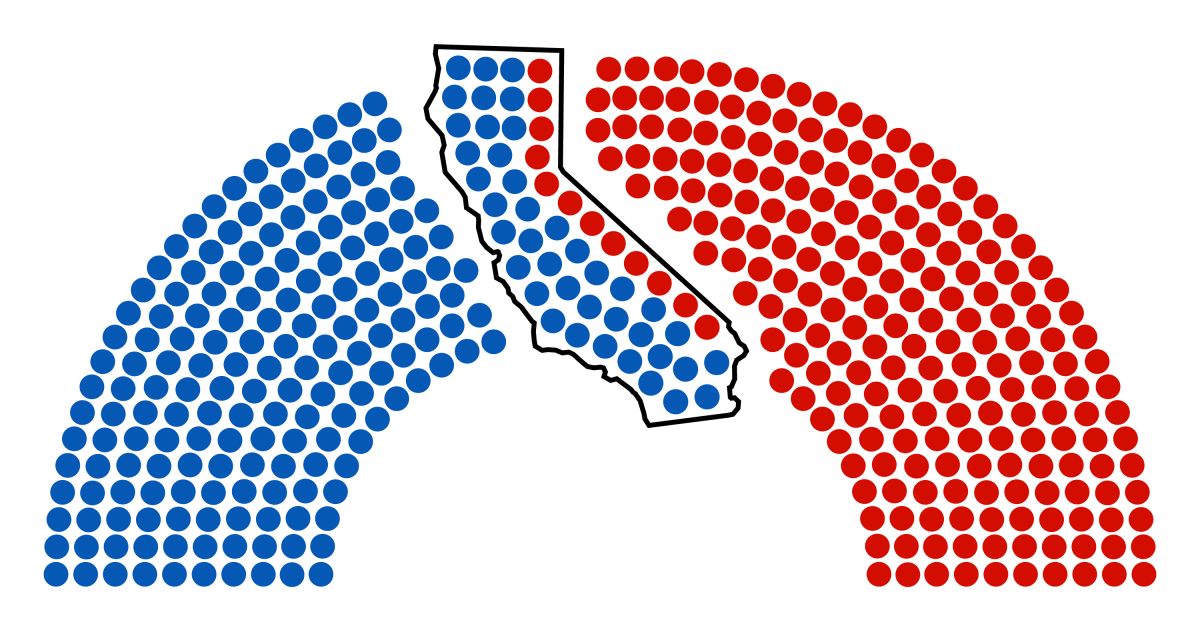
Barring divine intervention or the West Coast falling into the sea, President Biden will handily win California in the November election.
But should he — or presumptive GOP nominee Donald Trump — secure a second term in the fall, the future of either’s policy agenda rests heavily on which party controls Congress, where Republicans currently hold a wafer-thin majority in the U.S. House of Representatives.
With the Golden State home to some of the most hotly contested swing districts in the country, the House’s fate will almost certainly come down to California.
The battle for the next two years of partisan political control will be waged door-to-door, from California’s beachside suburban cul-de-sacs to the tiny farm towns in the state’s fertile Central Valley.
Those battlefields will look a lot like Bridgecreek Plaza — a sun-bleached shopping center a few hundred yards from a freeway onramp in Orange County’s Huntington Beach. The mall is home to a crystal store, several insurance brokers, a dentist and the local Republican Party headquarters.
It’s also where about two dozen GOP faithful gathered on the morning of election day, bowing their heads for a quick prayer and pledging allegiance to a portable flag before turning their attention to Jessica Millan Patterson, chair of the California Republican Party.
Patterson was in a very good mood.
When she was first elected to lead the party, in 2019, California Republicans were “essentially the third-largest party in the state,” having sunk below the share of voters registering “decline to state” under party preference.
But Patterson had presided over a massive voter registration drive over the last five years, and the party had moved back into second. People across the country liked to dismiss “blue California,” she said, but they were forgetting that California has more registered Republicans than any other state.
“California Republicans are the reasons why we have a House majority,” she added, to raucous cheering.
That majority was what they hoped to hold on to, and the group would spend the morning of the March 5 primary election canvassing for Scott Baugh, a Republican attorney and former state Assembly member vying to push Democratic Rep. Katie Porter’s soon-to-be-open congressional seat back from blue to red.
Scott Baugh is trying again to flip Orange County’s 47th District back to the red column. The seat is a chief target of state and national Republican efforts to maintain control of the House.
(Gary Coronado / Los Angeles Times)
The latest round of redistricting put more conservative enclaves such as Huntington Beach and Newport Beach into California’s 47th Congressional District, and Baugh lost to Porter only narrowly in 2022 despite being vastly outspent, making the coastal Orange County district one of the most competitive in the nation.
The charismatic Porter will be out of the House picture after a failed Senate run; her seat is one of the National Republican Congressional Committee’s three offensive targets in California and top priorities. And it’s equally prized by Democrats.
In a country where enmity and distrust separate the two major political parties on most issues, California’s utmost importance to any November House strategy is one of the few things on which Republicans and Democrats can agree.
California is home to 10 races rated as competitive by the nonpartisan Cook Political Report — five of them in districts that are represented by Republicans but that President Biden won in 2020. In the months to come, both parties will be investing significant resources in those races, as national attention inevitably turns west.
With an expected Biden-Trump rematch, voter turnout in 2024 is also likely to be supercharged compared with the 2022 midterm election. That could give an edge to Democrats, given the registration advantage that they hold in many of the competitive districts. Republicans gained one California House seat in the 2022 midterms, a nonpresidential election when turnout was substantially lower than when Biden and Trump topped the ballot two years prior.
“At the end of the day, the path to 218 runs through California,” said Democratic Congressional Campaign Committee spokesperson Dan Gottlieb, referring to the number of seats needed to garner a House majority.
Dave Min will face Baugh in November’s runoff for the 47th District seat, which Katie Porter is vacating. Min’s bruising primary battle for the crucial seat has already cost Democrats millions.
(Rich Pedroncelli / Associated Press)
Gottlieb was bullish on his party’s chances, citing the high turnout expected for the presidential election, along with strong Democratic candidates and “a bunch of dysfunctional and out-of-touch Republicans enabling the worst of their party’s chaos and dysfunction and extremism.”
But Gottlieb’s GOP counterpart was equally roseate in his outlook, with National Republican Congressional Committee spokesperson Ben Petersen reveling in the ugly and expensive primary fights that consumed Democrats in several of the state’s most crucial swing districts.
In the O.C. district where GOP volunteers fanned out for Baugh on primary morning, Democrats had sunk millions into a bruising primary battle between state Sen. Dave Min and fellow Democrat Joanna Weiss. Min ultimately emerged victorious, but only after surviving a barrage of negative advertising centered on his 2023 arrest for driving while intoxicated — arguably a gift to Republicans ahead of his fall battle with Baugh.
“Extreme Democrats are stumbling out of their vicious primary fights broke and bested by Republicans, who saw a groundswell of support for a commonsense safety and affordability agenda,” Petersen said, adding that the primary results made clear the GOP was “playing offense in California” in a way that would set the stage for victories in November.
Baugh, though, is not expected to go unscathed. In 2022, Porter’s ad campaign ripped the Republican for his antiabortion stance, as well as his work as a lobbyist and criminal charges he faced over campaign violations, for which he ultimately paid $47,000 in fines.
In the San Joaquin Valley, there were last-minute fears that a bruising primary battle would lock Democrats out of one of the races where they have the best chance of flipping a seat, but those concerns proved overblown.
Rudy Salas, backed by the Democratic establishment, vanquished fellow Democrat Melissa Hurtado to secure a spot in the fall against incumbent Rep. David Valadao (R-Hanford) in the 22nd Congressional District, but that race also put a dent in Democratic coffers.
The November race will be a rematch of the pair’s 2022 runoff, when Salas lost to Valadao by several thousand votes. And Salas and Valadao won’t be the only rematch on the November ticket.
In a heavily agricultural San Joaquin Valley district that includes all of Merced County and parts of Fresno, Madera, San Joaquin and Stanislaus counties, incumbent GOP Rep. John Duarte will once again face off against Democratic challenger Adam Gray. Duarte won the 13th Congressional District in the midterm election by fewer than 600 votes, one of the closest races in the nation.
Several hundred miles southeast, in Southern California, Democratic challenger Will Rollins will again take on GOP incumbent Rep. Ken Calvert, the longest-serving member of the California delegation. The recently redrawn 41st Congressional District stretches from the suburban Inland Empire, where Calvert has long lived, to Palm Springs, where Rollins and his partner make their home.
The district’s new boundaries — which now include one of the largest concentrations of LGBTQ+ voters in the nation and liberal pockets of Californians in the desert — are far more friendly to Democrats. They also set up Rollins, who is gay, as a potent challenger to Calvert, who voted against LGBTQ+ rights in the past, but who says his views have since evolved.
One race that will have some new blood this year, after the same pair of candidates dueled in three previous elections, is California’s 27th Congressional District in northern Los Angeles County.
Once solidly Republican, the district has been reconfigured by redistricting, and has undergone a political transition driven by younger, more diverse transplants from L.A. seeking affordable housing in Santa Clarita and the Antelope Valley. The district briefly switched from red to blue with former Rep. Katie Hill’s victory in 2018, but the young Democrat’s very public scandals and ultimate resignation helped hand the seat back to the GOP.
Now-incumbent GOP Rep. Mike Garcia beat Democrat Christy Smith in a 2019 special election to fill the seat, then twice more for full terms in 2020 and 2022. He will face off against George Whitesides, a fresh Democratic challenger, in November.
Ludovic Blain, executive director of the California Donor Table, a progressive group that pools donor funds, said his organization hopes to invest about $10 million in California House races in the fall, working with local nonprofits in key areas to turn out voters of color.
They’ll be focusing on seven key races: the three aforementioned rematches, Porter’s open seat and two other Orange County races, and the Garcia-Whitesides matchup.
One point of concern Blain raised is that Republican Steve Garvey’s place near the top of the ticket, facing off against Rep. Adam B. Schiff (D-Burbank) in the Senate race, might affect Democrats in House races.
Schiff engaged in a controversial strategy in the primary, boosting Garvey to lock out Porter and his other major Democratic challenger, Rep. Barbara Lee (D-Oakland), whom Blain’s organization supported.
It was a gambit that some in the Democratic establishment said would actually help Democrats in other tight races, since a less-competitive Senate race would siphon away far less money from the party’s coffers.
But others, like Blain, argue that Garvey’s presence could hurt down-ballot Democrats. Plus, having him on the ballot may draw in moderate Republican and independent voters who remain sour on Trump.
“Having Garvey, I think, does spike or further encourage Republican voters to turn out, and more importantly, to vote down the ticket,” Blain said.
Patterson agreed. Unlike Trump, Garvey will likely campaign across the state, providing a lift for other Republicans while he’s at it.





new video loaded: Senate Republicans Block Limits to Trump’s War Powers
transcript
transcript
Senate Republicans Block Limits to Trump’s War Powers
Senate Republicans voted against a Democratic bill that would have required President Trump to obtain congressional authorization to continue waging war against Iran.
-
“The yeas are 47. The nays are 53. The motion to discharge is not approved.” “President Trump decided to attack Iran. That decision was profound, deliberate and correct. The president understands the weight of war.” “Why is Donald Trump hellbent on making history repeat itself? Why is he plunging America headfirst into a war that Americans do not want, and which he cannot even explain? The American people deserve a say, and that is what our resolution is about.”
By Shawn Paik
March 5, 2026
Politics
DHS defends McLaughlin against allegations husband’s company profited millions from ad contracts: ‘Baseless’

NEWYou can now listen to Fox News articles!
EXCLUSIVE: Newly obtained financial statements shed light on claims that former Department of Homeland Security (DHS) Assistant Secretary Tricia McLaughlin’s husband’s company made millions from a DHS advertising campaign.
DHS Secretary Kristi Noem faced intense questioning during a Senate Judiciary Committee hearing Tuesday, and Sen. John Kennedy, R-La., specifically called out the agency for contracting a public relations firm headed by McLaughlin’s husband, Benjamin Yoho.
“I have personally reviewed the allegations against Ms. McLaughlin, and I find them to be baseless,” DHS General Counsel James Percival told Fox News Digital. “Nothing illegal or unethical occurred with respect to these contracts. Ms. McLaughlin was not involved in selecting any subcontractors.
“She is, however, a superstar in the public affairs world, so I am not surprised that she married a successful businessman whose services were attractive to these outside firms.”
Newly obtained financial statements address allegations that former Department of Homeland Security Assistant Secretary Tricia McLaughlin’s husband’s firm improperly profited from a multimillion-dollar DHS ad campaign. Lawmakers pressed Secretary Kristi Noem over the contracts during a heated Senate hearing. (Jack Gruber/USA Today)
Kennedy alleged that Yoho’s firm, The Strategy Group, “got most of the money” out of what the Louisiana Republican senator says was $220 million in “television advertisements that feature [Noem] prominently.”
“I’m sorry,” Kennedy said. “Safe America Media was a company formed 11 days before you picked them. And that the Strategy Group got most of the money. And the head of that is married to your former spokesperson.”
“It’s just hard for me to believe knowing the president as I do, that you said, ‘Mr. President, here’s some ads I’ve cut, and I’m going to spend $220 million running them,’ that he would have agreed to that,” Kennedy explained. “I don’t think Russ Vought at OMB [Office of Management and Budget] would have agreed to that.”
‘YOU SHOULD BE ASHAMED!’: PROTESTER DRAGGED FROM KRISTI NOEM’S SENATE HEARING
Senate scrutiny intensified over a DHS advertising campaign after Sen. John Kennedy, R-La., questioned whether a firm linked to McLaughlin’s husband benefited unfairly. DHS officials and the company deny any wrongdoing or multimillion-dollar profits. (Andrew Harrer/Bloomberg via Getty Images)
The Strategy Group is a conservative advertising agency for which Yoho serves as CEO.
Figures obtained by Fox News Digital show a slightly lesser total advertising expenditure of approximately $185 million, with a total of roughly $146.5 million going to a campaign called “Save America.”
However, of the total that went to “Save America,” roughly $348,000 went to production costs, while the remaining $142 million went to “media buys.”
Sources at DHS say that media buys are the cost of actually buying the ads themselves, whether purchased from social media or for a TV ad.
Kennedy also alleged that the bidding process for the contracts never took place and that Safe America Media’s recent founding was a cause for concern and collusion between McLaughlin and her husband’s business.
WATCH THE MOST VIRAL MOMENTS AS KRISTI NOEM’S HEARING GOES OFF THE RAILS
Debate over DHS’ “Save America” ad campaign intensified as senators challenged its costs and contractor ties, even as agency officials touted the initiative as a historic success in promoting self-deportation. (Graeme Sloan/Getty Images)
“Yes they did,” Noem responded during the hearing. “They went out to a competitive bid, and career officials at the department chose who would do those advertising commercials.”
The Strategy Group posted to X Tuesday that it never had a contract with the department. While it did receive several hundred thousand dollars for production costs associated with the advertising campaigns, The Strategy Group never made millions.
“The Strategy Group has never had a contract with DHS,” the post said. “We had a subcontract with Safe America [Media] for limited production services. Safe America paid us $226,137.17 total for 5 film shoots, 45 produced video advertisements and 6 produced radio advertisements.
DHS SPOKESWOMAN TRICIA MCLAUGHLIN TO LEAVE TRUMP ADMIN, SOURCE CONFIRMS
Critics raised concerns about potential conflicts of interest in a high-dollar DHS advertising effort, but department representatives say McLaughlin recused herself and that subcontracting decisions were made independently. (AP Photo/Jose Luis Magana, File)
“If you’re going to try to question our integrity, bring actual evidence — we did,” the post concluded.
Because these ads were purchased using public funds, all contract totals are publicly available.
Lauren Bis, who took up the role of assistant secretary once McLaughlin left office, told Fox News Digital Tuesday that scrutiny from Republicans and Democrats over the advertising spending was unjustified because the campaigns resulted in “the most successful ad campaign in U.S. history.”
“Sanctuary politicians are attacking this ad campaign because it has been successful in CLOSING our borders and getting more than 2.2 million illegal aliens to LEAVE the U.S.,” Bis said.
“The DHS domestic and international ad campaign was the most successful ad campaign in U.S. history. The results speak for themselves: 2.2 million illegal aliens self-deported, and we now have the most secure border in American history.”
KRISTI NOEM TO FACE SENATE GRILLING OVER MINNEAPOLIS SHOOTINGS AS DHS SHUTDOWN HITS WEEK 3
The Trump administration reaffirmed that all illegal immigrants are eligible for deportations as they focus on arresting violent criminals first. (Raquel Natalicchio/Houston Chronicle via Getty Images)
Bis also compared the cost of arresting and deporting an illegal migrant to that of the minimal cost of an illegal migrant self-deporting. The department says the advertising campaign played a key role in marketing self-deportation.
A spokesperson at DHS also told Fox News Digital that contractors decide who they hire, fulfilling the terms of a contract, not the department itself.
“By law, DHS cannot and does not determine, control or weigh in on who contractors hire or use to fulfill the terms of the contract,” a DHS spokesperson told Fox. “Those decisions are made by the contractor alone. We have only become aware of these companies because of this inquiry and did not hire those companies.”
The spokesperson also noted that McLaughlin “recused herself” from interactions with subcontractors to avoid “any perceived appearance of impropriety.”
“Upon hearing who the subcontractors were for production of the ad, Ms. McLaughlin recused herself from any interaction or engagement with any subcontractors to avoid any perceived appearance of impropriety,” the spokesperson continued. “DHS Office of Public Affairs is the program officer. Ms. McLaughlin oversees the DHS Office of Public Affairs, which is simply the vehicle for this contract.”
Department of Homeland Security Secretary Kristi Noem takes her seat as she arrives to testify during a Senate Judiciary Committee hearing Tuesday on Capitol Hill in Washington, D.C. (Jim Watson/AFP via Getty Images)
McLaughlin told Fox News Digital the criticism of her and her family by senators at the hearing is a matter of public manipulation.
CLICK HERE TO DOWNLOAD THE FOX NEWS APP
“This is yet another example of politicians intentionally trying to dupe and manipulate the public to try to manufacture division and anger,” McLaughlin told Fox News Digital. “The ad spend and contracts are a matter of public record, and the process was done by the book.
“These politicians would rather smear private citizens and American small businesses than do any basic research.”
Fox News Digital’s Alexandra Koch contributed to this report.
Related Article


WASHINGTON — Senate Republicans blocked a war powers resolution Wednesday designed to withdraw U.S. forces from hostilities in Iran, as the Trump administration accelerates its military campaign in a conflict that has killed hundreds, including at least six American service members.
The motion failed in a vote of 47-53.
In addition to pulling out military resources from the Middle East, the measure — introduced by Sens. Chuck Schumer (D-N.Y.), Adam Schiff (D-Calif.) and Tim Kaine (D-Va.) — would have required Congress’ explicit approval before future engagement with Iran, a power granted to the legislative branch in the Constitution.
The House, where Republicans also hold an advantage, is scheduled to weigh in on a similar measure Thursday. Even if both Democratic-led measures were to succeed, President Trump was widely expected to veto the legislation.
“We are doing very well on the war front, to put it mildly,” President Trump said at a White House event on Wednesday afternoon. The president, who has come under scrutiny for offering shifting explanations on the war’s endgame, said that if he was asked to scale the American military operation from one to 10, he would rate it a 15.
Democrats dispute that Trump possesses the authority to wage the ongoing operation in Iran without explicit congressional approval.
Acknowledging the measure was unlikely to succeed, they framed the vote as a strategy to force lawmakers to put their support for or opposition to the war on record.
“Today every senator — every single one — will pick a side,” Schumer said. “Do you stand with the American people who are exhausted with forever wars in the Middle East, or stand with Donald Trump and Pete Hegseth as they bumble us headfirst into another war?”
Senate Majority Leader John Thune (R-S.D.) and most of his Republican colleagues have maintained that the president carried out a “pre-emptive” and “defensive” strike in Iran, giving him full authority to continue unilateral military operations.
Republicans saw the vote as the “last roadblock” stopping Trump from carrying out his mission against the Islamic Republic.
“I think the president has the authority that he needs to conduct the activities and operations that are currently underway there. There are a lot of controversy and questions around the war powers act, but I think the president is acting in the best interest of the nation and our national security interests,” Thune said at a news conference.
Senators largely held to party loyalties, with the exception of Kentucky Republican Rand Paul, who broke ranks to support the measure, and Pennsylvania Democrat John Fetterman, who opposed it.
The vote comes as Defense Secretary Pete Hegseth said Wednesday that the war against Iran is “accelerating,” with American and Israeli forces expanding air operations into Iranian territory. He pointed to evidence released by U.S. Central Command of a submarine strike on an Iranian warship, and also lauded other strikes throughout the region as civilian casualties in Iran surpassed 1,000 on the fourth day of the conflict, according to rights groups.
“We’re going to continue to do well,” Trump said Wednesday. “We have the greatest military in the world by far and that was a tremendous threat to us for many years. Forty-seven years they’ve been killing our people and killing people all over the world, and we have great support.”
Republicans blocked a similar war powers vote in January after the president ordered U.S. special forces to capture and extradite Venezuelan President Nicolás Maduro in Caracas on drug trafficking charges.
GOP leaders argued that the outcome of that mission equated to a quick success in the Middle East, despite an uncertain timeline from the Department of Defense.
In the House, lawmakers will vote on a separate war powers effort Thursday. That bill is led by Rep. Ro Khanna (D-Calif.) and Rep. Thomas Massie (R-Ky.), the two lawmakers who authored the Epstein Files Transparency Act.
“Instead of sending billions overseas, we need to invest in jobs, healthcare, and education here,” Khanna said on X.
In addition to that proposal, moderate Democrats in the House have introduced a separate resolution that would give the administration a 30-day window to justify continued hostilities in the Middle East before requiring a formal declaration of war or authorization from Congress.

Trump, BBC agree on mediator for $10 billion lawsuit over Jan 6 documentary editing controversy

Rhode Island teacher accused of sexting, kissing high school boy

Detroit Tigers 2026 roster prediction 2.0: Is Kevin McGonigle ready?

Latest California-based gig work app lets people book content creators, editors

Study says the real value of a $100K salary in Dallas is…less than that

Florida High School Football Rankings: Top 25 teams – Oct. 21

Cleary's 21 help Le Moyne down Central Connecticut State 69-64 in OT

How old is Bo Nix? What to know about Oregon quarterback ahead of 2024 NFL Draft

99th annual Pony Swim held in Virginia

Indiana Members Credit Union announced as new anchor tenant at Bottleworks District

DHS defends McLaughlin against allegations husband’s company profited millions from ad contracts: ‘Baseless’

Fareed Zakaria’s takes on Trump and the collapse of nuclear stability

Sánchez defies Trump in political gamble as Madrid say no to war

Satellite images show Iran school strike hit more buildings than earlier reported

US submarine sinks Iranian warship by torpedo in a first since World War II
-

 World1 week ago
Exclusive: DeepSeek withholds latest AI model from US chipmakers including Nvidia, sources say
-

 Massachusetts1 week ago
Mother and daughter injured in Taunton house explosion
-

 Wisconsin3 days ago
Setting sail on iceboats across a frozen lake in Wisconsin
-

 Maryland4 days ago
AM showers Sunday in Maryland
-

 Denver, CO1 week ago
10 acres charred, 5 injured in Thornton grass fire, evacuation orders lifted
-

 Florida4 days ago
Florida man rescued after being stuck in shoulder-deep mud for days
-

 Massachusetts2 days ago
Massachusetts man awaits word from family in Iran after attacks
-

 Oregon6 days ago
2026 OSAA Oregon Wrestling State Championship Results And Brackets – FloWrestling