Politics
Opinion: What Kamala Harris needs to remember about California's anti-immigrant past

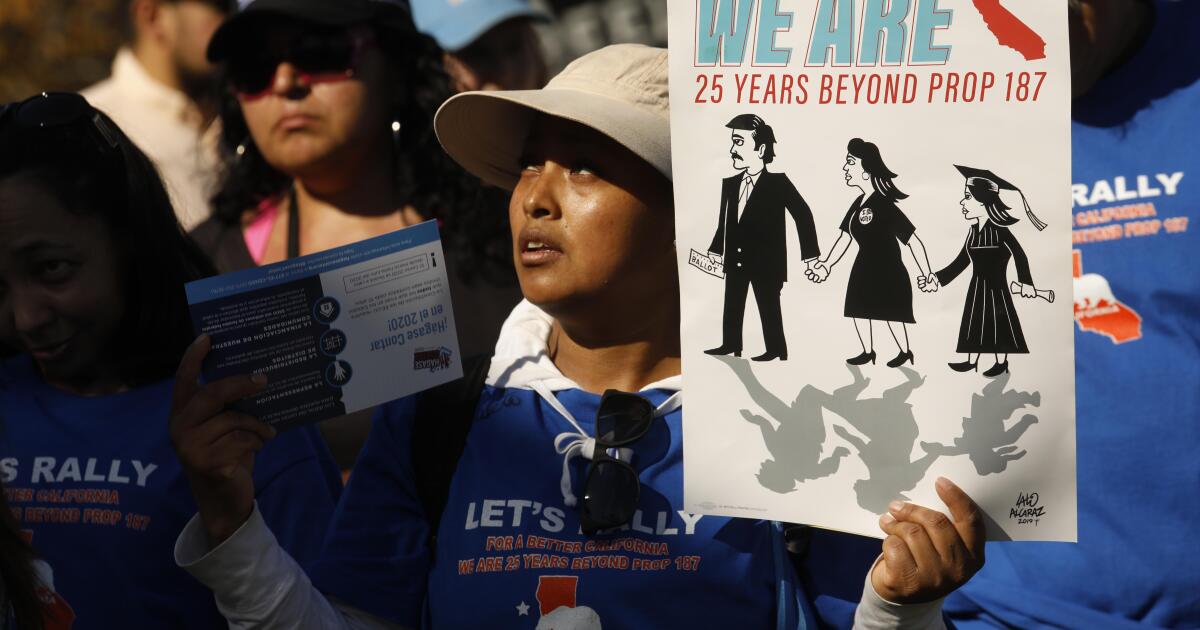
The Democratic Party, and its presidential nominee Kamala Harris, should stop touting “border security” and offer a new approach to the immigration debate, one firmly rooted in American values of justice, opportunity and truth-telling.
The contrast with Donald Trump should be easy to sell: The former president is promising to enact the “largest mass deportation” in the nation’s history and issue an executive order denying birthright citizenship to any child born of residents who are in the country without papers. These actions would have a devastating impact on millions of people, many of whom have been in the United States for decades. It would wreak havoc on our economy, which is not just dependent on immigrants with and without papers, but bolstered by them. And it would tarnish beyond repair our moral standing as a human rights leader around the world.
While the Republican Party’s embrace of exclusion is frightening, equally troubling is the Democrats’ embrace of policies that falsely equate border security with more restrictive asylum regulations, including President Biden’s executive order in June that closes the border to asylum applicants when numbers reach certain limits. The hope seems to be that a somewhat less cruel approach than mass deportation will satisfy those sympathetic to immigrants but also pull some would-be MAGAistas away from the xenophobic abyss.
Harris seemed to play into this strategy with her now infamous 2021 remarks telling Guatemalans: “Do not come … If you come to our border, you will be turned back.” Although it may have been more a statement of fact than a threat, it revealed a serious lack of understanding about the forces leading migrants to leave their homes. It also hurt her — and the administration’s — credibility with immigrant communities; a “big blemish,” as a political scientist at UC Irvine told The Times. Her latest talking points — emphasizing drug cartel prosecutions and the border crackdown bill Republicans tanked earlier this year — lean in the same anti-immigrant-tinged direction.
So what should Harris say and do? To borrow her own emerging slogan, she should argue that “we are not going back” to divisive policies and “build the wall” attitudes. Tough talk against immigrants has a short political shelf life. We in California know this story first-hand.
This year marks the 30th anniversary of the state’s passage of Proposition 187 in 1994, a measure that sought to block undocumented immigrants in California from accessing basic, lifeline services — especially healthcare and public education for their children. It required every teacher, school nurse, firefighter and police officer to report anyone they merely suspected to be undocumented. The initiative was stayed and eventually deemed unconstitutional by federal courts, but even without going into effect it ignited a counteroffensive on behalf of all Californians.
Three decades later, California’s political terrain has shifted so significantly that the state has extended earned income tax credits, college tuition programs and health insurance to undocumented residents. Most significantly, it is now nearly impossible for an anti-immigrant candidate to win statewide office.
The move away from exclusion didn’t happen on its own. At first, it activated a tug-of-war between California moderates and progressives about how to push back against anti-immigrant fear and fervor, with some arguing for the defensive middle ground, similar to Harris’ stance now.
What prevailed instead was a grassroots effort to establish a multiracial, cross-sector coalition of support for commonsense policies in a sanctuary state. In just one example, when anti-immigrant jurisdictions began using traffic stops to criminalize non-citizens — upending families, communities and swaths of the economy, not to mention traffic — the coalition got Assembly Bill 60 passed, after a battle spanning more than a decade, in 2013, giving undocumented immigrants access to a special driver’s license.
Along the way the process proved the benefits of inclusion to the state. As The Times reported last week, international migrants have “lifted” the U.S. and California economies, filling and creating jobs and “pumping millions of tax dollars” into government coffers.
Indeed, Golden State politicians are now likely to remind their audiences that the state’s economy — the fifth largest in the world — is home to more than 10 million immigrants with $383 billion in spending power, and that 40% of the state’s entrepreneurs are immigrants. Even undocumented immigrants are a proven boon: At a national level, they contribute $13 billion more annually to the Social Security system than they will even be able to withdraw.
California’s shift away from Proposition 187 thinking can and should be exported nationally. It’s a ready-made opportunity for any political figure, but especially Harris and the Democrats, to look to the future.
Surveys show that despite the attacks on their very existence, immigrants and their children are largely optimistic, a sharp contrast to the dark tones of a MAGA movement that thinks America can only be great if it goes back to some mythical, all-white past. Harris should wholeheartedly embrace a more hopeful vision of America, one rooted in facts that prove the contributions of immigrants, instead of being tempted to in any way countenance Trump’s hate-filled agenda.
We are both the children of once-undocumented parents. We know that immigrants enrich our society, that the demonizing of newcomers is morally and factually wrong. A bold and brave commitment to inclusion will strengthen the United States, reflect the values of a democratic and diverse nation, and move us closer to realizing the American dream that so many, especially immigrants, aspire to.
Manuel Pastor is a professor of sociology and director of the Equity Research Institute at USC. Miguel Santana is president and CEO of the California Community Foundation.

Politics
McCarthy says Trump will use ‘everything he can’ to force Senate action on SAVE America Act

NEWYou can now listen to Fox News articles!
As infighting over the SAVE America Act throws congressional Republicans into disarray, President Donald Trump’s bid to get the stalled election bill across the finish line gained one notable ally.
Former House Speaker Kevin McCarthy, R-Calif., told Fox News Digital that he supports the election integrity measure and indicated that Trump should continue to use every available tool to pressure the Senate to pass it.
“He’s going to try everything he can to make sure he passes that through,” McCarthy said in a brief interview outside the U.S. Capitol.
The ex-speaker’s comments came after Trump abruptly called off a signing ceremony Wednesday for a bipartisan housing bill to pressure the Republican-controlled Senate to act on the SAVE America Act.
President Donald Trump boards Air Force One as he departs Reading Regional Airport in Reading, Pa., on June 23, 2026. (Evelyn Hockstein/Reuters)
IRATE REPUBLICANS ACCUSE TRUMP OF HANDING DEMOCRATS A WIN AFTER BLOWING UP HOUSING PACKAGE
The move surprised Republican lawmakers, some of whom were praising the bill’s passage at a press conference when Trump’s Truth Social post broke.
But Trump has repeatedly cast the election measure — requiring proof of citizenship to vote in federal elections and voter identification requirements — as his top legislative priority.
The legislation’s momentum, however, has slowed in the upper chamber, where Republican leadership insists the votes aren’t there amid widespread Democratic opposition. Senate Republicans have also been unwilling to eliminate the legislative filibuster, which requires a 60-vote threshold to pass the legislation.
Former Speaker of the House Kevin McCarthy speaks during a ceremony honoring President Ronald Reagan on the 115th anniversary of his birthday at the Ronald Reagan Presidential Library in Simi Valley, Calif., on Feb. 6, 2026. (Hans Gutknecht/MediaNews Group)
TRUMP CALLS MAIL IN VOTING CORRUPT AS SENATE BEGINS DEBATE ON SAVE ACT REQUIRING VOTER ID
Amid the SAVE standoff, a group of conservative lawmakers effectively shut down the House floor in an effort to force Senate action on the election bill.
But the Senate recessed Wednesday for two weeks over the July 4 holiday, leaving the measure in limbo until lawmakers return.
The conservative-led blockade sparked fierce backlash, with several members inside the GOP conference telling Fox News Digital the move risked torpedoing their own legislative agenda.
Meanwhile, the House has also yet to pass a version of the legislation incorporating several of the president’s priorities, including a mail-in voting crackdown and provisions banning men from competing in women’s sports and child sex change procedures.
Trump has not indicated whether he will sign the 21st Century ROAD to Housing Act, despite the likely existence of a veto-proof majority.
House Speaker Mike Johnson, R-La., told reporters Thursday that the housing bill had been transmitted to the White House for Trump’s signature following a meeting with the president.
Speaker of the House Mike Johnson, R-La., talks with reporters in the U.S. Capitol on June 10, 2026. (Tom Williams/CQ-Roll Call, Inc via Getty Images)
CLICK HERE TO DOWNLOAD THE FOX NEWS APP
Trump now has 10 days to sign the package or veto it. If he does nothing, the legislation automatically becomes law at the end of the 10-day period.

WASHINGTON — California’s two Democratic senators on Thursday criticized the Trump administration after it requested $87.6 billion from Congress to address some of the nation’s most “urgent needs” but omitted funding for victims of last year’s Los Angeles wildfires.
“Donald Trump’s desire to punish Los Angeles and the state of California for not voting for him, means once again that thousands of Angelinos are left watching this administration fight for anything but them, their businesses, and their communities,” Sens. Alex Padilla and Adam Schiff said in a joint statement.
“These fires did not discriminate based on party or political preference. Neither should this administration,” they added.
The omission is the latest strain in a yearlong standoff between California leaders and the Trump administration over federal disaster aid, and it comes after Los Angeles Mayor Karen Bass and Los Angeles County Supervisor Kathryn Barger met with President Trump at the Oval Office in April to request the funding.
At the meeting, Trump signaled his commitment to working with local officials to help with disaster recovery efforts. The officials asked for $16 billion that would be split between the city and county. The money would consist primarily of disbursements from the Federal Emergency Management Agency flagged for communities hit by the fires, part of a $33.9-billion wildfire relief funding request made by Gov. Gavin Newsom.
Two months later, those talks have yet to yield results sought by local leaders.
The budget request, submitted by the Office of Management and Budget on Wednesday, mostly seeks funding for the Pentagon to address costs related to the Iran war. It also includes $11.1 billion in economic assistance for American farmers, $1.4 billion to address the Ebola virus outbreak in Central Africa, $500 million to support “ongoing efforts to complete restorations and construction projects” across the nation’s capital and $1 billion to boost the pensions of workers at General Motors that were cut as a result of the automaker’s bankruptcy.
“I urge the Congress to take action on these important and urgent requests as soon as possible,” White House budget director Russell Vought wrote in a letter addressed to House Speaker Mike Johnson (R-La.).
Vought said the administration was open to discussing “additional relief for other urgent matters.” The White House did not immediately respond when asked why the budget request did not mention the Eaton and Palisades disaster relief funds.
State leaders, including Newsom, have repeatedly accused the Trump administration of stonewalling billions in wildfire aid. The governor visited Washington in December to meet with lawmakers, including three who serve on the Senate and House appropriations committees, to push for the funding.
The governor also attempted to meet with FEMA about the matter, but said his request was denied. Newsom, a political foe of Trump’s, would not say whether he had attempted to meet with Trump to talk about the recovery efforts.
Politics
Trump administration pledges $150M in aid, deploys Navy warships after deadly Venezuela earthquakes

Secretary Rubio details US aid to Venezuela after earthquakes
Secretary Rubio, in Manama, Bahrain, outlines the comprehensive U.S. government response to the devastating back-to-back earthquakes in Venezuela. He confirms immediate deployment of search and rescue teams, medical resources and humanitarian assistance, emphasizing the urgency to save lives. Rubio reiterates President Donald Trump’s commitment to supporting Venezuela and collaborating with international partners on recovery efforts and long-term stability.
NEWYou can now listen to Fox News articles!
Following a catastrophic set of earthquakes that left at least 235 people dead in Venezuela, the Trump administration has activated a government-wide humanitarian response, pledging $150 million in aid and deploying U.S. Navy warships to assist in life-saving rescue operations.
The rapid mobilization Thursday comes after back-to-back magnitude 7.2 and 7.5 earthquakes rocked northern Venezuela roughly 120 miles west of Caracas Wednesday night.
The rare earthquake “doublet” injured more than 940 people and turned the state of La Guaira into a disaster zone, while forcing the closure of the damaged Simón Bolívar International Airport, according to Venezuela’s Health Ministry.
US RESCUE TEAMS TO DESCEND ON HARD-HIT CARIBBEAN AFTER CATASTROPHIC HURRICANE MELISSA’S IMPACT
Rescuers search for victims in a collapsed building following an earthquake in Caracas on June 24, 2026. (Manaure Quintero / AFP via Getty Images)
The U.S. Department of State announced on Thursday it is mobilizing $150 million in aid, which includes $50 million in new bilateral awards for relief partners on the ground — such as Samaritan’s Purse, Catholic Relief Services and World Vision — along with a $100 million contribution to a United Nations humanitarian pooled fund.
To spearhead efforts on the ground, the State Department has deployed a regional Disaster Assistance Response Team alongside two highly specialized urban search-and-rescue teams from fire departments in Fairfax County, Virginia, and Los Angeles County, California.
U.S. WARSHIPS TO PATROL INTERNATIONAL WATERS AROUND VENEZUELA AS TRUMP VOWS TO STOP CARTELS
Members of the County of Los Angeles Fire Department’s international urban search and rescue team (USA-2) prepare to leave for Venezuela, in Pacoima, Calif., Thursday. (Blake Fagan/AFP via Getty Images)
U.S. Southern Command (SOUTHCOM) said it is surging assigned U.S. military forces to the region, directing the USS Fort Lauderdale and the USS Billings to Venezuela to back the State Department-led operations.
The USS Fort Lauderdale will serve as a “floating command center” with a flight deck to support heavy-lift helicopters and a well deck to launch landing craft, according to SOUTHCOM.
Meanwhile, the agile USS Billings will provide critical support close to the shorelines to accelerate the disaster response missions.
U.S. SOUTHCOM said it has directed USS Fort Lauderdale (LPD 28) and USS Billings (LCS 15) to Venezuela to support State Department-led U.S. government relief operations in Venezuela. (@Southcom/X)
SOUTHCOM said it is also sending rotary-wing aircraft, which will provide critical life-saving airlift support, transporting U.S. government response personnel, search and rescue teams and partners during relief operations.
Amid the crisis, the State Department emphasized that the safety of U.S. citizens remains the administration’s highest priority.
“The Trump Administration has no higher priority than the safety and security of Americans. The Department of State is working tirelessly to provide consular assistance to U.S. citizens and their families in the affected areas,” officials wrote in a statement. “The United States remains steadfast in its commitment to helping Venezuela recover from this devastating disaster and will continue to explore additional ways to provide meaningful assistance during this critical time.”
CLICK HERE TO DOWNLOAD THE FOX NEWS APP
U.S. citizens in Venezuela are urged to enroll in the Smart Traveler Enrollment Program (STEP) and can contact the State Department 24/7 at 202-501-4444 for emergency assistance.
Family members in the U.S. seeking information on loved ones can call toll-free at 888-407-4747.
-
 Lifestyle2 minutes ago
‘Supergirl’ has a solid hero but could use a better villain : Pop Culture Happy Hour
-

 Technology12 minutes ago
Of course Meta thinks gambling is the future
-

 World17 minutes ago
Death toll from Venezuela earthquakes rises to at least 589, with thousands reported missing
-

 Politics25 minutes ago
McCarthy says Trump will use ‘everything he can’ to force Senate action on SAVE America Act
-

 Health27 minutes ago
Switching from cigarettes to vapes linked to higher risk of major eye diseases, large study finds
-

 Sports33 minutes ago
2026 World Cup Odds: Which Nations are Favored to Reach Semifinals?
-

 Technology40 minutes ago
World Cup ticket scams target desperate fans
-
Business42 minutes ago
Snap sued by parents of girl who was raped by man she met on Snapchat


