Politics
Opinion: This surprise argument could derail Trump's effort to delay the Jan. 6 trial

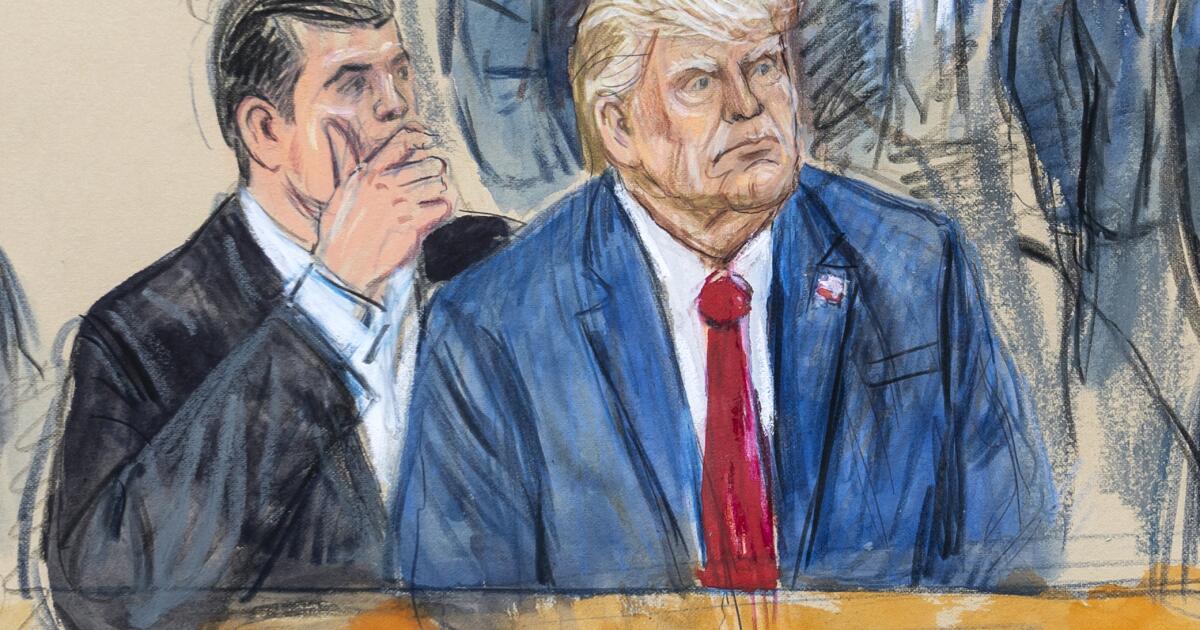
As all eyes watched every word filed by Donald Trump and federal prosecutors ahead of next week’s crucial arguments on immunity, a third party slipped in the side door with a brief that may dramatically foil the former president’s efforts to leverage the issue for maximum delay.
The watchdog organization American Oversight, which is not a party to the case, successfully petitioned the U.S. Court of Appeals for the D.C. Circuit to accept its friend-of-the-court brief on the ground that it provides a “unique perspective.”
Indeed it does. The brief makes the apparently compelling argument that the court shouldn’t be hearing this appeal at all because it lacks jurisdiction — that is, the power to consider it in the first place. If the court agrees, it would mean dismissing the appeal and returning the case to U.S. District Judge Tanya Chutkan, abruptly aborting Trump’s best opportunity to delay the federal Jan. 6 trial.
Trump’s argument is that he is entitled to avoid trial because the Constitution prohibits indicting him for conduct he undertook as president, at least if it was within the “outer perimeter” of his official duties. Most observers, including me, think Trump will lose the claim on the merits, but it’s likely that the U.S. Supreme Court will have to make that pivotal determination. The question is when — before trial, putting the case on ice, or afterward.
Chutkan has decided that she can’t go forward with the trial until that’s settled, reasoning that immunity is a right not to go to trial in the first place. That suggests that even if Trump is bound to lose his claim, he will be able to string out the process for at least a couple of months, bumping back the start of probably the most important of the four criminal trials he faces. Originally scheduled for March, the trial is thereby being delayed deeper into Trump’s campaign to return to the White House.
Enter the American Oversight brief, written by lawyers with the Washington-based firm Arnold & Porter. The brief relies on a unanimous 1989 Supreme Court opinion, Midland Asphalt Corp. vs. United States, written by the late Justice Antonin Scalia. The defendant in the criminal case, Midland Asphalt, had moved unsuccessfully for a dismissal of the charges based on the prosecution’s alleged violation of grand jury rules.
The Supreme Court held that neither it nor the circuit court had the power to hear the case on “interlocutory appeal,” or before trial. As with the vast majority of issues that may arise at trial, the court ruled, this one could be considered only after a conviction.
The court emphasized that in criminal cases, the compelling interest in prompt trials demands that courts apply the interlocutory appeal doctrine “with utmost strictness.” Federal courts have jurisdiction over such appeals, the justices found, only if they are brought under a constitutional or statutory provision that expressly gives the defendant a right not to go to trial.
Since the Midland Asphalt opinion, the court has identified only three categories of motions that may be considered before trial in criminal cases: motions to reduce bail and those concerning the double jeopardy clause in the Constitution’s 5th Amendment, and the speech or debate clause, which protects legislators from being “questioned” — that is, tried — at all.
Trump’s immunity argument therefore doesn’t seem to fit within Midland Asphalt’s exceptions. It doesn’t rest on any explicit constitutional guarantee. And the D.C. Circuit Court previously held that a right based on constitutional principles such as the separation of powers doesn’t cut it.
The Justice Department and Trump had been assuming the D.C. Circuit Court has jurisdiction based on Nixon vs. Fitzgerald, which established broad but not endless immunity from lawsuits over a president’s conduct while in office. But that civil case was not subject to the “utmost strictness” standard the Supreme Court has applied to criminal trials. It also predated the Midland Asphalt opinion, which the Justice Department somewhat bafflingly failed to mention.
There may be a reason the Midland Asphalt doctrine doesn’t apply here, but I can’t think of one.
Jurisdiction is an issue that courts take extremely seriously, and I think the D.C. Circuit Court should and probably will consider the argument that it lacks jurisdiction very carefully. It’s already ordered the parties to address American Oversight’s position at oral argument Tuesday, when it’s likely to be a subject of intense questioning.
If the argument succeeds, it will be an appellate version of the sort of Perry Mason moment that rarely happens in a real courtroom. With a wave of a jurisdictional wand, Trump would be back in the district court preparing for an only slightly delayed trial.
Harry Litman is the host of the “Talking Feds” podcast. @harrylitman



Politics
FBI’s Patel delivers blunt warning to law enforcement attackers: ‘We’re going to put you down’

NEWYou can now listen to Fox News articles!
FBI Director Kash Patel issued a direct warning to anyone who attacks law enforcement, vowing Saturday that those who “touch a cop” will be tracked down and arrested amid growing concerns over violence against officers.
The comments came while Patel was speaking on SiriusXM Patriot’s “Breitbart News Saturday,” discussing violence against federal officers.
“You have to back the blue,” Patel said. “I say the following to as many officers and Americans that I get in front of: If you touch a cop, we’re going to put you down. And that’s what we’re doing.”
He said the FBI is “going to back our partners,” noting that any criminal who assaults or impedes law enforcement is “going to face the full force of law enforcement.”
FBI Director Kash Patel had a stern warning for anyone who wishes to harm law enforcement professionals. (Chip Somodevilla/Getty Images, File)
CHICAGO’S POLICE CHIEF PUTS CRIMINALS ON NOTICE AFTER FEDERAL AGENTS TARGETED IN WEEKEND CONFRONTATIONS
“We’re not saying that you can’t go out there and peacefully protest,” Patel said. “We are simply saying, … you cannot interfere with [an officer in their] lawful execution of [their] lawful duty.
Since the start of the Trump administration’s immigration enforcement crackdown, the Department of Homeland Security has reported violence against federal agents spiked to a record high.
DHS SHUTDOWN PUTTING AMERICANS AT RISK AS WORLD CUP SECURITY PREP ‘SIGNIFICANTLY BEHIND’: SEN FETTERMAN
The director added police around the country are “so empowered by the fact that we are backing the blue, that they know they have that backing.”
“They also know that if they are physically harmed, they’re just not going to have some perp get away with it,” he said. “We’re going to go find them and we’re going to arrest them.”
Patel’s stance on the issue has remained consistent throughout his time serving in the administration; In June, he posted a similar statement on social media.
Patel said his agency will always “back the blue.” (Stephanie Tacy/NurPhoto via Getty Images, File)
CLICK HERE TO DOWNLOAD THE FOX NEWS APP
“Hit a cop, you’re going to jail… doesn’t matter where you came from, how you got here, or what movement speaks to you,” Patel wrote in a June 7 X post. “If the local police force won’t back our men and women on the thin blue line, we @FBI will.”
The FBI did not immediately respond to Fox News Digital’s request for comment.

SACRAMENTO — As Democratic leaders in California challenge President Trump’s latest effort to restrict the use of mail-in ballots, they also must grapple with a troubling development in the last election.
A significant number of mail-in ballots arrived too late to be counted in the Nov. 4 special election for Proposition 50, Gov. Gavin Newsom’s successful measure to reconfigure the state’s congressional districts, according to state data.
Ballots came in late at an average rate four times higher than that of the 2024 election, with rural counties seeing some of the biggest increases, according to a Times review.
“Something changed,” said Melvin E. Levey, who heads the Merced County Registrar of Voters. “We don’t like seeing late ballots and if someone has made the effort to vote, we want to count it.”
Merced saw almost a sevenfold increase in late-arriving mail ballots in the November election compared with the year before.
Vote-by-mail ballots are considered late if they are not postmarked on or ahead of election day or do not arrive within seven days of election day.
The issue appears to be linked to the U.S. Postal Service, which last year reduced the number of trips to pick up mail at post offices in mostly rural areas. Election officials warned before Nov. 4 that the Postal Service changes could delay the postmarking of ballots and lead to votes not being counted.
During the Nov. 4 election in California, an average of 8 out of every 1,000 vote-by-mail ballots were rejected by counties because they arrived too late, according to Secretary of State data. In the 2024 general election, which included the presidential race, an average of 2 of every 1,000 vote-by-mail ballots were rejected for being late.
In Kern County, for example, 3,303 mail-in ballots — or 1.95% of returned mail-in ballots — were not counted in the 2025 special election because they arrived too late. In 2024, that number was 332 — or 0.14%. And in Riverside County, 5,831 ballots — or 0.95% of those mailed in — were deemed too late to count, more than double the number of late ballots rejected in 2024.
Postal Service spokesperson Cathy Purcell recommended that voters mail their ballot a week in advance of when it must be received by election officials to ensure it arrives on time.
“You should never be mailing your ballot on election day,” Purcell told The Times.
Before last’s year’s special election, California Secretary of State Shirley Weber issued a similar warning about the delays. Anyone dropping off their ballot at a post office on election day should get it postmarked at the counter, she said.
“We don’t want anyone to just toss it into the mailbox as we have been able to do in the past and have it counted,” she said. “The Postal Service has said that they may not be counted in certain areas.”
California voter data expert Paul Mitchell expressed astonishment about the Postal Service’s guidance.
“We’ve had six, eight years of elections where people were feeling confident about mailing in their ballot,” said Mitchell, vice president of the voter data firm Political Data Inc. “Now the USPS is saying they have to mail it in a week early.”
“That is a dramatic change that can disenfranchise voters who are just following the same pattern that they’ve used in prior elections,” he added.
Democrats have been defending the vote-by-mail system in the face of Republican attacks. Trump recently signed an executive order to impose federal restrictions on mail-in ballots and, without evidence, has long criticized mail-in ballots as a source of fraud and a factor in his 2020 election loss to Joe Biden.
The Nov. 4 special election on Proposition 50 was the Democrats’ attempt to counter Trump’s push for Republican-led states, most notably Texas, to redraw their electoral maps to keep Democrats from gaining control of the U.S. House of Representatives in the 2026 midterms and upending his agenda. The ballot measure overwhelmingly passed.
Nearly 89% of votes in the Nov. 4 election were vote-by-mail ballots, according to Weber’s office. In addition to Proposition 50, tax measures were also on the ballots in some counties.
Postal Service changes
About a month before the Nov. 4 election, Weber and Atty. Gen. Rob Bonta held a news conference to encourage California voters to vote early because of service changes at the U.S. Postal Service.
Bonta told reporters that voters living 50 or more miles from six large mail processing centers in urban areas who mailed their ballots on election day would not have those ballots postmarked in time. The centers are in Los Angeles, Bell Gardens, San Diego, Santa Clarita, Richmond and West Sacramento, according to Bonta’s office.

The changes at the U.S. Postal Service are part of a 10-year plan that kicked off several years ago aimed at improving services and reducing costs at the independent federal agency.
In the 17 counties that are mostly or entirely within the 50-mile distance from the mail facilities, the average rate of late ballots doubled in the November 2025 election compared with the election the year before — from 2.5 per 1,000 ballots received in 2024 to 5.6 per 1,000 in 2025.
But in counties that are entirely or mostly outside of the 50-mile radius, the average rate of late ballots quadrupled — from 2 per 1,000 ballots received in 2024 to 9.3 per 1,000 in 2025, state election records show.
Similar complaints about late ballots because of the mail changes have been reported in other states, including in Snohomish County, Wash., according to the New York Times.
The U.S. Postal Services told the Times that there are “any number of factors” that may affect the timeliness of mail.
“The Postal Service has successfully delivered America’s election mail, and we are confident that we will do so again this year,” spokesperson Nikolaj Hagen said. “We rely on long-standing, robust and tested policies and procedures, which have proven successful in the secure and timely delivery of election mail.”
Hagen added that “adjustments to our transportation operations will result in some mailpieces not arriving at our originating processing facilities on the same day that they are mailed.”
Postmarks are generally applied at those processing facilities, Hagen said, so the postmark date may not reflect the date the mail was collected by a letter carrier, dropped off at a retail location, or placed in a collection box.
While the U.S. Postal Service uses postmarking as an internal tool to track the place and date the mail was accepted, outside entities also use the postmarks for their own purposes, including the Internal Revenue Service, which requires federal tax returns to be mailed by April 15.
Several U.S. senators, including Sen. Alex Padilla (D-Calif.), sent a letter in January to USPS Postmaster Gen. Dave Steiner warning that changes to postmarking will make it more difficult for people, particularly those in rural areas, to vote by mail and pay tax bills on time.
On Tuesday, Trump signed an executive order that seeks to put new federal controls on voting by mail in states, repeating his long-held but unsubstantiated claim that mail-in ballots are a source of widespread fraud in U.S. elections.
The order directs the U.S. Postal Service to take control of mail balloting by designing new envelopes with special bar codes that will allow the federal government to ensure that such ballots go out only to eligible voters.
States must follow the USPS process if they plan to use the federal mail system for sending or receiving ballots. They also must submit to the USPS lists of eligible voters in advance of such ballots passing through the mail system.
Separately, the Republican National Committee is challenging a Mississippi law that allows ballots that arrive up to five days after election day to be accepted and counted. The case was argued before the conservative-leaning U.S. Supreme Court in March.
Times staff reporter Kevin Rector contributed to this report.

NEWYou can now listen to Fox News articles!
President Donald Trump delivered a Good Friday message from the Resolute Desk celebrating the resurrection of Jesus Christ while declaring that religion is experiencing a “resurgence” across the United States in his second term.
“As I have often said, to be a great nation, you must have religion, and you must have God,” Trump said.
The president framed his message with faith as a central pillar of American strength, pointing to what he described as a broader cultural shift toward religion.
The video, shared via Truth Social on Good Friday, honored the Christian faith tradition and what he claims is a renewal of religion in the United States.
TRUMP ADMIN ISSUES NEW GUIDANCE TO PROTECT RELIGIOUS EXPRESSION ACROSS FEDERAL WORKFORCE
President Donald Trump bows his head in prayer during the National Prayer Breakfast at the Washington Hilton in Washington, D.C., Feb. 5, 2026. (Saul Loeb/AFP)
President Trump has often recalled his Presbyterian upbringing, attending Sunday school. He has previously credited his faith to his devout Scottish mother and a “very strong” but “great-hearted” father in remarks at the 2024 National Faith Summit.
“In churches across the nation on Sunday, the pews will be fuller, younger and more faithful than they have at any time in many, many years,” Trump said. “Religion is growing again in our country for the first time in decades.“
The president has invited prayer and faith back into the public square with both an America 250 prayer initiative and the establishment of the White House Faith Office early in his second term.
TRUMP TO SPEAK AT MUSEUM OF THE BIBLE ON RELIGIOUS LIBERTY IN EDUCATION
President Trump speaks during the National Prayer Breakfast at the Washington Hilton in Washington, D.C., Feb. 5, 2026. (Saul Loeb/AFP/Getty Images)
Trump said he’s “proud to join with Christians” during Holy Week in his address.
“This Holy Week, I’m proud to join with Christians across the country and around the world to celebrate the most glorious miracle in all of time — the resurrection of our Lord and Savior, Jesus Christ,” Trump said.
“In his life, Christ displayed true humility. In His death, He modeled true love.”
The president also invoked scripture in his address, quoting John 3:16.
TARGETED FOR THEIR FAITH OVERSEAS, PERSECUTED CHRISTIANS GET A WHITE HOUSE WELCOME UNDER TRUMP
President Donald Trump calls people to the podium to stand with him during a National Day of Prayer event in the Rose Garden of the White House May 1, 2025, in Washington. (Alex Brandon/AP)
“As it says in Gospel of John, for God so loved the world that He gave His only son, for whoever believes in Him should not perish, but have eternal life,” Trump said.
President Trump’s outspoken approach to the Christian holiday serves as a foil to his predecessor. Former President Joe Biden most recently shared a brief three-paragraph statement during his tenure to celebrate the season in 2024.
Trump has been more candid in his approach to his faith since he survived an assassination attempt in Butler, Pennsylvania, in July 2024.
“I believe that my life was saved that day in Butler for a very good reason,” he declared during his address to a joint session of Congress in 2025. “I was saved by God to make America great again. I believe that.”
The president ended his remarks by wishing everyone a blessed holiday.
CLICK HERE TO DOWNLOAD THE FOX NEWS APP
“Happy Easter to all. May God bless you. May God bless the United States of America,” Trump concluded.
The White House did not immediately respond to Fox News Digital’s request for comment.

After the Minnesota surge, ICE is moving to a quieter enforcement approach

Mitch Albom: Detroit Opening Day tradition embraces the local perfectly

San Francisco man missing from Seaside motel under suspicious circumstances

Logan Farrington, Petar Musa stay hot in leading Dallas to 4-0 victory over D.C. United – WTOP News

Nu Stadium party! Inter Miami host epic home opener | MLSSoccer.com

Florida High School Football Rankings: Top 25 teams – Oct. 21

How old is Bo Nix? What to know about Oregon quarterback ahead of 2024 NFL Draft

Cleary's 21 help Le Moyne down Central Connecticut State 69-64 in OT

99th annual Pony Swim held in Virginia

Indiana Members Credit Union announced as new anchor tenant at Bottleworks District
After the Minnesota surge, ICE is moving to a quieter enforcement approach

FBI’s Patel delivers blunt warning to law enforcement attackers: ‘We’re going to put you down’

Indonesia receives bodies of peacekeepers killed in southern Lebanon
Judge halts Trump effort requiring colleges to show they don’t consider race in admissions

Trump says ‘America needs God’ in Good Friday message touting ‘resurgence of religion’
-

 South-Carolina7 days ago
South Carolina vs TCU predictions for Elite Eight game in March Madness
-

 Education1 week ago
Video: Transgender Athletes Barred From Women’s Olympic Events
-

 Miami, FL1 week ago
Jannik Sinner’s Girlfriend Laila Hasanovic Stuns in Ab-Revealing Post Amid Miami Open
-

 Minneapolis, MN1 week ago
Boy who shielded classmate during school shooting receives Medal of Honor
-

 Vermont7 days ago
Skier dies after fall at Sugarbush Resort
-

 Politics7 days ago
Trump’s Ballroom Design Has Barely Been Scrutinized
-

 Atlanta, GA7 days ago
Fetishist ‘No Kings’ protester in mask drags ‘Trump’ and ‘JD Vance’ behind her wheelchair
-
 Entertainment3 days ago
Inside Ye’s first comeback show at SoFi Stadium