Politics
Opinion: Dear non-voter: Will this postcard get you to the polls?

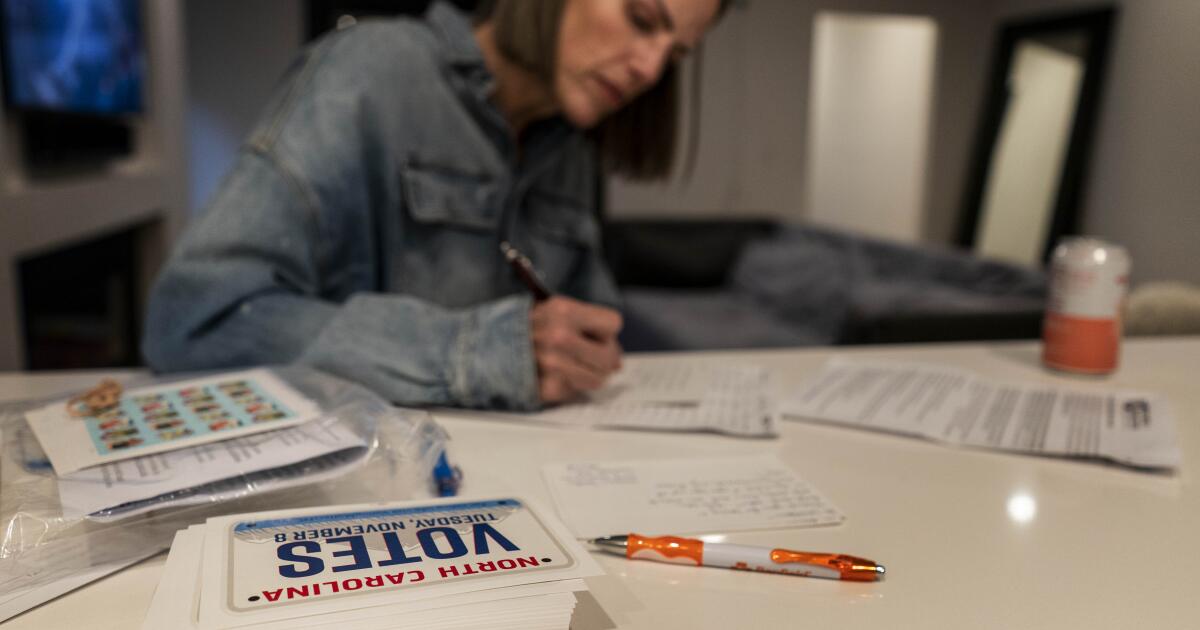
I became a one-way pen pal for democracy in 2018, writing letters and postcards to strangers in the lead-up to that year’s midterm elections.
I had spent the months before marching for women, science, immigrants and Muslims. Then I decided marching wasn’t enough. I needed to engage individual Americans about electing politicians who shared my values.
So that September, I attended a grassroots event to learn about volunteer voter outreach hosted by a Los Angeles group called Civic Sundays. We could choose to learn how to knock on doors, call and text prospective voters or write postcards to engage people.
I’d never heard of writing postcards to strangers as a way to encourage them to vote. But I was charmed by the thought of an analog means of saving democracy. Civic Sundays and other organizations, many of which sprang to life following the 2016 presidential election, supply volunteers with lists of names and addresses of registered voters. The writers supply penmanship, stamps and sometimes the postcards themselves.
I joined a large table of people with seemingly professional-level glitter and Magic Marker skills. While their postcards looked like illuminated manuscripts, I painstakingly struggled to make mine legible. A fourth-grade teacher once told me my writing resembled a hostage taker’s ransom note, but fortunately, I didn’t have to take a handwriting test to get a seat at the postcard table (some organizations do actually require one).
I found the work rather wholesome, but I wasn’t sold on the idea of trying to engage a population that couldn’t be bothered to vote.
The more postcards I wrote, the more I started to wonder: Who were these infrequent voters? Why weren’t they doing their civic duty? If I looked their address up on Google Maps, what would I see? Unmown lawns? Gated mansions?
I became racked by a desire to know who exactly were these shirkers of civic responsibility. But we’d been given clear instructions: Do not personally engage the recipients of your missives. Instead, we followed a clear and concise script of just a few sentences.
I participated in another postcard-writing campaign for the 2020 presidential election. This time, I specifically requested names from a swing state, Michigan. As I wrote to these strangers, I became increasingly frustrated, imagining them enjoying their weekends without a scintilla of voting guilt while I agonized over whether they might be offended by a postage stamp with a cat on it.
When I mentioned these frustrations to a cynical friend, he told me to read the Trappist monk Thomas Merton’s famous 1966 “Letter to a Young Activist.” I should have been suspicious, seeing as my friend would be the last person to write a postcard to a stranger. Sure enough, Merton’s words did not reassure me about the fate of my postcards. “[D]o not depend on the hope of results,” he wrote. “When you are doing the sort of work you have taken on, essentially an apostolic work, you may have to face the fact that your work will be apparently worthless and even achieve no result at all, if not perhaps results opposite to what you expect.”
After reading Merton’s letter, I spent some months not writing the scofflaw voters of Michigan, Georgia, Arizona or anywhere else.
But when the 2024 election campaign started up, with the future of the country once again on the ballot, I asked for another postcard list.
This time one of the choices was to write to people in my own state, California. This felt more like writing a neighbor than someone far away and utterly unknown. Once I had my list and started reading the names and addresses, I realized some of my postcards would be going to people who lived near the town where I work.
And then it happened. I recognized a name. The Gen Zer who needed a nudge to vote was one of my thoughtful, capable students.
I finally had an answer about the people I was writing to. They were just like the rest of us: unmarried singles and matriarchs of big families, people who drive electric cars and people who drive big trucks, charming people and irritating people and neighbors who played their music too loud but were sweet with their kids. People so busy leading their lives they sometimes forgot or opted not to vote.
Recognizing just one name made me certain I had to keep penning these epistles of democracy, to keep reminding others, even if they didn’t listen or want to hear it, that their vote mattered. With new insight into Merton’s famous missive, I had to put my trust in, as he put it, “the value, the rightness, the truth of the work itself.”
Melissa Wall is a professor of journalism at Cal State Northridge who studies citizen participation in the news. This article was produced in partnership with Zócalo Public Square.



Politics
Trump admin sues Illinois Gov. Pritzker over laws shielding migrants from courthouse arrests

NEWYou can now listen to Fox News articles!
The U.S. Justice Department filed a lawsuit against Illinois Gov. JB Pritzker over new laws that aim to protect migrants from arrest at key locations, including courthouses, hospitals and day cares.
The lawsuit was filed on Monday, arguing that the new protective measures prohibiting immigration agents from detaining migrants going about daily business at specific locations are unconstitutional and “threaten the safety of federal officers,” the DOJ said in a statement.
The governor signed laws earlier this month that ban civil arrests at and around courthouses across the state. The measures also require hospitals, day care centers and public universities to have procedures in place for addressing civil immigration operations and protecting personal information.
The laws, which took effect immediately, also provide legal steps for people whose constitutional rights were violated during the federal immigration raids in the Chicago area, including $10,000 in damages for a person unlawfully arrested while attempting to attend a court proceeding.
PRITZKER SIGNS BILL TO FURTHER SHIELD ILLEGAL IMMIGRANTS IN ILLINOIS FROM DEPORTATIONS
The Trump administration filed a lawsuit against Illinois Gov. JB Pritzker over new laws that aim to protect migrants from arrest at key locations. (Getty Images)
Pritzker, a Democrat, has led the fight against the Trump administration’s immigration crackdown in Illinois, particularly over the indiscriminate and sometimes violent nature in which they are detained.
But the governor’s office reaffirmed that he is not against arresting illegal migrants who commit violent crimes.
“However, the Trump administration’s masked agents are not targeting the ‘worst of the worst’ — they are harassing and detaining law-abiding U.S. citizens and Black and brown people at daycares, hospitals and courthouses,” spokesperson Jillian Kaehler said in a statement.
Earlier this year, the federal government reversed a Biden administration policy prohibiting immigration arrests in sensitive locations such as hospitals, schools and churches.
The U.S. Immigration and Customs Enforcement’s “Operation Midway Blitz,” which began in September in the Chicago area but appears to have since largely wound down for now, led to more than 4,000 arrests. But data on people arrested from early September through mid-October showed only 15% had criminal records, with the vast majority of offenses being traffic violations, misdemeanors or nonviolent felonies.
Gov. JB Pritzker has led the fight against the Trump administration’s immigration crackdown in Illinois. (Kamil Krazaczynski/AFP via Getty Images)
Immigration and legal advocates have praised the new laws protecting migrants in Illinois, saying many immigrants were avoiding courthouses, hospitals and schools out of fear of arrest amid the president’s mass deportation agenda.
The laws are “a brave choice” in opposing ICE and U.S. Customs and Border Protection, according to Lawrence Benito, executive director of the Illinois Coalition for Immigrant and Refugee Rights.
“Our collective resistance to ICE and CBP’s violent attacks on our communities goes beyond community-led rapid response — it includes legislative solutions as well,” he said.
The DOJ claims Pritzker and state Attorney General Kwame Raoul, also a Democrat, violated the U.S. Constitution’s Supremacy Clause, which establishes that federal law is the “supreme Law of the Land.”
ILLINOIS LAWMAKERS PASS BILL BANNING ICE IMMIGRATION ARRESTS NEAR COURTHOUSES
Border Patrol Commander Gregory Bovino leaves the Dirksen U.S. Courthouse in Chicago. (Brian Cassella/Chicago Tribune/Tribune News Service via Getty Images)
CLICK HERE TO DOWNLOAD THE FOX NEWS APP
Raoul and his staff are reviewing the DOJ’s complaint.
“This new law reflects our belief that no one is above the law, regardless of their position or authority,” Pritzker’s office said. “Unlike the Trump administration, Illinois is protecting constitutional rights in our state.”
The lawsuit is part of an initiative by U.S. Attorney General Pam Bondi to block state and local laws the DOJ argues impede federal immigration operations, as other states have also made efforts to protect migrants against federal raids at sensitive locations.
The Associated Press contributed to this report.

WASHINGTON — The Supreme Court ruled against President Trump on Tuesday and said he did not have legal authority to deploy the National Guard in Chicago to protect federal immigration agents.
Acting on a 6-3 vote, the justices denied Trump’s appeal and upheld orders from a federal district judge and the U.S. 7th Circuit Court of Appeals that said the president had exaggerated the threat and overstepped his authority.
The decision is a major defeat for Trump and his broad claim that he had the power to deploy militia troops in U.S. cities.
In an unsigned order, the court said the Militia Act allows the president to deploy the National Guard only if the regular U.S. armed forces were unable to quell violence.
The law dating to 1903 says the president may call up and deploy the National Guard if he faces the threat of an invasion or a rebellion or is “unable with the regular forces to execute the laws of the United States.”
That phrase turned out to be crucial.
Trump’s lawyers assumed it referred to the police and federal agents. But after taking a close look, the justices concluded it referred to the regular U.S. military, not civilian law enforcement or the National Guard.
“To call the Guard into active federal service under the [Militia Act], the President must be ‘unable’ with the regular military ‘to execute the laws of the United States,’” the court said in Trump vs. Illinois.
That standard will rarely be met, the court added.
“Under the Posse Comitatus Act, the military is prohibited from execut[ing] the laws except in cases and under circumstances expressly authorized by the Constitution or Act of Congress,” the court said. “So before the President can federalize the Guard … he likely must have statutory or constitutional authority to execute the laws with the regular military and must be ‘unable’ with those forces to perform that function.
“At this preliminary stage, the Government has failed to identify a source of authority that would allow the military to execute the laws in Illinois,” the court said.
Although the court was acting on an emergency appeal, its decision is a significant defeat for Trump and is not likely to be reversed on appeal. Often, the court issues one-sentence emergency orders. But in this case, the justices wrote a three-page opinion to spell out the law and limit the president’s authority.
Justice Amy Coney Barrett, who oversees appeals from Illinois, and Chief Justice John G. Roberts Jr. cast the deciding votes. Justice Brett M. Kavanaugh agreed with the outcome, but said he preferred a narrow and more limited ruling.
Conservative Justices Clarence Thomas, Samuel A. Alito Jr. and Neil M. Gorsuch dissented.
Alito, in dissent, said the “court fails to explain why the President’s inherent constitutional authority to protect federal officers and property is not sufficient to justify the use of National Guard members in the relevant area for precisely that purpose.”
California Gov. Gavin Newsom and Atty. Gen. Rob Bonta filed a brief in the Chicago case that warned of the danger of the president using the military in American cities.
“Today, Americans can breathe a huge sigh of relief,” Bonta said Tuesday. “While this is not necessarily the end of the road, it is a significant, deeply gratifying step in the right direction. We plan to ask the lower courts to reach the same result in our cases — and we are hopeful they will do so quickly.”
The U.S. 9th Circuit Court of Appeals had allowed the deployments in Los Angeles and Portland, Ore., after ruling that judges must defer to the president.
But U.S. District Judge Charles Breyer ruled Dec. 10 that the federalized National Guard troops in Los Angeles must be returned to Newsom’s control.
Trump’s lawyers had not claimed in their appeal that the president had the authority to deploy the military for ordinary law enforcement in the city. Instead, they said the Guard troops would be deployed “to protect federal officers and federal property.”
The two sides in the Chicago case, like in Portland, told dramatically different stories about the circumstances leading to Trump’s order.
Democratic officials in Illinois said small groups of protesters objected to the aggressive enforcement tactics used by federal immigration agents. They said police were able to contain the protests, clear the entrances and prevent violence.
By contrast, administration officials described repeated instances of disruption, confrontation and violence in Chicago. They said immigration agents were harassed and blocked from doing their jobs, and they needed the protection the National Guard could supply.
Trump Solicitor Gen. D. John Sauer said the president had the authority to deploy the Guard if agents could not enforce the immigration laws.
“Confronted with intolerable risks of harm to federal agents and coordinated, violent opposition to the enforcement of federal law,” Trump called up the National Guard “to defend federal personnel, property, and functions in the face of ongoing violence,” Sauer told the court in an emergency appeal filed in mid-October.
Illinois state lawyers disputed the administration’s account.
“The evidence shows that federal facilities in Illinois remain open, the individuals who have violated the law by attacking federal authorities have been arrested, and enforcement of immigration law in Illinois has only increased in recent weeks,” state Solicitor Gen. Jane Elinor Notz said in response to the administration’s appeal.
The Constitution gives Congress the power “to provide for calling forth the militia to execute the laws of the union, suppress insurrections and repel invasions.”
But on Oct. 29, the justices asked both sides to explain what the law meant when it referred to the “regular forces.”
Until then, both sides had assumed it referred to federal agents and police, not the standing U.S. armed forces.
A few days before, Georgetown law professor and former Justice Department lawyer Martin Lederman had filed a friend-of-the-court brief asserting that the “regular forces” cited in the 1903 law were the standing U.S. Army.
His brief prompted the court to ask both sides to explain their view of the disputed provision.
Trump’s lawyers stuck to their position. They said the law referred to the “civilian forces that regularly execute the laws,” not the standing army.
If those civilians cannot enforce the law, “there is a strong tradition in this country of favoring the use” of the National Guard, not the standing military, to quell domestic disturbances, they said.
State attorneys for Illinois said the “regular forces” are the “full-time, professional military.” And they said the president could not “even plausibly argue” that the U.S. Guard members were needed to enforce the law in Chicago.

new video loaded: Trump Announces Construction of New Warships
transcript
transcript
Trump Announces Construction of New Warships
President Trump announced on Monday the construction of new warships for the U.S. Navy he called a “golden fleet.” Navy officials said the vessels would notionally have the ability to launch hypersonic and nuclear-armed cruise missiles.
-
We’re calling it the golden fleet, that we’re building for the United States Navy. As you know, we’re desperately in need of ships. Our ships are, some of them have gotten old and tired and obsolete, and we’re going to go the exact opposite direction. They’ll help maintain American military supremacy, revive the American shipbuilding industry, and inspire fear in America’s enemies all over the world. We want respect.

By Nailah Morgan
December 23, 2025

At least four injured after multi-vehicle accident involving bus in Bridgeport, per police

GOVERNOR MEYER ORDERS LOWERING OF FLAGS FOR STATE TROOPER KILLED IN DMV SHOOTING

Florida man charged in racially motivated attack plot

Georgia high school student tased by officer speaks out

Episode 39 of the ongoing Halemaʻumaʻu eruption is underway at Kīlauea | Maui Now

Florida High School Football Rankings: Top 25 teams – Oct. 21

Cleary's 21 help Le Moyne down Central Connecticut State 69-64 in OT

How old is Bo Nix? What to know about Oregon quarterback ahead of 2024 NFL Draft

99th annual Pony Swim held in Virginia

Video: ‘It Didn’t Have to Happen This Way:’ U.Va. Faculty Call for Review of Police Response to Protests

A 3-D Look Inside Trump’s Revamped Oval Office

Trump admin sues Illinois Gov. Pritzker over laws shielding migrants from courthouse arrests

Europeans show solidarity with Denmark after Trump’s Greenland threat

Explosion at a Pennsylvania nursing home kills at least 2, governor says

What does Christmas look like for Ukraine? | Global News Podcast
-

 Iowa1 week ago
Addy Brown motivated to step up in Audi Crooks’ absence vs. UNI
-

 Maine1 week ago
Elementary-aged student killed in school bus crash in southern Maine
-

 Maryland1 week ago
Frigid temperatures to start the week in Maryland
-

 New Mexico1 week ago
Family clarifies why they believe missing New Mexico man is dead
-

 South Dakota1 week ago
Nature: Snow in South Dakota
-

 Detroit, MI1 week ago
‘Love being a pedo’: Metro Detroit doctor, attorney, therapist accused in web of child porn chats
-

 Health1 week ago
‘Aggressive’ new flu variant sweeps globe as doctors warn of severe symptoms
-

 Maine1 week ago
Family in Maine host food pantry for deer | Hand Off