Politics
Most California Republicans in competitive congressional races are silent on Trump's conviction

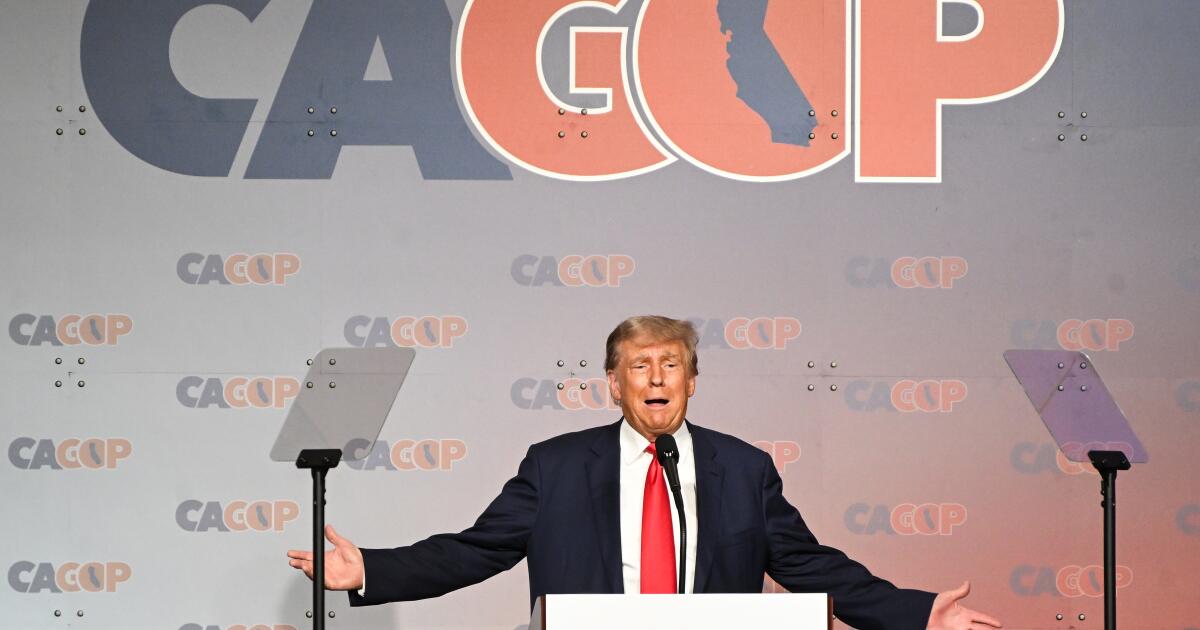
Most of the Republican candidates for Congress in California’s most competitive districts reacted to the news of former President Trump’s historic criminal conviction with radio silence.
A New York jury deliberated for 9½ hours over two days before convicting Trump of 34 counts of falsifying business records in a scheme to illegally influence the 2016 election through hush money payments to a porn actor who said the two had sex.
After the verdict, California’s Republican leaders quickly cast doubt on the verdict’s legitimacy and argued it would boost Trump’s chances of reelection in November.
Former House Speaker Kevin McCarthy of Bakersfield said that Trump’s “only ‘crime’ is running against Joe Biden in 2024.”
Jessica Millan Patterson, the chair of the California Republican Party, said the prosecution was “a politically motivated case brought by a far-left district attorney” and that the guilty verdict “never should have happened.”
San Diego-area Rep. Darrell Issa (R-Bonsall) called the verdict and the trial “a disgrace.”
Democrats, by contrast, praised the verdict as proof of the American legal system functioning as it should. Rep. Adam B. Schiff (D-Burbank), who is running for Senate, said that “the rule of law prevailed” despite Trump’s efforts to “distract, delay and deny.”
In California’s most hotly contested congressional races, though, few wanted to publicly tangle with the question of Trump’s conviction.
Representatives for Reps. Young Kim (R-Anaheim Hills), Michelle Steel (R-Seal Beach), Mike Garcia (R-Santa Clarita), David Valadao (R-Hanford) and John Duarte (R-Modesto) did not return requests for comment. Nor did representatives for Matt Gunderson, who is challenging Rep. Mike Levin (D-San Juan Capistrano) in coastal Orange and San Diego counties, or Stockton Mayor Kevin Lincoln, who is running against Rep. Josh Harder (D-Tracy) in the Central Valley.
A representative for Republican Steve Garvey, who is running for Senate against Schiff, said he had no comment on the verdict.
One exception was Scott Baugh, who is running to flip the coastal Orange County seat held by Rep. Katie Porter (D-Irvine). Baugh, the former chair of the Orange County GOP, characterized Trump’s trial as a political prosecution and said the verdict “should surprise no one.”
“A politically motivated prosecutor and a hostile judge set the trial up for so many prejudicial errors,” Baugh said in a prepared statement. “President Trump will have his opportunity to appeal and I am confident that a fair hearing will expose and resolve these issues.”
And longtime Riverside Rep. Ken Calvert (R-Corona), who is fighting to retain his once-safe seat in a now-competitive swing district, said in a statement on Thursday evening that Trump’s prosecution was political — but his comment was more muted than the loudest GOP voices.
Calvert said that Americans who believe that “justice should be blind to politics” should be “concerned” by the trial’s outcome. He continued: “It’s alarming that our criminal justice system continues to be taken advantage of by partisan prosecutors who want to use the power of their office to influence our democratic elections.”
Whether to lock arms with Trump has been a fraught question for Republicans in California for nearly a decade, but especially this year. Republicans hold such a razor-thin majority in the House of Representatives that a handful of hyper-competitive races in the Golden State could determine which party controls the chamber. The nonpartisan Cook Political Report has rated 10 California races as competitive.
Remaining silent on the verdict makes sense for Republicans in those competitive battleground districts, said Dan Schnur, a politics professor at USC, UC Berkeley and Pepperdine.
“You’ll notice that the loudest voices supporting Trump on this tend to be Republicans in very safe seats,” Schnur said. “Candidates who need to reach swing voters don’t have that luxury.”
One challenge for candidates, said UC San Diego political science professor Thad Kousser, is that partisan allegiances determine how voters viewed the trial.
Polling has found that Democrats overwhelmingly saw the trial as fair, while only a tiny percentage of Republicans agreed. Independents were evenly split. A Trump-like message about a rigged, unfair trial that might resonate with a candidate’s Republican base could also turn off independents, Kousser said.
“Anyone trying to win a November race in a competitive district needs to worry about both mobilizing their base through more Trump-like rhetoric, but also the cost of alienating the middle,” he said.
Rob Stutzman, a GOP strategist who isn’t involved in any congressional races, said that while the verdict can be used as a tool by both parties to turn out voters in November, it’s a “touchy subject.”
“You may have independents in congressional seats who are indifferent to the verdict, but don’t necessarily want to see Republican incumbents defending Trump or decrying the verdict,” Stutzman said.
But Shawn Steel, who represents California on the Republican National Committee and is married to Steel, of Orange County, said the verdict will have “absolutely no impact” on California’s House races.
“The White House got the verdict they planned years ago,” Steel said. “The Manhattan jurors who convicted Trump did it out of malice and hate. Today’s verdict, along with the not-guilty verdict of the O.J. Simpson criminal trial, proved the steep decline of trust in the American criminal justice.”
Harmeet Dhillon, a San Francisco attorney who also represents California on the Republican National Committee and whose law firm represents the Trump campaign, said Californians are more concerned with quality-of-life issues, such as homelessness, crime and illegal immigration than they are with the trial.
“People are fed up,” she said. “People are much more motivated in this election to vote because things are getting bad here in California.”
While California Republican House candidates were largely quiet, some of their allies in other states, such as Arizona Senate candidate Kari Lake and vice presidential hopeful Sen. Tim Scott of South Carolina, were not.
“This was a rigged, disgraceful trial,” Trump told reporters after leaving the courtroom. “The real verdict is going to be Nov. 5 by the people.”
The Biden campaign said Thursday’s verdict showed that the law applied to everyone, but warned that the only way to keep Trump out of the White House is voting in November.
“Convicted felon or not, Trump will be the Republican nominee for president,” campaign spokesman Michael Tyler said. “The threat Trump poses to our democracy has never been greater. He is running an increasingly unhinged campaign of revenge and retribution, pledging to be a dictator ‘on Day One’ and calling for our Constitution to be ‘terminated’ so he can regain and keep power.”
In the wake of Trump’s conviction, Democrats seized upon 23 vulnerable House Republicans who had endorsed the former president, including Duarte, Garcia, Calvert and Steel.
“House Republicans have continued to put Donald Trump first and the American people last,” said Courtney Rice, a spokesperson for the Democratic Congressional Campaign Committee. “Their districts deserve better than their cult-like adherence to a wannabe dictator. Each and every one of them should rescind their endorsement, but won’t.”
Trump’s trial, which began in April in New York City, was one of four felony cases that Trump was facing, though it was thought to be the only one likely to see a trial before the November election.
The verdict hinged on whether Trump falsified business records to hide a $130,000 hush money payment that Michael Cohen — Trump’s lawyer and, later, a witness for the prosecution — made to adult film actor Stormy Daniels, who alleged she’d had a sexual encounter with Trump a decade prior.
Manhattan Dist. Atty. Alvin Bragg had to convince the jury that Trump not only commanded Cohen to make the payments, but that he did so in order to influence the outcome of the 2016 election, rather than to shield his family from the story. Trump pleaded not guilty and denied the sexual encounter with Daniels; Cohen testified that he had been deeply involved in the scheme.


NEWYou can now listen to Fox News articles!
Rep. Diana DeGette, D-Colo., a 30-year incumbent, lost to a Democratic Socialists of America (DSA)-backed challenger in a high-profile primary on Tuesday evening.
Melat Kiros, a 29-year-old socialist, defeated DeGette in a Democratic primary for a deep-blue House seat anchored in Denver, according to The Associated Press, scoring a major victory for the socialist left on Tuesday evening.
The DSA had been aiming to cast DeGette’s loss as evidence of its growing momentum after a slate of socialist candidates won Democratic primaries in New York City last week.
“Today, the East Coast, next week the Mountain West,” the DSA wrote in a social media post last week.
Rep. Diana DeGette speaks during a press conference outside the U.S. Capitol building in Washington, D.C., on Jan. 10, 2024. (Samuel Corum/Getty Images)
SOCIALISTS CHEER ‘SHOCKWAVE’ PRIMARY NIGHT AS DSA-BACKED CANDIDATES WIN, ADVANCE ACROSS THE MAP
If elected in November, Kiros, who was born in Ethiopia, will likely join the ranks of the far-left group known as the Squad and become one of a handful of the House chamber’s outspoken socialists.
The millennial challenger was endorsed by Sen. Bernie Sanders, I-Vt., Rep. Alexandria Ocasio-Cortez, D-N.Y., and the anti-incumbent leftist organization Justice Democrats. Controversial socialist streamer Hasan Piker, who has said Hamas is “a thousand times better” than Israel and praised the Chinese Communist Party, also backed Kiros’ insurgent primary run.
DeGette, a member of the Congressional Progressive Caucus who supports abolishing Immigration and Customs Enforcement (ICE), sought to win a 16th House term by flexing her leftist bona fides. She argued her seniority on an influential House committee would allow her to push for Medicare-for-All legislation — a longtime priority of the party’s far-left flank.
DeGette, who was endorsed by former CPC Chairwoman Pramila Jayapal, D-Wash., also spotlighted her experience as an impeachment manager during Trump’s second impeachment trial in 2021.
Though DeGette and Kiros shared few policy disagreements, they diverged sharply over Israel and antisemitism. Kiros also sharply criticized DeGette for accepting corporate PAC contributions.
Kiros, a PhD student and lawyer, was fired from a New York firm in 2023 after publishing an open letter, arguing that pro-Palestinian student protesters calling for the elimination of Israel were not antisemitic and appearing to defend Hamas.
Melat Kiros participated in a League of Women Voters Congressional District 1 candidate forum at Montview Presbyterian Church in Denver on May 28, 2026. (RJ Sangosti/MediaNews Group/The Denver Post)
WATCH: HOUSE DEMS UNLOAD ON TEXAS DEMOCRAT OVER ‘DEMENTED’ ANTISEMITIC COMMENTS
She has also described the Oct. 7, 2023, attacks against the Jewish state as the “inevitable consequence of apartheid” and declined to characterize the deadly firebombing of protesters in Boulder last year who were urging the release of hostages held by Hamas in Gaza as antisemitic.
“I don’t know what was in the heart of the perpetrator,” Kiros told Colorado’s 9News in a recent television interview. “All I know is that he went and attacked innocent people because of what they might have believed.”
A June 2025 bipartisan resolution condemning the attack as part of a “rise in ideologically motivated attacks on Jewish individuals” won every present lawmaker’s support, except for Reps. Rashida Tlaib, D-Mich., and Thomas Massie, R-Ky., who voted present.
Kiros has also suggested the United States deserved 9/11.
“Inevitable in the sense that we destabilized a lot of the Middle East that forced people to believe that another act of violence was the only response,” Kiros told 9News when asked if she thought the terror attack was “the inevitable consequence of American foreign policy.”
“And again, just like I said before, our responsibility is to get rid of those conditions that lead to violence in the first place,” Kiros continued.
DeGette argued that Kiros’ embrace of Piker and her comments about antisemitism and 9/11 were disqualifying.
“I’m shocked and disgusted that Kiros is doubling down on excusing terrorism and the murder of innocent people,” the 30-year incumbent wrote on Facebook earlier this month.
Streamer and creator Hasan Piker speaks at a press conference during day two of Web Summit Vancouver at the Vancouver Convention Centre in Vancouver, Canada, on May 13, 2026. (Sam Barnes/Web Summit via Sportsfile via Getty Images)
CLICK HERE TO DOWNLOAD THE FOX NEWS APP
Colorado’s 1st Congressional District is the most liberal seat in the state and voted for former Vice President Kamala Harris by 56 points in 2024.
The primary fight was further scrambled by University of Colorado Regent Wanda James, also running for DeGette’s seat. Though James did not pose the same threat as Kiros, her vote share could ultimately have swayed the contest.

Gov. Gavin Newsom has signed off on a 100% state tax on money any Californians receive from Trump’s $1.8-billion “anti-weaponization” fund for his political allies.
Newsom unveiled his proposal in May, after Trump’s Justice Department said it would create a fund to compensate Trump’s allies who claim they have “suffered weaponization and lawfare” under Biden’s Justice Department.
The settlement fund was criticized by politicians on both sides of the aisle, including Sen. Mitch McConnell (R-Ky.), who described it as a “slush fund to pay people who assault cops.”
The fund remains in legal limbo. Earlier this month, a federal judge in Virginia extended a court-ordered block on the plan, which critics warned could be used to pay pardoned Jan. 6 rioters.
Fast-tracked into law as part of Senate Bill 122, Newsom’s plan imposes “a tax on any settlement fund payment from the federal Anti-Weaponization Fund, or any subsequent fund, settlement, or agreement, as provided, at a rate of 100%,” according to the bill text. The tax applies to all tax years between 2026 and 2030.
Newsom signed the bill Tuesday. In a statement, his office said the tax is meant to ensure that, should Trump’s fund proceed, California recipients won’t “receive favorable state treatment on those payments.”
“We believe democracy is worth defending, the rule of law matters, and public dollars should support victims—not those who attacked the very institutions that protect our freedoms,” Newsom said in the statement.
University of Southern California law professor Ariel Jurow Kleiman, an expert on tax law and policy, said that while Newsom’s tax is a “novel legal strategy,” she believes there is “no categorical legal restriction” preventing California from implementing it.
States have a “wide degree of discretion” to design their tax systems — including how they define income — so long as they do not violate their constitutions, Jurow Kleiman said.
If a California resident wanted to challenge the tax in court, they would need to show they were harmed by it to have standing to sue, according to Jurow Kleiman. That would mean receiving a payment from Trump’s settlement fund and then paying the 100% California tax. Unless the settlement fund is established and distributes payments, that scenario is unlikely.
While there have been proposals to levy a 100% tax on income above certain thresholds — Sen. Bernie Sanders (I-Vt.) in 2023 said he supports a 100% tax on income exceeding $1 billion — Jurow Kleiman said she is not aware of any governments that have adopted such a policy.

NEWYou can now listen to Fox News articles!
The House has officially shipped a colossal bipartisan housing package to President Donald Trump, and lawmakers are hoping that, at the very least, he doesn’t veto it.
Trump was supposed to sign the 21st Century ROAD to Housing Act last week, but his last-minute decision to ghost the signing ceremony with House Speaker Mike Johnson, R-La., and Senate Majority Leader John Thune, R-S.D., put into question whether the bill was dead.
His refusal to sign the bill, which passed with overwhelmingly bipartisan support in both chambers, was to leverage the Safeguarding American Voter Eligibility (SAVE) America Act, which doesn’t currently have the votes to succeed in the Senate.
WARREN TELLS TRUMP TO ‘SIGN THE DAMN BILL’ AS BIPARTISAN HOUSING PACKAGE REMAINS STALLED IN WASHINGTON
Trump has refused to sign the 21st Century ROAD to Housing Act. (Shawn Thew/EPA/Bloomberg via Getty Images)
Trump appears to be in no hurry to sign the bill, despite Republicans who are hungry for a win in the affordability fight ahead of the midterm elections.
“It’s so unimportant … compared to the SAVE America Act,” Trump told reporters in the Oval Office on Monday. “I think the SAVE America Act is exactly what it says. It’s saving America from crooked elections.”
“Here’s what I would like to sign, much more than a bill that — big deal, it’s a yawn,” he continued. “Some people say it’s wonderful. To me, compared to the SAVE America Act, just about everything is a big yawn.”
GOP INFIGHTING OVER TRUMP’S VOTER ID BILL ERUPTS AS TOP SENATOR CALLS STRATEGY ‘FANTASY’
It’s legislation that is loaded with nearly 60 provisions from both sides of the aisle in both chambers that’s designed to make it easier for homes to be built and for younger Americans to buy their first home. It also includes a ban on hedge funds buying up housing stock that Trump pushed Congress to include during the State of the Union earlier this year.
Sen. Elizabeth Warren, D-Mass., one of the architects behind the bill in the upper chamber alongside Sen. Tim Scott, R-S.C., charged that Congress handed the bill to Trump “on a silver platter.”
“When you ask me what happens next, if he cared about the American people, he’d have already signed the damned thing, and we’d be underway,” Warren said on WCVB’s “On the Record” on Sunday.
But Trump doesn’t have to put his signature on the bill for it to become law.
IRATE REPUBLICANS ACCUSE TRUMP OF HANDING DEMOCRATS A WIN AFTER BLOWING UP HOUSING PACKAGE
The Senate advanced a massive, Trump-backed housing package geared toward lowering the costs of homes and supercharging the housing supply. Sen. Elizabeth Warren, D-Mass., pitched it as legislation to prevent America from becoming a “nation of renters.” (Jemal Countess/Getty Images for Protect Borrowers; Anna Moneymaker/Getty Images)
The Constitution grants presidents the ability to veto a bill within 10 days of it being transferred over to the White House. In that scenario, Congress could override a veto of the housing package.
It’s happened before under the Trump administration. In early 2021, Congress overrode Trump’s veto of the annual National Defense Authorization Act — a massive Pentagon funding authorization package that some House Republicans are trying to use as a vehicle to pass the SAVE America Act.
But during that 10-day period, if Trump doesn’t sign the bill, it would automatically become law. That’s unless Congress completely adjourns, in which case a “pocket veto” could happen. The Senate is currently in recess and the House is scheduled to leave town by week’s end, but neither count as a full adjournment.
CLICK HERE TO DOWNLOAD THE FOX NEWS APP
Johnson, who spent the last few days meeting with Trump at the White House about the housing bill and the SAVE America Act, said: “I hope he does sign it.”
“If he doesn’t, it’s still law,” Johnson said. “We’ll still celebrate it, but he’s trying to make a point, and I think he’s making it very effectively. And the fact that you all ask me every three steps down the hallway illustrates that he has achieved the desired objective, and that is to make SAVE America the number one thing, because if we don’t get that right, everybody’s concerned about what happens next.”
-

 Technology7 minutes ago
Meta is adding ridiculous ‘rate limits’ and a soft paywall to its smart glasses
-

 World12 minutes ago
Boy, 2, pulled alive from rubble six days after Venezuela’s devastating twin earthquakes
-

 Politics13 minutes ago
Socialism goes west as DSA-backed challenger ousts longtime Democrat
-

 Health19 minutes ago
Americans are giving up multivitamins for a different daily health habit, study finds
-

 Sports22 minutes ago
2026 World Cup Quarterfinal Odds: Which Squads Will Make Final 8?
-

 Technology27 minutes ago
Warehouse robots move packages without human handoff
-
 Business34 minutes ago
Disneyland to offer $59 evening tickets next month
-
 Entertainment37 minutes ago
After Amazon drops OpenAI movie ‘Artificial,’ film finds new home at Neon

