Politics
Many immigrant spouses without legal status left out of Biden's plan despite deep U.S. ties


Almost as soon as President Biden announced a sweeping executive action in June to set more than 500,000 people on a path to U.S. citizenship, immigrants who won’t qualify under the plan began pushing to be included.
The new policy — unveiled before Biden dropped out of the presidential race as he was attempting to shore up progressive credentials — would shield from deportation undocumented spouses of U.S. citizens if they have lived in the country for the last decade, don’t have any disqualifying criminal convictions and pass a vetting process to ensure they pose no threat to public safety or national security.
The program would allow these spouses, many with children here and deep roots in their communities, to remain in the U.S. and work legally. They would also be allowed to access immigration benefits available to spouses of U.S. citizens. Biden cast the change as a moral imperative to keep families together, as well as an economic benefit to bring more workers out of the shadows.
Formal regulations to implement Biden’s policy could be released any day, with applications expected to open later this month.
But Biden’s proposal leaves out many people who immigration advocates say are equally deserving of protection, but fall short of the proposed criteria. That includes spouses who followed the current rules and voluntarily left the country to apply for reentry, and are now outside the U.S. A Biden administration official said last month that the issue was under review.
Other immigrants would be barred from participating in Biden’s plan due to decades-old border offenses or because they did not pass a U.S. consular vetting process.
Christopher Sánchez, 24, shows a picture of his father, Isaías Sánchez Gonzalez, who was denied a visa in 2016.
(Myung J. Chun / Los Angeles Times)
Advocates for such families estimate that more than 1 million people married to U.S. citizens are unable to access the pathway to citizenship for various reasons.
Adriana Gutiérrez, 41, and husband José, 43, are among those who fall through the cracks of Biden’s program, which relies on an authority known as “parole in place.”
José, who asked that his last name not be used, entered the U.S. illegally more than 20 years ago. He met Gutiérrez almost immediately. They married and now live in the Sacramento area with their four children.
They’ve lived a quiet, law-abiding life. But attorneys advised them to not apply for a green card because they may instead bring unwanted attention to José’s situation.
That’s because shortly before the couple met, José had attempted to cross the border illegally using a cousin’s U.S. birth certificate. He was caught, deported and punished with a lifetime reentry ban. A few days later, he crossed back into the U.S. illegally.
“We’re together, but we’re living in this shadow,” Gutiérrez said. “It seems unfair that we’re having to pay such a harsh price for something that he did over 20 years ago.”
Others won’t receive protection under Biden’s plan because they tried to follow the previous immigration rules.
Immigrants who enter the country lawfully and marry U.S. citizens can obtain legal residency and, later, U.S. citizenship. But as a penalty for skirting immigration law, those who enter illegally and get married must leave the country in order to adjust their immigration status and usually wait at least a decade before being allowed back. In practice, many receive waivers that permit them to speed up the process and be reunited with their families.
Celenia Gutiérrez (no relation to Adriana) said her husband, Isaías Sánchez Gonzalez, left their Los Angeles home and three children in 2016 for a visa interview in Juarez, Mexico. He assumed he would be quickly readmitted and reunited with his family.
Instead he was barred from returning because, after the interview, a consular officer suspected he belonged to a criminal organization, a claim he denies.
“I dedicated myself to acting right. I never had any problems with the law or police,” Sánchez Gonzalez said. He believes the consular officer may have suspected his tattoos — of the Virgen de Guadalupe, comedy and tragedy theater masks, and the Aztec calendar — were gang related.
“I like tattoos, but if I had known the problems they would cause, believe me, I wouldn’t have gotten them,” he said.
After the denial, his wife, who was studying to be a nurse, was forced to defer her schooling and get a job to provide for two households while battling depression.
Sánchez Gonzalez, 46, now lives in Tijuana. His wife and children visit one or two weekends a month.
Celenia Gutiérrez, 41, believes her husband could have qualified for Biden’s spousal protections had he simply remained in the U.S. instead of attempting to rectify his legal status.

Celenia Gutiérrez shows a picture taken in June with husband Isaías Sánchez Gonzalez, second from left, and their children Christopher Sánchez, 24, far left; Brandon Sánchez, 13 and Anthony Sánchez, 19.
(Myung J. Chun / Los Angeles Times)
“We decided to get married so we could get his papers,” she said. “We didn’t want him to get deported. We tried to do everything good, and it still happened.”
Just before Biden announced the program, his administration fought a legal battle against a U.S. citizen from Los Angeles who similarly became separated from her husband after he went to El Salvador for a visa interview and was rejected, despite his assurances of having a clean criminal record.
The government alleged — based on his tattoos, an interview and confidential law enforcement information — that Luis Asencio Cordero was a gang member, which he denied. In June the Supreme Court’s conservative majority ruled against the couple, finding that Asencio Cordero’s wife, Sandra Muñoz, had failed to establish that her constitutional right to marriage extends to living with him in the U.S.
Due to the uncertainty of reentry, many immigrants have opted to stay in the U.S. and continue risking deportation.
American Families United, established in 2006 to advocate on behalf of U.S. citizens who are married to foreign nationals, is urging the Biden administration to offer a review of more complicated cases, including those of immigrant spouses in the U.S. who know they would face reentry barriers, and those who already left the country for a consular interview and were denied while abroad.
The group believes the vetting process and interviews by consular officials can be too subjective and unaccountable. Such decisions are rarely reviewable by federal courts, though immigrants denied while in the U.S. can appeal.
“We’re asking for discretion,” said Ashley DeAzevedo, president of American Families United. The organization has a membership list of nearly 20,000 people, most of whom are families with complex cases. “It’s very hard to have 10 years’ presence in the United States, be married to a U.S. citizen and not have some form of complication in your immigration history.”
In an interview last month with The Times, Tom Perez, a senior advisor to the president, said the administration has contemplated what to do about immigrants who attempted to legalize their immigration status and ended up separated. It’s unknown how many such families exist, he said.
“How do we deal with folks who actually followed the rules in place and are in Guatemala or wherever they might be?” he said. “That is an issue that is squarely on the table.”
Al Castillo, 55, a Los Angeles man who asked to be identified by his middle name, has been separated from his wife for two years, after she left the country to apply for permanent residency in accordance with the rules.
She hasn’t been denied reentry, but has found the bureaucratic process so complicated and nerve racking that she’s unsure whether she will be allowed to return or would qualify for protection under Biden’s program. Afraid to take the wrong step, she now finds herself in limbo, her husband said.
The rule, “unless it’s written in the right way, won’t be able to help us,” Castillo said.
When Biden announced the program, he said he wanted to avoid separating families.
“From the current process, undocumented spouses of U.S. citizens must go back to their home country … to obtain long-term legal status,” the president said. “They have to leave their families in America, with no assurance they’ll be allowed back in.”
Shortly after Biden announced the program, former President Trump’s reelection campaign slammed it. In a statement, the campaign’s national press secretary Karoline Leavitt called it “mass amnesty” and claimed it would lead to a surge in crime, invite more illegal immigration and guarantee more votes for the Democratic Party.
Meanwhile, Vice President Kamala Harris, who is now running against Trump, issued a statement calling the action “a significant step forward” and saying those who will benefit deserve to remain with their families.
On a call with DeAzevedo and other advocates last month, Rep. Lou Correa (D-Santa Ana) said that protecting immigrants who are married to U.S. citizens is an economic issue as much as it is about being on the right side of history.
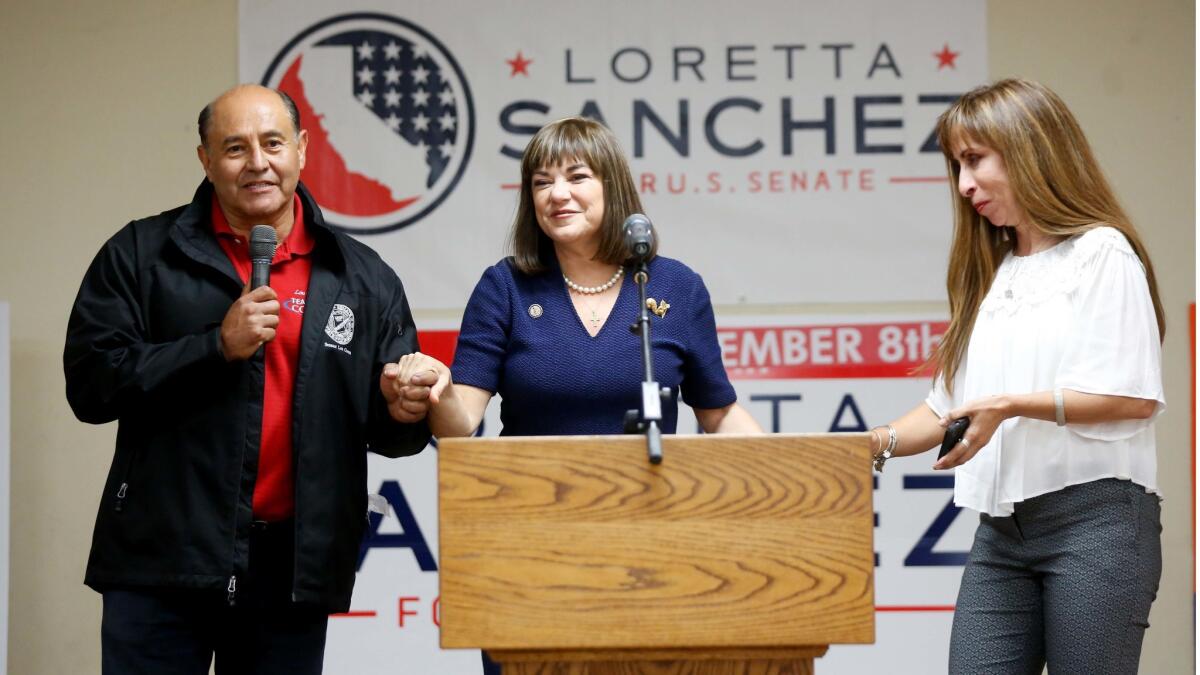
Rep. Lou Correa and wife Esther, far right, along with U.S. Senate candidate Loretta Sanchez, greet supporters in Santa Ana.
(Gary Coronado / Los Angeles Times)
“You want to keep the American economy strong?” he said. “We need more workers. And what better worker could you bring into the mainstream than those that have been here 10, 20, 30 years working hard, that have children, grandchildren, have mortgages to pay, have followed the law, paid their taxes?”

Politics
Biden judge rejects Trump’s sanctuary cities lawsuit, says even a win wouldn’t solve DOJ’s problem

Authorities investigate ICE ramming incident in New Jersey
Criminal defense attorney Josh Ritter and former NYPD Lt. Darrin Porcher react to the New Jersey incident where an illegal alien allegedly rammed an ICE agent. They emphasize the staggering 3300% increase in vehicle attacks against law enforcement officers.
NEWYou can now listen to Fox News articles!
A federal judge has tossed the Trump administration’s lawsuit against four New Jersey sanctuary cities, ruling the Justice Department targeted local policies that largely mirror a statewide immigration directive — meaning a court victory wouldn’t eliminate restrictions on ICE cooperation.
U.S. District Judge Evelyn Padin of the District of New Jersey, who was appointed by President Joe Biden, on Wednesday dismissed the Department of Justice’s lawsuit against Newark, Hoboken, Jersey City and Paterson, ruling the federal government lacked standing because striking down the cities’ policies would not remedy its alleged injuries.
“The Federal Government’s case has a fundamental flaw — it treats the Challenged Policies as though they operate in isolation. They do not,” Padin wrote. “New Jersey’s Immigrant Trust Directive is a statewide directive that, like the Challenged Policies, limits voluntary cooperation with federal civil immigration enforcement beyond what the law requires.”
The lawsuit was part of President Donald Trump’s renewed immigration crackdown following his return to office. Since declaring a national emergency at the southern border on Jan. 20, 2025, the administration has aggressively targeted so-called sanctuary jurisdictions, arguing that local policies limiting cooperation with ICE obstruct federal immigration enforcement and violate the Constitution.
DHS TORCHES NEW JERSEY’S PROFANE ‘F—ICE ACT’ AS ASSAULTS ON AGENTS SKYROCKET 1,300%
Immigration and Customs Enforcement (ICE) agents stand outside Delaney Hall detention center in Newark, New Jersey. 5/28/26. (Rashid Umar Abbasi for Fox News Digital.)
The Justice Department filed the lawsuit in May 2025, arguing the four cities’ sanctuary policies violate the Constitution’s Supremacy Clause by interfering with federal immigration enforcement, including limiting voluntary cooperation with ICE, restricting information sharing, declining to honor certain immigration detainers and barring participation in civil immigration enforcement beyond what federal law requires.
Newark, Hoboken and Jersey City each adopted executive orders declaring themselves “fair and welcoming” or “sanctuary” cities, while Paterson implemented police procedures designed to comply with New Jersey’s immigrant protections. The cities have argued the policies preserve community trust and allow local police to focus on state and local crime rather than federal civil immigration enforcement.
But Padin did not address the question of whether the sanctuary policies are constitutional. Instead, she ruled the federal government lacked standing because New Jersey’s Immigrant Trust Directive independently imposes many of the same restrictions on law enforcement agencies across the state.
GOP CANDIDATE RIPS BLUE STATE DIRECTIVE MEDDLING IN POLICE FORCE’S COOPERATION WITH ICE: ‘HANDCUFFED’
New Jersey Gov. Mikie Sherrill said ICE is denying her access to Newark’s Delaney Hall detention center. (Rashid Umar Abbasi for Fox News Digital; Daniel Heuer/Bloomberg via Getty Images)
The directive, first issued under former Gov. Phil Murphy in 2018 and codified into state law by Gov. Mikie Sherrill earlier this year, limits when state and local police can cooperate with federal immigration authorities on civil immigration enforcement.
Because the statewide directive wasn’t challenged in this case, Padin concluded that even if she struck down the cities’ policies, many of the same restrictions would remain in place.
“Even if the Court enjoined the Challenged Policies,” she wrote, “its injuries would persist.”
NEW JERSEY’S BAN ON PRIVATELY OPERATED ICE DETENTION CENTERS STRUCK DOWN BY COURT
That directive has already survived multiple legal challenges. The Third Circuit upheld it after New Jersey counties argued it conflicted with federal immigration law, and the Justice Department later sued New Jersey directly over the policy, lost and did not appeal.
“No judgment here could invalidate the ITD or relieve municipal law enforcement officers of their independent obligation to follow it,” Padin wrote.
U.S. Immigration and Customs Enforcement agents are seen at Terminal 1 of JFK Airport in New York City. An ICE agent saved the life of a 1-year-old boy at JFK after performing the Heimlich maneuver, the Department of Homeland Security said. (Getty Images)
The opinion also faulted the government for failing to identify concrete injuries caused solely by the cities’ policies. While the Justice Department cited several instances in which ICE detainers allegedly were ignored, every example involved the Essex County Correctional Facility, a county-operated jail that is not a defendant in the lawsuit and is governed by the statewide directive.
“The Federal Government must plead facts that substantiate its feared harm,” Padin wrote.
CLICK HERE TO DOWNLOAD THE FOX NEWS APP
Padin dismissed the lawsuit without prejudice, meaning the administration isn’t barred from bringing the case again if it can overcome the standing issue.
The Justice Department declined to comment.

WASHINGTON — The Supreme Court ruled Thursday that the Trump administration may end the Temporary Protected Status granted to more than 350,000 Haitians and Syrians whose home countries remain unsafe.
In a 6-3 decision, the court’s conservative majority said Congress gave the administration, not judges, the power to cancel or renew this temporary protection for non-citizens who are living and working here.
In a second win Thursday for the Trump administration, the court also upheld the administration’s policy of blocking asylum seekers at the southern border.
By the same 6-3 vote, the court said migrants do not have a right to apply for asylum if they are not already in the United States.
The decision on Temporary Protected Status could affect up to 1.3 million non-citizens who are in the country.
In 1990, Congress authorized this emergency humanitarian relief for non-citizens whose home countries were wracked by armed conflict, natural disasters or other extraordinary disruptions.
Under the law, the Department of Homeland Security may grant this protection for 6, 12 or 18 months and either renew or extend it for a similar period.
But this legal authority has been under dispute since Trump returned to the White House last year and targeted the 1.3 million people with TPS from 17 countries who were living in the United States.
Trump’s lawyers said the law made clear there was “no judicial review” of the government’s decision to cancel the grant of temporary protection.
However, immigrant rights lawyers argued the government failed in its duty to consult the State Department and assess whether it was safe for migrants to return home.
Repeatedly, U.S. district judges agreed with the challengers and ruled the administration’s decisions were “arbitrary” and unreasonable. But in nearly every case, the Supreme Court granted emergency appeals from the administration and set aside those orders.
Since TPS was created, the government has ended the protected designation for citizens of 18 countries.
DHS under then-Secretary Kristi Noem ended TPS for Honduras, Nicaragua, Afghanistan and Venezuela. A spokesperson for the agency previously said the Haiti designation became “a de facto amnesty program” and that allowing Syrians to remain is contrary to national interest.
Advocates for the immigrants argue that the administration failed to conduct the required process to properly evaluate each country’s conditions and instead acted on political grounds driven by racial animus.
State Department travel advisories for both countries warn people against traveling to either because of the risk of terrorism, kidnapping and widespread violence. But Federal Register notices announcing the terminations said country conditions had improved enough.
Recently released internal documents show that DHS decided to terminate protections for Haitians without any input from the State Department.
Citing the documents, which were obtained by the National TPS Alliance in a separate lawsuit, lawyers for the Haitians asked the Supreme Court to dismiss the case and send it back to lower courts. They argued that the justices should first consider the communications before issuing a decision.
Internal emails show that homeland security officials sought a recommendation from the State Department in May 2025, ahead of Noem’s early June deadline on whether to extend protections for Haiti. But by the time Noem signed what appears to be a final decision memo, U.S. Citizenship and Immigration Services had not received input from the State Department, the emails show.
“State recommendation for Haiti TPS has not come in despite of many outreach,” a homeland security deputy assistant secretary wrote in a June 2, 2025, email. A recommendation “would be helpful to have,” the person added.
Eleven days later, a USCIS project manager wrote in an email that Noem “recently elected to terminate Haiti without country conditions from DOS.”
USCIS initially recommended automatically extending protections before Homeland Security decided to terminate them, earlier versions of the memo indicate.
The June decision was blocked by a federal judge. In November, DHS issued another notice terminating TPS protections for Haitians.
That time, according a previously publicized email, a homeland security senior counselor asked a State Department official for the agency’s views on the country conditions in Haiti. The official, Spencer Chretien, didn’t address the country conditions but responded that “there would be no foreign policy concerns.”
Lawyers for the Haitians argued that response didn’t meet the legal standard for a sufficient consultation, though the Trump administration disagreed.

NEWYou can now listen to Fox News articles!
An explosive meeting in the Senate turned into a win for President Donald Trump and his administration as key Republicans flipped on another bid to handcuff the administration’s authorities in Iran.
In its final act before leaving Washington, D.C., for an over two-week break, the Senate rejected Democrats’ attempt to rein in Trump’s war powers in Iran as talks continue between Iran and the U.S. to hammer out a long-term peace deal.
It was the same war powers resolution from Sen. Tim Kaine, D-Va., that passed over a month ago and stunned Republicans in the upper chamber.
‘HE NAMED NAMES’: TRUMP’S SENATE MEETING EXPLODES INTO SHOUTING MATCH OVER IRAN
Majority Leader John Thune, R-S.D., and Senate GOP leaders are pushing forward with budget reconciliation to fund the final piece of government that had been shut down by Senate Democrats’ opposition to President Donald Trump’s Immigration and Customs Enforcement actions. (Nathan Posner/Anadolu)
What seemed like a predetermined outcome just hours after Trump and Sen. Bill Cassidy, R-La., sparred over the Iran war, and the administration’s lack of forthcomingness with lawmakers, during a closed-door meeting to discuss the president’s marquee voter ID and citizenship verification legislation turned into a surprise late night win.
Trump argued to the GOP that the previous war powers resolution, which passed on Tuesday thanks in part to a pair of Republicans being absent, hurt the administration’s negotiating position with the Iranians.
Meetings with key holdouts at the White House helped change the minds of Cassidy and Sen. Rand Paul, R-Ky., who has routinely voted with Democrats on every war powers resolution brought forward, and provided the administration with a win as they work toward a deal beyond the 60-day memorandum of understanding with Iran.
IRATE REPUBLICANS ACCUSE TRUMP OF HANDING DEMOCRATS A WIN AFTER BLOWING UP HOUSING PACKAGE
“I want to thank Vice President [JD] Vance and Special Envoy [Steve] Witkoff for the thorough briefing this afternoon on Iran,” Cassidy said on X. “I appreciate the quick invitation to the White House to address many of my concerns.”
And Paul, who voted present, noted that his “opinion on the debate over war and executive power has not changed and I have voted that way several times.”
“But since hostilities seem to be over and the President asked me to give consideration to his negotiating position, I will do so,” Paul said on X. “My vote of present is a way to give the President more space and leverage to negotiate a lasting peace.”
Sen. Chris Murphy, D-Conn., who has been at the forefront among Democrats in pushing war powers resolutions in the upper chamber, acknowledged that “this is a different moment,” but cautioned that the ceasefire appeared to be “precarious right now.”
When asked if he believed Trump’s case to Republicans that the successful war powers vote just a day before was hurting the administration’s leverage, Murphy said, “The Iranians don’t — you know, all they have to do is read a poll and find out that people in this country don’t support the war. They didn’t support the war.”
TRUMP HEADS TO CAPITOL HILL FOR PIVOTAL MEETING AS SENATE GOP DIVISIONS DEEPEN
President Donald Trump boards Air Force One as he departs Reading Regional Airport in Reading, Pa., on Tuesday, June 23, 2026. (Evelyn Hockstein/Reuters)
Still, it marked a key win for Senate Majority Leader John Thune, R-S.D., and the Senate GOP’s whip operation, led by Senate Majority Whip John Barrasso, R-Wyo., to flip the skeptics into backers of the administration’s long game in Iran after several contentious weeks in the Senate spurred by Trump’s last-minute decisions that either derailed or torpedoed several of his key agenda items.
Thune and Barrasso, accompanied by Sens. Lindsey Graham, R-S.C., and Bernie Moreno, R-Ohio, huddled in the GOP leader’s office as the vote wound down late Wednesday to call Trump, and share the news of the vote.
“Wow! The Senate just changed its vote on Iran from 50-48 against, to 50-47 for,” Trump said on Truth Social. “Rand Paul and Bill Cassidy changed. Thank you to Leader John Thune, Lindsey Graham, Bernie Moreno, and all. This vote puts Iran on notice!”
It also comes at a time when speculation has swirled over the nature of Thune and Trump’s relationship as the president, accompanied by chatter online, have ramped up the pressure to pass the Safeguarding American Voter Eligibility (SAVE) America Act.
CLICK HERE TO DOWNLOAD THE FOX NEWS APP
Moreno made the case that the questions over their relationship, and Thune’s position as leader, was just noise, and that “there’s not a single solitary Senator running for office that says leader Thune should be replaced, not one, even non-incumbents.”
“What today showed is that President Trump has a kind of relationship with John Thune where he says, ‘Hey, let me talk to the guys,’ understand the situation,” Moreno said. “As much as Cassidy and Trump got into it, it was because they’re both passionate, they’re both smart people.”
“And now, we’ve most importantly sent the Iranians a message that President Trump has the full backing of the Congress, and that was an incredibly important day,” he continued. “That’s a huge victory for us.”
-

 Movie Reviews6 minutes ago
8News Reel Talk: ‘Toy Story 5’ movie review
-

 World15 minutes ago
Strong Earthquake Rocks Venezuela Capital
-

 Health46 minutes ago
Does Berberine Aid Weight Loss? The Best Time To Take It To Boost Results
-
 Lifestyle1 hour ago
John Cena wanted to step away from the WWE ring before he became ‘too slow for the show’ : Wild Card with Rachel Martin
-

 Technology1 hour ago
Here’s a bunch of Prime Day deals on keyboards, mice, and other peripherals we like
-

 World1 hour ago
Israel slams UN report as ‘political blood libel’ for alleging deliberate targeting of Palestinian children
-

 Politics1 hour ago
Biden judge rejects Trump’s sanctuary cities lawsuit, says even a win wouldn’t solve DOJ’s problem
-

 Health1 hour ago
Latest COVID vaccine may have unexpected health benefit, study suggests

