Politics
Inside Kamala Harris and Doug Emhoff's L.A.

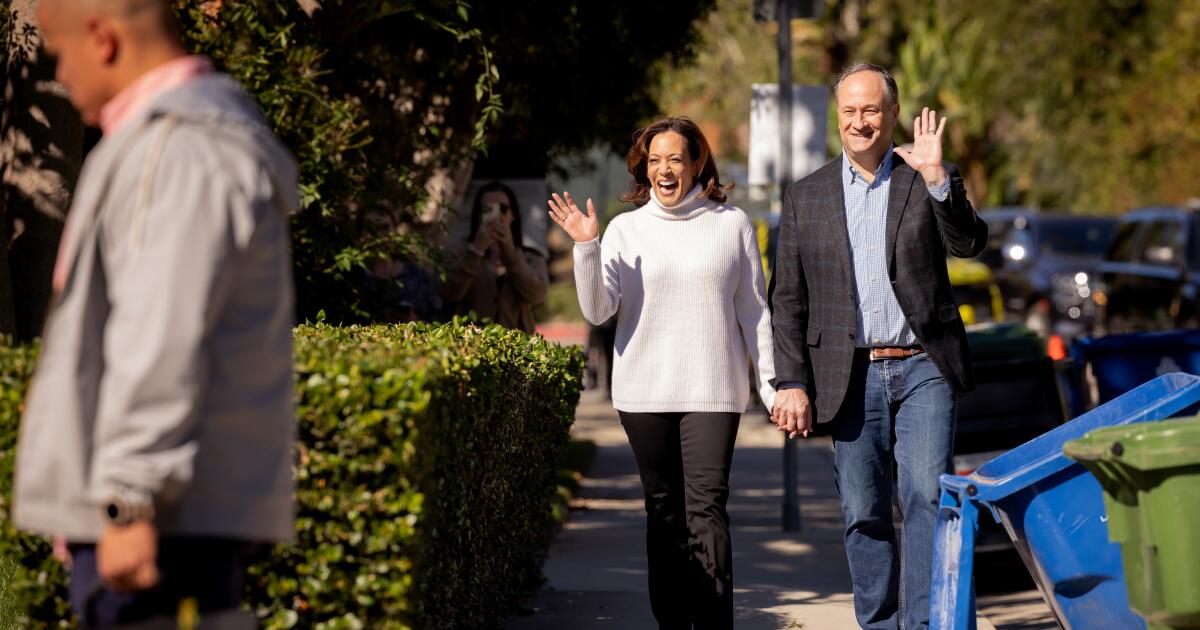
The headaches begin the moment Air Force Two touches down at LAX. A trail of black SUVs exits the Los Angeles airport and snakes along the 405 Freeway, choking traffic with rolling road closures across West Los Angeles as it makes its way to the tony neighborhood of Brentwood. Inside the quiet enclave, the motorcade rolls to a stop in front of the home of one of the country’s most famous political couples.
In a city full of celebrities and A-listers, Vice President Kamala Harris and Second Gentleman Doug Emhoff’s presence is hard to escape.
On a mid-October weekend, the couple came to town to celebrate the marriage of Emhoff’s 29-year-old son, Cole Emhoff, to his longtime girlfriend, Greenley Littlejohn, 28. Two days after the wedding, the pair was snacking on guacamole, salsa and chips in a dimly lighted vinyl booth upstairs at one of their favorite Mexican haunts, El Cholo in Santa Monica, when Emhoff received a text message from a friend.
The second gentleman’s buddy was just saying hello: He knew Emhoff was in town because he’d seen the motorcade speed by. (So much for sneaking into town).
“It’s just really an amazing thing for this town to have a vice president based here,” Emhoff told The Times in the couple’s first joint interview since taking office. “It’s intense. I’m from this area and I’m like, ‘Wow.’ This is incredible for our neighborhood.”
Vice President Kamala Harris and Second Gentleman Doug Emhoff are photographed in Los Angeles in November.
(Christina House / Los Angeles Times)
For Harris, the impulse to escape Washington — where she faces Republican scorn and criticism within her own party — for downtime at home has been difficult to satisfy over the last few years. While President Biden has made a near weekly habit of returning home to neighboring Delaware, the taxpayer-funded, cross-country flight to L.A. is harder to justify unless it includes official business. Harris’ trips home to L.A. are often camouflaged with an event to celebrate a local small business or a stop to raise awareness about one of her policy focuses such as Black maternal healthcare or reproductive rights. The vice president was also anchored to Washington during the first half of her term to cast tiebreaking votes in an evenly divided Senate.
But the Brentwood home, largely concealed by its verdant surroundings, has become a sanctuary for one of the world’s most visible figures. The four-bedroom, 3,500-square-foot house, less than a mile from Sunset Boulevard and roughly a 10-minute drive from the Will Rogers State Historic Park, is off-limits to reporters. In October, a group of protesters pulled up in cars outside to call for a cease-fire in the Israel-Hamas war, though Harris wasn’t there to hear their pleas.
As vice president, Harris is briefed multiple times a day, and reporters often follow her from event to event. But at home, Harris can avoid the scrutiny to recharge, cooking and chatting with her family as they watch from the kitchen table.
“Ask anybody who has ever worked in D.C. — in Congress or the Senate or at the White House — the trip from California, it’s not easy. It doesn’t matter if you’re on Air Force Two or on a United flight,” said Brian Brokaw, a former advisor to Harris. “When she’s home, she wants to enjoy that comfort and to the extent that she sees a very small and tight circle.”
Vice President Kamala Harris, left, and Second Gentleman Doug Emhoff order food at El Cholo Mexican restaurant in Santa Monica in October.
(Christina House / Los Angeles Times)
The Vice President’s Residence at the Naval Observatory, where she and Emhoff reside in Washington, provides some respite from the well-trodden White House complex where she keeps an office, but friends and aides say she considers it the people’s house — not home. In keeping with tradition of her predecessors, she redecorated the Victorian mansion — adding her own Californian touches — but the residence is on “borrowed time,” said Sen. Laphonza Butler (D-Calif.), a close friend and former advisor to Harris’ 2020 presidential campaign.
“At the end of day, home is home. The mattress that hugs just right is a different kind of rest,” Butler told The Times in an interview last summer. “The community that embraced you and trusted you to serve them as the first Black woman as attorney general, then as a U.S. senator and then as their vice president — that is meaningful. To know that you will get that kind of support and kindness and welcome is a place that, you know, if I were her I would run to every chance I got.”
Visits home frequently center on one of Harris’ most sacred traditions: Sunday family dinner. Harris begins planning the meal midweek, staging a choreographed spread in which everyone has a role.
Emhoff is in charge of cocktails, his son, Cole, curates the music playlist and his 24-year-old daughter, Ella, is tasked with making her signature guacamole. Cole’s new wife, Greenley, has taken on responsibility for dessert. While the couple host a regular rotation of foreign dignitaries, lawmakers, reporters and administration officials at the Vice President’s Residence (they hosted thousands of people at nearly two dozen holiday parties this year), Sunday dinner is strictly a private affair for Harris, who’s had the same core group of friends for decades. When Harris is in town, Sunday is off-limits for travel, according to an aide.
“It’s just a way to stay connected, reconnect and have some sense of normalcy in a world that sometimes isn’t,” Emhoff said. “We’re back in our city, back in our home. And then of course you go outside, and there’s all the Secret Service and everything that reminds you that it’s still a little bit different.”
The guest list is a regular rotation of family — Emhoff’s parents and Harris’ nieces are frequent guests — and close friends who live nearby or are in town for the weekend. The group cleans up while cooking, using “Uncle Freddy” as a shorthand for the process that Harris said she picked up as a child when visiting her parents’ close friend at his basement apartment in Harlem. Inside Uncle Freddy’s tiny kitchen, which “was the size of this table,” he would clean any utensil as soon as he finished using it, an efficiency she has encouraged Cole and Ella to incorporate into their blended family’s own elaborate meals.
Vice President Kamala Harris and Second Gentleman Doug Emhoff are photographed in Los Angeles in November.
(Christina House / Los Angeles Times)
The menu often features a dish that takes at least five hours to prepare, Harris said, which varies from a simmering Bolognese to a roast chicken using herbs from her backyard garden.
She’s also tried to incorporate her international travel into the end-of-week ritual, making time to speak to hotel chefs about local recipes and where to stop to find ingredients on the way to the airport. The day before our interview, Harris selected a recipe she picked up during a November 2022 visit to Bangkok for the Asia-Pacific Economic Cooperation summit: a pork dish marinated in coriander root and served with lemongrass over coconut rice.
“I freaked the Secret Service out because they’re kind of used to going to, like, golf courses with their principal,” she said, laughing at the memory of directing her motorcade to a Bangkok market. “With me, they’re going to the fish market.”
If the schedule allows, Harris will stop for ingredients, whether that’s detouring to a market in Kauai, Hawaii, for a certain type of fish or finding the right spices in Bangkok, according to a former Secret Service agent on her detail who spoke on condition of anonymity in order to discuss sensitive security information.
“We’ve got a whole motorcade, we’ve got a whole American delegation and we’ve got all this Thai security and she’s rolling through this market to find these particular spices,” he recalled of Bangkok.
But she tries to return the favor by inviting the Secret Service agents tasked with protecting her inside the Brentwood home, the only outsiders seemingly allowed to puncture the sanctuary. On the Fourth of July, Harris and Emhoff grill in the backyard for the agents forced to spend the holiday in L.A., handing out plates of hot dogs, hamburgers, potato salad, baked beans and other barbecue favorites. Unlike previous White House protectees, Harris not only cooks the food but serves it, the agent said.
Before Secret Service sweeps, security detail and motorcades, Harris and Emhoff had a routine, as much as a politician and an entertainment lawyer could. Harris, a proud Bay Area native, permanently relocated to L.A. in 2014 after marrying Emhoff. She was closing out her reelection bid for attorney general, a statewide campaign that entailed an exhaustive travel schedule outside of L.A. But L.A. was a “second city” to Harris, according to her close friend Chrisette Hudlin, an Angeleno who introduced her to Emhoff. Though Harris was firmly rooted in San Francisco, as attorney general she spent considerable time in L.A., where she had another office. As godmother to Hudlin’s children, she attended soccer games and debates and even once stood in for Hudlin at her son’s school birthday party.
“That made the transition rather seamless,” Hudlin said of Harris’ move to L.A. “That was a big decision for her because she loves San Francisco so much. That’s where she began her career. [The Bay] is where she grew up.”
Harris’ political identity is tied to the Bay Area, where she forged a career as San Francisco’s first Black and South Asian female district attorney and first woman of color elected as California’s attorney general. Though she was living in Brentwood, when she launched her U.S. Senate and presidential bids, she rarely spoke of L.A., instead emphasizing her Oakland roots on the campaign trail.
Harris is still fiercely loyal to the Bay Area, but she insists she loves L.A. One of the biggest adjustments she had to make was “that it is normal in L.A. to drive within the same city for an hour to go to a restaurant,” she said.
“I had to wrap my head around that,” she said. “It took a little adjustment.”
“But then what happened, you turned the corner,” Emhoff interrupted.
“I turned the corner,” Harris agreed. “I do love it here.”
Harris has internalized local frustration with her long tail of security, often choosing to limit travel around L.A. while she’s in town to spare drivers waiting for her motorcade to pass by. In grappling with her California split personality, Harris said she coined a term to describe herself: “Sangeleno,” a hybrid identifier combining San Francisco and Los Angeles that does not appear destined to catch on.
For the record:
8:01 a.m. Jan. 7, 2024An earlier version of this article incorrectly said that Harris purchases produce at the Brentwood Country Mart. She buys her produce at a nearby farmers market. It also said California Sen. Alex Padilla’s staff ordered 250 candles. The order was for 125 candles.
The pair are wistful about their life before the national stage, recalling shows at the Hollywood Bowl or seeing movies at the now shuttered Cinerama Dome on a Sunday afternoon. The couple would slowly make their way back west, stopping at Huntington Meats next to the Grove or the Brentwood farmers market to pick up provisions for dinner, or strolling through the Brentwood Country Mart. Harris likes to go to Gearys, the luxury homeware and jewelry store in Beverly Hills, for special occasion gifts (she bought Cole and Greenley’s wedding gift there). Zankou Chicken holds a special place in Emhoff’s heart, while Harris speaks fondly of going to Guelaguetza for mole near her office in Koreatown when she was attorney general. As a Westside entertainment lawyer, Emhoff enjoyed dinner at Toscana and Craig’s, where he took Harris on their first date. He is a former member of Hillcrest, a historically Jewish country club.
Vice President Kamala Harris arrives at Los Angeles International Airport for a flight back to Washington, D.C., with Second Gentleman Doug Emhoff, not pictured.
SUVs arrive at Los Angeles International Airport with Vice President Kamala Harris and Second Gentleman Doug Emhoff in November.
Emhoff has tried to replicate some of his routine in Washington, trading in the Santa Monica stairs for the Georgetown University steps made famous by “The Exorcist.” On visits home, Harris stuffs bags full of herbs from her garden, doling them out to staff members and military aides on Air Force Two on the five-hour ride back to Washington. She also brings kumquats from two trees in her backyard.
Harris and Emhoff agreed that Mexican food is required eating while they’re home, whether that’s ordering takeout from Frida’s or sneaking away to El Cholo (Washington’s Mexican food scene “is just different,” Harris politely declares). Although Emhoff used to eat at the original El Cholo on Western Avenue as a lawyer and USC law student, he said the couple have grown accustomed to going to the Santa Monica location because of its proximity to the house.
Music is their other passion. But while Emhoff and Harris are only a week apart in age (Emhoff’s birthday is Oct. 13 and Harris’ birthday is Oct. 20), they have vastly different tastes.
“I’m hip-hop, he’s Depeche Mode,” Harris said as the two laughed.
The two have compromised on “chill hotel lobby music” such as the English trip-hop duo Zero 7. On the April evening of Prince’s death in 2016, the two huddled together on the couch on their back patio, dancing and talking for three hours as twilight faded into the evening.
Although they compromised on music, they haven’t on sports. She’s held onto the Golden State Warriors, while he’s passionate about the Lakers.
“There’s a lot of s— talking and gloating,” Harris said.
Some of that has carried over to social media, where they playfully bet on who has to wear the other team’s jersey.
Emhoff once made the mistake of donning Harris’ San Francisco Giants hat while he was in town visiting her. The pair snapped a photo while at a Giants game that circulated online, a fleeting decision that Emhoff said his L.A. friends refuse to let him forget.
“It turned out to be forever like the one picture of us as a couple that was used,” he said.
Harris has an acute understanding of what it’s like to live in L.A. even when she’s 2,600 miles away. During the Getty fire of 2019, Harris and Emhoff had to twice evacuate their Brentwood home. (That’s L.A. living: In 1961, future President Nixon was renting a house on Bundy Street when a devastating fire swept through the Bel-Air and Brentwood neighborhoods. Nixon leapt onto the roof of his house and was photographed watering down the shingles with a garden hose.)
During the Getty fire, Harris was sitting in a Senate committee meeting on natural disasters when she learned of one of the evacuations through a passed note. She left the meeting, called Cole, and asked him to go to the house and collect their personal belongings. Harris and the younger Emhoff had very different perspectives on what is considered valuable, she said as she laughed (Emhoff didn’t seem to treasure photographs the way she did). Three weeks after the scare, she introduced a bill in the Senate to set aside $1 billion in annual funding to help communities with wildfire preparedness.
“It’s such a gut-wrenching feeling,” Emhoff recalled of seeing images of the inferno burning behind the Sunset sign along the 405 Freeway while he was away in Washington. “That’s our exit. And you’re looking at it in flames.”
Vice President Kamala Harris, top right, and Second Gentleman Doug Emhoff board Air Force Two at Los Angeles International Airport in November.
(Christina House / Los Angeles Times)
Emhoff’s brother, who recently retired as a firefighter in Santa Cruz, was always on his mind.
“It’s a hard feeling because when you’re not there, you just want to be there,” he added.
In Washington, Harris has tried to bring the comforts of home to her sprawling residence at the Naval Observatory. She created a signature candle, scented with notes of jasmine, with Melanie Apple Fields, a candlemaker who owns Studio City-based Voyage et Cie.
Harris gives the candles as gifts, emblazoned with the vice president’s seal in gold, to dinner party guests and to dignitaries, including the president of El Salvador and King Abdullah II of Jordan, Apple Fields said. Each candle is accompanied with a short description of the business.
“She always says to me, ‘I just want you to be successful,’” Apple Fields said of her phone conversations with the vice president.
Harris first encountered Apple Fields’ candles at the Peninsula before she sought out the candlemaker at her Studio City storefront. The two bonded over the scent both their mothers wore, Nina Ricci’s L’Air du Temps, and Harris began placing orders for batches of Apple Fields’ candles. Two weeks after the 2020 presidential election was called for Biden, Harris phoned Apple Fields to ask her to scent the Vice President’s Residence.
She has since made thousands of candles for Harris, along with lotions, soaps and bubble baths that are displayed in rooms throughout the Vice President’s Residence and for Harris to take on the road. Apple Fields produces candles for First Lady Jill Biden, who prefers the scent of gardenia, and Sen. Alex Padilla (D-Calif.), whose staff called and asked her to produce 125 candles using Harris’ scent for an event he was hosting. Harris’ office gave Padilla permission to produce a similar candle but asked that he use a different scent. Padilla settled for one of the brand’s signature scents.
When the motorcade arrives in Brentwood next time Harris is in town, she and Emhoff will probably have some homeowner issue to deal with: no running hot water, no heat or a broken stove, all of which happened on recent trips home. Once she’s dealt with that, she’ll relax — maybe pour a glass of wine, or draw a bath — and begin planning her next Sunday dinner.


NEWYou can now listen to Fox News articles!
Lawmakers on Capitol Hill had split reactions to the Supreme Court’s ruling to strike down President Donald Trump’s bid to end birthright citizenship, further allowing children born in the United States to be recognized as U.S. citizens.
“It’s a terrible decision,” Rep. Byron Donalds, R-Fla., told Fox News Digital.
“Regulate folks before they come in — in terms of not coming here just to have a baby and leave,” Rep. Ro Khanna, D-Calif., said.
“In terms of the immigration process coming in, there should be regulation. Not that once you’re born here that we’re going to denaturalize you,” he continued.
REPUBLICAN ACCUSES SCOTUS OF BETRAYING US, PUSHES BILL RESTRICTING BIRTHRIGHT CITIZENSHIP, PREGNANT VISITORS
Rep. Ro Khanna, the U.S. Supreme Court and Rep. Byron Donalds weighed in after the high court rejected President Donald Trump’s bid to end birthright citizenship. (Shannon Finney/NBC via Getty Images; Li Rui/Xinhua via Getty Images; Nathan Posner/Anadolu via Getty Images)
The case, which left many Republicans and Democrats divided, challenged Trump’s executive order to detach birthright citizenship from the 14th Amendment. Most Democrats who Fox News Digital spoke to argued that if the ruling had gone the other way, it would have been considered unconstitutional.
“I think they got it right,” Rep. Christian Menefee, D-Texas said. “The Supreme Court said that the Constitution says what it says. That if anybody even has a question about what the 14th Amendment says, I think it’s a little embarrassing. So I’m glad they got it right.”
TRUMP SUFFERS MAJOR SUPREME COURT DEFEAT AS JUSTICES UPHOLD BIRTHRIGHT CITIZENSHIP
Rep. Christian Menefee (D-TX) speaks onstage during DJ Michael 5000 Watts King’s Day at The Bell Tower on 34th on February 16, 2026 in Houston, Texas. Watts passed away on January 30, 2026 at the age of 52. (Marcus Ingram/Getty Images)
“I believe in the Constitution,” Rep. James Clyburn, D-S.C., said when asked about the ruling.
“The Constitution is the Constitution. If you don’t like the Constitution, you can try to change it,” Rep. Seth Magaziner, D-R.I., said. “But honestly, I think we’ve got much bigger problems as a country than Americans trying to live their lives as birthright citizens.”
The 6-3 decision highlights a significant loss for Trump’s immigration agenda as he has criticized birthright citizenship as a “magnet for illegal immigration.”
ICE SURGES ENFORCEMENT, MAKES 10,000 ARRESTS IN FIVE DAYS AMID SUPREME COURT BIRTHRIGHT CITIZENSHIP DECISION
“I think the president has an obsession with immigrants in this country,” Rep. Sarah Elfreth, D-Md., said. “He’s hell bent on making it as uncomfortable as possible. We’ve seen that time and again with ICE, we’ve seen this with an attack on the 14th Amendment .”
Justice Clarence Thomas, Justice Neil Gorsuch and Justice Samuel Alito were the three to dissent — arguing the 14th Amendment does not guarantee birthright citizenship to all children born to parents who are unlawfully and temporarily in the country. Alito cited that the ruling fails to recognize the rise of “birth tourism,” the concept that foreigners come to America just to give birth, potentially opening the door to national security threats.
CLICK HERE TO DOWNLOAD THE FOX NEWS APP
Rep. Ilhan Omar, D-Minn., and Rep. Maxine Waters, D-Calif., declined to comment on the ruling to Fox News Digital.
“Americans should be happy, because the Constitution means more than one guy’s opinion,” Rep. Bennie Thompson, D-Miss., said.
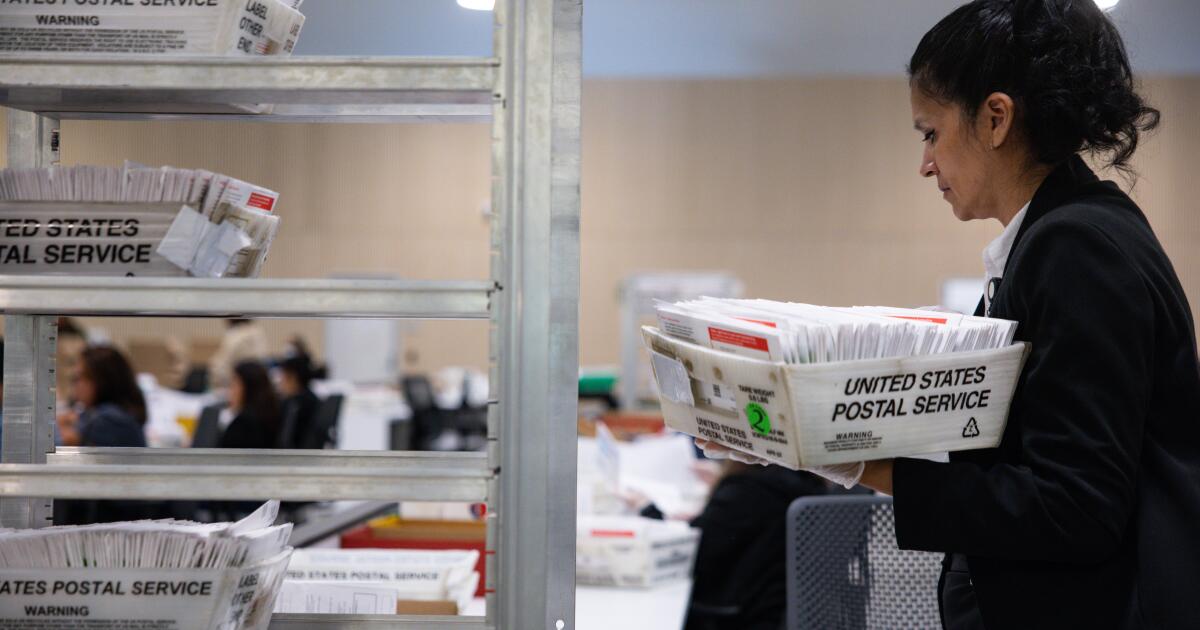
WASHINGTON — President Trump has spent months waging an unusually aggressive campaign to reshape how states run elections, leveraging federal agencies in ways no previous president has attempted.
He has pushed the Department of Homeland Security to compile a list of citizens in each state to help determine voter eligibility. He is seeking to give the Postal Service a role in deciding who can receive mail ballots. He has threatened to withhold federal funding from states unless they phase out electronic voting machines. And he is pressuring Republican lawmakers to overhaul voting laws, claiming without evidence that elections are being rigged.
The efforts have run into resistance in court and within his own party. They have also left postal workers and local election officials bracing for an election cycle marked by deepening doubts about election integrity, and uncertainty about how the federal government may challenge the post-election results.
“It’s an unprecedented power grab to reshape how our elections work so that he and his allies can maintain and expand power,” said Eric Kashdan, director of federal advocacy at the Campaign Legal Center, a nonpartisan government ethics organization.
The White House defends the effort as fulfilling a campaign promise, and argues the administration is “lawfully enacting the agenda President Trump was elected to enact.”
One of Trump’s defining efforts to assert some federal control over state elections has been his insistence on passing the SAVE America Act, which would require voters to provide proof of citizenship when they register, require Americans to show identification when casting a ballot and require states to send voter data to the Department of Homeland Security.
His relentless push for the measure has prompted him to derail a bipartisan housing bill and threaten to forgo signing any piece of legislation unless the voting measure is approved. He says he considers the matter a “national emergency.” Despite the pressure campaign, Senate Republican leaders maintain there is not enough support to pass the measure.
The political stakes ahead of the midterms have been laid out more bluntly by House Speaker Mike Johnson (R-La.), whose chamber has approved the SAVE America Act. Last month, Johnson warned conservatives gathered at the Faith & Freedom Coalition that if Democrats win back control of the House, they will “go after the president’s family, the Cabinet, his donors, friends,” and supporters.
“I run the protection program,” Johnson said. “I will take care of you.”
Setbacks in court
The administration’s ambitions have hit numerous snags in court in the last month, with judges reaffirming in many cases that the Constitution gives states — not the federal government — primary authority over elections.
In one case, U.S. District Judge Sparkle L. Sooknanan, who was appointed by President Biden, went further.
She said a federal immigration database the Department of Homeland Security was compiling to determine voter eligibility violated privacy laws. She added that the database has resulted in states actively removing U.S. citizens from voter rolls based on inaccurate information.
“All in all, the federal government has knowingly trampled on the privacy rights of American citizens in a manner that threatens the sacred right to vote,” Sooknanan wrote. “This Court cannot stand idly by while that happens.”
James Percival, the general counsel for Homeland Security, said the ruling was the latest example of “how hard the Left will fight to stop us from solving problems they insist do not exist.”
The Supreme Court’s conservative majority this week also dealt a blow to the GOP and upheld state laws that allow for counting mail ballots that are postmarked by election day but arrive late.
The decision left Trump fuming. He said it was a “a little bit surprising” to see the court’s decision, claiming without evidence that the result will inevitably give “people more time to vote illegally.”
Democrats, in turn, saw the ruling as a necessary check on the Trump administration’s efforts.
“While we continue to see unprecedented efforts to interfere with elections from the Trump administration, it is a relief to see federal courts make clear that these attacks on mail and absentee voting are clearly illegal and unconstitutional,” Sen. Alex Padilla (D-Los Angeles) said in a statement after the ruling.
Trump is still eyeing changes to voting by mail. In March, he issued an executive order that seeks to limit who can receive mail ballots. Under the proposed rule, the Postal Service would not deliver mail ballots to states that don’t turn over sensitive voter data to the federal government, Postmaster General David Steiner told a Senate panel last month.
The admission drew immediate condemnation from Democratic lawmakers. They argued the regulation is an illegal attempt to coerce states into handing over their voter rolls.
“Please push back on being a pawn in this authoritarian playbook,” Sen. Elissa Slotkin (D-Mich.) told Steiner. “The Postal Service is one of the most important institutions in our country. Don’t taint it with the obsession of this one man.”
A day after that back-and-forth, U.S. District Court Judge Indira Talwani, who was nominated by President Obama, blocked those plans — at least for now.
“The Constitution does not grant the President any specific powers over elections,” the judge wrote, while adding that the Postal Service does not have the legal authority to determine who can vote by mail and how.
The White House said Wednesday that the administration remains confident the executive order will be in place by the November election.
Taken together, the administration’s efforts are unprecedented, UCLA law professor Rick Hasen said. That’s because the Constitution puts control over elections in the hands of the states and grants Congress the ability to pass laws, he said.
“The president really only has authority through federal statutes that have already been passed,” Hasen said. “It’s not surprising that many courts have struck down or stopped him from doing things to try to interfere with how elections are being run.”
Postal workers waiting for clarity
The legal setback for the Postal Service proposed rule was welcome news to the union representing postal workers.
“We believe that what we’re being asked to do is in violation of the oath that we took,” said Jonathan Smith, the president of the American Postal Workers Union, which represents more than 200,000 postal workers.
Following the ruling, the union called on the agency to abandon the rule, arguing it “will crush mailers’ trust in the Postal Service” and undermine “one of the most important functions the Postal Service and postal workers perform in service of the United States and its remarkable democracy.”
In several states, the union has run ads promoting mail voting as safe and a needed option for Americans. The ads were planned before Trump signed his executive order in March seeking to limit who can receive mail ballots, Smith said.
Now, the ads are taking a different meaning. Smith argued that “sometimes God works in mysterious ways.”
“The ad was then and is now intended as a piece to educate America about how good vote by mail is, how much it has been working out,” Smith said. “It’s an educational piece, not a response to the White House.”
Ahead of the election, Smith said postal workers are waiting for clarity on how their duties may change. But right now, he says, there isn’t much.
Orange County Registrar Bob Page said his office is monitoring any changes to existing federal and state election laws to ensure any changes, if needed, are implemented without disruptions. But he acknowledged the timing crunch could create some hurdles the closer the election gets.
“In many ways, any change to how California voters cast their ballots made between now and election day would create a challenge and may even be disruptive,” Page said.
He said many counties have ordered outgoing and return ballot envelopes for the election to ensure envelopes for more than 23 million California voters are ready to use by the Oct. 5 mailing deadline. Any change to how ballots should be prepared or mailed could present an issue.
“Our office has received calls from voters asking about potential changes to vote-by-mail procedures usually tied to media coverage about proposed changes,” he said. “We inform these voters that our procedures have not changed because the law has not changed and that we will mail their 2026 General Election ballots by Oct. 5.”
L.A. County prepares for possible voting changes
In Los Angeles County, election officials are also in a battle to bring clarity to the process as the administration ushers in a series of proposed changes to the election.
Dean Logan, the head of the Los Angeles County registrar-recorder/county clerk’s office, said his office is fighting to contain a wave of election misinformation, including some that is amplified by the White House.
“It’s not something that we’ve seen happen before, and certainly not at the level we’ve seen,” Logan said.
Rather than respond to every claim, Logan says his office picks its battles, intervening only when a falsehood appears likely to reach a wide audience. Even then, the office tries to avoid engagement with whoever is spreading it.
If the administration imposes a new rule closer to the election, Logan said his office is ready to follow the law.
“It’s really been about finding this balance of staying alert and prepared for the possibility [of change] but also not getting sucked into the political distraction,” he said.
Last month, Trump claimed without evidence that Democrats have cheated to win California’s primary elections, and boasted about federal prosecutors in Los Angeles investigating the matter.
Trump has also continued to claim Democrats are trying to rig or cheat in the upcoming election, remarks that have faced rebukes from members of his own party.
“I think it is ironic that we control the House, Senate, Supreme Court and the White House and we are yelling election fraud. I mean, we won all the damn elections,” Rep. Thomas Massie (R-Ky.) told reporters last month.
At the national level, Senate Democrats have said they plan to send election observers to polling places on behalf of Congress in reaction to Trump’s efforts.
“We are not waiting for chaos to arrive,” Senate Minority Leader Chuck Schumer (D-N.Y.) said last month. “We are preparing now.”
Times staff writer Justine McDaniel contributed to this report from Washington.
Politics
Sanctuary county refused 615 ICE transfer requests, turned over just 11 illegal immigrants, records show

Angel mom Cheryl Minter demands accountability from Fairfax DA
The House GOP grilled Fairfax DA Steve Descano over his controversial soft-on-crime record, particularly his office’s leniency toward illegal immigrant criminals. During powerful testimony, Angel Mom Cheryl Minter detailed how her daughter’s murder by an alleged illegal alien with over 30 prior arrests highlighted the tragic consequences.
NEWYou can now listen to Fox News articles!
FIRST ON FOX: Records obtained by a conservative legal group show Fairfax County, Virginia, declined to transfer 615 illegal immigrants to ICE over the past 16 months, while turning over just 11.
Fairfax County, whose board includes one Republican supervisor for what is the most populous jurisdiction in the Old Dominion, formally designated itself a sanctuary jurisdiction in 2021 after passing the Public Trust and Confidentiality Policy or “Trust Policy.”
America First Legal filed a Freedom of Information Act request with the county seeking records from the office of Fairfax County Sheriff Stacey Ann Kincaid, who testified at a contentious House hearing earlier this spring on Fairfax’s reluctance to cooperate with federal law enforcement.
The data, obtained directly from a Fairfax County Sheriff’s Office document, showed that for the entirety of 2025, Kincaid’s office refused to transfer 448 illegal immigrants to the Department of Homeland Security for processing and instead only turned over a total of nine to ICE. During the first four months of 2026, Fairfax declined to transfer another 167 illegal immigrants, while turning over only two.
WATCH: ANGEL MOM TURNS TABLES ON SANCTUARY POLITICIANS WITH BASIC QUESTION ABOUT THEIR PRIORITIES
Fairfax County Sheriff Stacey Kincaid (Eva Russo/Getty Images)
Since then, county policy has barred law enforcement from honoring ICE civil detainers or otherwise assisting with federal immigration enforcement.
America First Legal (AFL), which first obtained the data, placed much of the blame on Fairfax County Commonwealth’s Attorney Stephen Descano, who sat beside Kincaid at the recent hearing and faced sharp questioning from Republicans over his prosecutorial discretion in cases involving illegal immigrants arrested in the county.
SOROS-BACKED DA’S LAX ILLEGAL IMMIGRATION POLICIES LED TO ‘PREVENTABLE’ BUS STOP STABBING MURDER: COMPLAINT
AFL said in a statement obtained by Fox News Digital that Fairfax’s overall framework encourages recidivism by illegal immigrant offenders and has directly led to several gruesome cases, including the murder of Fredericksburg, Virginia, woman Stephanie Minter, whose alleged killer is an illegal immigrant from West Africa with a lengthy criminal record in Fairfax County.
AFL noted that Descano is under investigation by the Justice Department’s Civil Rights Division over claims U.S. citizens are effectively discriminated against because of the prosecutor’s stated preferential policies, which appeared on his campaign pages and elsewhere and were highlighted by Subcommittee Chairman Tom McClintock, R-Calif., and others during the hearing.
The group pointed to fatal stabbings; the alleged assault of a woman on the Washington & Old Dominion Trail, a popular rail trail spanning from Washington, D.C., to Purcellville that has long been considered safe; and other crimes allegedly committed by illegal immigrants who, it said, received light sentences or had charges dropped.
FEDERAL JUDGE BLOCKS BLUE STATE’S LAW PROHIBITING ICE AGENTS FROM WEARING MASKS ON THE JOB
Descano has long defended his prosecutorial discretion as evidence-based and handled on a case-by-case basis.
A Descano spokesperson told Fox News Digital in a statement Thursday that the DOJ’s probe is politically motivated and has “distort[ed] the office’s policy.” The spokesperson also said the notice appeared to arrive intentionally just before Descano testified before McClintock.
“Our office’s policies are fair, legal and reflect the values of Fairfax County, and we will not be distracted from our mission of keeping this community safe and holding individuals accountable when they commit crimes,” the spokesperson said.
Fox News Digital also reached out to Kincaid’s office for comment.
Fairfax County Commonwealth’s Attorney Steve Descano, left, and Fairfax County Sheriff Stacey Ann Kincaid, right, testify before Congress. (Tom Williams/Getty Images)
AFL counsel Will Scolinos rejected the county’s defense, telling Fox News Digital that tragic cases such as Minter’s murder are the product of the Trust Policy and the shielding of “hundreds of illegal aliens … from federal law enforcement.”
“This deliberate obstruction by county officials protects illegal alien lawbreakers and endangers every family in Northern Virginia,” Scolinos said. “For too many families, it is already too late. But to protect other Virginians from future crimes at the hands of illegal aliens with prior arrests, Fairfax County must reverse this reckless, anti-American governance immediately.”
In the most recent month recorded, April 2026, 32 illegal immigrants were listed as being in the sheriff’s office’s custody, with none released to ICE. All 32 were subject to an “informed detainer,” and three were listed as convicted.
AFL also noted that Santa Clara County, California — home to the San Francisco 49ers’ new stadium — informed the group that it received 529 ICE detainer requests in 2025 and honored none.
SIGN UP TO GET THE POLITICS NEWSLETTER
“If each detainer represents a unique illegal alien, an average of 1.34 arrested illegal aliens were released into Santa Clara every day,” AFL said in April.
CLICK HERE TO DOWNLOAD THE FOX NEWS APP
The numbers reflect a pattern that is expected to continue drawing scrutiny from the Trump administration and groups such as AFL, which has also sought data from sanctuary jurisdictions nationwide.
Fox News Digital reached out to DHS for comment.
-

 New Hampshire5 minutes ago
N.H. State Police announce unexpected death of 19-year veteran
-

 New Jersey12 minutes ago
Legendary NJ Fourth of July lobster catch created record that will never be broken
-

 New Mexico15 minutes ago
$7K baby bond for each New Mexico child? What the state treasurer is proposing
-

 North Carolina20 minutes ago
Warsaw man extradited back to Duplin County in last year’s lottery ticket probe
-

 North Dakota27 minutes ago
North Dakota’s Vantis BVLOS system now open to UAS operators at no cost – Unmanned airspace
-

 Ohio30 minutes ago
Licking County real estate transfers for June 15-19, 2026, hit $697K
-

 Oklahoma35 minutes ago
Can Missouri football get revenge on Oklahoma? How Sooners shape up
-
Oregon42 minutes ago
Oregon Lottery Pick 4 results for July 2

