Politics
How Newsom plans to fix California's projected $37.9-billion budget deficit

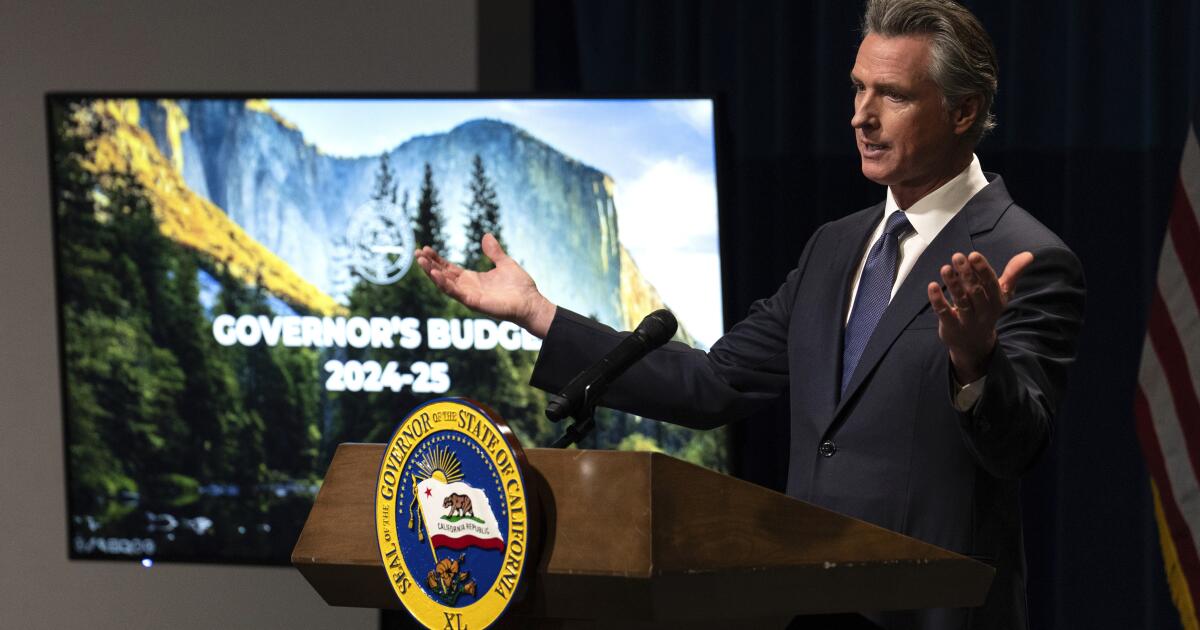
Gov. Gavin Newsom asked California lawmakers on Wednesday to dip into the state’s rainy-day reserves, and signaled his desire to potentially delay a minimum wage increase for healthcare workers as part of his plan to offset an expected $37.9-billion deficit.
A confluence of weaker-than-expected state revenues, delayed tax deadlines and overspending based on inaccurate budget projections created the budget shortfall. Newsom’s new deficit estimate is more than double the shortfall he and lawmakers anticipated last June, a tacit admission of how badly the state underestimated the size and scope of the budget hole, and marks substantial disagreement within California government about the depth of the financial problem.
Newsom described his plan as an example of resilience as he outlined the $291.5-billion budget proposal for fiscal year 2024-25 during a presentation Wednesday in Sacramento. His proposal to offset the shortfall includes declaring a budget emergency in order to dip into reserves; cutting $8.5 billion in spending from programs that support climate change efforts, housing and other services; and reconsidering the healthcare wage increase.
“This is a story of correction and normalcy, and one that we in some respects anticipated — the acuity perhaps not — and one we’re certainly prepared to work through,” Newsom said.
The deficit deepens state government’s economic challenges and could pose political problems for Newsom this year as he grapples with lawmakers and interest groups about his proposed cuts.
His budget proposal indicates that he wants to work with lawmakers to add funding restrictions to a law he signed last year that increases the minimum wage for healthcare workers to $25 per hour. Such changes could delay the pay hike from taking effect if state revenues drop below a certain level.
The governor’s plan seeks to maintain funding for many of his expensive policy promises, including the expansion of Medi-Cal eligibility to all immigrants regardless of legal status.
But his decision to dip into the budgetary reserves sounds a new alarm for the Golden State. Until now, Newsom has rebuffed calls from Democratic lawmakers to tap into the state’s rainy-day fund and other reserves, which act as a piggy bank that can be cracked open during a financial crisis to avoid sweeping cuts to critical services and social safety net programs.
The governor is proposing that he declare a budget emergency this summer, which is required by law to draw down the reserve accounts. His plan to spend $13.1 billion of the reserves means less funding will be available to backfill spending if revenues continue to decrease, possibly forcing more painful and drastic cuts in the years ahead.
Newsom is also looking to dip into the reserves at a time when he’s proposing decreased annual spending. The 2024-25 budget marks a decline of nearly $20 billion in spending from the budget lawmakers passed last June for the current fiscal year.
California’s budget difficulties were compounded last year when the state and federal government delayed the deadline to file 2022 income tax returns from April to November due to winter storms that pummeled coastal California and flooded parts of the state. The extended deadline affected more than 99% of California taxpayers in 55 of the state’s 58 counties, according to the state Department of Finance.
In a typical budget year, state government has tax receipts in hand before the governor unveils a revised budget proposal in mid-May and before reaching a final spending agreement with lawmakers in June. The tax delay forced lawmakers and the governor to enact the current budget in July based on estimates of how much money the state would collect in tax revenues by the November deadline.
“If you recall, this time last year we were dealing with unprecedented flooding,” Newsom said. “Little did we know that those extreme weather patterns would lead to this extreme volatility in financial projections.”
The Department of Finance anticipated last year that there would be a nearly $32-billion shortfall in the current fiscal year, which ends on June 30. That forced lawmakers and the governor to trim their spending plans.
The state budget is highly dependent on income taxes paid by California’s highest earners. Revenues are prone to volatility, hinging on capital gains from investments, bonuses to executives and windfalls from new stock offerings.
Newsom and lawmakers anticipated additional revenue declines driven by a declining stock market, high interest rates and increased inflation. But Newsom’s new estimate indicates the deficit is much worse than lawmakers and the governor planned for in June.
Now state leaders must cut spending further in the upcoming fiscal year to make up for last year’s actual revenue shortfall and an anticipated deficit in the coming year.
“The timing challenge related to this deficit estimate is definitely unique,” said Gabriel Petek of the Legislative Analyst’s Office.
In December, the office projected the budget deficit would be $68 billion — much higher than Newsom’s estimate. The governor chalked up the difference to the Department of Finance anticipating greater revenues than the Legislative Analyst’s Office, among other accounting discrepancies.
“We just are a little less pessimistic than they are about the next year,” Newsom said.
Despite the budget challenges, there’s no indication of a larger economic crisis in California.
“Until now, California has been growing faster than the U.S., on a per capita basis, and has been one of the fastest-growing states in the U.S.,” said Jerry Nickelsburg, an economics professor and director of the UCLA Anderson Forecast. “And now it’s growing at about the rate of the U.S., as really everyone sort of slows down a bit.”
He noted that there’s more geopolitical risk worldwide and that the presidential election could affect U.S. economic policy in the near future.
But Nickelsburg added that the slow growth is expected to be short-lived, with economic growth accelerating later this year and into 2025.
Newsom’s January budget proposal begins a six-month process of hearings and negotiations with the California Assembly and Senate, both of which will have new leaders by the time the budget talks intensify.
He promised to provide a more complete fiscal plan in May when the state has a more accurate understanding of 2023 income tax collections.
Newsom shot down the idea of California enacting a wealth tax to address the shortfall.
K-12 schools somewhat relieved
The budget proposal was something of a relief for schools: no major cuts, no major step back of priorities and expanded efforts such as free school meals for all and gradual expansion of transitional kindergarten that will allow all 4-year-olds to attend public school by the start of the 2025-26 school year.
But funding for facilities to improve early-education classrooms is delayed for a second straight year. The total for public school funding is $109.1 billion, about 40% of the state budget.
Overall, the funding level guaranteed under the state’s complex formula works out to $8 less per student over last year, to a total of $17,653 per student — a small difference but one that adds up with nearly 6 million public school students. The funding level also becomes potentially significant coupled with inflation and employee wage increases. School districts also are anxious over the expiration of COVID-relief funding that had led to record, but temporary, revenues for schools.
“This certainly takes the cake on being the best bad-year budget” for K-12, said Kevin Gordon, president of Capitol Advisors Group, a firm that lobbies on behalf of school districts.
Delaying increases for universities
Newsom proposes deferring a 5% budget increase for the University of California and California State University, and providing two years’ worth of increases next year. In 2022, he pledged five years of 5% annual base funding increases to deliver long-sought financial stability in exchange for gains in access, equitable student achievement, affordability and training for state workforce needs.
A highly anticipated measure to help address the need for new affordable student housing with a zero-interest revolving loan fund would be suspended under the proposed budget.
On financial aid, the proposal forgoes a planned one-time investment of $289 million for the middle-class scholarship program. And a sweeping plan to significantly increase Cal Grants for needy students will not kick in this year due to the budget shortfall.
Sonya Christian, chancellor of California Community Colleges, said Newsom’s proposal maintains key investments, such as the $60-million expansion of nursing programs in community colleges.
Cuts to social services
Newsom’s budget proposal includes backtracking or delaying planned funding for numerous programs serving vulnerable Californians.
Child-welfare advocates were stunned Wednesday by a proposed $30-million reduction in funding for an urgent response program that helps youth in foster care and families in crisis, a move that could eliminate the service entirely.
“While we recognize the large deficit affecting the administration’s budget proposal, we can’t continue down this path of deprioritizing kids that has led to alarmingly poor outcomes,” Ted Lempert, president of the nonprofit group Children Now, said in a statement.
Other funding planned for this year has been delayed to make up for the shortfall.
That includes delaying $80 million for a program meant to reduce the number of families in the child welfare system experiencing homelessness, and $50 million for a program that helps homeless Californians with disabilities. The funds would be delayed to the 2025-26 budget under Newsom’s proposal.
And Behavioral Health Bridge Housing program designed to provide shelter to homeless Californians with serious mental health issues would see $235 million in funding delayed.
Some homeless funding delayed
Newsom proposed more than $1.2 billion in total cuts to a variety of housing programs, including regional planning grants, low-interest development loans and assistance for first-time home buyers, and suggested delaying payments until next year for several programs that address homelessness.
His plan would maintain $3.4 billion for homelessness, including funds to dismantle encampments and provide grants to local governments to prevent people from losing their homes.
Newsom spoke forcefully about the public’s demand to see results from the billions the state spends on homelessness.
“People have just had it,” he said. “They want these encampments cleaned up. They’re done. They’re fed up.”
Cuts to environmental programs
Newsom proposed cutting the state’s multiyear climate budget by 11% from the $54 billion approved in 2022, including reductions to clean-transportation programs and others that address forest maintenance, watershed resilience, coastal protection and rising sea levels.
“We would have hoped for a little bit more of a courageous proposal — something that is more creative and solutions-oriented about how to fund the transition that is so desperately needed toward clean energy and resilience,” said Mary Creasman, chief executive of California Environmental Voters.
Newsom acknowledged that 2023 was the planet’s hottest year on record, and vowed to “hold Big Oil accountable” for its role in the climate crisis. That includes a recommendation in the budget to eliminate some subsidies that benefit oil and gas corporations, such as funds geared toward intangible drilling costs and allowances for economic credits.
In a statement, Barry Vesser, chief operating officer with the Santa Rosa-based Climate Center, said that was a wise recommendation, but that the governor should go even further and eliminate all tax breaks and subsidies for fossil fuel corporations.
Times staff writers Mackenzie Mays, Queenie Wong, Hayley Smith, Howard Blume, Jenny Gold, Teresa Watanabe, Debbie Truong, Andrew Khouri and Doug Smith contributed to this report.



NEWYou can now listen to Fox News articles!
House Republicans are demanding ActBlue, a top Democratic campaign fundraising apparatus, turn over international communications, probing whether the organization knowingly misled lawmakers and dodged subpoenas to hide weaknesses in its screening process to weed out illegal, overseas donations.
House Administration Committee Chairman Bryan Steil, R-Wis., House Judiciary Committee Chairman Jim Jordan, R-Ohio, and House Oversight Committee Chairman James Comer, R-Ky., collectively laid out their demands in a letter published on Tuesday.
“For more than a year, the Committees have conducted oversight regarding ActBlue’s ‘fundamentally unserious approach to fraud prevention,’” the letter reads.
“Recent reporting … strongly suggests that ActBlue deliberately obstructed the Committees’ investigation, including through misleading statements and noncompliance with our subpoenas.”
BREAKING THE FOURTH WALL: LEFT-WING GROUPS DEFIANT AS GOP SHEDS LIGHT ON GROUPS TIED TO CHINA
Rep. Jim Jordan leaves a House Republican Conference meeting at the U.S. Capitol in Washington, D.C., on Dec. 10, 2024. (Tom Williams/CQ-Roll Call, Inc)
The letter is addressed to Regina Wallace-Jones, the CEO and president of ActBlue, and is the most recent entry in investigations that began in 2023 when Republicans originally raised concerns about foreign donations possibly influencing American elections.
It also follows New York Times reporting on a memo from Covington & Burling, a law firm, warning that gaps in its screening armor could present “a substantial risk for ActBlue.”
The memo, on its own, does not implicate wrongdoing or indicate that ActBlue accepted international donations. Even so, the reporting caught the eye of Republicans in Congress.
Steil, Jordan and Comer are collectively asking ActBlue to produce two internal documents to examine the internal understanding ActBlue may have had about its own weaknesses.
The first is a resignation letter from General Counsel Aaron Ting — a document Republicans contend centers on liabilities created by ActBlue’s donation security.
Republicans believe the second, a message from ActBlue’s former legal counsel Zain Ahmad, relates to an ignored whistleblower complaint about those practices.
HOUSE HEARING RAISES RED FLAGS OVER FORMER TECH MOGUL’S ‘CCP NETWORK’ ALLEGEDLY FUNDING OF FAR-LEFT GROUPS
House Oversight Committee Chairman Rep. James Comer (R-KY) speaks to the media on his Committee’s investigation into former President Joe Biden’s cognitive state, in the Rayburn House Office Building on July 24, 2025 in Washington, DC. (Kevin Dietsch/Getty Images)
Republicans have already requested those documents before, but haven’t received them.
“There is considerable reason to believe that ActBlue may have deliberately withheld this responsive material to impede our investigation,” the letter states.
For its own part, ActBlue has claimed it makes every effort to ensure its fundraising complies with legal requirements.
In ActBlue’s own letter published in Nov. 2023, Wallace-Jones, the CEO, affirmed that the organization maintained the highest standards for scrutiny of its fundraising.
“Our approach is multilayered, with checks and confirmations occurring throughout the donation process to verify donors and donor information,” Wallace-Jones wrote.
“These measures, which include compliance measures, technological tools, and manual reviews, help to ensure the identity of donors, root out potential foreign contributions, and protect donors from financial fraud.”
OVERSIGHT DEMANDS DOJ ANSWERS ON FOREIGN FUNDING OF AGITATOR GROUPS AS IRAN, ANTI-ICE PROTESTS CONTINUE
Regina Wallace-Jones of Palo Alto soaks up the first evening of the DNC Convention at the United Center in Chicago, IL on Monday, August 19, 2024. (Photo by Yalonda M. James/San Francisco Chronicle via Getty Images)
CLICK HERE TO DOWNLOAD THE FOX NEWS APP
Republican lawmakers have given ActBlue two weeks to produce the requested documentation, setting a deadline for April 28, 2026.
“Absent these steps, the Committees are prepared to use available mechanisms to enforce our subpoenas,” the letter reads.
WASHINGTON — Eric Swalwell’s downfall has raised the possibility of a broader reckoning on Capitol Hill as congressional staffers, reporters and opposition researchers race to verify long-standing rumors of a sordid underground culture among the city’s most powerful.
Former lawmakers across the political spectrum have warned for years of a hushed congressional bacchanal marked by inappropriate revelry and sexual misconduct. But a sense of growing momentum gripped Congress on Tuesday, as Democrats grappled with Swalwell’s resignation and Republicans called for other lawmakers to face scrutiny.
The 72-hour collapse of Swalwell’s political career has shifted attention not only to his closest associates in Congress, but also to a larger set of sitting lawmakers from both parties suspected of lurid sexual activity. Several members have claimed that Swalwell’s alleged behavior was an open secret amid a cacophony of rumors on social media of other potential offenders.
“I think that many people knew about this for a while,” Rep. Anna Paulina Luna, a Florida Republican, said in an interview with The Times.
Luna, who planned to lead the charge to expel Swalwell before he resigned, alleged that young staffers would talk among one another about Swalwell’s conduct. Lawmakers should have done more to approach him about the rumors, she said.
Multiple current and former female staffers who spoke with The Times described a broader culture of warning one another about lawmakers with reputations for inappropriate conduct.
But the warnings, passed privately among junior aides, have focused on “sleazy” activity and boundary-crossing behavior, said one former legislative aide, who asked to remain anonymous. Whispers about sleazy behavior generally do not meet the coverage threshold for traditional newsrooms, which are bound by strict ethical standards.
Another former aide said that quiet guidance shared among female staffers focused on behavior that is legal, but nevertheless viewed as unprofessional and unbecoming of members of Congress — a line that has prevented many from speaking out publicly.
Now, a race is on for leverage between two political parties facing comparable strategic risks — each with members facing growing questions over their alleged conduct — and for scoops among news outlets, seeking to break the story first.
The Monday resignations of Swalwell and Texas Republican Rep. Tony Gonzales, who faced his own sex scandal, was also forcing lawmakers to address the issue publicly. Sen. Ruben Gallego (D-Ariz.) — one of Swalwell’s closest friends in Congress — answered questions from reporters at length Tuesday, telling them he should have confronted Swalwell when he heard rumors about his behavior.
“You let your guard down. I let him into my circle. … I deeply regret it,” Gallego said.
He denied knowing about Swalwell’s alleged misconduct when asked about the behavior.
“Look, we socialized. We went out. But I never saw him engage in any of the predatory behavior, harassment, sexual assault,” Gallego said.
Notably quiet was President Trump, who has faced sexual assault accusations of his own and frequently parried with Swalwell throughout his presidency. Although Trump posted an article reporting Swalwell’s resignation on social media, he has not commented on the matter in his own words.
The unraveling scandal comes at a time when lawmakers have come together across party lines to push for transparency in the case of Jeffrey Epstein, the late sex offender and alleged sex trafficker whose network of powerful associates included Democrats and Republicans alike.
The White House did not immediately respond to a request for comment.
Meanwhile, details of the Swalwell scandal continued to unfold Tuesday, as a Beverly Hills woman accused him of drugging and raping her in 2018. The Times could not immediately reach his attorney; he previously denied allegations of rape and sexual misconduct made by multiple women in published accounts last week.
Sex scandals are not a new phenomenon on Capitol Hill, which has seen over a dozen members embroiled in controversy over the last decade, including Katie Hill of California, Cory Mills and Matt Gaetz of Florida, and Blake Farenthold of Texas, among others.
But several prominent former members — including former House Speaker Kevin McCarthy — have warned of a more widespread cultural problem.
“Every member in Congress knows not to let any young staffer get around Swalwell or Matt Gaetz. It’s not a secret there,” McCarthy said Sunday on ABC’s “This Week.”
Luna had pressed lawmakers to address alleged sexual misconduct on Capitol Hill. In February, she called on the “predatory freaks” in Congress to leave office as she complained about the process to get ethical complaints handled.
“It pisses me off because while some of us are actually working and busting our asses, these clowns are sexually harassing their own staff, doing illegal crap, insider trading etc,” Luna wrote at the time.
Luna said Monday that she was encouraged to see bipartisan support for expelling Swalwell and Gonzales.
A longtime staffer who spoke on condition of anonymity said Tuesday that allegations against Swalwell have sparked conversations about how to do more to help staffers report sexual misconduct, such as reforming procedural rules that would allow staffers to report any of their concerns directly to ethics panels, and about the need for ethics investigations to move more quickly.
“Congress has a short-term memory, that is the difficulty here,” the staffer said. “After these guys leave their seats, there needs to be a concerted and consistent effort for reforms to be established and be made permanent.”

new video loaded: Vance Says Pope Should Stay Out of U.S. Affairs
transcript
transcript
Vance Says Pope Should Stay Out of U.S. Affairs
Vice President JD Vance weighed in on the tension between President Trump and Pope Leo XIV as Catholics expressed dismay about Mr. Trump’s attacks.
-
“I certainly think that in some cases, it would be best for the Vatican to stick to matters of morality, to stick to matters of, you know, what’s going on in the Catholic Church and let the president of the United States stick to dictating American public policy.” “I don’t think that the message of the Gospel is meant to be abused in the way that some people are doing. And I will continue to speak out loudly against war, looking to promote peace.” “Pope Leo said things that are wrong. There’s nothing to apologize for. He’s wrong.” “I’m not a big fan of Pope Leo. He’s a very liberal person. I don’t think he’s doing a very good job.” “I did post it, and I thought it was me as a doctor, and it had to do with the Red Cross. There’s a Red Cross worker there, which we support.” “It’s terrible. It’s gross. It’s blasphemous.” “I stand with the pope. I mean, the pope speaks the Gospel. He speaks for peace.”

By Shawn Paik
April 14, 2026

Video: Designer Fashion Hits the 2026 WNBA Draft

Godzilla Minus Zero stomps through New York in first teaser trailer

Trump blasts close ally Meloni, says she’s failing US on Iran

Dem fundraising giant in the hot seat as GOP lawmakers demand answers over dodged subpoena

Weight gain in certain decade of life may be more dangerous, study suggests

Florida High School Football Rankings: Top 25 teams – Oct. 21

How old is Bo Nix? What to know about Oregon quarterback ahead of 2024 NFL Draft

Cleary's 21 help Le Moyne down Central Connecticut State 69-64 in OT

99th annual Pony Swim held in Virginia

Indiana Members Credit Union announced as new anchor tenant at Bottleworks District
Dem fundraising giant in the hot seat as GOP lawmakers demand answers over dodged subpoena

Fifth woman accuses former US lawmaker Eric Swalwell of sexual misconduct

Commercial Ships Transit Strait of Hormuz as U.S. Blockades Iran’s Ports

Video: How Stephen Miller Is Adjusting Trump’s Immigration Agenda

Biden DOJ weaponized FACE Act against pro-life Americans, 882-report alleges
-

 Atlanta, GA1 week ago
1 teenage girl killed, another injured in shooting at Piedmont Park, police say
-

 Georgia1 week ago
Georgia House Special Runoff Election 2026 Live Results
-

 Arkansas4 days ago
Arkansas TV meteorologist Melinda Mayo retires after nearly four decades on air
-

 Pennsylvania1 week ago
Parents charged after toddler injured by wolf at Pennsylvania zoo
-
 Milwaukee, WI1 week ago
Potawatomi Casino Hotel evacuated after fire breaks out in rooftop HVAC system
-

 Ohio9 hours ago
‘Little Rascals’ star Bug Hall arrested in Ohio
-

 Austin, TX7 days ago
ABC Kite Fest Returns to Austin for Annual Celebration – Austin Today
-

 World1 week ago
Zelenskyy warns US-Iran war could divert critical aid from Ukraine