Politics
How Kamala Harris found her groove. And why being vice president is still tough

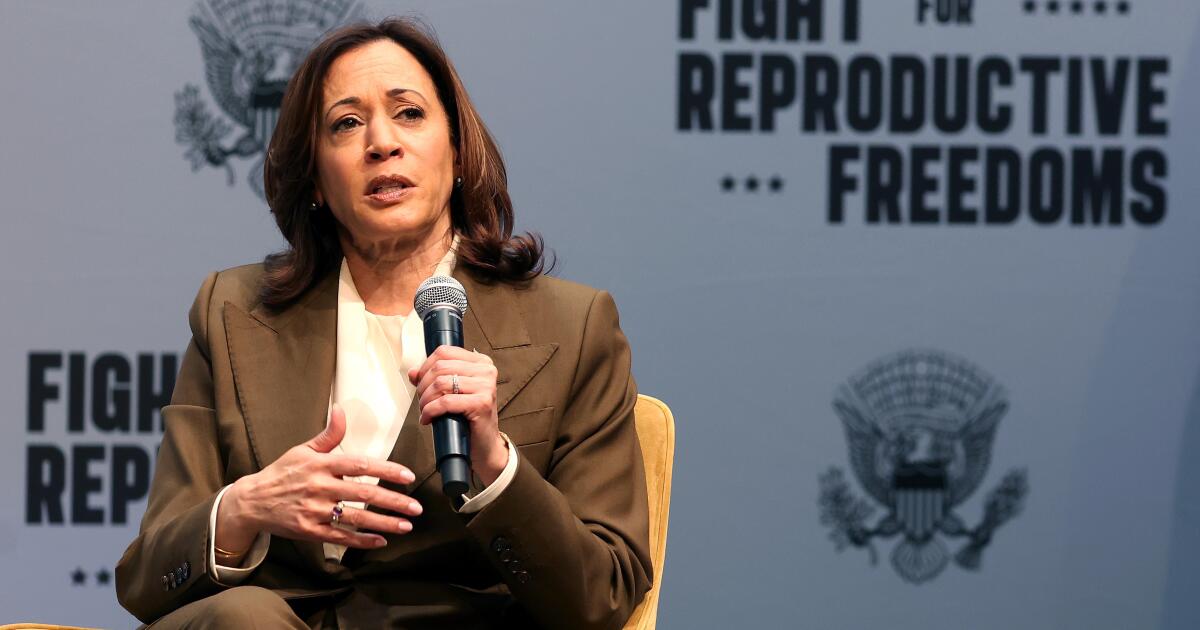
“Proud,” Kamala Harris said, elongating the word and stretching its vowels. “PROUD!”
Donald Trump expressed his great delight at choosing three of the Supreme Court justices who overturned the constitutional right to abortion and now the vice president was using his own word — proud — to whip up a labor hall packed with jeering, cheering Nevada Democrats.
“Proud,” she said. “Proud for taking the freedom of choice from millions of women and people in America.”
With that, her voice rose as though she could scarcely believe the statement issuing from her lips.
“He openly talks about his admiration for dictators,” Harris continued in the same tone of wonderment, as some in the audience murmured their disapproval. “Dictators jail journalists. Dictators suspend elections.”
“Dictators.” She emphasized each word. “Take. Your. Rights.”
After a history-making ascent to the vice presidency and a humbling descent into mockery and disdain following her rocky start, Harris finally seems to have found her footing in a role to which she is accustomed and adept: prosecuting attorney.
She’s become a top fundraiser for Democrats, an emissary to groups that are lukewarm toward President Biden — in particular Black and younger voters — and emerged as the administration’s most forceful voice on abortion, women’s health and, as Harris frames it, the threat Trump poses to freedom and individual choice.
On a recent three-day swing through California and Nevada, she highlighted the abortion issue and urged Democrats to vote early ahead of Tuesday’s Nevada primary.
“Do you believe in freedom?” the vice president hollered, and a crowd of 300 or so partisans inside the brightly lighted union hall screamed in affirmation. “Do you believe in democracy?”
“Are we ready to fight for it? Because when we fight” — and here they joined Harris in a thundering chorus — “we win!”
Columnist Mark Z. Barabak joins candidates for various offices as they hit the campaign trail in this momentous election year.
Her higher profile — as cheerleader, prosecutor, pugilist — is a reset of sorts after Harris’ many early missteps and a series of assignments, among them immigration reform and border control, that seemed destined to fail.
Her purpose, and utility, changed when the Supreme Court issued its abortion decision in the Dobbs case in June 2022, overturning Roe vs. Wade.
Even as her approval ratings continue to languish, those in the vice president’s orbit say she has grown more assured in a capacity that better suits her skills as a former district attorney and California attorney general.
The abortion issue “taps into her policy background, her political values, her legal training and experience,” said Jamal Simmons, who served a year as Harris’ communications director, ending in January 2023. “The issue is a comfort zone for her and since Dobbs she has done other things with greater confidence and dexterity.”
::
The travels of the vice president are intended to be as frictionless as possible.
A blocks-long motorcade glides along freeways closed to traffic and knifes through city streets cleared specially for her path. Invited guests cheer Harris’ airport arrival and departure, and reporters are kept at bay by an aggressive squadron of Secret Service agents.
Still, outside events have a way of piercing the bubble.
So the vice president appeared ready when protesters popped up in San José, where Harris appeared as part of her national “Fight for Reproductive Freedoms” tour. Several hundred backers filled a large auditorium at the adobe-style Mexican Heritage Plaza, as Harris fielded questions gently lofted by the actress Sophia Bush.
Demonstrators unfurled banners reading “Free Palestine” and “Ceasefire Now.” They repeatedly interrupted Harris, loudly condemning the Biden administration’s support for Israel in its war with Hamas.
“You are complicit in genocide,” a young woman hollered from the fourth row before being escorted from the auditorium as the crowd chanted, “MVP!” “MVP!” — short for Madam Vice President.
Harris looked on, expressionless. Protest is a fundamental part of democracy, she said evenly. Everyone wants to see the conflict in the Middle East come to an end.
A second outburst followed. Moments later a third. “So,” Harris began, then paused at length. “There are a lot of big issues impacting our world right now. Which evoke rightly very, very strong emotions and fears and anger and tears.
“The topic for today,” she went on, assuming the tone of an admonishing schoolteacher, “is the topic of what has happened in our country after the Dobbs decision … and so I’m going to get back to the issue. Because it’s an important one and we should not be distracted.”
By the fourth interruption, Harris merely paused and waited as a demonstrator in the balcony was led away. Supporters chanted, “Four more years!” She then picked up precisely where she’d left off mid-sentence, making her case against Trump and the conservative Supreme Court majority, as though nothing had happened at all.
Equanimity could well be part of the job description.
As the first female, Black and Asian American vice president, Harris has drawn extraordinary scrutiny and with it an outsized presumption of what she can plausibly achieve.
The vice presidency is, and always has been, inherently limiting — there is no greater trespass than overstepping or overshadowing the president — and that can’t help but diminish those holding the job, whatever their place in history.
Even fans of Harris have a hard time comprehending her status and appreciating that gap between expectation and reality.
Mia Casey, the mayor of Hollister, rose before dawn and drove an hour and 15 minutes to see Harris in San José.
“I liked her when she was running with Biden, but I haven’t seen a lot of her,” Casey said from her perch, 10 rows back and left of center stage. “I expected to see her more visible out there, doing some more meaty things in D.C.”
::
If Harris’ main mission is working to reelect Biden (and herself) in November, another aspect is convincing Casey and others that she’s far more than a bit player in the Biden administration — or Biden-Harris administration, as the vice president prefers.
At her Las Vegas rally, Harris delivered a joined-at-the-hip accounting of the last three years.
“President Biden and I canceled more than $138 billion” in student loans, she said. “President Biden and I took on Big Pharma” to cap the price of insulin. “President Biden and I” boosted loans to hundreds of small businesses.
Still, it’s often her lot to be eclipsed, or treated as a mere afterthought.
Introducing Harris, Nevada Sen. Catherine Cortez Masto recalled the depths of the pandemic lockdown, when the Las Vegas Strip went dark and unemployment in the metropolitan area soared past 30%.
“It was one president who came and worked with us to ensure that we could turn our economy around and come out of that horrific time,” Cortez Masto said. She paused for dramatic effect. “And that was President Biden.”
“And,” she hastened, “Vice President Harris.”
It was a non sequitur, but at least the senator recognized the guest of honor.
::
Harris loves to cook, so a pre-rally stop at the Chef Jeff Project in North Las Vegas offered a happy convergence of pleasure and politics.
The program was started by Jeff Henderson, an ex-convict turned celebrity chef, who mentors at-risk youth for careers in the culinary arts. His industrial-size kitchen in a scruffy strip mall serves as a kind of shrine to second chances, so the cramped quarters offered a perfect backdrop for Harris’ event. Its theme: the power of redemption.
Standing before a small portable lectern and speaking before a brace of cameras, the vice president announced a change in federal policy that would make it easier for once-incarcerated people to obtain Small Business Administration loans.
Yes, she said over the whir of an ice machine, there must be accountability, especially for criminal wrongdoing. “But is it not the sign of a civil society to allow people the ability to come back and earn their way back?”
Harris swept through the work area, past tall shelves piled high with plates and pans, stopping where Kam Winslow was stirring a giant bowl of jambalaya. “Let’s talk about your process,” she said. “Tell me how you did it.”
As Winslow explained — dicing chicken, browning andouille sausage, saving the shrimp for last, so it doesn’t overcook — Harris punctuated his narration with a series of small interjections. “Yes.” “Uh-huh.” “Delicious.”
“You know what I love about cooking, is the process,” Harris told him. “It’s about having patience and knowing that it’s going to take steps, right? Like it’s just not going to be easy to do.”
“Same with life,” Winslow said.
“Yes, that’s exactly right,” agreed the vice president, who’s learned a few things in recent years about trial and error, mistakes and do-overs. “That’s exactly right.”

Politics
McCarthy says Trump will use ‘everything he can’ to force Senate action on SAVE America Act

NEWYou can now listen to Fox News articles!
As infighting over the SAVE America Act throws congressional Republicans into disarray, President Donald Trump’s bid to get the stalled election bill across the finish line gained one notable ally.
Former House Speaker Kevin McCarthy, R-Calif., told Fox News Digital that he supports the election integrity measure and indicated that Trump should continue to use every available tool to pressure the Senate to pass it.
“He’s going to try everything he can to make sure he passes that through,” McCarthy said in a brief interview outside the U.S. Capitol.
The ex-speaker’s comments came after Trump abruptly called off a signing ceremony Wednesday for a bipartisan housing bill to pressure the Republican-controlled Senate to act on the SAVE America Act.
President Donald Trump boards Air Force One as he departs Reading Regional Airport in Reading, Pa., on June 23, 2026. (Evelyn Hockstein/Reuters)
IRATE REPUBLICANS ACCUSE TRUMP OF HANDING DEMOCRATS A WIN AFTER BLOWING UP HOUSING PACKAGE
The move surprised Republican lawmakers, some of whom were praising the bill’s passage at a press conference when Trump’s Truth Social post broke.
But Trump has repeatedly cast the election measure — requiring proof of citizenship to vote in federal elections and voter identification requirements — as his top legislative priority.
The legislation’s momentum, however, has slowed in the upper chamber, where Republican leadership insists the votes aren’t there amid widespread Democratic opposition. Senate Republicans have also been unwilling to eliminate the legislative filibuster, which requires a 60-vote threshold to pass the legislation.
Former Speaker of the House Kevin McCarthy speaks during a ceremony honoring President Ronald Reagan on the 115th anniversary of his birthday at the Ronald Reagan Presidential Library in Simi Valley, Calif., on Feb. 6, 2026. (Hans Gutknecht/MediaNews Group)
TRUMP CALLS MAIL IN VOTING CORRUPT AS SENATE BEGINS DEBATE ON SAVE ACT REQUIRING VOTER ID
Amid the SAVE standoff, a group of conservative lawmakers effectively shut down the House floor in an effort to force Senate action on the election bill.
But the Senate recessed Wednesday for two weeks over the July 4 holiday, leaving the measure in limbo until lawmakers return.
The conservative-led blockade sparked fierce backlash, with several members inside the GOP conference telling Fox News Digital the move risked torpedoing their own legislative agenda.
Meanwhile, the House has also yet to pass a version of the legislation incorporating several of the president’s priorities, including a mail-in voting crackdown and provisions banning men from competing in women’s sports and child sex change procedures.
Trump has not indicated whether he will sign the 21st Century ROAD to Housing Act, despite the likely existence of a veto-proof majority.
House Speaker Mike Johnson, R-La., told reporters Thursday that the housing bill had been transmitted to the White House for Trump’s signature following a meeting with the president.
Speaker of the House Mike Johnson, R-La., talks with reporters in the U.S. Capitol on June 10, 2026. (Tom Williams/CQ-Roll Call, Inc via Getty Images)
CLICK HERE TO DOWNLOAD THE FOX NEWS APP
Trump now has 10 days to sign the package or veto it. If he does nothing, the legislation automatically becomes law at the end of the 10-day period.

WASHINGTON — California’s two Democratic senators on Thursday criticized the Trump administration after it requested $87.6 billion from Congress to address some of the nation’s most “urgent needs” but omitted funding for victims of last year’s Los Angeles wildfires.
“Donald Trump’s desire to punish Los Angeles and the state of California for not voting for him, means once again that thousands of Angelinos are left watching this administration fight for anything but them, their businesses, and their communities,” Sens. Alex Padilla and Adam Schiff said in a joint statement.
“These fires did not discriminate based on party or political preference. Neither should this administration,” they added.
The omission is the latest strain in a yearlong standoff between California leaders and the Trump administration over federal disaster aid, and it comes after Los Angeles Mayor Karen Bass and Los Angeles County Supervisor Kathryn Barger met with President Trump at the Oval Office in April to request the funding.
At the meeting, Trump signaled his commitment to working with local officials to help with disaster recovery efforts. The officials asked for $16 billion that would be split between the city and county. The money would consist primarily of disbursements from the Federal Emergency Management Agency flagged for communities hit by the fires, part of a $33.9-billion wildfire relief funding request made by Gov. Gavin Newsom.
Two months later, those talks have yet to yield results sought by local leaders.
The budget request, submitted by the Office of Management and Budget on Wednesday, mostly seeks funding for the Pentagon to address costs related to the Iran war. It also includes $11.1 billion in economic assistance for American farmers, $1.4 billion to address the Ebola virus outbreak in Central Africa, $500 million to support “ongoing efforts to complete restorations and construction projects” across the nation’s capital and $1 billion to boost the pensions of workers at General Motors that were cut as a result of the automaker’s bankruptcy.
“I urge the Congress to take action on these important and urgent requests as soon as possible,” White House budget director Russell Vought wrote in a letter addressed to House Speaker Mike Johnson (R-La.).
Vought said the administration was open to discussing “additional relief for other urgent matters.” The White House did not immediately respond when asked why the budget request did not mention the Eaton and Palisades disaster relief funds.
State leaders, including Newsom, have repeatedly accused the Trump administration of stonewalling billions in wildfire aid. The governor visited Washington in December to meet with lawmakers, including three who serve on the Senate and House appropriations committees, to push for the funding.
The governor also attempted to meet with FEMA about the matter, but said his request was denied. Newsom, a political foe of Trump’s, would not say whether he had attempted to meet with Trump to talk about the recovery efforts.
Politics
Trump administration pledges $150M in aid, deploys Navy warships after deadly Venezuela earthquakes

Secretary Rubio details US aid to Venezuela after earthquakes
Secretary Rubio, in Manama, Bahrain, outlines the comprehensive U.S. government response to the devastating back-to-back earthquakes in Venezuela. He confirms immediate deployment of search and rescue teams, medical resources and humanitarian assistance, emphasizing the urgency to save lives. Rubio reiterates President Donald Trump’s commitment to supporting Venezuela and collaborating with international partners on recovery efforts and long-term stability.
NEWYou can now listen to Fox News articles!
Following a catastrophic set of earthquakes that left at least 235 people dead in Venezuela, the Trump administration has activated a government-wide humanitarian response, pledging $150 million in aid and deploying U.S. Navy warships to assist in life-saving rescue operations.
The rapid mobilization Thursday comes after back-to-back magnitude 7.2 and 7.5 earthquakes rocked northern Venezuela roughly 120 miles west of Caracas Wednesday night.
The rare earthquake “doublet” injured more than 940 people and turned the state of La Guaira into a disaster zone, while forcing the closure of the damaged Simón Bolívar International Airport, according to Venezuela’s Health Ministry.
US RESCUE TEAMS TO DESCEND ON HARD-HIT CARIBBEAN AFTER CATASTROPHIC HURRICANE MELISSA’S IMPACT
Rescuers search for victims in a collapsed building following an earthquake in Caracas on June 24, 2026. (Manaure Quintero / AFP via Getty Images)
The U.S. Department of State announced on Thursday it is mobilizing $150 million in aid, which includes $50 million in new bilateral awards for relief partners on the ground — such as Samaritan’s Purse, Catholic Relief Services and World Vision — along with a $100 million contribution to a United Nations humanitarian pooled fund.
To spearhead efforts on the ground, the State Department has deployed a regional Disaster Assistance Response Team alongside two highly specialized urban search-and-rescue teams from fire departments in Fairfax County, Virginia, and Los Angeles County, California.
U.S. WARSHIPS TO PATROL INTERNATIONAL WATERS AROUND VENEZUELA AS TRUMP VOWS TO STOP CARTELS
Members of the County of Los Angeles Fire Department’s international urban search and rescue team (USA-2) prepare to leave for Venezuela, in Pacoima, Calif., Thursday. (Blake Fagan/AFP via Getty Images)
U.S. Southern Command (SOUTHCOM) said it is surging assigned U.S. military forces to the region, directing the USS Fort Lauderdale and the USS Billings to Venezuela to back the State Department-led operations.
The USS Fort Lauderdale will serve as a “floating command center” with a flight deck to support heavy-lift helicopters and a well deck to launch landing craft, according to SOUTHCOM.
Meanwhile, the agile USS Billings will provide critical support close to the shorelines to accelerate the disaster response missions.
U.S. SOUTHCOM said it has directed USS Fort Lauderdale (LPD 28) and USS Billings (LCS 15) to Venezuela to support State Department-led U.S. government relief operations in Venezuela. (@Southcom/X)
SOUTHCOM said it is also sending rotary-wing aircraft, which will provide critical life-saving airlift support, transporting U.S. government response personnel, search and rescue teams and partners during relief operations.
Amid the crisis, the State Department emphasized that the safety of U.S. citizens remains the administration’s highest priority.
“The Trump Administration has no higher priority than the safety and security of Americans. The Department of State is working tirelessly to provide consular assistance to U.S. citizens and their families in the affected areas,” officials wrote in a statement. “The United States remains steadfast in its commitment to helping Venezuela recover from this devastating disaster and will continue to explore additional ways to provide meaningful assistance during this critical time.”
CLICK HERE TO DOWNLOAD THE FOX NEWS APP
U.S. citizens in Venezuela are urged to enroll in the Smart Traveler Enrollment Program (STEP) and can contact the State Department 24/7 at 202-501-4444 for emergency assistance.
Family members in the U.S. seeking information on loved ones can call toll-free at 888-407-4747.
-

 Rhode Island3 minutes ago
32 photos capturing Rhode Island Pride’s nighttime magic
-

 South-Carolina6 minutes ago
South Carolina adds to America250 time capsule set to be buried July 4
-

 South Dakota11 minutes ago
17 Republican attorneys general, including South Dakota’s, sue California over plastics law
-

 Tennessee18 minutes ago
‘Oppressive’ heat is on the way. How long will heat dome last in Tennessee
-

 Texas21 minutes ago
Giraffe that escaped Texas ranch spotted by helicopter, manager says
-

 Utah26 minutes ago
Utah weather conditions trigger historic red flag warning as wildfires rage in state
-

 Vermont33 minutes ago
Arlington Common, Albert Construction recognized by Preservation Trust of Vermont
-

 Virginia35 minutes ago
Virginia Cannabis: Will Retail Finally Start In 2027?

