Politics
Column: Will Trump's conviction survive the Supreme Court's immunity ruling? It's complicated

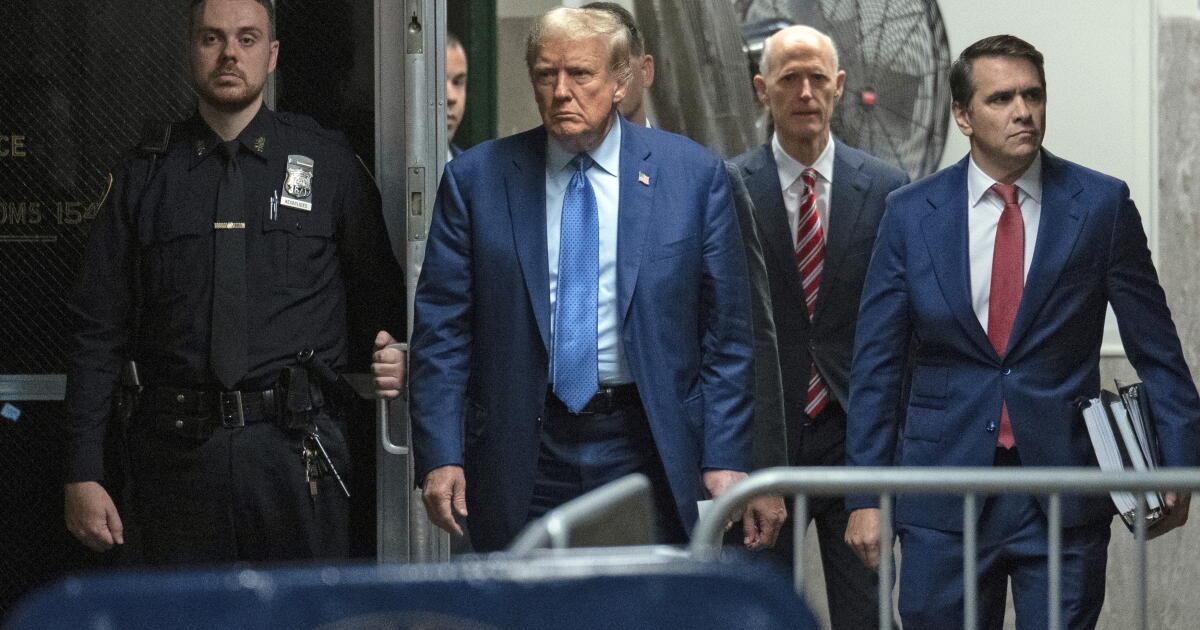
It was only hours after the Supreme Court issued its staggering term-ending opinion on presidential immunity when Donald Trump invoked it in an attempt to set aside his criminal conviction in New York.
On the surface, the effort would seem ill-fated and even brazen.
The opinion made a top-line distinction between “official actions” — which are either immune or presumed immune from criminal prosecution — and “unofficial actions,” which are not. And it’s hard to imagine more prototypically unofficial actions than those of which Trump was convicted in the New York case. While still running for president, Trump devised a scheme to suppress stories of his alleged trysts — in particular with the adult film actor Stormy Daniels — and falsified business records to further the cover-up.
Most of the critical conduct took place before Trump was in office, the exception being the payments to his fixer, Michael Cohen, that generated the false paperwork. And the reimbursement of Cohen from a personal bank account was patently unofficial conduct even though it coincided with Trump’s presidency.
So Judge Juan M. Merchan, who presided over the trial, might be expected to make quick work of Trump’s effort to shoehorn the conviction into the sphere of “official action” for which the court prescribed immunity.
In fact, however, the court’s opinion is strewn with mines and sinkholes that Trump might be able to use to gain a new trial or at least render his conviction provisional for an extended period. These facets of the opinion are part and parcel of its enormous scope and overreach, all to protect a party of exactly one: the only president ever to be charged with a crime.
The court’s revolutionary holding places the president largely outside the reach of criminal law, but the conservative majority wasn’t content to stop there. Its expansive guidance “for the ages,” as Justice Neil M. Gorsuch put it at oral argument, dictates that a jury may not even consider a president’s official acts as evidence to prove a crime involving unofficial conduct.
The court’s reasoning here is particularly threadbare, simply asserting that allowing evidence of official actions would undo the protections of immunity, which the conservative majority considers necessary to ensure a nimble and vigorous presidency. Yet it makes little sense to suggest that a president would be constrained by the prospect that a jury might one day hear about their official actions. Most official actions are public anyway, and those that aren’t can be protected by executive privilege and other means when there is a particular need to to so.
This is where Justice Amy Coney Barrett parted with her fellow conservatives, noting that “the Constitution does not require blinding juries to the circumstances surrounding conduct for which Presidents can be held liable.”
In the context of Trump’s motion to set aside his New York conviction, a fair-minded court should have little trouble concluding that the conduct at issue was unofficial and therefore not subject even to the generous immunity protections prescribed by the justices. However, some of the evidence presented at trial at least arguably concerned official conduct, particularly under the Supreme Court’s wide-ranging, categorical definition of the term.
Most notably, the jury heard testimony from Hope Hicks about a conversation she had with Trump in 2018, when she was the White House communications director, about a report on Cohen’s hush money payments to Daniels and its public opinion repercussions. Prosecutors described Hicks’ testimony, which ended with her breaking down in tears, as “devastating.”
So was Trump’s conversation with Hicks in the White House “official conduct” that, under the immunity opinion, never should have been presented to the jury? And if so, do the convictions have to be set aside?
Those questions are far from straightforward. The answers depend not only on how the Hicks conversation is characterized but also on a thicket of procedural issues. Those include whether Trump may have waived the issue, whether any waiver applies under the Supreme Court’s holding and whether any error in allowing the testimony could be deemed harmless given the strength of the rest of the evidence.
Trump’s conviction may well survive the Supreme Court ruling in the end, but getting to that point won’t be quick or simple. Moreover, Merchan’s ruling is likely to be appealed to higher courts in New York and eventually the U.S. Supreme Court. That prospect could well temper the analysis of lower courts that now understand the breadth and zeal of the justices’ determination to shield Trump from accountability.
It appears as if the Supreme Court has dealt Trump not just a get-out-of-jail-free card but a whole deck of them, allowing him to contest and delay multiple facets of the nearly 100 criminal counts against him. If it turns out that he can use it to his advantage in New York, where he stands already convicted of manifestly personal conduct, it’s hard to imagine a case where he can’t.
Harry Litman is the host of the “Talking Feds” podcast and the “Talking San Diego” speaker series. @harrylitman

Politics
Israel shares intelligence warning Iran plotted new assassination attempt against Trump: report

NEWYou can now listen to Fox News articles!
Israel recently shared intelligence with the United States indicating Iran had developed a fresh plan to assassinate President Donald Trump, according to a Wall Street Journal report Thursday citing people familiar with the matter.
The reported intelligence would mark an escalation in the longstanding threats against Trump, who Iran has repeatedly vowed to retaliate against over the 2020 U.S. strike that killed Islamic Revolutionary Guard Corps Gen. Qassem Soleimani.
The White House referred Fox News Digital to Trump’s remarks Wednesday when asked about the report.
TRUMP FACES UNPRECEDENTED THIRD ASSASSINATION ATTEMPT
President Donald Trump speaks during a news conference at the NATO Summit in Ankara, Turkey, July 8, 2026. Trump addressed threats against his life after a report said Israel shared intelligence with the United States about an alleged new Iranian assassination plot. (Kerem Uzel/Bloomberg via Getty Images)
“They want to take out the U.S. leader — me. I’m on whatever list. I saw this morning I’m on every single one of their lists,” Trump said. “And, so far, I guess I’ve been a bit lucky, but maybe that doesn’t last very long. These are evil, sick people. And we have to root out that cancer. That cancer. You know what you do? You’ve got to cut out cancer early. And that’s the way I feel.”
Fox News Digital has also reached out to Israel’s Embassy in Washington and Iran’s Mission to the United Nations for comment.
The Journal reported the intelligence surfaced as Trump and Israeli Prime Minister Benjamin Netanyahu have diverged in recent weeks over how to proceed after last month’s conflict with Iran. Netanyahu has advocated for continuing military pressure on Tehran, while Trump has sought to preserve a fragile ceasefire after U.S. strikes on Iranian nuclear sites.
NETANYAHU REJECTS REPORTS OF A RIFT WITH PRESIDENT TRUMP, SAYS THE TWO REMAIN ALIGNED ON IRAN
President Donald Trump, left, and Israeli Prime Minister Benjamin Netanyahu at the White House March 25, 2019. The leaders spoke Thursday after The Wall Street Journal reported Israel had shared intelligence with the United States about an alleged new Iranian plot targeting Trump. (AP Photo/Susan Walsh, File)
Trump and Netanyahu spoke Thursday and agreed to continue coordination between the two countries, according to a statement from Netanyahu’s office, which said Trump also updated the Israeli leader on recent U.S. activity in the Gulf.
Prime Minister Benjamin Netanyahu during his conversation with U.S. President Donald Trump. (Avi Ohayon/GPO)
CLICK HERE TO DOWNLOAD THE FOX NEWS APP
Iranian mourners at the funeral for Supreme Leader Ali Khamenei chanted for Trump’s death and displayed a banner that said, “We Will Kill Trump,” according to the Journal.
Iran has publicly vowed for years to retaliate against Trump over the U.S. operation that killed Soleimani, the former commander of the Islamic Revolutionary Guard Corps’ Quds Force, in Baghdad in January 2020.

WASHINGTON — A tentative armistice between the United States and Iran reached less than a month ago appeared all but dead Wednesday after the two sides traded fresh military strikes, and as President Trump directed further attacks on the Islamic Republic.
The escalation marked a dramatic turn after the Trump administration spent weeks selling a diplomatic breakthrough with Tehran that proved controversial across the political aisle, lifting oil sanctions and a naval blockade on Iran in exchange for the promise of talks over the status of the Strait of Hormuz and its decades-old nuclear program.
Now, speaking to reporters at the NATO summit in Turkey, Trump said he believed the truce — which diplomats describe as a memorandum of understanding — was “over” and that it was a “waste of time” dealing with Iranian leadership.
“They’re scum. They’re sick people,” Trump said of Iranian leaders, whom he had characterized last month as “very rational people” and “very nice to deal with.”
The president’s dim views of the ceasefire agreement’s fate were shared by Iran’s foreign ministry, which issued a statement on Wednesday saying the American attacks, the reinstatement of a U.S. naval blockade on the Strait of Hormuz, and Israel’s continuing attacks in Lebanon rendered “important and fundamental” parts of the deal “ineffective.”
The truce’s unraveling was underscored by Trump ordering the U.S. military to launch a series of strikes against Iran on Wednesday afternoon to “further degrade their ability to threaten” the commercial shipping through the Strait of Hormuz.
“The United States is holding Iran accountable for recent unjustified aggression against commercial shipping and civilian crews freely navigating a vital international waterway,” U.S. Central Command said in a statement on social media.
Earlier in the day, Trump signaled that the United States planned to “hit them hard” and floated the possibility of taking over Kharg Island, which is vital to Iran’s economy. His remarks quickly prompted oil prices to rise and global stock markets to fall, a worry that Trump acknowledged but which did not seem to sway his decision-making in relation to Iran.
“If we hit Iran, oil goes up a little bit, it is all right,” Trump said. He later added that the United States may “do some other thing that could lift it a little bit, but I don’t think it’s gonna lift it a lot at all.”
As Trump signals the continuation of fighting, his administration has been seeking more than $67 billion in funding to cover expenses related to the Iran war, a request that Congress has not yet approved as lawmakers have been split over the president’s handling of the conflict.
“The American people are paying the price for Trump’s total failure in Iran,” Senate Minority Leader Chuck Schumer (D-N.Y.) said in a statement Wednesday. “Our troops are back in harm’s way and high gas costs are continuing to punish working families.”
The president’s stance on the war marked the latest setback to a fragile truce that has barely held since the 14-page agreement was signed June 17, as the U.S. and Iran engaged over the last few weeks in cycles of attacks and counterattacks.
Trump was noticeably angrier at Iran on Wednesday as he cast doubt over the deal. Last month, Trump had complimented Iranian leadership for trying to reach a peace deal and celebrated the reopening of the Strait of Hormuz, a crucial shipping route for the world’s oil and gas. But based on his remarks, it was clear he was out of patience.
“I am not happy with them,” Trump said. “They’re cuckoo. There’s something wrong with these people. For 47 years, they’ve been the bully of the Middle East and they are not the bully anymore. They are not the bully anymore.”
Trump expressed frustration with Iran’s negotiators and their resistance to abiding by U.S. demands to reopen the strait. When asked if he intended to send troops to Iran, the president dismissed the idea.
“Why would I go in now?” Trump said. “I’d go in when they’re completely eliminated or an agreement is made.”
Still, the president kept the door open for negotiations, saying that his envoys Steve Witkoff and Jared Kushner “want to negotiate.”
“They’re good people, Steve Witkoff, Jared Kushner, but they have to come back to me,” Trump said. “As far as I’m concerned, it’s just a waste of time dealing with [the Iranians]. They’re liars.”
The latest breakdown to the ceasefire followed a now-familiar chain reaction of tit-for-tat attacks, starting with a series of strikes on three oil tankers transiting the Strait of Hormuz on Tuesday, including a Qatari vessel carrying natural gas, according to the United Kingdom Maritime Trade Operations center.
The Qatari tanker was off the coast of Oman when it was hit and caught fire, the maritime monitor said, in what experts say was a move to thwart ships attempting to use an alternate transit route to the one Iran specified. Iran did not claim responsibility, but a report on Iranian state television said the Qatari tanker came under attack after ignoring warnings to turn back.
The two other vessels were damaged but were able to continue to their destination, according to the U.K. group.
Qatar, which has played a vital role in facilitating negotiations between the U.S. and Iran, condemned the attack on its tanker as “unacceptable.”
The U.S. responded with a wave of strikes against more than 80 Iranian targets aimed at “impos[ing] heavy costs for targeting and attacking commercial shipping crewed by innocent civilians in an international waterway,” according to a statement from U.S. Central Command. That tally included roughly 60 Islamic Revolutionary Guard Corps small boats in the strait.
Iranian state media said U.S. strikes targeted Sirik, Qeshm Island and Bushehr and Bandar Abbas, while a U.S. drone strike on the port city of Mahshahr killed one Revolutionary Guard member.
Ahead of the strikes, the White House revoked the 60-day temporary license given to Tehran to sell and deliver oil during the truce.
Iran’s military countered with its own strikes on 85 U.S. military facilities in Bahrain and Kuwait; it also shot down an MQ-9 drone, according to a statement on Wednesday.
Kuwait said its military intercepted two ballistic missiles and 13 drones, but that none had resulted in material damage or casualties.
Global oil prices surged 6% on news of Trump’s reversal on the deal, rising to more than $78 a barrel, down from the peak during the war but still above prewar levels.
The renewed violence appeared to have little effect on the funeral for Iran’s Supreme Leader Ayatollah Ali Khamenei, who was killed in an Israeli strike on Feb. 28, in the war’s opening hours.
The funeral, a days-long period of mourning, is set to end on Thursday, when Khamenei’s body will return from Iraq to be buried in the city of Mashhad, his birthplace. Negotiations were to begin once more.
In his remarks Wednesday, Trump said Iranian leaders had asked for a “timeout” to attend the funeral, and that he had promised not to kill them.
“And I said give it to them, and they start shooting missiles,” Trump said.
Whether those talks — which were meant to deal with the thorniest issues between the two countries, including the Strait of Hormuz and Iran’s nuclear program — will go ahead remains unclear. Iran, for its part, maintained a defiant attitude.
“The era of bullying and extortion is over,” wrote Mohammad Ghalibaf, Iran’s parliamentary speaker. “It leads nowhere. We don’t fold.”
Ali Akbar Velayati, a senior advisor to the supreme leader, posted on X that Trump’s policy had “driven the region towards fire.”
“We had previously warned that the region is not a place for the political gambling of small countries, and we have repeatedly proven that adventures are met with an immediate response,” he wrote.
He added that the Axis of Resistance — a reference to Iran’s network of allied groups in Lebanon, Iraq and Yemen — would not be “silent against humiliation and adventurism” and has “its finger on the trigger.”
Bulos reported from Beirut and Ceballos from Washington.
Politics
Omar’s disclosures erased millions, leaving her with potential negative net worth. She won’t explain why.

NEWYou can now listen to Fox News articles!
Rep. Ilhan Omar, D-Minn., refused to address her revised financial disclosures that could imply she has a negative net worth after the progressive lawmaker dramatically reducing the reported value of assets tied to her husband’s business ventures.
“Can you tell us if your husband still has the consulting business and the wine business?” Fox News Digital asked Omar.
The congresswoman stayed silent as she was repeatedly questioned, after previously telling Fox News Digital that the original filing — showing Omar’s reported assets reducing by as much as $29.9 million — was inaccurate and “incomplete” information.
ILHAN OMAR’S OFFICE SAYS SHE’S ‘NOT A MILLIONAIRE’ AFTER $30M FILING REVISED DOWN TO UNDER $100K: REPORT
US Representative Ilhan Omar, Democrat of Minnesota, speaks during a press conference with family members of Palestinian-American journalist Shireen Abu Akleh as members of Congress call for US investigations into Israel’s actions and reintroduce the Justice for Shireen Act, outside the US Capitol in Washington, DC, May 18, 2023. The Al Jazeera journalist, who was a dual US citizen, was killed on May 11, 2022. The Israeli army later admitted one of its soldiers likely shot the reporter. (Photo by SAUL LOEB / AFP) (Photo by SAUL LOEB/AFP via Getty Images)
The controversy surrounding Omar’s finances began when a 2024 financial report estimated that Omar and her husband possessed between $6 million and $30 million in assets, all while the Minnesota fraud scandal within the Somali community was beginning to come to fruition.
A more recent 2025 financial disclosure report shows Omar’s revised value of shared assets between her and husband to sit at a maximum of $125,000 — a multi-million-dollar drop from the year prior. The lower estimate of their assets, $20,000, compared to the low and high debt estimates, $30,000 and $100,000, would imply the Minnesota Democrat could have a negative net worth.
Both her and her husband have separate debts, each ranging somewhere between $15,000 and $50,000 — from her own student loans and her husband’s credit card debt, according to the disclosures.
WATCH: OMAR SILENT WHEN CONFRONTED ON ALLEGED TIES TO MASSIVE MINNESOTA FRAUD SCANDAL
RICHFIELD, MN – AUGUST 08: Rep. Ilhan Omar (D-MN) (C) campaigns with her husband Tim Mynett (R) at the Richfield Farmers Market on August 8, 2020 in Richfield, Minnesota. Omar is hoping to retain her seat as the representative for Minnesota’s 5th Congressional District in next week’s primary election. (Photo by Stephen Maturen/Getty Images)
The biggest change in the documents involved Omar’s husband, Tim Mynett. His reported ownership interests in both his winery and venture capital advisory firm, which were previously valued in the millions of dollars, are listed with no value now.
In Omar’s 2024 financial disclosure records, Mynett’s share in his winery was valued between $1 million and $5 million, and his share at the venture capital advisory firm was valued between $5 million and $25 million. Now, his equity interests are both listed at $0.
Omar’s office previously told Fox News Digital that Mynett has partners in both businesses and said the earlier disclosure mistakenly reflected the businesses’ total equity rather than his ownership interest. The office also said the original filing listed assets without accounting for liabilities.
VANCE REFERS TIM WALZ, MINNESOTA ATTORNEY GENERAL TO DOJ FOR CRIMINAL INVESTIGATION OVER STATE’S ALLEGED FRAUD
House Oversight Committee Chairman James Comer, R-Ky., has publicly voiced his interest in the Ethics Committee opening an investigation into Omar’s personal finances after the 2025 financial reports came out showing the possibility of a $29 million drop in her net worth.
Vice President JD Vance also has previously said the U.S. Department of Justice will be opening a probe into her alleged fraud as part of the administration’s anti-fraud taskforce that he spearheads, though no formal investigations have been shared with the public at this time.
Omar has been reluctant to answer Fox News Digital’s questions about her financial fallout and potential probes to be opened against her.
The Minnesota lawmaker similarly dodged answering any of Fox News Digital’s questions just last month about the revised disclosures.
CLICK HERE TO DOWNLOAD THE FOX NEWS APP
“There’s also the possibility that it might rain on this sunny day,” Omar replied without responding directly to the content of the question.
Fox News Digital’s Robert Schmad contributed to this report.
-

 Los Angeles, Ca1 hour ago
O.C. police prep for beach, theme park ‘takeovers’ promoted on social media
-

 Detroit, MI1 hour ago
Detroit city leaders to DHS: Stop ICE pursuits which endanger the community
-

 San Francisco, CA2 hours ago
SF Supervisor Jackie Fielder hosts listening session after medical leave
-

 Dallas, TX2 hours ago
The Stewpot artists find healing, purpose and income through art in Dallas
-

 Miami, FL2 hours ago
Can Jason Marshall push for a starting spot – The Splash Zone 7/10/26
-

 Boston, MA2 hours ago
Police investigating shooting in Downtown Crossing – Boston News, Weather, Sports | WHDH 7News
-
 Denver, CO2 hours ago
Denver mayor announces new $100 million plan to bring in 10,000 jobs
-

 San Diego, CA2 hours ago
WEBTOON Brings Top Creators for San Diego Comic-Con Panels

