Politics
Column: Why the Supreme Court will probably put Trump back on the ballot in Colorado and nationwide

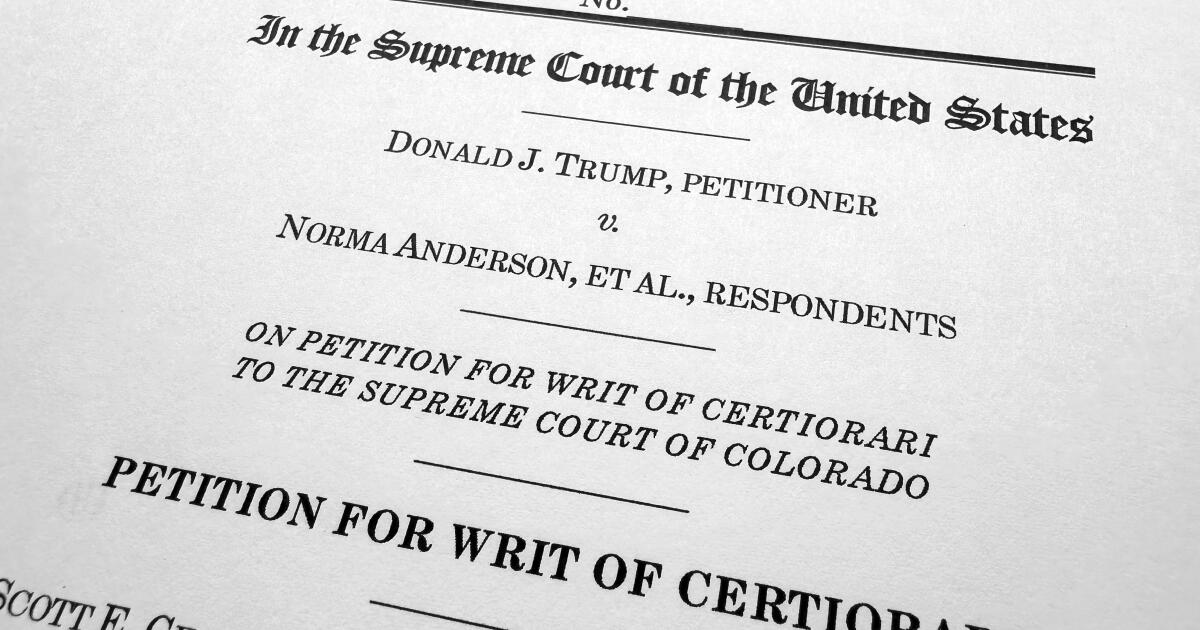
More than any U.S. Supreme Court case in decades, former President Trump’s appeal of the Colorado decision disqualifying him from the state’s primary ballot combines huge political moment with a scarcity of guiding law. For the court, which announced last week that it would hear the case on a warp-speed schedule, that is a precarious combination that exposes it to accusations of political bias.
So how will the court rule? I think it will be loath to permit a patchwork result in which Trump appears on the ballot in some states but not in others. To avoid such a patchwork, a majority of the justices is likely to reverse the Colorado Supreme Court’s ruling that Trump engaged in insurrection and is therefore ineligible for office under the 14th Amendment. And the court will probably do so in a way that also prevents other states from removing the former president from the ballot.
As the court arguably has in other landmark decisions, it may well act politically in the sense that it will be most concerned about the practical result. That’s different from saying that the decision will break down along party lines. A nakedly partisan outcome akin to the Bush vs. Gore opinion would be a disaster for the court’s already diminished reputation.
The majority could well consist of those most likely to share Chief Justice John G. Roberts Jr.’s concern for the court’s standing and hesitation to intrude on the election. Such a majority would be more likely to include justices open to institutionalist arguments, such as Elena Kagan and Brett M. Kavanaugh, than far-right rebels Samuel J. Alito Jr. and Clarence Thomas. That kind of coalition might favor a rationale that is less than pristine but serves broader social and political goals.
An early sign of such a consensus is the court’s unanimous order accepting the case and setting an expedited timetable, with oral argument scheduled in a month. The later the court acts, the more intrusive and controversial its role will be.
The court also preserved maximum flexibility in taking the case. Instead of considering the limited legal questions presented by the Colorado Republican Party or the challengers to Trump’s qualification for the ballot, the justices accepted Trump’s broader question. That means that any of the seven or so bases for reversal set out in Trump’s petition are fair game.
It’s difficult at this point to imagine the court upholding the Colorado opinion and thereby also allowing each state to make its own determination as to whether the Republican front-runner appears on the ballot. I don’t think such an arrangement would be unconstitutional, but it would be an ugly outcome that would be laid directly at the court’s feet.
The Constitution does accord a significant role to the states in electing the president, so much so that the winner of the national popular vote has lost two of the last six elections. I don’t think the framers would have been bothered by the prospect of different states having different candidates on their presidential ballots. But they didn’t anticipate a national two-party system either.
In 2024, the social, cultural and political fact is that the presidential election is a fully national contest that will play out according to quaint and obscure state rules. For one of the two major-party candidates to be missing from some state ballots and not others could encourage even more Americans to refuse to recognize the election’s legitimacy. I think the court would regard that as abhorrent.
Moreover, it would be virtually impossible for the court to devise a one-size-fits-all solution that bans Trump from the ballot in every state. The court is not a fact-finding body, and this case doesn’t begin to present the sort of record from which it could conclude that Trump “engaged in insurrection” under Section 3 of the 14th Amendment. The justices could find that Colorado’s determination was not in error under federal law, but that’s a far cry from ensuring the same result in every other state.
That’s why a majority of the justices is more likely to reverse the Colorado Supreme Court under a principle of federal law that also shuts down parallel efforts to remove Trump from the ballot in Maine, Massachusetts, Illinois and other states.
Trump’s petition provides the justices with several means of doing so, from finding fault with the Colorado court’s definition of “insurrection” to determining that the president is not an “officer” of the United States. All these means of reversing the Colorado decision have significant flaws. But given the political, legal and practical considerations before the court, I believe it will settle on one of them to avoid even messier consequences.
Harry Litman is the host of the “Talking Feds” podcast. @harrylitman


NEWYou can now listen to Fox News articles!
The Justice Department is turning to former Trump attorney Joeseph diGenova to spearhead a probe into ex-CIA Director John Brennan and others over the origins of the Trump-Russia investigation, as the department reshuffles leadership of the sprawling inquiry.
Acting Attorney General Todd Blanche has tapped diGenova to serve as counsel overseeing the matter, according to a New York Times report, putting a former Trump attorney in a key role in the high-profile probe. A federal grand jury seated in Miami has been impaneled since late last year.
The Department of Justice did not immediately respond to Fox News Digital’s request for comment.
DOJ ACTIVELY PREPARING TO ISSUE GRAND JURY SUBPOENAS RELATING TO JOHN BRENNAN INVESTIGATION: SOURCES
Joseph diGenova represented President Donald Trump during special counsel Robert Mueller’s investigation. (Tom Williams/CQ-Roll Call/Getty Images)
DiGenova, a former U.S. attorney in Washington, D.C., who represented Trump during special counsel Robert Mueller’s investigation, has repeatedly accused Brennan of misconduct tied to the origins of the Russia probe—allegations that have not resulted in criminal charges.
He also said in a 2018 appearance on Fox News that Brennan colluded with the FBI and DOJ to frame Trump.
The origins of the Russia investigation have been the subject of ongoing scrutiny by Trump allies, who have argued that intelligence and law enforcement officials improperly launched the probe.
BRENNAN INDICTMENT COULD COME WITHIN ‘WEEKS’ AS PROSECUTORS REQUEST OFFICIAL TRANSCRIPTS
Joseph diGenova has previously said that ex-CIA chief John Brennan colluded with the FBI and DOJ to frame Trump. (Tom Williams/CQ-Roll Call/Getty Images)
DiGenova’s appointment follows the ouster of Maria Medetis Long, a national security prosecutor in the South Florida U.S. attorney’s office. She had been overseeing the inquiry, including a false statements probe related to Brennan and broader conspiracy-related investigations.
As the investigation continues, federal investigators have issued subpoenas seeking information related to intelligence assessments of Russian interference in the 2016 election.
CLICK HERE TO DOWNLOAD THE FOX NEWS APP
John Brennan has denied any wrongdoing related to the Russia investigation. (William B. Plowman/NBC/NBC NewsWire via Getty Images; Alex Wong/Getty Images)
Brennan has previously denied wrongdoing related to the Russia investigation and has defended the intelligence community’s assessment that Moscow interfered in the 2016 election.
Politics
Supreme Court weighs phone searches to find criminals amid complaints of ‘digital dragnets’

WASHINGTON — A man carrying a gun and a cellphone entered a federal credit union in a small town in central Virginia in May 2019 and demanded cash.
He left with $195,000 in a bag and no clue to his identity. But his smartphone was keeping track of him.
What happened next could yield a landmark ruling from the Supreme Court on the 4th Amendment and its restrictions against “unreasonable searches.” The court will hear arguments on the issue on April 27.
Typically, police use tips or leads to find suspects, then seek a search warrant from a judge to enter a house or other private area to seize the evidence that can prove a crime.
Civil libertarians say the new “digital dragnets” work in reverse.
“It’s grab the data and search first. Suspicion later. That’s opposite of how our system has worked, and it’s really dangerous,” said Jake Laperruque, an attorney for the Center for Democracy & Technology.
But these new data scans can be effective in finding criminals.
Lacking leads in the Virginia bank robbery, a police detective turned to what one judge in the case called a “groundbreaking investigative tool … enabling the relentless collection of eerily precise location data.”
Cellphones can be tracked through towers, and Google stored this location history data for hundreds of millions of users. The detective sent Google a demand for information known as a “geofence warrant,” referring to a virtual fence around a particular geographic area at a specific time.
The officer sought phones that were within 150 yards of the bank during the hour of the robbery. He used that data to locate Okello Chatrie, then obtained a search warrant of his home where the cash and the holdup notes were found.
Chatrie entered a conditional guilty plea, but the Supreme Court will hear his appeal next week.
The justices agreed to decide whether geofence warrants violate the 4th Amendment.
The outcome may go beyond location tracking. At issue more broadly is the legal status of the vast amount of privately stored data that can be easily scanned.
This may include words or phrases found in Google searches or in emails. For example, investigators may want to know who searched for a particular address in the weeks before an arson or a murder took place there or who searched for information on making a particular type of bomb.
Judges are deeply divided on how this fits with the 4th Amendment.
Two years ago, the conservative U.S. Court of Appeals for the 5th Circuit in New Orleans ruled “geofence warrants are general warrants categorically prohibited by the 4th Amendment.”
Chief Justice John Roberts sided with the court’s liberals in a 4th Amendment privacy case in 2018.
(Alex Wong / Getty Images)
Historians of the 4th Amendment say the constitutional ban on “unreasonable searches and seizures” arose from the anger in the American colonies over British officers using general warrants to search homes and stores even when they had no reason to suspect any particular person of wrongdoing.
The National Assn. of Criminal Defense Lawyers relies on that contention in opposing geofence warrants.
Its lawyers argued the government obtained Chatrie’s “private location information … with an unconstitutional general warrant that compelled Google to conduct a fishing expedition through millions of Google accounts, without any basis for believing that any one of them would contain incriminating evidence.”
Meanwhile, the more liberal 4th Circuit in Virginia divided 7-7 to reject Chatrie’s appeal. Several judges explained the law was not clear, and the police officer had done nothing wrong.
“There was no search here,” Judge J. Harvie Wilkinson wrote in a concurring opinion that defended the use of this tracking data.
He pointed to Supreme Court rulings in the 1970s declaring that check records held by a bank or dialing records held by a phone company were not private and could be searched by investigators without a warrant.
Chatrie had agreed to having his location records held by Google. If financial records for several months are not private, the judge wrote, “surely this request for a two-hour snapshot of one’s public movements” is not private either.
Google changed its policy in 2023 and no longer stores location history data for all of its users. But cellphone carriers continue to receive warrants that seek tracking data.
Wilkinson, a prominent conservative from the Reagan era, also argued it would be a mistake for the courts to “frustrate law enforcement’s ability to keep pace with tech-savvy criminals” or cause “more cold cases to go unsolved. Think of a murder where the culprit leaves behind his encrypted phone and nothing else. No fingerprints, no witnesses, no murder weapon. But because the killer allowed Google to track his location, a geofence warrant can crack the case,” he wrote.
Judges in Los Angeles upheld the use of a geofence warrant to find and convict two men for a robbery and murder in a bank parking lot in Paramount.
The victim, Adbadalla Thabet, collected cash from gas stations in Downey, Bellflower, Compton and Lynwood early in the morning before driving to the bank.
After he was robbed and shot, a Los Angeles County sheriff’s detective found video surveillance that showed he had been followed by two cars whose license plates could not be seen.
The detective then sought a geofence warrant from a Superior Court judge that asked Google for location data for six designated spots on the morning of the murder.
That led to the identification of Daniel Meza and Walter Meneses, who pleaded guilty to the crimes. A California Court of Appeal rejected their 4th Amendment claim in 2023, even though the judges said they had legal doubts about the “novelty of the particular surveillance technique at issue.”
The Supreme Court has also been split on how to apply the 4th Amendment to new types of surveillance.
By a 5-4 vote, the court in 2018 ruled the FBI should have obtained a search warrant before it required a cellphone company to turn over 127 days of records for Timothy Carpenter, a suspect in a series of store robberies in Michigan.
The data confirmed Carpenter was nearby when four of the stores were robbed.
Chief Justice John G. Roberts, joined by four liberal justices, said this lengthy surveillance violated privacy rights protected by the 4th Amendment.
The “seismic shifts in technology” could permit total surveillance of the public, Roberts wrote, and “we decline to grant the state unrestricted access” to these databases.
But he described the Carpenter decision as “narrow” because it turned on the many weeks of surveillance data.
In dissent, four conservatives questioned how tracking someone’s driving violates their privacy. Surveillance cameras and license plate readers are commonly used by investigators and have rarely been challenged.
Solicitor Gen. D. John Sauer relies on that argument in his defense of Chatrie’s conviction. “An individual has no reasonable expectation of privacy in movements that anyone could see,” he wrote.
The justices will issue a decision by the end of June.
Politics
Trump renews bridge, power plant threat against Iran in push for deal, mocks ‘tough guy’ IRGC

NEWYou can now listen to Fox News articles!
President Donald Trump mocked the Islamic Revolutionary Guard on Sunday morning for staking claim to a Strait of Hormuz “blockade” the U.S. military had already put in place.
“Iran recently announced that they were closing the Strait, which is strange, because our BLOCKADE has already closed it,” Trump wrote on Truth Social. “They’re helping us without knowing, and they are the ones that lose with the closed passage, $500 Million Dollars a day! The United States loses nothing.
“In fact, many Ships are headed, right now, to the U.S., Texas, Louisiana, and Alaska, to load up, compliments of the IRGC, always wanting to be ‘the tough guy!’”
Trump declared Saturday’s IRGC fire was “a total violation” of the ceasefire.
“Iran decided to fire bullets yesterday in the Strait of Hormuz — A Total Violation of our Ceasefire Agreement!” his post began.
“Many of them were aimed at a French Ship, and a Freighter from the United Kingdom. That wasn’t nice, was it? My Representatives are going to Islamabad, Pakistan — They will be there tomorrow evening, for Negotiations.”
Trump remains hopeful about diplomacy, but is not ruling out a return to force, where he once warned about ending “civilation” in Iran as they know it.
“We’re offering a very fair and reasonable DEAL, and I hope they take it because, if they don’t, the United States is going to knock out every single Power Plant, and every single Bridge, in Iran,” Trump’s stern warning continued.
“NO MORE MR. NICE GUY!
“They’ll come down fast, they’ll come down easy and, if they don’t take the DEAL, it will be my Honor to do what has to be done, which should have been done to Iran, by other Presidents, for the last 47 years. IT’S TIME FOR THE IRAN KILLING MACHINE TO END!”
-

 Culture18 minutes ago
Poetry Challenge: Memorize “The More Loving One” by W.H. Auden
-
 Lifestyle23 minutes ago
Photos: How overfishing in Southeast Asia is an ecological and human crisis
-

 Technology36 minutes ago
Blue Origin successfully reused its New Glenn rocket
-

 World42 minutes ago
Distress call captures tanker under fire, Iran shuts Hormuz trapping thousands of sailors
-

 Politics48 minutes ago
Trump ally diGenova tapped to lead DOJ probe into Brennan over Russia probe origins
-

 Health54 minutes ago
Experts reveal why ‘nonnamaxxing’ trend may improve mental, physical health
-

 Sports60 minutes ago
‘Demon’ Finn Balor settles score with Dominik Mysterio at WrestleMania 42
-

 Technology1 hour ago
iPhone and Samsung flashlight tricks you should know