Politics
Column: Trump asks why Harris hasn't done all she's promised. The answer: Because she's VICE president

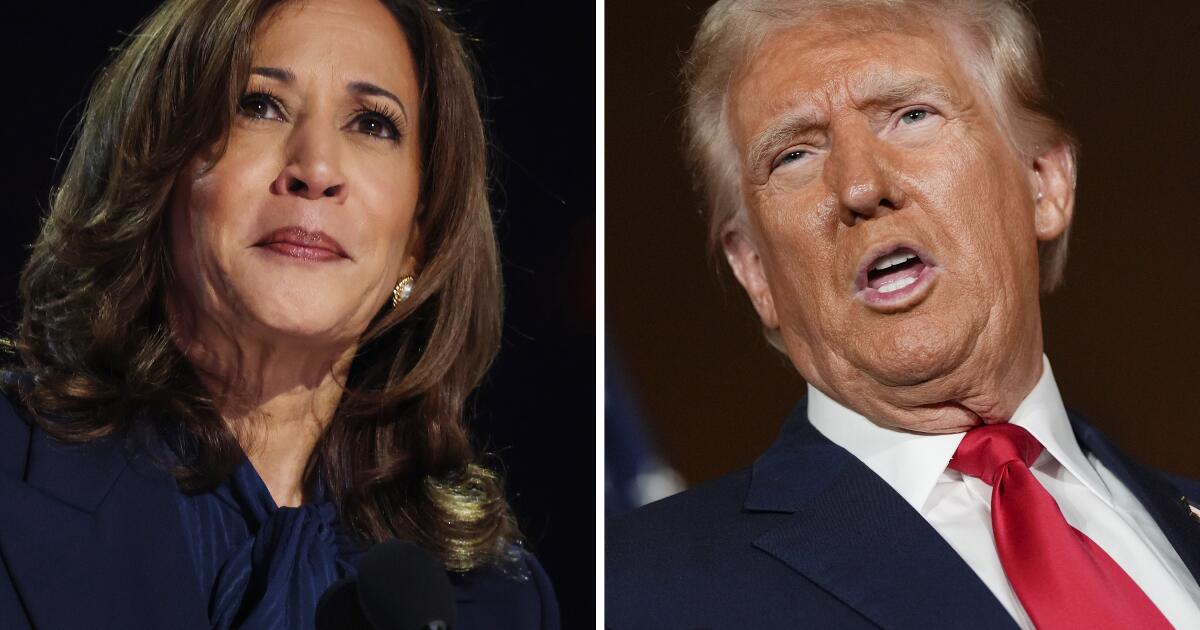
He’s called her Laffin’ Kamala and Lyin’ Kamala. Crazy Kamala and Comrade Kamala.
He’s described the vice president as lazy, dumb and antisemitic. (Even though her husband is Jewish, so maybe Donald Trump should throw in masochistic as well?)
Ever since Kamala Harris became his opponent, an obviously flummoxed Trump has grappled with how to run against a Democrat who doesn’t share his gender, flesh tone or senior status.
Test marketing, he’s fastened onto one line of attack that is particularly noteworthy. Not because it hasn’t sprung from a sandbox, but because it’s such a facile and specious argument: Why, Trump demands, hasn’t Harris already accomplished all that she is promising on the campaign trail?
“She says she’s going to lower the cost of food and housing, starting on Day 1,” he said at a recent swing-state rally in Pennsylvania. “But Day 1 for Kamala was 3½ years ago. So why didn’t she do it then?”
Here’s why: Because she’s serving as vice president of these United States.
Go ahead, criticize the Biden administration and assail its record. Call it, if you’d like, the worst and most incompetent in the whole history of humankind.
But don’t pretend that Harris is the one in charge.
As vice president, “you’re in the room, but you’re not the decision-maker,” said Joel Goldstein, an emeritus law professor at St. Louis University who has written two books on the vice presidency. “You have a voice, but ultimately there’s one vote that counts, and you don’t have it.”
If the question is, “Why didn’t she do it?” Goldstein went on, “the answer is, ‘It wasn’t her administration.’”
The vice presidency has often served as the punch line in a long-running joke — that is, when the office and its occupant have gotten any attention at all. In the corpus of our political system, a vice president is like an appendix; it does some good, but you could easily live without one.
John Adams — the first to hold the position, under President Washington — once called the vice presidency the “most insignificant office that ever the invention of man contrived or his imagination conceived.”
Walter Mondale, who was President Carter’s understudy, described the vice presidency as “an awkward office.” It falls under two branches of government, the executive and legislative, where the vice president serves as tiebreaker in the Senate. (Last December, Harris set a record by casting the most tiebreaking votes ever.)
“Over most of its history,” Mondale noted, “neither branch wanted to see” the vice president.
But the nature of the job changed dramatically under Mondale, who worked out an arrangement with Carter to function as more than a potted plant. Mondale became the first vice president to have an office in the White House, met regularly with the president and carved out a meaningful advisory role in Carter’s administration, a precedent that has been followed in Washington ever since.
One thing that hasn’t changed, however, is the inherently subordinate nature of the vice presidency.
“You step into a role where, by definition, you’re not supposed to lead,” said Christopher Devine, an associate political science professor at the University of Dayton and the author of books on vice presidential candidates. “You’re supposed to take a step back and serve in the shadow of the president.”
That led to a huge expectation gap for Harris — who made history as America’s first female, Black and Asian American vice president — which, in turn, led to a lot of whatever-happened-to questions as she settled into semi-anonymity and the customary role of deferring to the president and carrying out his vision.
It was only a few weeks ago that Harris began fully emerging in her own right, after President Biden stepped aside and the vice president stepped up to replace him as the Democratic nominee.
Since then, polls suggest most voters have little clue what exactly Harris has been up to these last 3½ years, which, from a political standpoint, is one of those good-and-bad things.
Blueprint, a Democratic polling and research organization, said a recent survey found “the general public does not give Harris credit for many of the Biden administration’s popular policies — but that she also won’t have to carry the president’s baggage on issues like inflation.”
In a Washington Post/ABC/Ipsos poll, nearly 6 in 10 respondents said they believe Harris had “just some” or “very little” influence on the administration’s immigration policies, and more than 6 in 10 said she had limited influence on Biden’s economic policies.
(Both surveys were completed before last week’s Democratic National Convention, which devoted four days to wreathing Harris’ in Biden’s successes while ignoring the administration’s failings.)
There are legitimate questions about the counsel Harris has given the president, which would speak to the judgment she’d exercise in the Oval Office. Harris said, for instance, she was “the last person in the room” before Biden launched the deadly and chaotic withdrawal of U.S. troops from Afghanistan. (Trump, of course, can’t help but exaggerate, asserting the vice president had “the final vote … the final say” in the matter.)
Exactly what kind of counsel Harris has offered Biden — and the extent to which the president has paid heed — is unknowable for now.
“It’s always confidential, always behind closed doors,” Goldstein noted. “The vice president can’t say, ‘The president was about to screw up and I told him don’t do that and the sun came out the next day.’”
If only.
What can be said is that it’s absurd to suggest that Harris wielded the power to stem inflation, secure the border, fix the country’s housing shortage and solve the myriad other problems Trump lays at her feet.
There’s a reason President Truman famously kept on his desk — and not the vice president’s — a sign reading “The Buck Stops Here.”
Surely Trump appreciates that pecking order, even if the alpha-obsessed ex-president doesn’t let on.



According to President Trump, the United States attacked Iran because the Islamic Republic posed “imminent threats” to the U.S. and its allies, including through its use of terrorist proxies and continued pursuit of nuclear weapons.
“Its menacing activities directly endanger the United States, our troops, our bases overseas and our allies throughout the world,” he said in a recorded statement Saturday.
According to leading Democrats in Congress, Trump’s justification is questionable, especially given his claims of having “completely obliterated” Iran’s nuclear capabilities in separate U.S. bombings last June.
“Everything I have heard from the administration before and after these strikes on Iran confirms this is a war of choice with no strategic endgame,” said Rep. Jim Himes (D-Conn.), ranking Democrat on the House Intelligence Committee and part of a small group of congressional leaders — the Gang of Eight — who were briefed on the operation by Secretary of State Marco Rubio.
That divide is bound to remain an issue politically heading into this year’s midterm elections, and could be a liability for Republicans — especially considering that some in the “America First” wing of the MAGA base were raising their own objections, citing Trump’s 2024 campaign pledges to extricate the U.S. from foreign wars, not start new ones.
The debate echoed a similar if less immediate one around President George W. Bush’s decision to go to war in Iraq following the Sept. 11, 2001, attacks, also based on claims that “weapons of mass destruction” posed an immediate threat. Those claims were later disproved by multiple findings that Iraq had no such arsenal, fueling recriminations from both political parties for years.
The latest divide also intensified unease over Congress ceding its wartime powers to the White House, which for years has assumed sweeping authority to attack foreign adversaries without direct congressional input in the name of addressing terrorism or preventing immediate harm to the nation or its troops.
Even prior to the weekend bombings, Democrats including Sen. Adam Schiff of California were pushing Congress to pass a resolution barring the Trump administration from attacking Iran without explicit congressional authorization.
“President Trump must come to Congress before using military force unless absolutely necessary to defend the United States from an imminent attack,” Sen. Tim Kaine (D-Va.), a member of the armed services and foreign relations committees, said in a statement Thursday.
In justifying the daylight strikes that killed Supreme Leader Ayatollah Ali Khamenei just two days later, Trump accused the Iranian government of having “waged an unending campaign of bloodshed and mass murder” for nearly half a century — including through attacks on U.S. military assets and commercial shipping vessels abroad — and of having “armed, trained and funded terrorist militias” in multiple countries, including Hezbollah and Hamas.
Trump said that after the U.S. bombed Iran last summer, it had warned Tehran “never to resume” its pursuit of nuclear weapons. “Instead, they attempted to rebuild their nuclear program and to continue developing long-range missiles that can now threaten our very good friends and allies in Europe, our troops stationed overseas, and could soon reach the American homeland,” he said.
Other Republican leaders largely backed the president.
“The United States did not start this conflict, but we will finish it. If you kill or threaten Americans anywhere in the world — as Iran has — then we will hunt you down, and we will kill you,” said Defense Secretary Pete Hegseth.
“Every president has talked about the threat posed by the Iranian regime. President Trump is the one with the courage to take bold, decisive action,” said Atty. Gen. Pam Bondi.
While Iran’s coordination with and sponsorship of groups such as Hezbollah and Hamas are well known, Trump’s claims about Tehran’s ongoing development of nuclear weapons systems are less established — and the administration has provided little evidence to back them up.
Democrats seized on that lack of fresh intelligence in their responses to the attacks, contrasting Trump’s latest statements about imminent threats with his assertion after last year’s bombings that the U.S. had all but eliminated Iran’s nuclear aspirations.
“Let’s be clear: The Iranian regime is horrible. But I have seen no imminent threat to the United States that would justify putting American troops in harm’s way,” said Sen. Mark Warner (D-Va.), vice chairman of the Senate Intelligence Committee and a member of the Gang of Eight. “What is the motivation here? Is it Iran’s nuclear program? Their missiles? Regime change?”
Senate Minority Leader Chuck Schumer (D-N.Y.) said in a statement that the Trump administration “has not provided Congress and the American people with critical details about the scope and immediacy of the threat,” and must do so.
House Minority Leader Hakeem Jeffries (D-N.Y.) said the Trump administration needs congressional authority to wage such attacks barring “exigent circumstances,” and didn’t have it.
“The Trump administration must explain itself to the American people and Congress immediately, provide an ironclad justification for this act of war, clearly define the national security objective and articulate a plan to avoid another costly, prolonged military quagmire in the Middle East,” he said.
After the U.S. military announced Sunday that three U.S. service personnel were killed and five others seriously wounded in the attacks, the demands for a clearer justification and new constraints on Trump only increased.
Rep. Ro Khanna (D-Fremont) said Sunday he is optimistic that Democrats will be unified in trying to pass the war powers resolution, and also that some Republicans will join them, given that the strikes have been unpopular among a portion of the MAGA base.
Rep. Thomas Massie (R-Ky.), who partnered with Khanna to force the release of the Jeffrey Epstein files, has said he will work with him again to push a congressional vote on war with Iran, which he said was “not ‘America First.’”
Benjamin Radd, a political scientist and senior fellow at the UCLA Burkle Center for International Relations, said that whether or not Iran represented an “imminent” threat to the U.S. depends not just on its nuclear capabilities, but on its broader desire and ability to inflict pain on the U.S. and its allies — as was made clear to both the U.S. and Israel after the Hamas attacks on Israel on Oct. 7, 2023, which Iran praised.
“If you are Israel or the United States, that’s imminent,” he said.
What happens next, Radd said, will largely depend on whether remaining Iranian leaders stick to Khamenei’s hard-line policies, or decide to negotiate anew with the U.S. He expects they might do the latter, because “it’s a fundamentalist regime, it’s not a suicidal regime,” and it’s now clear that the U.S. and Israel have the capabilities to take out Iranian leaders, Iran has little ability to defend itself, and China and Russia are not rushing to its aid.
How the strikes are viewed moving forward may also depend on what those leaders decide to do next, said Kevan Harris, an associate professor of sociology who teaches courses on Iran and Middle East politics at the UCLA International Institute.
If the conflict remains relatively contained, it could become a political win for Trump, with questions about the justification falling away. But if it spirals out of control, such questions are likely to only grow, as occurred in Iraq when things started to deteriorate there, he said.
Israel and the U.S. are betting that the conflict will remain manageable, which could turn out to be true, Harris said, but “the problem with war is you never really know what might happen.”
On Sunday, Iran launched retaliatory attacks on Israel and the wider Gulf region. Trump said the campaign against Iran continued “unabated,” though he may be willing to negotiate with the nation’s new leaders. It was unclear when Congress might take up the war powers measure.

new video loaded: Trump’s War of Choice With Iran

By David E. Sanger, Gilad Thaler, Thomas Vollkommer and Laura Salaberry
March 1, 2026

NEWYou can now listen to Fox News articles!
Some of the top rumored Democratic potential candidates for president in 2028 are showing a united front in opposing U.S. strikes on Iran, with several high-profile figures accusing President Donald Trump of launching an unnecessary and unconstitutional war.
Former Vice President Kamala Harris said Trump was “dragging the United States into a war the American people do not want.”
“Let me be clear: I am opposed to a regime-change war in Iran, and our troops are being put in harm’s way for the sake of Trump’s war of choice,” Harris said in a statement Saturday following the joint U.S. and Israeli strikes throughout Iran.
“This is a dangerous and unnecessary gamble with American lives that also jeopardizes stability in the region and our standing in the world,” she continued. “What we are witnessing is not strength. It is recklessness dressed up as resolve.”
Former Vice President Kamala Harris, Rep. Alexandria Ocasio-Cortez and California Gov. Gavin Newsom are leading Democratic 2028 hopefuls who spoke out against U.S. strikes on Iran. (Big Event Media/Getty Images for HumanX Conference; Reuters/Liesa Johannssen; Mario Tama/Getty Images)
California Gov. Gavin Newsom delivered some of his sharpest criticism during a book tour stop Saturday night in San Francisco, accusing Trump of manufacturing a crisis.
“It stems from weakness masquerading as strength,” Newsom said. “He lied to you. So reckless is the only way to describe this.”
“He didn’t describe to the American people what the endgame is here,” Newsom added. “There wasn’t one. He manufactured it.”
Newsom is currently promoting his memoir, “Young Man in a Hurry,” with recent and upcoming stops in South Carolina, New Hampshire and Nevada — three key early voting states in the Democratic presidential calendar.
Earlier in the day, Newsom said Iran’s “corrupt and repressive” regime must never obtain nuclear weapons and that the “leadership of Iran must go.”
“But that does not justify the President of the United States engaging in an illegal, dangerous war that will risk the lives of our American service members and our friends without justification to the American people,” Newsom wrote on X.
California is home to more than half of the roughly 400,000 Iranian immigrants in the United States, including a large community in West Los Angeles often referred to as “Tehrangeles.”
DEMOCRATS BUCK PARTY LEADERS TO DEFEND TRUMP’S ‘DECISIVE ACTION’ ON IRAN
Rep. Alexandria Ocasio-Cortez, D-N.Y., a leading progressive voice and “Squad” member, accused Trump of dragging Americans into a conflict they did not support.
“The American people are once again dragged into a war they did not want by a president who does not care about the long-term consequences of his actions. This war is unlawful. It is unnecessary. And it will be catastrophic,” Ocasio-Cortez said.
“Just this week, Iran and the United States were negotiating key measures that could have staved off war. The President walked away from these discussions and chose war instead,” she continued.
“In moments of war, our Constitution is unambiguous: Congress authorizes war. The President does not,” she said, pledging to vote “YES on Representatives Ro Khanna and Thomas Massie’s War Powers Resolution.”
Illinois Gov. JB Pritzker criticized the strikes and accused Trump of ignoring Congress. (Daniel Boczarski/Getty Images for Vox Media)
Illinois Gov. JB Pritzker, another Democrat often mentioned as a potential 2028 contender, also criticized the strikes and accused Trump of ignoring Congress.
“No justification, no authorization from Congress, and no clear objective,” Pritzker wrote on X.
“Donald Trump is once again sidestepping the Constitution and once again failing to explain why he’s taking us into another war,” he continued. “Americans asked for affordable housing and health care, not another potentially endless conflict.”
“God protect our troops,” Pritzker added.
Pennsylvania Gov. Josh Shapiro focused his criticism on war powers, arguing Trump acted outside constitutional guardrails.
“In our democracy, the American people — through our elected representatives — decide when our nation goes to war,” Shapiro said, adding that Trump “acted unilaterally — without Congressional approval.”
JONATHAN TURLEY: TRUMP STRIKES IRAN — PRECEDENT AND HISTORY ARE ON HIS SIDE
Pennsylvania Gov. Josh Shapiro focused his criticism on war powers, arguing Trump acted outside constitutional guardrails. (Rachel Wisniewski/Bloomberg via Getty Images)
“Make no mistake, the Iranian regime represses its own people… they must never be allowed to possess nuclear weapons,” he said. “But that does not justify the President of the United States engaging in an illegal, dangerous war.”
Shapiro added that “Congress must use all available power” to prevent further escalation.
Former Transportation Secretary Pete Buttigieg also accused Trump of launching a “war of choice.”
“The President has launched our nation and our great military into a war of choice, risking American lives and resources, ignoring American law, and endangering our allies and partners,” Buttigieg wrote on X. “This nation learned the hard way that an unnecessary war, with no plan for what comes next, can lead to years of chaos and put America in still greater danger.”
Buttigieg has been hitting early voting states, stopping in New Hampshire and Nevada in recent weeks to campaign for Democrats ahead of the 2026 midterm elections.
Sen. Ruben Gallego, D-Ariz., who has been floated as a rising national figure within the party, said he lost friends in Iraq to an illegal war and opposed the strikes.
CLICK HERE TO DOWNLOAD THE FOX NEWS APP
“Young working-class kids should not pay the ultimate price for regime change and a war that hasn’t been explained or justified to the American people. We can support the democracy movement and the Iranian people without sending our troops to die,” Gallego wrote on X.
Fox News’ Daniel Scully and Alex Nitzberg contributed to this report.
Related Article


Diabetes surge among Americans could be driven by ‘healthy’ breakfasts, doctor warns

Deion Sanders mourns loss of Colorado quarterback Dominiq Ponder: ‘One of my favorites’

Iran networks suffer losses amid airstrikes, showing digital evolution of conflicts

WGA cancels Los Angeles awards show amid labor strike

After ‘Yellowstone’ and a twist of fate, Luke Grimes rides again as Kayce in ‘Marshals’

Florida High School Football Rankings: Top 25 teams – Oct. 21

Cleary's 21 help Le Moyne down Central Connecticut State 69-64 in OT

How old is Bo Nix? What to know about Oregon quarterback ahead of 2024 NFL Draft

99th annual Pony Swim held in Virginia

Indiana Members Credit Union announced as new anchor tenant at Bottleworks District

Israel FM says Europe too divided, slams Spanish PM

Satellite images provide view inside Iran at war

Video: What the Texas Primary Battle Means for the Midterms

Dems’ potential 2028 hopefuls come out against US strikes on Iran

At least nine killed after Iranian strike on Israel’s Beit Shemesh
-

 World4 days ago
Exclusive: DeepSeek withholds latest AI model from US chipmakers including Nvidia, sources say
-

 Massachusetts4 days ago
Mother and daughter injured in Taunton house explosion
-

 Montana1 week ago
2026 MHSA Montana Wrestling State Championship Brackets And Results – FloWrestling
-

 Denver, CO4 days ago
10 acres charred, 5 injured in Thornton grass fire, evacuation orders lifted
-

 Louisiana7 days ago
Wildfire near Gum Swamp Road in Livingston Parish now under control; more than 200 acres burned
-

 Technology1 week ago
YouTube TV billing scam emails are hitting inboxes
-

 Technology1 week ago
Stellantis is in a crisis of its own making
-

 Politics1 week ago
OpenAI didn’t contact police despite employees flagging mass shooter’s concerning chatbot interactions: REPORT