Politics
Column: The California roots of Trump's anti-immigrant pitch to Black voters

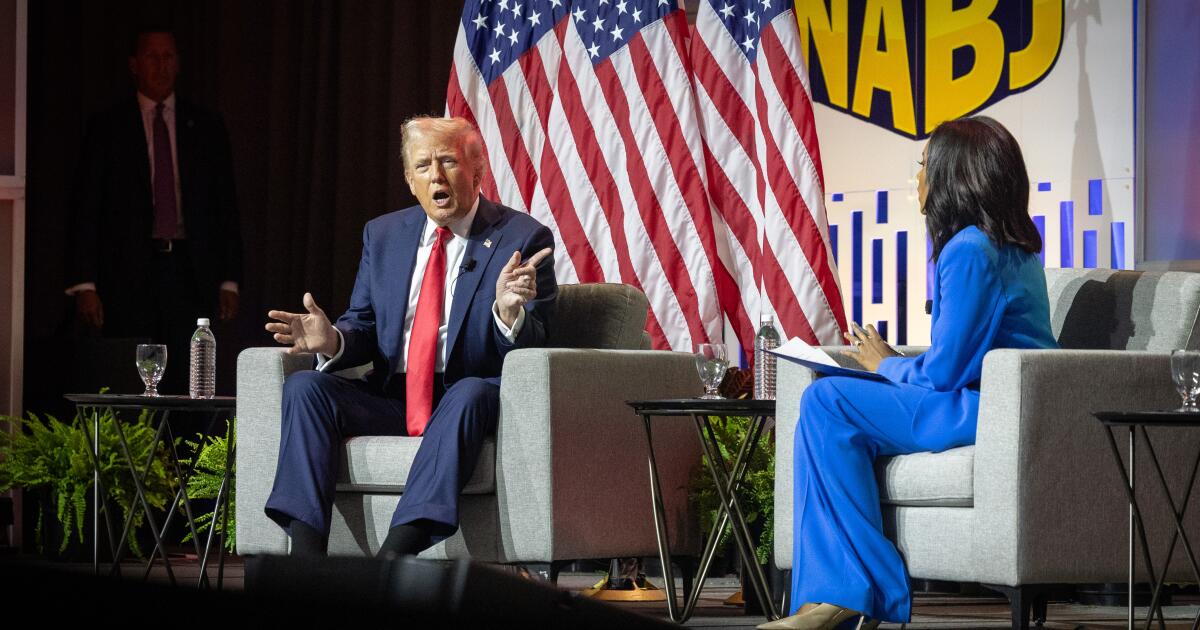
Donald Trump is nothing if not consistent, and his Dumpster fire of an interview with reporters at the National Assn. of Black Journalists convention in Chicago this week showed the Republican presidential nominee in full, foul mode.
He lied. He insulted. He whined. He was racist and misogynistic. He evaded questions and elided answers, and showed all the grace and gratitude of a kindergartner who pees in a sandbox and expects others to clean up the mess.
Above all, the Republican presidential candidate kept stabbing at the same illegal immigration scapegoat that’s the centerpiece of his 2024 presidential campaign. This time, though, he tried to further his contention that Donald J. Trump is the greatest president for Black people since Abraham Lincoln.
He unveiled the strategy during his June 28 debate with President Biden, when Trump stated that immigrants were a “big kill on the Black people” and were “taking Black jobs.” In Georgia, which he narrowly lost in 2020, his campaign has aired radio and television commercials insisting Biden cares more about illegal immigrants than the Black community.
At the NABJ convention, Trump blamed open borders for endangering the job security of Black workers — never mind that unemployment rates for them have reached historic lows under both the Trump and Biden administrations, a time when illegal immigration has grown to numbers not seen in a generation. When a moderator asked what was his message to all the Black reporters gathered before him and people watching online, Trump responded it was “to stop people from invading our country … who happen to be taking Black jobs.” When asked what he would do on Day 1 of a new term, he blurted out, “Close the border.”
Trump’s gambit is yet another legacy of Proposition 187, the 1994 California ballot initiative that sought to make life miserable for undocumented immigrants. Then and now, GOP politicians figure that the best way to court Black voters — a longtime bedrock of the Democratic Party — is to argue that immigrants in the country illegally are a burden that hits their community harder than others by taking away social services and bleeding jobs away.
Here’s the thing: There is a historical basis for these concerns, even if Trump has pushed the Illegal Immigrant Bogeyman dial to 11.
When South L.A. began to turn from the heart of the city’s Black community to a Latino-majority enclave during the 1980s and 1990s, the subsequent tensions were real. In the wake of the L.A. riots, groups protested outside work sites and blasted contractors for giving jobs to Latinos instead of Black workers because the former group would work for cheaper than the latter. The assumption by Latino political leaders during the fight against Prop. 187 that Black people would join them without question offended leaders and community activists.
Incidents like that led to 47% of Black voters favoring Prop. 187, a margin that helped the resolution pass comfortably.
Some of the most prominent Black voices in the anti-immigrant movement over the past 25 years — homeless activist Ted Hayes, the late radio show host Terry Anderson, the Rev. Jesse Lee Peterson, former gubernatorial candidate Larry Elder — came from that era. One of the loudest anti-immigrant voices in Southern California today is Fontana Mayor Acquanetta Warren, a Compton native who has scolded immigrants from the dais for not speaking English and has waged an aggressive campaign against street vendors. Throw in deep-rooted anti-Black sentiments among Latinos that got a prominent showcase during the 2022 L.A. City Hall racist tape leak scandal, and no wonder Trump thinks banking on getting Black voters angry enough against a supposed south-of-the-border invasion is a winner.
The reality is that Black people aren’t as receptive to an anti-immigrant message as Trump and the GOP would like to think.
L.A. councilmember Marqueece Harris-Dawson, right, during a City Council meeting in 2023
(Irfan Khan/Los Angeles Times)
A 2006 Pew Research Center study showed that 47% of Black people thought immigrants in the U.S. without legal documents should be allowed to stay, compared with 33% of whites. But by 2013, a similar Pew report showed 82% of Black people felt there should be a path toward legalization for those immigrants, compared with 67% of whites. The figure dropped in a Pew survey released this year to 73%, but it’s still far higher than the 53% of whites who feel the same, and just two percentage points behind Latinos, who have increasingly turned to the right against illegal immigration since the Prop. 187 days.
This general acceptance doesn’t surprise L.A. Councilmember Marqueece Harris-Dawson. He campaigned against Prop. 187 in 1994, going door-to-door in his native South L.A. to argue that the initiative was a wedge issue being used by Republicans to divide Black and Latino neighbors against each other and make them forget their shared working-class status.
“One line I would tell people is, ‘Do you hear them [Prop. 187 supporters] talk about people from Canada? From Germany?” Harris-Dawson said. “Black and Latino people I talked to understood it clearly.”
Harris-Dawson didn’t have to make the same argument recently in Atlanta, where the subject of illegal immigration came up in conversation.
“They said, ‘We support immigration reform, because we don’t want working-class people who can’t play defense,’” he said. In other words, it was better for the Black community for immigrants to have full rights instead of keeping them without papers and thus easier to use to undercut Black workers. “The sophistication of that! They get that workers don’t take jobs; employers give jobs.”
He can see Trump peeling off Black voters from the Democrats by continuing to hammer on the illegal immigration issue — but “he’ll also lose them” because of Trump’s long history of racist dog whistles. Besides, the councilmember argued, “people have seen it play out. … You see new neighbors come in and think, ‘Oh, there’s a good family.’ And they are. And then 10 years later, the parents still don’t have papers and the kids can’t go to college.
“Black folks can sympathize,” Harris-Dawson concluded, with “people who deal with systems that are ostensibly there to help you, but in fact do the opposite.”

The Supreme Court ruled 6-3 that President Trump could fire independent regulators for any reason. But the justices carved out an exception for the Federal Reserve, preventing the immediate removal of Lisa D. Cook, a Federal Reserve governor.
Politics
Emotion and feelings: How Democratic Socialists’ congressional insurgency could come back to bite them

NEWYou can now listen to Fox News articles!
Democratic Socialists of America are on the charge, running hot off their wins in the New York Democratic primaries last week. Their victories in multiple Congressional seats – felling both Reps. Adriano Espaillat, D-N.Y., and Dan Goldman, D-N.Y. – signals that the party is ready to move on from the same old, same old.
Espaillat chaired the Congressional Hispanic Caucus. Goldman was a key House staffer during the first impeachment of President Donald Trump.
“Even Dan Goldman’s not good enough for them,” said House Judiciary Committee Chairman Jim Jordan, R-Ohio, on Fox. “That is how radical it’s become.”
Some moderate Democrats are trying to distance themselves from the left.
MAMDANI-BACKED SOCIALISTS LOOK TO TAKE NEW YORK PLAYBOOK NATIONWIDE AFTER PRIMARY VICTORIES
The left flank of the Democratic Party has surged to the top of the nation’s most hotly-contested primaries. (Michael M. Santiago/Getty Images)
“That’s not the same brand of politics that we have. We’re not those type of Democrats,” said Rep. Tom Suozzi, D-N.Y., who represents a battleground district.
“There’s a new group of Democratic Socialists who are socialists who are not commonsense Democrats. Who are not interested in getting things done. They’re interested in throwing bombs. Not actually solving problems,” said Rep. Josh Gottheimer, D-N.J.
LURCHING LEFT: MAMDANI-BACKED CANDIDATES OUST ESTABLISHMENT DEMOCRATS
Some Democrats are worried how far left candidates command more attention than those in the middle. Rep. Kristen McDonald Rivet, D-Mich., worries that the outsized attention garnered by the left sends the wrong impression to voters.
“What they don’t want is divisiveness. They don’t want screaming and yelling,” said McDonald Rivet.
Mainstream Democrats feel trapped in the middle as the left – specifically the New York City left – wields an outsized media and political megaphone.
“Those candidates would not have won in Virginia where I live,” said Rep. Suhas Subramanyam, D-Va.
Rep. Tom Suozzi, D-N.Y., is among the moderate Democrats trying to distance themselves from the party’s insurgent wing. (Nathan Posner/Anadolu via Getty Images)
Republicans believe they are primed to nationalize the midterms. Republicans can do that by highlighting the extreme views of Democratic Socialists who captured primary victories in New York City. The GOP wants to portray their opponents as veering left.
“These are board-certified communists, right?” asked Sen. Roger Marshall, R-Kan. “They want no police. They want no private property.”
President Trump capitalized on the Democratic outcomes in his home city.
“The Democrat party is in big trouble because this isn’t stopping with New York,” he forecast.
VICTORIES BY MAMDANI-BACKED CONGRESSIONAL CANDIDATES SPOTLIGHTS GROWING RIFT IN DEMOCRATIC PARTY
This shakeup has progressive leaders demanding transformation at the top.
“You’re going to see, I think, people voting for new leadership and to change their representation,” said Rep. Alexandria Ocasio-Cortez, D-N.Y.
The Democratic Party tapped Sen. Elissa Slotkin, D-Mich., to deliver their official response to President Trump’s 2025 State of the Union speech. Slotkin is a moderate who won in a battleground race in 2024 – even as the President prevailed in the Wolverine State. But during an appearance on SiriusXM, Slotkin insists on a Democratic Party management switch.
“If people can’t understand that the game has fundamentally changed and they can’t adapt, then they need to let others,” said Slotkin. “The old models do not work for people.”
House Minority Leader Hakeem Jeffries, D-N.Y., is perceived by Republicans as vulnerable after his preferred candidates failed in their congressional primaries. (Roberto Schmidt/Getty Images)
Republicans believe House Minority Leader Hakeem Jeffries, D-N.Y., is vulnerable after the DSA elected their candidates over his preferred picks in New York City.
“I think Hakeem Jeffries’ friends and neighbors gave him a big middle finger,” said House Oversight Chairman James Comer, R-Ky. “If you lose three elections in your hometown, that’s a pretty big slap in the face.”
He added that Democrats “are going further and further to the left to the point where they are full-blown, card-carrying socialists.”
And then there is the anti-Israel, anti-Jewish, and in some cases, antisemitic take by some of these candidates. Rep. Greg Landsman, D-Ohio, is a moderate Democrat from a swing district. He’s Jewish and one of the most pro-Israel Democrats in the House.
“There are some on the left who use Israel the way that some on the right use immigrants or trans kids as a way to divide. And I think it’s terrible. It’s also just not what voters want us talking about,” said Landsman.
HOUSE DEMOCRAT LASHES OUT WHEN GRILLED ON WHETHER SOCIALIST VICTORIES WOULD THREATEN DEM UNITY
Yours truly tangled with Rep. John Larson, D-Conn. – who once chaired the House Democratic Caucus. I pressed him about what the party would do about some candidates “who are too far to the left.”
“What does that mean? That’s your statement. Did the people of New York vote?” queried Larson.
I assured him that they did.
“Is that democracy?” asked Larson.
“But if some of them are antisemitic,” I countered.
“Is that a democracy?” continued Larson.
“Will you stand by people if they have antisemitic views?” I followed up.
Larson finally addressed my inquiry. His answer crystallized the schism the Democratic Party now faces.
“I’m against antisemitism, if that’s your question,” Larson declared.
Rep. John Larson, D-Conn., got into a heated exchange with Fox News’ Chad Pergram over the views of some likely members of his party’s next freshman class. (Bill Clark/CQ-Roll Call, Inc via Getty Images)
The fact that Democrats are now facing this debate robs them of valuable time on economic issues.
Landsman argued that voters would prefer candidates to stick to groceries and the price of gas.
Gottheimer echoed Landsman on kitchen table subjects.
“We should be focused on ways to actually solve problems like that. Not coming in here and using tea party tactics and trying to divide up the country and pray to socialist ideals,” said Gottheimer.
So what is the party to do?
DEMOCRACY ’26: STAY UP TO DATE WITH THE FOX NEWS ELECTION HUB
“They’re our nominees. We’re going to support them. We’re going to welcome them. They’re going to be part of our caucus and we’re going to unite behind Leader Jeffries,” said Rep. Robert Garcia, D-Calif., the top Democrat on the Oversight panel.
But that doesn’t address the fissures. It doesn’t address how voters may perceive the party. And it doesn’t establish if these new Democratic nominees will work on behalf of the party to raise money and advocate for Democrats across the board. Or, will they become professional bomb throwers – ala what the right has endured for a while.
“It’s going to be a lot harder to get things done when you get more and more extreme candidates who are here because they’re interested in political celebrity. They are interested in fighting. They’re interested in making points,” asserted Rep. Dusty Johnson, R-S.D.
Republicans have had an abysmal week themselves – President Donald Trump and Sen. Bill Cassidy, R-La., for instance, got into a shouting match over Iran. (Chip Somodevilla/Getty Images; Tyler Kaufman/Getty Images)
Republicans suffered through an absolutely abysmal week. House GOP leaders had to yank multiple bills off the floor and send lawmakers home early because of internal disputes. President Trump and Sen. Bill Cassidy, R-La., got into a shouting match about Iran. And the president even threatened to veto a bipartisan housing bill. President Trump then refused to sign the bill at the Capitol, despite his aides touting the bill and House Republicans tricking out Statuary Hall for a signing ceremony.
The President characterized the housing bill as “a yawn.”
But the Democrats’ internal fractures may have superseded any internecine fighting among Republicans.
“While it’s not been a great week for Republicans, I think it’s been a much worse week for Democrats because of these primary elections,” observed Rep. Mario Diaz-Balart, R-Fla.
CLICK HERE TO DOWNLOAD THE FOX NEWS APP
Democrats will certainly run on economic issues and capitalize on statements by the President about basic issues like housing. But will a genuine policy debate outweigh fears about progressives nationwide?
Emotion and feelings rule in politics. And it could be a problem for Democrats if Republicans appropriate what happened in New York and Xerox it onto battleground districts across the country.

Anthropic teamed up with California to get more state workers to use its artificial intelligence assistant Claude as part of an effort to leverage technology to make the government more efficient.
Gov. Gavin Newsom, who announced the partnership on Monday, said state agencies will be able to access Claude at a 50% discount. Free training and other assistance will also be available to the workers. California’s local governments will also get the same discount under the agreement.
Government workers can use Claude to draft and summarize documents, analyze information and do other tasks.
Anthropic, an AI company based in San Francisco, has a version of its AI assistant for government clients that provides more security than what it provides other consumers.
The new partnership shows how AI is playing a bigger role at work as tech companies market their tools as ways to complete tasks more quickly. Last year, San Francisco made Microsoft 365 Copilot Chat, which is powered by OpenAI’s model, available to nearly 30,000 city employees.
Still, the rise of automation at work has heightened concerns that people will lose their jobs. There are also worries that there are not yet adequate guardrails in place to mitigate data privacy and security risks.
Anthropic and the governor said that they’re focused on the responsible use of AI.
“AI should not replace the human work of government; it should help our workers move faster, solve problems more effectively, and deliver better results for Californians,” Newsom said in a statement.
The remarks didn’t appear to comfort union leaders.
“Wow. Look local government, the Gov is giving you a 50% off coupon to give up your residents’ private data, outsource your jobs to big tech. Isn’t that cool? Because California basically invented AI slop!” said Lorena Gonzalez Fletcher, president of the California Federation of Labor Unions, AFL-CIO, in a post on X.
Anthropic has faced political hurdles as it pushes to get more companies and government agencies to use its products.
Most notable, it’s sparred publicly with the Trump administration, which ordered the company to cut off foreign access to its most powerful AI systems this month.
The Trump administration cited potential national security risks, but Anthropic disagreed with the findings. Last week, tensions decreased after the U.S. government gave Anthropic permission to restore access to its AI model Mythos to certain clients.
Valued at nearly $1 trillion, Anthropic has also signaled it plans to become a publicly traded company.
California has already started using Claude more in state government to develop tools to get the public to engage more in AI policy discussions and assist state workers, the governor’s office said in its news release.
State agencies, including the Department of Motor Vehicles, are also using AI to reduce wait times and improve customer service.
“As state employees, our goal is to provide our fellow Californians with the best possible service,” Government Operations Agency Secretary Nick Maduros said in a statement. “To do that, we need to make sure our teams have access to the best modern tools, including Claude and other emerging technologies.”
-

 New York52 minutes ago
Metropolitan Diary Challenge Day 2: How to Write Your N.Y. Story
-

 Los Angeles, Ca57 minutes ago
Company has weeks to complete cleanup of Boyle Heights warehouse fire, officials announce
-

 Detroit, MI1 hour ago
18 New Kid-Friendly Places That Opened in Metro Detroit in 2026 (So Far!)
-

 San Francisco, CA2 hours ago
Anza expedition celebrates 250th anniversary in San Francisco
-

 Dallas, TX2 hours ago
Preston Hollow residents oppose proposed $800 million mixed-use development in Dallas, survey reveals
-

 Miami, FL2 hours ago
Bradley Beal to Miami Heat rumors draw skepticism
-

 Boston, MA2 hours ago
Boston Pops surprise travelers at Logan Airport with July 4th preview performance
-

 Denver, CO2 hours ago
Denver Broncos Crack Top 10 in NFL Uniform Rankings

