Politics
Column: Katie Porter is nearly done with Congress. But she's not finished yet

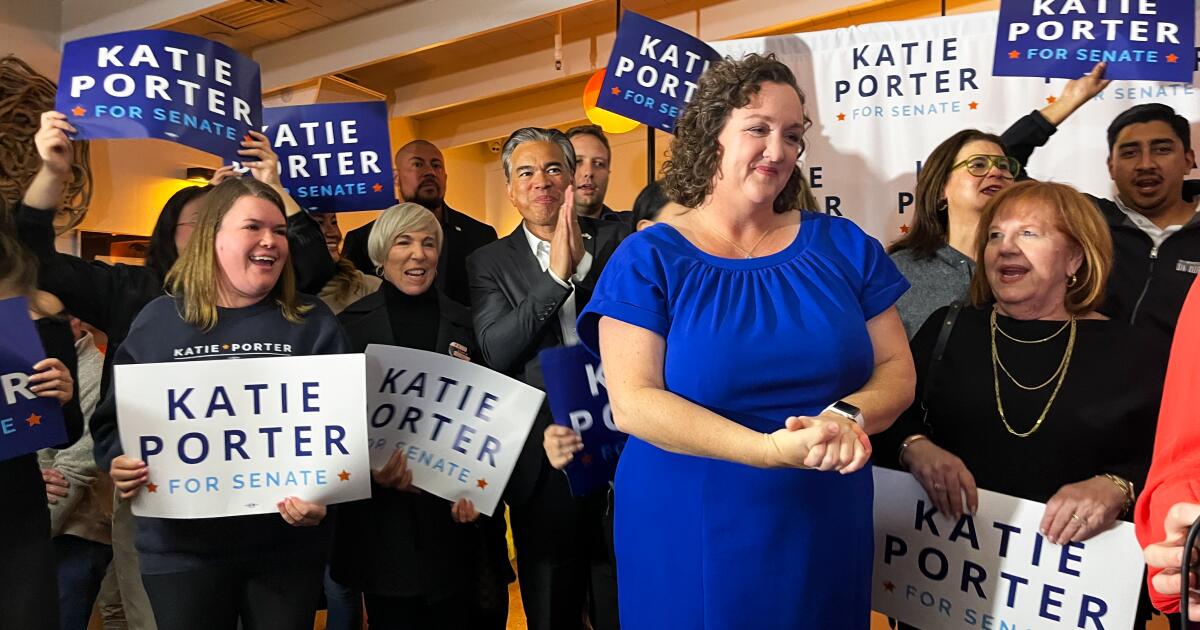
Katie Porter is seated at Starbucks, nursing an iced coffee and discussing might-have-beens as a stream of customers in seasonal uniform — shorts, flip-flops — flows steadily past.
This is not how she hoped to spend her summer.
The Orange County congresswoman had gone from unknown to political celebrity virtually overnight, wielding a whiteboard and marking pen to skewer lobbyists, torment chief executives and harry various corporate heavies — to the utter rapture of the online, cable-TV-consuming wing of the Democratic Party.
She transformed herself from UC law professor into a fundraising dynamo, a progressive heroine and oft-discussed prospect for higher office. Then it all came crashing down as Porter lost, badly, in a fractious Senate primary to fellow Rep. Adam B. Schiff. Now he’s the one cruising to election and potential lifetime tenure in Washington, as Porter confronts the end of her congressional career a few short months from now.
She has, Porter says, no regrets.
Not for how she waged her Senate campaign. Not for yielding the national political platform she built. Not for walking away from a House seat — which Republicans are eagerly eyeing — after three terms and six years in Washington, a point when many in her line of work are just getting started.
“What in the universe do I wish was different?” Porter asked, before answering herself. “A lot. A lot.”
The war in Gaza, for instance, which activated a peace movement in the Democratic Party and bolstered the candidacy of Rep. Barbara Lee, Porter’s main competition for liberal support against the more centrist Schiff.
“Do I think I underestimated some factors and overestimated some others? Sure. Do I think that there were calculations and calculuses that I made? Yes,” Porter went on. “But when I look at that campaign, I don’t think there was … a particular moment or a particular decision that shaped it either way.”
The morning rush had petered out. An egg-and-spinach wrap sat before Porter, untouched.
She’s still smarting over the millions of dollars in negative advertising the crypto industry and tech bros dumped on her head to help Schiff. But, she says, her endorsement of her erstwhile rival is wholehearted and sincere.
“Adam and Barbara and I remained very cordial throughout the race,” Porter said. “We saw each other every day at work. People forget that. We’re sitting in delegation meetings together; we’re on the airplane together. One of the first people I saw after I lost was Barbara Lee’s son, who was like, ‘You ran a great race.’ We understand that when you run, someone wins and someone loses.”
Her one hope for Schiff is that he uses the fall campaign (such as it is against his handpicked opponent, the hapless Republican Steve Garvey) to talk about some of the many issues facing California.
“We need a real policy debate in California,” Porter said. “We have a narrative about California being [Gov. Gavin Newsom’s] golden California dreaming, but also people who are like, ‘This is a failed state; people are leaving’ — that whole narrative. … This race was a chance to have a real policy debate about our state, and I don’t think that happened.”
Blame the short attention span of voters. Blame a diminished political press corps. Blame a contest that managed to captivate very few Californians. Blame hairsplitting among generally like-minded Democrats and the lack of any real GOP competition to spur a deep and meaningful discussion.
Even as Schiff coasts to election, Porter said: “I hope Adam will go back to some of the policies that were really important in the Senate race — whether that was housing, whether that was the environment, energy, whether that was taxes — and try to have some of those conversations and arrive in the Senate really willing to think about ‘What does California need from Washington?’”
A customer approached Porter, wide-eyed, to offer good wishes. The 47th Congressional District, which runs along the Orange County coast, is home to one of the most competitive House races in the country, a fight pitting Democrat Dave Min against Republican Scott Baugh to replace Porter on Capitol Hill.
She has few illusions about the institution she’s leaving behind.
Congress is a lumbering beast of a place, deeply polarized and highly antagonistic, and Porter said there’s little desire by leaders of either major party to fix that.
“My colleagues want to talk — and you will hear them talk this fall, whether it’s Congressman Schiff running for the Senate, or a House candidate or Vice President Harris — they want to talk endlessly about the crisis of confidence in the Supreme Court,” Porter said. “What about the crisis of confidence in us, in Congress, and who we work for and how effective we are? That’s a conversation worth having, too.”
(There’s a reason Porter was no favorite of former House Speaker Nancy Pelosi, who threw her considerable clout behind Schiff in the Senate primary.)
For now, Porter is looking forward to returning to the classroom in January — her face lit up at the mention of standing in front of students again — taking up her old position at UC Irvine. She’ll teach a first-year law class and courses on commercial law and legislation.
She has a new Burmese kitten, Dino, and a basset hound puppy, Poppy. As a single mom of three children, she’ll gladly forsake the arduous cross-country commute to Washington, and also looks forward to being around when her kids get home from school.
A sip of coffee. Another passerby — a woman in a neon-green safety vest — bids Porter well.
She hasn’t ruled out a future run for statewide office — Porter could be a formidable candidate for attorney general or governor — but feels no haste to decide. (By contrast, she was the first to jump in to the Senate race, even before the late Sen. Dianne Feinstein had stated her intention to step aside.)
Porter reprimanded the nearly half dozen gubernatorial hopefuls who’ve already launched their campaigns.
“Between now and election day, in my opinion, nobody should be campaigning for governor,” Porter said. Democrats, quite rightly, insist that Donald Trump poses an existential threat to democracy and that the party must do all it can to stop him.
“If you believe that” — here Porter brandished a fist — “then that’s what we should all be working on right now.” Not jockeying in an election still more than two years off.
At 50, still in the blush of youth by today’s silvered political standards, Porter has plenty of highway ahead of her.
She remains committed, she said, to public service of some sort.
“I’m not tired at all of being a candidate. I’m not tired of campaigning,” she said, finally turning attention to her neglected spinach wrap. “But I just don’t know what that looks like, and I’m not gonna be rushed.
“I’m going to look for the thing that feels right, whether that’s elective office — I don’t know at what level — whether that’s administration, whether that’s some kind of civil service board position in California,” or possibly a role in a Kamala Harris administration.
Her brief, ascendant House career may be nearly over. But, Porter suggested, she’s not through yet.

Politics
McCarthy says Trump will use ‘everything he can’ to force Senate action on SAVE America Act

NEWYou can now listen to Fox News articles!
As infighting over the SAVE America Act throws congressional Republicans into disarray, President Donald Trump’s bid to get the stalled election bill across the finish line gained one notable ally.
Former House Speaker Kevin McCarthy, R-Calif., told Fox News Digital that he supports the election integrity measure and indicated that Trump should continue to use every available tool to pressure the Senate to pass it.
“He’s going to try everything he can to make sure he passes that through,” McCarthy said in a brief interview outside the U.S. Capitol.
The ex-speaker’s comments came after Trump abruptly called off a signing ceremony Wednesday for a bipartisan housing bill to pressure the Republican-controlled Senate to act on the SAVE America Act.
President Donald Trump boards Air Force One as he departs Reading Regional Airport in Reading, Pa., on June 23, 2026. (Evelyn Hockstein/Reuters)
IRATE REPUBLICANS ACCUSE TRUMP OF HANDING DEMOCRATS A WIN AFTER BLOWING UP HOUSING PACKAGE
The move surprised Republican lawmakers, some of whom were praising the bill’s passage at a press conference when Trump’s Truth Social post broke.
But Trump has repeatedly cast the election measure — requiring proof of citizenship to vote in federal elections and voter identification requirements — as his top legislative priority.
The legislation’s momentum, however, has slowed in the upper chamber, where Republican leadership insists the votes aren’t there amid widespread Democratic opposition. Senate Republicans have also been unwilling to eliminate the legislative filibuster, which requires a 60-vote threshold to pass the legislation.
Former Speaker of the House Kevin McCarthy speaks during a ceremony honoring President Ronald Reagan on the 115th anniversary of his birthday at the Ronald Reagan Presidential Library in Simi Valley, Calif., on Feb. 6, 2026. (Hans Gutknecht/MediaNews Group)
TRUMP CALLS MAIL IN VOTING CORRUPT AS SENATE BEGINS DEBATE ON SAVE ACT REQUIRING VOTER ID
Amid the SAVE standoff, a group of conservative lawmakers effectively shut down the House floor in an effort to force Senate action on the election bill.
But the Senate recessed Wednesday for two weeks over the July 4 holiday, leaving the measure in limbo until lawmakers return.
The conservative-led blockade sparked fierce backlash, with several members inside the GOP conference telling Fox News Digital the move risked torpedoing their own legislative agenda.
Meanwhile, the House has also yet to pass a version of the legislation incorporating several of the president’s priorities, including a mail-in voting crackdown and provisions banning men from competing in women’s sports and child sex change procedures.
Trump has not indicated whether he will sign the 21st Century ROAD to Housing Act, despite the likely existence of a veto-proof majority.
House Speaker Mike Johnson, R-La., told reporters Thursday that the housing bill had been transmitted to the White House for Trump’s signature following a meeting with the president.
Speaker of the House Mike Johnson, R-La., talks with reporters in the U.S. Capitol on June 10, 2026. (Tom Williams/CQ-Roll Call, Inc via Getty Images)
CLICK HERE TO DOWNLOAD THE FOX NEWS APP
Trump now has 10 days to sign the package or veto it. If he does nothing, the legislation automatically becomes law at the end of the 10-day period.

WASHINGTON — California’s two Democratic senators on Thursday criticized the Trump administration after it requested $87.6 billion from Congress to address some of the nation’s most “urgent needs” but omitted funding for victims of last year’s Los Angeles wildfires.
“Donald Trump’s desire to punish Los Angeles and the state of California for not voting for him, means once again that thousands of Angelinos are left watching this administration fight for anything but them, their businesses, and their communities,” Sens. Alex Padilla and Adam Schiff said in a joint statement.
“These fires did not discriminate based on party or political preference. Neither should this administration,” they added.
The omission is the latest strain in a yearlong standoff between California leaders and the Trump administration over federal disaster aid, and it comes after Los Angeles Mayor Karen Bass and Los Angeles County Supervisor Kathryn Barger met with President Trump at the Oval Office in April to request the funding.
At the meeting, Trump signaled his commitment to working with local officials to help with disaster recovery efforts. The officials asked for $16 billion that would be split between the city and county. The money would consist primarily of disbursements from the Federal Emergency Management Agency flagged for communities hit by the fires, part of a $33.9-billion wildfire relief funding request made by Gov. Gavin Newsom.
Two months later, those talks have yet to yield results sought by local leaders.
The budget request, submitted by the Office of Management and Budget on Wednesday, mostly seeks funding for the Pentagon to address costs related to the Iran war. It also includes $11.1 billion in economic assistance for American farmers, $1.4 billion to address the Ebola virus outbreak in Central Africa, $500 million to support “ongoing efforts to complete restorations and construction projects” across the nation’s capital and $1 billion to boost the pensions of workers at General Motors that were cut as a result of the automaker’s bankruptcy.
“I urge the Congress to take action on these important and urgent requests as soon as possible,” White House budget director Russell Vought wrote in a letter addressed to House Speaker Mike Johnson (R-La.).
Vought said the administration was open to discussing “additional relief for other urgent matters.” The White House did not immediately respond when asked why the budget request did not mention the Eaton and Palisades disaster relief funds.
State leaders, including Newsom, have repeatedly accused the Trump administration of stonewalling billions in wildfire aid. The governor visited Washington in December to meet with lawmakers, including three who serve on the Senate and House appropriations committees, to push for the funding.
The governor also attempted to meet with FEMA about the matter, but said his request was denied. Newsom, a political foe of Trump’s, would not say whether he had attempted to meet with Trump to talk about the recovery efforts.
Politics
Trump administration pledges $150M in aid, deploys Navy warships after deadly Venezuela earthquakes

Secretary Rubio details US aid to Venezuela after earthquakes
Secretary Rubio, in Manama, Bahrain, outlines the comprehensive U.S. government response to the devastating back-to-back earthquakes in Venezuela. He confirms immediate deployment of search and rescue teams, medical resources and humanitarian assistance, emphasizing the urgency to save lives. Rubio reiterates President Donald Trump’s commitment to supporting Venezuela and collaborating with international partners on recovery efforts and long-term stability.
NEWYou can now listen to Fox News articles!
Following a catastrophic set of earthquakes that left at least 235 people dead in Venezuela, the Trump administration has activated a government-wide humanitarian response, pledging $150 million in aid and deploying U.S. Navy warships to assist in life-saving rescue operations.
The rapid mobilization Thursday comes after back-to-back magnitude 7.2 and 7.5 earthquakes rocked northern Venezuela roughly 120 miles west of Caracas Wednesday night.
The rare earthquake “doublet” injured more than 940 people and turned the state of La Guaira into a disaster zone, while forcing the closure of the damaged Simón Bolívar International Airport, according to Venezuela’s Health Ministry.
US RESCUE TEAMS TO DESCEND ON HARD-HIT CARIBBEAN AFTER CATASTROPHIC HURRICANE MELISSA’S IMPACT
Rescuers search for victims in a collapsed building following an earthquake in Caracas on June 24, 2026. (Manaure Quintero / AFP via Getty Images)
The U.S. Department of State announced on Thursday it is mobilizing $150 million in aid, which includes $50 million in new bilateral awards for relief partners on the ground — such as Samaritan’s Purse, Catholic Relief Services and World Vision — along with a $100 million contribution to a United Nations humanitarian pooled fund.
To spearhead efforts on the ground, the State Department has deployed a regional Disaster Assistance Response Team alongside two highly specialized urban search-and-rescue teams from fire departments in Fairfax County, Virginia, and Los Angeles County, California.
U.S. WARSHIPS TO PATROL INTERNATIONAL WATERS AROUND VENEZUELA AS TRUMP VOWS TO STOP CARTELS
Members of the County of Los Angeles Fire Department’s international urban search and rescue team (USA-2) prepare to leave for Venezuela, in Pacoima, Calif., Thursday. (Blake Fagan/AFP via Getty Images)
U.S. Southern Command (SOUTHCOM) said it is surging assigned U.S. military forces to the region, directing the USS Fort Lauderdale and the USS Billings to Venezuela to back the State Department-led operations.
The USS Fort Lauderdale will serve as a “floating command center” with a flight deck to support heavy-lift helicopters and a well deck to launch landing craft, according to SOUTHCOM.
Meanwhile, the agile USS Billings will provide critical support close to the shorelines to accelerate the disaster response missions.
U.S. SOUTHCOM said it has directed USS Fort Lauderdale (LPD 28) and USS Billings (LCS 15) to Venezuela to support State Department-led U.S. government relief operations in Venezuela. (@Southcom/X)
SOUTHCOM said it is also sending rotary-wing aircraft, which will provide critical life-saving airlift support, transporting U.S. government response personnel, search and rescue teams and partners during relief operations.
Amid the crisis, the State Department emphasized that the safety of U.S. citizens remains the administration’s highest priority.
“The Trump Administration has no higher priority than the safety and security of Americans. The Department of State is working tirelessly to provide consular assistance to U.S. citizens and their families in the affected areas,” officials wrote in a statement. “The United States remains steadfast in its commitment to helping Venezuela recover from this devastating disaster and will continue to explore additional ways to provide meaningful assistance during this critical time.”
CLICK HERE TO DOWNLOAD THE FOX NEWS APP
U.S. citizens in Venezuela are urged to enroll in the Smart Traveler Enrollment Program (STEP) and can contact the State Department 24/7 at 202-501-4444 for emergency assistance.
Family members in the U.S. seeking information on loved ones can call toll-free at 888-407-4747.
-
 Lifestyle1 minute ago
‘Supergirl’ has a solid hero but could use a better villain : Pop Culture Happy Hour
-

 Technology11 minutes ago
Of course Meta thinks gambling is the future
-

 World16 minutes ago
Death toll from Venezuela earthquakes rises to at least 589, with thousands reported missing
-

 Politics23 minutes ago
McCarthy says Trump will use ‘everything he can’ to force Senate action on SAVE America Act
-

 Health26 minutes ago
Switching from cigarettes to vapes linked to higher risk of major eye diseases, large study finds
-

 Sports31 minutes ago
2026 World Cup Odds: Which Nations are Favored to Reach Semifinals?
-

 Technology38 minutes ago
World Cup ticket scams target desperate fans
-
Business41 minutes ago
Snap sued by parents of girl who was raped by man she met on Snapchat


