Politics
Column: Champagne wishes and caviar dreams … of a Senate seat in Wisconsin?

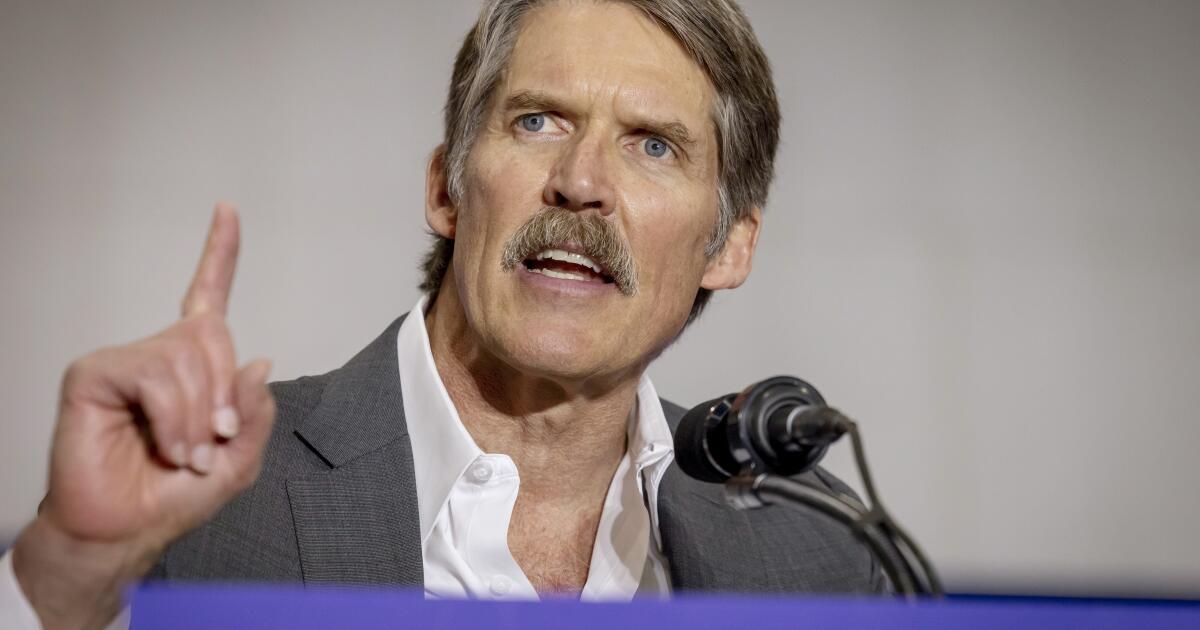
Eric Hovde has, from the looks of it, a pretty swell life.
The banking executive is a millionaire many times over. He owns an ocean-view mansion in Laguna Beach and was named by the Orange County Business Journal for three years running as one of the county’s most influential individuals.
Yet for more than a decade, Hovde, 60, has had a hankering to hold political office. Normally, this is where we’d insert the long litany of rich folk — Michael Huffington, Al Checchi, Meg Whitman among them — who’ve tried and face-planted in their bid to get elected statewide in California.
But Hovde isn’t running here: He’s the leading Republican candidate for U.S. Senate in Wisconsin. It’s where Hovde was born and raised — though, save for an unsuccessful Senate run in 2012, he’s been pretty scarce there the past several years.
Hovde’s opponent is Democrat Tammy Baldwin, who’s running for a third term and starts as a favorite — though not an overwhelming one — to win reelection. In recent years, Wisconsin has replaced Florida as perhaps the most competitive swing state in America.
“We’re deeply polarized by party,” said Charles Franklin, a pollster at Wisconsin’s Marquette University, who notes several contests have been decided in the last decade by exceedingly close margins.
It’s vital for Democrats to hold onto Baldwin’s seat in November if they stand any chance of keeping their bare Senate majority. So naturally they’ve sought to turn Hovde’s California ties into a major campaign issue.
They’ve posted billboards and created a website linking Hovde, or, rather, “California bank owner Eric Hovde (R-Laguna Beach),” to a luxe life of champagne and pleasure. A TV spot — crashing surf, sparkling wine and, of course, palm trees — ends with a rhetorical question: “Eric Hovde on Wisconsin’s side? Don’t bank on it.”
That attempt at California-shaming amounts to a role reversal of sorts. Typically, it’s Republicans in red states like Texas who wield the Golden State as a weapon, turning Gavin Newsom, Kamala Harris and Nancy Pelosi into demon figureheads.
However, it’s not the state’s left-leaning politicians that Democrats are trying to yoke around Hovde’s neck. Rather, they’re trying to raise doubts about his relatability.
“There are rich people in Wisconsin who have multiple homes, too,” said Lilly Goren, who teaches political science at Waukesha’s Carroll University. “But if you spend most of your time out in California where you don’t have to deal with snow and rain and sleet and it’s always sunny, we think you’re living a little bit of a different life.”
Hovde insists he’s a Wisconsinite down to the tips of his toes, which he sank not long ago into Madison’s frozen Lake Mendota. (Actually, he plunged in chest-deep.)
“So the Dems and Sen. Baldwin keep saying I’m not from Wisconsin, which is a complete joke,” a shirtless Hovde said, mid-dip, in a social media post that has been viewed more than 1 million times.
”!!Warning,” the post reads. “Not safe for Californians and career politicians!!”
Brrr.
In an interview last year with the Milwaukee Journal Sentinel, before Hovde launched his candidacy, he “guffawed with amusement” when asked if he was spending the bulk of his time in California or Wisconsin.
“I’m born in Wisconsin, raised in Wisconsin and graduated from the University of Wisconsin,” Hovde told the newspaper. “My home is Wisconsin. I have a business in Wisconsin. So that’s my response.”
The business, Hovde Properties, is a Madison-based real estate company founded by his grandfather. Hovde is also chairman and CEO of Irvine-based H Bancorp and its chief subsidiary, Sunwest Bank.
Since entering the race, Hovde has adopted a nothing-to-see-here approach to questions about his residency — even as he immerses in ice water and exults over the “fantastic fun” of ax-throwing, another moment shared on social media, as a way of bolstering his Badger State bona fides.
Lately, however, the California question has been overshadowed by remarks Hovde made about older voters, who happen to make up a sizable chunk of Wisconsin’s electorate. (A quarter of residents are 60 or older; nearly 1 in 5 are 65 and up.)
Hinting at irregularities in the 2020 election — which seems to be the price of admission to the GOP these days — Hovde repeated bogus claims of widespread voting fraud at Wisconsin nursing homes. In doing so, he questioned the capacity of elderly residents to coherently cast their ballot.
“If you’re in a nursing home, you only have a five-, six-month life expectancy,” Hovde said in a talk-radio interview. “Almost nobody in a nursing home is at a point to vote.”
Which is one way to address the Democratic advantage among seniors — you could simply disenfranchise them — though, for the record, Hovde later clarified his statement by saying, “I think elderly absolutely should vote.”
Unfortunately for Hovde, even as he worked to clean up that political mess, Sunwest Bank was named as co-defendant in a wrongful-death lawsuit targeting a Southern California senior living facility that the bank partly owns. A Hovde spokesperson said neither the bank nor Hovde were involved in the facility’s day-to-day operations.
All in all, that’s made for pretty rough going for Hovde, though there is some consolation should his Senate bid fall short. He still has that mansion awaiting him back in Laguna Beach.
Happy to troll Hovde, Wisconsin’s Democratic Party rounded up cast members of the “Real Housewives of Orange County,” who sent their best wishes in a video and said they dearly miss their sometime-neighbor.
“Cannot wait, just like your friends, for you to come back,” said cast member Gina Kirschenheiter.
“Be back safe, enjoy your journey,” said Vicki Gunvalson, the self-proclaimed “OG of the OC.” Blowing a kiss, she added, “Don’t forget to whoop it while you’re in Wisconsin. Have some cheese curds.”
Which just goes to show, the stereotypes and trash-talking run both ways.



If Democrats expect to flip a U.S. Senate seat in Texas, they’ll need all the stars to align. This almost never happens, because politics has a way of scrambling the constellations. But on Tuesday, the first star blinked on.
I’m referring to state Rep. James Talarico’s victory over Rep. Jasmine Crockett in the Democratic primary. Most political prognosticators agree that Talarico, an eloquent young Democrat who speaks openly about his Christian faith, is their best hope in a red state that Donald Trump won by 14 points.
The second star was Crockett’s conciliatory concession — far from a foregone conclusion after a nasty primary — in which she pledged to “do my part,” adding that “Texas is primed to turn blue, and we must remain united because this is bigger than any one person.”
The third star — a vulnerable Republican opponent — has not yet appeared over the Texas sky, although forecasters say it might.
Most observers agree that scandal-plagued Atty. Gen. Ken Paxton would be beatable in the general election, while incumbent Sen. John Cornyn would present a much tougher challenge. Cornyn is the kind of steady, conventional politician who tends to win elections, and so, of course, modern voters are extremely suspicious of him.
In the GOP primary on Tuesday, Cornyn’s 42% share of the vote edged out Paxton by about a point. Unfortunately for Republicans, neither candidate garnered enough votes to avoid a May 26 runoff election.
Conventional wisdom suggests that when a majority of Republican voters choose someone other than the incumbent in the first round of voting, an even greater majority will inevitably break toward the challenger in the runoff. If that happens, Paxton would become the nominee, and Democrats would get their third star to align.
Even better for Democrats — a fourth star, so to speak — would be for this protracted runoff to become a “knife fight,” as one Texas Republican predicted, in which Paxton staggers out of the fight as the battered GOP nominee.
The only problem is that Republicans can see these stars aligning, too.
And while the Texas Senate seat matters a lot on its own, it matters even more in the context of nationwide midterm elections, in which a Texas win would help Democrats take back the Senate.
Enter the cavalry — or, more accurately, President Trump, who is now entering a second war in the span of a week, this one a civil war in the Lone Star State.
The day after the primary, Trump announced that he would be “making my Endorsement soon, and will be asking the candidate that I don’t Endorse to immediately DROP OUT OF THE RACE!”
Reports suggest Trump may endorse Cornyn in order to save the seat for Republicans. But who knows? Trump is famously unpredictable. And it’s likely he admires Paxton’s ability to survive scandals that would have caused most normal politicians to curl up in the fetal position. As they say, “game recognizes game.”
Whomever he backs, conventional wisdom also says Trump should make his endorsement “soon,” as he promised. That would save Republicans a lot of time and money. But Trump currently has enormous leverage. Right now, people are coming to him, pleading for his support.
Do you think he wants to resolve that situation quickly?
Me neither.
With Trump, you never know what you’re going to get. In 2021, he helped torpedo Republican Senate candidates David Perdue and Kelly Loeffler in Georgia, handing Democrats control of the Senate. The following year he backed football legend Herschel Walker in another Georgia Senate race, which did not exactly work out great. Democrat Raphael Warnock won and holds that seat, though Walker is now ambassador to the Bahamas so that’s something.
This is to say: Trump’s political assistance does not always assist.
It’s unclear whether Trump’s endorsement would be dispositive — and whether he could muscle the other Republican out of the primary race.
Paxton, for example, initially vowed to stay in the race, no matter what. (He later suggested he would “consider” dropping out if the Senate passes the SAVE America Act, a bill to require proof of citizenship to vote.)
There’s also this: Trump’s endorsements tend to either be made out of vengeance or to pad the totals of an already inevitable winner, so his track record is probably overrated.
Case in point: While most of his endorsed candidates won their Texas elections, his endorsed candidate for agriculture commissioner lost reelection. And according to the Texas Tribune, “at least three Trump-endorsed candidates for Congress were headed to runoffs, one of them in a distant second place.”
Another issue is that Cornyn needs more than a perfunctory endorsement: He needs a clear, full-throated endorsement.
In a 2022 Missouri Senate race, Trump endorsed “ERIC,” which was awkward because two candidates named Eric were running.
More recently, he endorsed two rival candidates in the same 2026 Arizona gubernatorial race — like betting on both teams in the Super Bowl.
This is all to say that the only thing standing between Texas Democrats and a rare celestial alignment may be the whims of the Republican Party’s one and only star.
Sure, establishment Republicans can beg Trump to quickly step in and settle the race, and maybe he will. But it’s entirely possible the president will find a way to blow up his party’s chances for holding the U.S. Senate — and there’s nothing they can do to stop him.
When you’re a star, they let you do it.
Matt K. Lewis is the author of “Filthy Rich Politicians” and “Too Dumb to Fail.”

new video loaded: President Fires Noem as Homeland Security Secretary
transcript
transcript
President Fires Noem as Homeland Security Secretary
President Trump fired Kristi Noem, his embattled homeland security secretary, on Thursday and announced his plans to replace her with Senator Markwayne Mullin of Oklahoma.
-
“The fact that you can’t admit to a mistake which looks like under investigation is going to prove that Ms. Good and Mr. Pretti probably should not have been shot in the face and in the back. Law enforcement needs to learn from that. You don’t protect them by not looking after the facts.” “Our greatness calls people to us for a chance to prosper, to live how they choose, to become part of something special. Anyone who searches for freedom can always find a home here. But that freedom is a precious thing, and we defend it vigorously. You crossed the border illegally — we’ll find you. Break our laws — we’ll punish you.” “Did you bid out those service contracts?” “Yes they did. They went out to a competitive bid.” “I’m asking you — sorry to interrupt — but the president approved ahead of time you spending $220 million running TV ads across the country in which you are featured prominently?” “Yes, sir. We went through the legal processes. Did it correctly —” Did the president know you were going to do this?” “Yes.” “I’m more excited about just ready to get started. There’s a lot of work we can do to get the Department of Homeland Security working for the American people.”

By Jackeline Luna
March 5, 2026

NEWYou can now listen to Fox News articles!
The Department of Justice (DOJ) is continuing its investigation into former President Joe Biden’s use of an autopen in the final months of his administration — focusing on pardons and commutations — though a senior official said Biden is unlikely to face criminal exposure.
A senior DOJ official told Fox News the autopen investigation is ongoing and not closed, adding investigators are reviewing clemency actions taken in the final months of the Biden administration.
The official also pointed out, however, that the use of an autopen by a sitting president is “established law.”
The issue under review is whether the autopen was used in violation of the law, specifically, whether Biden personally approved each name included on pardon and commutation lists.
A framed portrait shows former President Joe Biden’s signature and an autopen along “The Presidential Walk of Fame” outside the Oval Office of the White House. (Andrew Harnick/Getty Images)
“These types of cases are tough. Executive privilege issues come into play,” the official said.
What is also clear, the official indicated, is that the target of any potential prosecution would not likely be Biden.
“It’s hard to imagine how [Biden] could be criminally liable for pardon power,” the senior DOJ official said.
BIDEN’S AUTOPEN PARDONS DISTURBED DOJ BRASS, DOCS SHOW, RAISING QUESTIONS WHETHER THEY ARE LEGALLY BINDING
The use of the autopen by former President Joe Biden remains under investigation. (AP Photo)
The official noted that one reason the former president would be unlikely to face charges stems from a 2024 Supreme Court ruling that originally involved current President Donald Trump but would also apply to Biden.
“We conclude that under our constitutional structure of separated powers, the nature of Presidential power requires that a former President have some immunity from criminal prosecution for official acts during his tenure in office,” the Supreme Court ruled in Trump v. United States in 2024.
“At least with respect to the President’s exercise of his core constitutional powers, this immunity must be absolute.”
Sources familiar with the matter told Fox News Digital that U.S. Attorney Jeanine Pirro’s team continues to review the Biden White House’s reliance on an autopen, contradicting a recent New York Times report that indicated the investigation had been paused.
DOJ SIGNALS IT’S STILL DIGGING INTO BIDEN AUTOPEN USE DESPITE REPORTS PROBE FIZZLED
President Donald Trump has pushed for consequences for former President Joe Biden’s alleged use of the autopen. (Julia Demaree Nikhinson/AP Photo)
Trump has pushed for consequences over the autopen controversy, alleging on social media that aides acted unlawfully in its use and raising the prospect of perjury charges against Biden.
Biden has rejected those claims, saying in a statement last year he personally directed the decisions in question.
“Let me be clear: I made the decisions during my presidency,” Biden said. “I made the decisions about the pardons, executive orders, legislation and proclamations. Any suggestion that I didn’t is ridiculous and false.”
The House Oversight Committee has homed in on Biden’s clemency actions, including five controversial pardons for family members in the final days of his presidency, citing what it described as a lack of “contemporaneous documentation” confirming that Biden directly ordered the pardons.
CLICK HERE TO DOWNLOAD THE FOX NEWS APP
The committee asked the DOJ to investigate “all of former President Biden’s executive actions, particularly clemency actions, to assess whether legal action must be taken to void any action that the former president did not, in fact, take himself.”
Fox News Digital’s Ashley Oliver contributed to this report.
Related Article


Brain aging may accelerate after cancer treatment, study suggests

Chargers’ Justin Herbert gushes over Madison Beer in heartfelt birthday tribute: ‘Changed my life forever’

AI T-shirt could detect hidden heart risks

Labubu maker Pop Mart is opening U.S. headquarters in Culver City

Commentary: From late-night TV to viral memes, Kristi Noem was the gag that kept on giving. What now?

Florida High School Football Rankings: Top 25 teams – Oct. 21

Cleary's 21 help Le Moyne down Central Connecticut State 69-64 in OT

How old is Bo Nix? What to know about Oregon quarterback ahead of 2024 NFL Draft

99th annual Pony Swim held in Virginia

Indiana Members Credit Union announced as new anchor tenant at Bottleworks District

‘No deal with Iran except unconditional surrender,’ Trump says

A dead woman’s key fob and two grisly crime scenes: How the Utah triple-murder suspect was tracked across state lines | CNN

DOJ continues Biden autopen probe despite former president unlikely to face charges
Fact check: Did French border guards mock influencers returning from Dubai amid Iran war?

Iran’s fight for survival / The widening war / Trump’s nebulous goals : Sources & Methods
-

 World1 week ago
Exclusive: DeepSeek withholds latest AI model from US chipmakers including Nvidia, sources say
-

 Wisconsin4 days ago
Setting sail on iceboats across a frozen lake in Wisconsin
-

 Massachusetts3 days ago
Massachusetts man awaits word from family in Iran after attacks
-

 Massachusetts1 week ago
Mother and daughter injured in Taunton house explosion
-

 Maryland5 days ago
AM showers Sunday in Maryland
-

 Florida5 days ago
Florida man rescued after being stuck in shoulder-deep mud for days
-

 Denver, CO1 week ago
10 acres charred, 5 injured in Thornton grass fire, evacuation orders lifted
-

 Oregon7 days ago
2026 OSAA Oregon Wrestling State Championship Results And Brackets – FloWrestling