Politics
California's war on plastic bag use seems to have backfired. Lawmakers are trying again

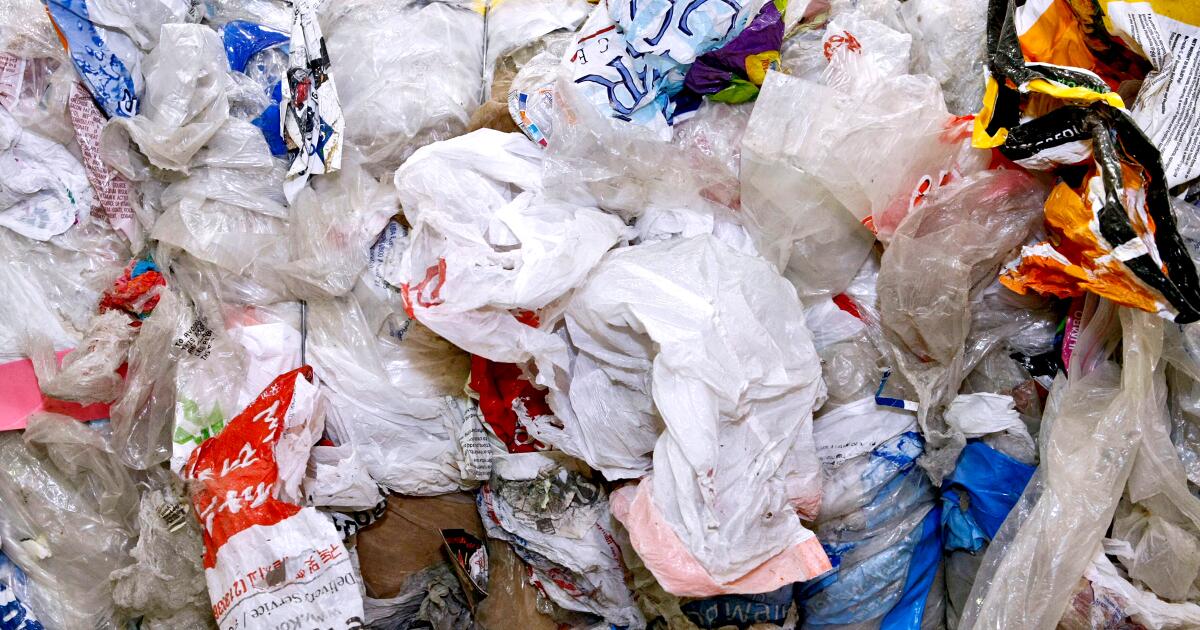
It was a decade ago when California became the first state in the nation to ban single-use plastic bags, ushering in a wave of anti-plastic legislation from coast to coast.
But in the years after California seemingly kicked its plastic grocery sack habit, material recovery facilities and environmental activists noticed a peculiar trend: Plastic bag waste by weight was increasing to unprecedented levels.
Aggressive and impactful reporting on climate change, the environment, health and science.
According to a report by the consumer advocacy group CALPIRG, 157,385 tons of plastic bag waste was discarded in California the year the law was passed. By 2022, however, the tonnage of discarded plastic bags had skyrocketed to 231,072 — a 47% jump. Even accounting for an increase in population, the number rose from 4.08 tons per 1,000 people in 2014 to 5.89 tons per 1,000 people in 2022.
The problem, it turns out, was a section of the law that allowed grocery stores and large retailers to provide thicker, heavier-weight plastic bags to customers for the price of a dime.
“It was a conscious decision to create a pathway for a type of reusable bag that barely existed,” said Mark Murray, director of Californians Against Waste, an environmental organization. “It was just emerging in the marketplace, but it happened to be made by a couple of California companies … which the manufacturers claimed they could certify as being reusable.”
He said the bags were made of 20% recyclable material and the manufacturers said they could be recycled at the end of their “useful life. … So we said, all right, fine. We’re gonna put that specific criteria into the law.”
“That experiment failed,” Murray said.
“It was a gaping hole,” said Mark Gold, director of Water Scarcity Solutions, Environmental Health at the Natural Resources Defense Council who worked on the original legislation — SB 270 — while he was with the organization Heal the Bay.
These “reusable” bags are made from a material known as HDPE, which is thicker and heavier than the LDPE plastic bags of yore. And although both materials can be recycled — and in commercial and agricultural settings often are recycled — they are generally not in residential and consumer settings, Murray said.
“Basically what happened is that plastic bag companies invented these thicker plastic bags that technically meet that definition of reusable but are clearly not being reused and don’t look like reusable bags and which just circumvent the law’s intent,” said Jenn Engstrom, CALPIRG’S state director.
Now, California legislators are hoping to correct that error by passing a law that closes that loophole and bans those thick plastic bags offered at the checkout line.
“The idea is to go back and redefine reusable bags as a way to get rid of all those setbacks that we’re now seeing very commonly in grocery stores,” Engstrom said.
Thick plastic bags are “not what consumers demanded when they overwhelmingly voted to support California’s bag ban at the ballot box when the policy was challenged,” Sen. Ben Allen (D-Santa Monica) told reporters recently in reference to Proposition 67, a 2016 ballot measure that would have negated the 2014 law.
“Californians want less plastic, not more.”
The proposed legislation was co-authored by Allen, Assemblymember Rebecca Bauer-Kahan (D-Orinda) and Sen. Catherine Blakespear (D-Encinitas).
Research has shown that the plastic problem is growing.
Plastic has been found everywhere scientists have looked: From the deepest oceanic trenches to the highest alpine peaks. Petroleum-based plastics do not biodegrade. Over time, they break down into smaller and smaller pieces — known as microplastics, microfibers and nanoplastics — and have been found in household dust, drinking water and human tissue and blood.
These small plastic pieces also carry chemicals and heavy metals known to cause illness and disease.
“If you’ve been paying attention and reading the news, looking around, you realize that we are literally choking our planet with plastic waste,” Blakespear said at the news conference. She noted that 5 trillion bags are used every year across the globe — and that the average use time per bag is 12 minutes.
Part of the issue has to do with the promises that product manufacturers made about recycling, and the hard realities of plastic collection and reuse. In 2018, the Environmental Protection Agency estimated that just 8.7% of all plastics were actually recycled.
In 2022, California Atty. Gen. Rob Bonta opened an investigation into the fossil fuel and petrochemical industries for their alleged role in causing and exacerbating a global crisis in plastic waste pollution, and for deceiving the public into thinking recycling could solve the problem of plastic waste.
Allen and Engstrom said states such as New Jersey and New York followed California’s move toward banning plastic bags but learned from California’s mistake and crafted legislation to close the loophole.
“There’s this virtuous cycle of dialogue between those states that want to do the right thing where we we build on each other’s work and almost challenge each other” to write effective, all-encompassing laws, Allen said.
He also said he anticipates a pretty clear road for this legislation as it moves through the Assembly and Senate, in large part because it is supported by the California Grocers Assn.
Daniel Conway, the association’s vice president for government relations, described the original plastic bag ban legislation as “revolutionary,” but “at the same time, I think like most good laws, you have to take a look and adapt to changes in the world that we live in.”
Gold wasn’t surprised the first law didn’t work.
“This is what happens when you try to fight plastic one item at a time,” he said. “It’s just not effective at stemming the plastic problem.”
He said a far better approach was SB 54, a bill that Gov. Gavin Newsom signed into law in 2022.
That sweeping law seeks to phase out single-use plastics through a policy concept known as Extended Producer Responsibility, which shifts the onus of waste from consumers, towns and cities to companies manufacturing products with environmental impacts.
The law also grants plastics companies extensive oversight and authority in terms of the program’s management, execution and reporting, via a Producer Responsibility Organization, which will be made up of industry representatives.
The legislation requires that by Jan. 1, 2028, at least 30% of plastic items sold, distributed or imported into the state be recyclable. By 2032, that number rises to 65%. It also calls for a 25% reduction in single-use plastic waste by 2032 and provides CalRecycle with the authority to increase that percentage if the amount of plastic in the economy and waste stream grows.
In the case of expanded polystyrene, that number needs to reach 25% by 2025. If the number isn’t hit, the ubiquitous, hard-to-recycle foamy plastic will be banned.


NEWYou can now listen to Fox News articles!
President Donald Trump is set to deliver what the White House is calling a “historic” speech Saturday night before a massive fireworks display celebrating America’s 250th anniversary.
Trump is still expected to take the stage at 10 p.m. at the conclusion of the Salute to America celebration on the National Mall, though timing of events may fluctuate due to adverse weather, per a senior White House official.
The president’s address is expected to look back on America’s history since its founding 250 years ago, a senior White House official told Fox News.
THE LESSON WE CAN LEARN FROM BICENTENNIAL HISTORY IS TO PARTY LIKE IT’S 1976
President Donald Trump speaks during a rally at Mount Rushmore National Memorial on July 3, 2026 in Keystone, South Dakota. (Chip Somodevilla/Getty Images)
Trump will deliver a “unique” speech featuring the stories of American heroes.
“It will be a unique speech unlike any other he’s given before,” the official added.
Earlier Saturday, Trump celebrated what he described as a “stronger than ever” America in a Truth Social post, praising the “incredible” crowds gathered in Washington despite the heat and storms.
FOURTH OF JULY APP GUIDES SPECTATORS THROUGH NINE-HOUR AIR SHOW FROM NASA JETS TO B-1 BOMBERS
The grand finale lasted over two minutes to cap a 23-minute light and fireworks display over Mount Rushmore after President Donald Trump’s 28-minute speech, brief by his lengthy standards. (Matt Gade)
The president also highlighted the air shows over the nation’s capital, saying the pilots and aircraft were “at a level never seen before.”
Trump also addressed recent vandalism at the Reflecting Pool, calling those responsible “Vandal Thugs” and promising the pool would be drained and repaired after the holiday weekend.
The president’s remarks come one day after he delivered a patriotic speech at Mount Rushmore, where he called the United States the “most exceptional nation ever to exist” and warned that communism posed the nation’s greatest threat.
TRUMP HAILS AMERICA AS ‘MOST EXCEPTIONAL NATION EVER TO EXIST’ IN MOUNT RUSHMORE SPEECH
The U.S. Air Force Thunderbirds perform a flyover during “Salute to America 250” Fourth of July celebrations on the National Mall on July 4, 2026, in Washington, DC. (Finn Gomez/Getty Images)
“Communism is the exact opposite of life, liberty and the pursuit of happiness — it is death, tyranny and the pursuit of evil.
A severe thunderstorm swept through Washington on Saturday evening, prompting emergency officials to urge people on the National Mall to seek shelter.
CLICK HERE TO DOWNLOAD THE FOX NEWS APP
Freedom 250, the event organizer, said it would provide updates on the evening’s schedule as weather conditions developed.

As CNN prepares for change under a new owner, the network’s chief legal affairs correspondent, Paula Reid, is heading for the exit and expected to jump to MS NOW.
The Washington-based Reid’s contract with CNN is up in several months and she has told the network she does not plan to renew. She is expected to sign on with CNN competitor MS NOW, according to people familiar with her plans who were not authorized to comment publicly.
A representative for MS NOW said the network does not comment on personnel matters but added, “as everyone in Washington knows, Paula Reid is an exceptional reporter, and any news organization would be fortunate to showcase her journalism.”
Reid‘s planned departure comes ahead of the impending merger of CNN parent Warner Bros. Discovery and Paramount. The combination has led to speculation over who will run CNN, and the uncertainty is said to have played a factor in Reid’s decision.
Reid joined CNN from CBS News in 2021.
CNN and Paramount’s CBS News will be combined after the merger, but the management structure is still under discussion. Paramount put Bari Weiss, founder of the heterodox digital news site the Free Press, in charge of CBS News in October, with a mandate to move the network’s coverage more to the political center. Based on the chaos that has ensued at CBS News under her watch, many CNN insiders are concerned over her possible stewardship of an even larger and more complex organization.
CBS News executives and on-air talent have pushed back at Weiss’ efforts to make changes at the division, which many insiders have viewed as an attempt to placate the Trump White House while Paramount seeks regulatory approvals needed ahead of closing the $111-billion Warner Bros. Discovery deal.
Internal resistance to Weiss has been strongest at the venerable news magazine “60 Minutes.” The program’s star correspondent Scott Pelley was fired last month after he confronted management over the dismissals of executive producer Tanya Simon and his on-air colleagues Sharyn Alfonsi and Cecilia Vega.
Weiss’ overhaul of the “CBS Evening News” with her handpicked anchor Tony Dokoupil has failed to improve the third-place program’s competitive position in the ratings. The program has also been criticized for some of its editorial decisions and logistical snafus.
CNN anchor Anderson Cooper has reportedly told colleagues he does not want to work for Weiss if the cable network is put under her purview. He already rejected an offer from Weiss to anchor the “CBS Evening News” and declined to renew his deal as a “60 Minutes” contributor after nearly two decades with the program.
The chaos at CBS has given pause to people at CNN. Larry Ellison, the tech billionaire and father of Paramount Chief Executive David Ellison, has reportedly promised Trump there will be sweeping changes to CNN after the merger.
Reid, 43, is among the many TV news correspondents and anchors that Trump has disparaged over the years, claiming they are unfair in their coverage. As White House correspondent for CBS News, Reid was known for asking tough questions of Trump during his White House briefings on the coronavirus.
Reid was a lawyer before becoming a journalist at CBS News in 2010. In addition to serving as White House correspondent for the network, she covered the Justice Department and the Supreme Court.
Reid would be another significant hire for MS NOW, the progressive-leaning channel that is rebuilding its roster after separating from NBC News and its parent, Comcast. The network formerly known as MSNBC is now part of Versant, a company with a stable of cable networks spun off by Comcast.
Peter Alexander, former chief White House correspondent for NBC News, is joining MS NOW as a morning anchor later this year. The network also hired former “CBS Mornings” executive producer Shauna Thomas as political director.

Doug Burgum highlights American innovation at Great American State Fair
Interior Secretary Doug Burgum joins ‘Fox & Friends’ live from the Great American State Fair in Washington. He emphasizes America’s legacy of innovation and entrepreneurship, discussing the impact of AI and free markets. Burgum also addresses recent vandalism at the Lincoln Memorial Reflecting Pool on June 22 and the upcoming July 4th opening of the Teddy Roosevelt Presidential Library.
NEWYou can now listen to Fox News articles!
Interior Secretary Doug Burgum is defending President Donald Trump’s many initiatives to address infrastructure in Washington, D.C., calling it a visible reminder that the country needs to actively press back against decline.
“Nations don’t crumble by fate — they decline by choice,” Burgum told Fox News Digital.
“From rehabilitating and installing historic memorials, statues, and fountains to removing hundreds of instances of graffiti and cleaning up crime on our streets, this administration is proving that American greatness is built through action,” he continued.
Burgum’s reasoning, which came ahead of the United States’ 250th Independence Day anniversary, addresses criticisms of the administration that have surfaced in recent weeks, casting doubt on whether Trump’s many renovation and construction initiatives in Washington, D.C. have been worth their price tag.
WHITE HOUSE SEIZES ON DELAYED OBAMA PRESIDENTIAL CENTER OPENING TO CROWN TRUMP ‘BUILDER-IN-CHIEF’
Split of sample tests in the Lincoln Memorial Reflecting Pool. (@realDonaldTrump via Truth Social)
As part of the 250th celebration, Trump has spent $14.7 million to restore the Lincoln Memorial’s reflecting pool, allocated $250 million to restore the Kennedy Center and is on track to spend over $400 million on the construction of a ballroom at the White House.
Trump, in a Truth Social update about the reflecting pool, framed the efforts as part of a larger effort.
“We’ve cleaned, renovated and beautified over 45 monuments and memorials, 28 statues and 22 fountains in Washington, D.C. Things are really looking good in our nation’s capital. Add to that the fact that when I became president, crime was rampant. And now Washington, D.C. is one of the safest cities anywhere in the United States,” Trump wrote.
REPUBLICANS QUESTION TRUMP’S ‘PRIVATELY FUNDED’ BALLROOM AFTER REPORT POINTS TO TAXPAYER BURDEN
Interior Secretary Doug Burgum reacted during a meeting with Venezuela’s interim President Delcy Rodríguez at the Miraflores Presidential Palace on March 4, 2026, in Caracas, Venezuela. (Federico Parra/AFP via Getty Images)
The Department of the Interior, which has overseen many of the improvements, further updated its accomplishments ahead of July 4.
The city has removed 510 instances of graffiti, removed 154 homeless encampments, applied 212 tons of repair materials to roads and parkways, restored 280,000 square feet of roadway paving, rehabilitated 1,301 benches and fixed 1,913 lights.
Burgum said the repairs were emblematic of the administration’s aggressive posture towards addressing problems that had gone ignored in the past. In addition to these major improvements, DOI has restored and cleaned dozens of monuments and statues around DC.
DOI also recently helped transform Meridian Hill Park, which got high praise on social media by DC residents, into a desirable place to visit with a restored fountain that had been under construction for years with very little movement. They also cleaned and restored some of the statues in the park, including the Joan of Arc statue and the James Buchanan Memorial.
FIRST ON FOX: TRUMP ADMIN TRANSFORMS DC HOTSPOT ONCE ROCKED BY GEORGE FLOYD PROTESTS IN SYMBOLIC REVERSAL
Washington DC city workers dismantle tents and remove personal belongings during a sweep of a homeless encampment in the Foggy Bottom neighborhood in Washington, DC, on August 14, 2025. (JIM WATSON/AFP via Getty Images)
CLICK HERE TO DOWNLOAD THE FOX NEWS APP
“While others accept decline, President Trump and the Department of the Interior are restoring the heart of our nation’s capital,” Burgum said. “The Golden Age of America isn’t just a slogan, it’s being rebuilt, one landmark, one street and one victory at a time.”
-

 Oklahoma1 minute ago
Widespread outages hit Norman and Oklahoma City as crews begin power restoration
-

 Oregon6 minutes ago
Wildfire Fact Sheet – (Incident #0383) | Central Oregon Fire Information
-

 Pennsylvania13 minutes ago
PHOTOS: Storm damage across central Pennsylvania
-

 Rhode Island16 minutes ago
Will Taylor Swift hold a post-wedding bash in Rhode Island?
-

 South-Carolina21 minutes ago
Summer offer leads to EDGE Jayden Broadie’s commitment to South Carolina
-
South Dakota28 minutes ago
SD Lottery Powerball, Lotto America winning numbers for July 4, 2026
-

 Tennessee31 minutes ago
Tennessee troopers investigating deadly crash involving UTV, train
-

 Texas36 minutes ago
Thousands gather in Arlington for the annual Independence Day Parade

