Politics
California tightens leash on puppy sales with new laws signed by Newsom

Brooke Knowles knew she wanted the black puppy posted on the Facebook page of a self-described home breeder of Coton De Tulears. He looked like he’d have an outgoing personality.
She put down a nonrefundable deposit and drove to Temecula to pick him up. She paid about $2,000 and named him Ted.
Before she even left for home, Ted vomited and had diarrhea on the grass outside. He was lethargic, his chest soaked with drool.
A closer look later at the paperwork provided by the seller revealed something else unsettling: Ted wasn’t bred in California. He had been imported from a kennel in Utah.
“I thought that I was getting a dog that had been bred at his home,” Knowles said in a series of interviews with The Times. “This poor puppy, he was so traumatized.”
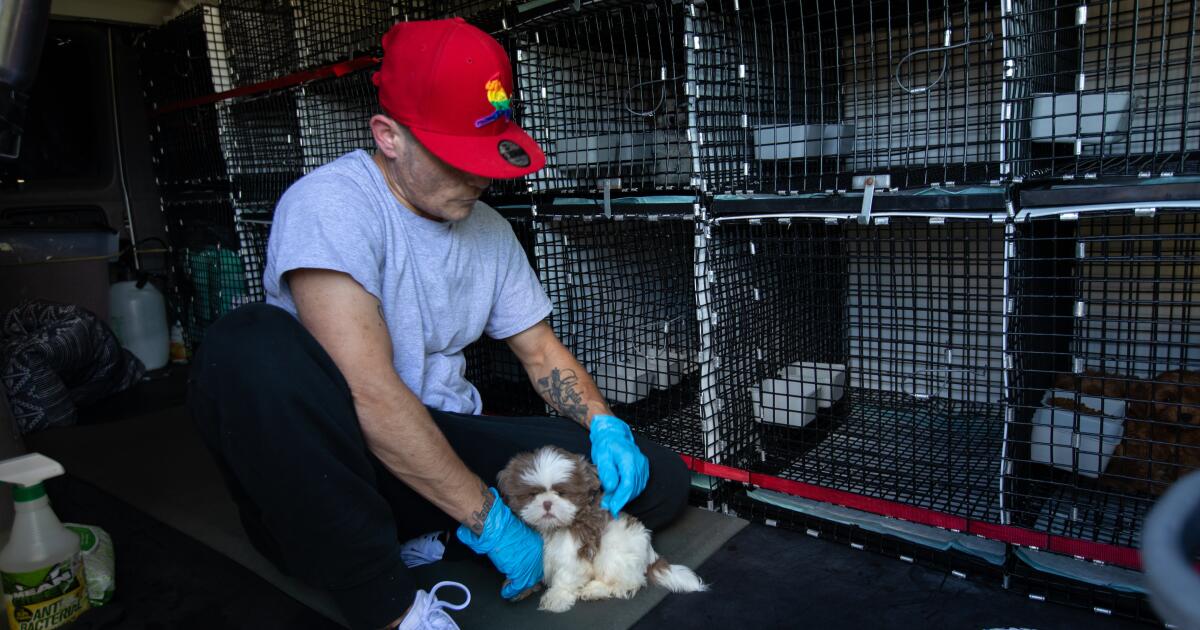
On Thursday, Gov. Gavin Newsom signed a series of animal welfare bills into state law that will restrict puppy sales and strengthen protections for buyers like Knowles. The bills were introduced as a result of a Times investigation last year that detailed how designer dogs are trucked into California from out-of-state commercial breeders and resold by people saying they were small, local operators.
The three bills Newsom signed into law are:
- Assembly Bill 519 by Assemblymember Marc Berman (D-Menlo Park) bans online marketplaces where dogs are sold by brokers, which is defined as any person or business that sells or transports a dog bred by someone else for profit. That includes major national pet retailers, including PuppySpot, as well as California-based operations that resell puppies bred elsewhere. The law applies to dogs, cats and rabbits under a year old. It does not apply to police dogs or service animals and provides an exemption for shelters, rescues and 4H clubs.
- AB 506 by Assemblymember Steve Bennett (D-Ventura) voids pet purchase contracts involving California buyers if the seller requires a nonrefundable deposit. The law also makes the pet seller liable if they fail to disclose breeder details and medical history.
- Senate Bill 312 by state Sen. Tom Umberg (D-Orange) requires pet sellers to share health certificates with the California Department of Food and Agriculture, which would then make them available without redactions to the public.
The bills were supported by California Atty. Gen. Rob Bonta, who said they are “an important step in shutting down deceptive sales tactics of these puppy brokers.”
“Sunlight is the best disinfectant, and it’s time to shine a light on puppy mills,” Newsom said in a statement. “Greater transparency in pet purchases will bring to light abusive practices that take advantage of pets in order to exploit hopeful pet owners. Today’s legislation protects both animals and Californians by addressing fraudulent pet breeding and selling practices.”
Lawmakers said new laws close loopholes that emerged after California in 2019 banned the sale of commercially bred dogs, cats and rabbits in pet stores. That retail ban did not apply to online sales, which surged during the COVID-19 pandemic.
The Times’ investigation found that in the years after the retail ban took effect, a network of resellers stepped in to replace pet stores, often posing as local breeders and masking where puppies were actually bred. Some buyers later discovered they had purchased dogs from sellers using fake names or disposable phone numbers after their pets became ill or died.
Times reporters analyzed the movement of more than 71,000 dogs coming into California since 2019 by requesting certificates of veterinary inspection, which are issued by a federally accredited veterinarian listing where the animal came from, its destination and verification that it is healthy enough to travel.
The California Department of Food and Agriculture has long received those health certificates from other states by mistake — the records are supposed to go to county public health departments — and, in recent years, made it a practice to immediately destroy them. Dog importers who were supposed to submit the records to counties largely failed to do so.
The Times obtained the records by requesting the documents from every other state. In the days following the story’s publication, lawmakers and animal advocates called on the state’s Food and Agriculture Department to stop “destroying evidence” of the deceptive practices by purging the records. The department began preserving the records thereafter, but released them with significant redactions.
In one instance, the state redacted the name and address of a person with numerous shipments of puppies from Ohio. The Times obtained the same travel certificates without redactions from the Ohio Department of Agriculture. The address listed on the records is for a Home Depot in Milpitas. The phone number on some of those travel certificates belongs to Randy Kadee Vo.
The Times’ reporting last year found Vo’s name and various Bay Area addresses, including a warehouse, were listed as the destination for 1,900 dogs imported into California since 2019. At the time, he disputed that number but declined to say how many he had imported. People who bought puppies from Vo told The Times that they were told they were buying puppies that were locally bred.
Shortly after The Times questioned Vo about the imports, a different name, along with the Home Depot address, began appearing on health certificates with his phone number. Vo did not respond to a request for comment.
The Times identified hundreds of records detailing other sellers with names that appear to be fake or addresses that go to unaffiliated businesses, shopping centers and commercial mailbox offices.
While the new laws were championed by animal welfare groups, some have questioned how adequately the laws will be enforced by state officials — particularly when it comes to policing out-of-state facilities selling online and then shipping puppies directly California buyers.
“Enforcement will now fall on nonprofits like ours to monitor and report issues that we see, in hopes that the agencies act,” said Mindi Callison, head of the Iowa-based anti-puppy-mill nonprofit Bailing Out Benji.
Callison said lawmakers should next turn their focus to requiring California breeders to be licensed, similar to standards in Iowa, Missouri and other states. California does not have a statewide licensing program, instead relying on local jurisdictions for oversight. While some cities and counties require breeders to be licensed and inspected, little information is available online to help consumers vet them.
“There is a higher risk of dogs being kept in inhumane conditions in states where there are no regulations to follow and have no eyes on them,” Callison said.
Opponents of the legislation argued that California’s previous attempts to cut off the supply from puppy mills by banning pet store sales only fueled an unregulated marketplace — and warned banning brokers will do the same.
“Eliminating these brokers will not reduce demand for pets; it will simply force more Californians into unregulated, riskier marketplaces,” said Alyssa Miller-Hurley of the Pet Advocacy Network, which represents breeders, retailers and pet owners, in a letter opposing the legislation.
For consumers like Knowles, the lack of transparency when buying her puppy Ted has been long-lasting and costly. More than a year after Knowles took the puppy to her home in Long Beach, he developed stomach issues that got so bad he wound up in the emergency room. She also had doubts that her puppy was a purebred Coton De Tulear as advertised.
She said a pet DNA test confirmed those suspicions and connected her with other people whose dogs were purchased from the same seller. The test results said one of the dogs share the same amount of DNA as people do with their full siblings – and that they’re mutts.
“We call him the most expensive rescue dog we’ve ever had,” Knowles said of Ted, who is now on a restrictive diet. “Our group started to call our dogs ‘Fauxtons,’ since they weren’t Cotons.”
Knowles sued the seller, Tweed Fox of Carlsbad Cotons, over the test results showing Ted was not a purebred puppy, but said she lost.
“Really the core issue is … masquerading to be something you’re not,” she said.
Fox told The Times that he began sourcing from a Utah company during the Covid pandemic, when the demand for puppies spiked beyond the number he was able to breed at home.
He thought the Utah puppies were purebreds because they came with the proper registration paperwork, but said that “turned out not to be the case.” He said he did not mislead customers because he was in fact a home breeder, and only advertised the out-of-state puppies as Coton de Tulears, “which is what I thought I was purchasing.”
“You only can breed so many in a home,” he said. “I thought I was providing equal quality puppies at the time, and apparently, I wasn’t at that point, except for my own home bred.”
Fox said he has since moved to Dallas, where he breeds and sells Cotons. While the California broker law won’t impact him now that he’s left the state, he said he refuses to buy anyone else’s puppies for resale.
“I only sell my own,” he said. “I’m not in the business to cheat people out of anything.”



new video loaded: President Fires Noem as Homeland Security Secretary
transcript
transcript
President Fires Noem as Homeland Security Secretary
President Trump fired Kristi Noem, his embattled homeland security secretary, on Thursday and announced his plans to replace her with Senator Markwayne Mullin of Oklahoma.
-
“The fact that you can’t admit to a mistake which looks like under investigation is going to prove that Ms. Good and Mr. Pretti probably should not have been shot in the face and in the back. Law enforcement needs to learn from that. You don’t protect them by not looking after the facts.” “Our greatness calls people to us for a chance to prosper, to live how they choose, to become part of something special. Anyone who searches for freedom can always find a home here. But that freedom is a precious thing, and we defend it vigorously. You crossed the border illegally — we’ll find you. Break our laws — we’ll punish you.” “Did you bid out those service contracts?” “Yes they did. They went out to a competitive bid.” “I’m asking you — sorry to interrupt — but the president approved ahead of time you spending $220 million running TV ads across the country in which you are featured prominently?” “Yes, sir. We went through the legal processes. Did it correctly —” Did the president know you were going to do this?” “Yes.” “I’m more excited about just ready to get started. There’s a lot of work we can do to get the Department of Homeland Security working for the American people.”

By Jackeline Luna
March 5, 2026

NEWYou can now listen to Fox News articles!
The Department of Justice (DOJ) is continuing its investigation into former President Joe Biden’s use of an autopen in the final months of his administration — focusing on pardons and commutations — though a senior official said Biden is unlikely to face criminal exposure.
A senior DOJ official told Fox News the autopen investigation is ongoing and not closed, adding investigators are reviewing clemency actions taken in the final months of the Biden administration.
The official also pointed out, however, that the use of an autopen by a sitting president is “established law.”
The issue under review is whether the autopen was used in violation of the law, specifically, whether Biden personally approved each name included on pardon and commutation lists.
A framed portrait shows former President Joe Biden’s signature and an autopen along “The Presidential Walk of Fame” outside the Oval Office of the White House. (Andrew Harnick/Getty Images)
“These types of cases are tough. Executive privilege issues come into play,” the official said.
What is also clear, the official indicated, is that the target of any potential prosecution would not likely be Biden.
“It’s hard to imagine how [Biden] could be criminally liable for pardon power,” the senior DOJ official said.
BIDEN’S AUTOPEN PARDONS DISTURBED DOJ BRASS, DOCS SHOW, RAISING QUESTIONS WHETHER THEY ARE LEGALLY BINDING
The use of the autopen by former President Joe Biden remains under investigation. (AP Photo)
The official noted that one reason the former president would be unlikely to face charges stems from a 2024 Supreme Court ruling that originally involved current President Donald Trump but would also apply to Biden.
“We conclude that under our constitutional structure of separated powers, the nature of Presidential power requires that a former President have some immunity from criminal prosecution for official acts during his tenure in office,” the Supreme Court ruled in Trump v. United States in 2024.
“At least with respect to the President’s exercise of his core constitutional powers, this immunity must be absolute.”
Sources familiar with the matter told Fox News Digital that U.S. Attorney Jeanine Pirro’s team continues to review the Biden White House’s reliance on an autopen, contradicting a recent New York Times report that indicated the investigation had been paused.
DOJ SIGNALS IT’S STILL DIGGING INTO BIDEN AUTOPEN USE DESPITE REPORTS PROBE FIZZLED
President Donald Trump has pushed for consequences for former President Joe Biden’s alleged use of the autopen. (Julia Demaree Nikhinson/AP Photo)
Trump has pushed for consequences over the autopen controversy, alleging on social media that aides acted unlawfully in its use and raising the prospect of perjury charges against Biden.
Biden has rejected those claims, saying in a statement last year he personally directed the decisions in question.
“Let me be clear: I made the decisions during my presidency,” Biden said. “I made the decisions about the pardons, executive orders, legislation and proclamations. Any suggestion that I didn’t is ridiculous and false.”
The House Oversight Committee has homed in on Biden’s clemency actions, including five controversial pardons for family members in the final days of his presidency, citing what it described as a lack of “contemporaneous documentation” confirming that Biden directly ordered the pardons.
CLICK HERE TO DOWNLOAD THE FOX NEWS APP
The committee asked the DOJ to investigate “all of former President Biden’s executive actions, particularly clemency actions, to assess whether legal action must be taken to void any action that the former president did not, in fact, take himself.”
Fox News Digital’s Ashley Oliver contributed to this report.
Related Article

Politics
Anxiety grows among California Democrats as gubernatorial candidates rebuff calls to drop out

SACRAMENTO — Despite a plea from the head of the California Democratic Party for underperforming candidates to drop out of the governor’s race, all but one of the party’s top hopefuls spurned the request.
Party leaders fear the growing possibility that the crowded field will split the Democratic electorate in the state’s June top-two primary election and result in two Republicans advancing to the November ballot, ensuring a Republican governor being elected for the first time since 2006.
His advice largely unheeded, state party Chairman Rusty Hicks on Thursday said the fate of a Democratic victory now rests squarely on the gubernatorial candidates who flouted him.
“The candidates for Governor now have a chance to showcase a viable path to win,” Hicks said in a statement Thursday.
Eight top Democratic candidates filed the official paperwork to appear on the June ballot after Hicks released a letter on Tuesday urging those “who cannot show meaningful progress towards winning” to drop out. Friday is the deadline to file to appear on the primary election ballot. On March 21, the secretary of state’s office will formally announce who will appear on the June ballot.
“It sounded like someone who has his head in the sand,” former Los Angeles Mayor Antonio Villaraigosa said of Hicks’ open letter. “[Most] of us filed within 24 hours of getting that letter. It created some press but not much else. It didn’t impact [most] of the candidates and it certainly didn’t impact my candidacy.”
Democratic strategist Elizabeth Ashford said it was appropriate for Hicks and other Democratic leaders to make a public plea as opposed to keeping such discussions solely behind closed doors.
But the response showed the limited power of the modern-day party bosses.
“It’s definitely not Tammany Hall,” said Ashford, referring to the storied Democratic political machine that had a grip on New York City politics for nearly a century. “The party and Rusty are influential and they are helpful and that is their role. I don’t think anyone would be comfortable with outright public strong-arming of specific candidates.”
Ashford, who worked for former Govs. Jerry Brown and Arnold Schwarzenegger, along with former Vice President Kamala Harris when she served as state attorney general, added that the minimal power of the state GOP is likely a factor in the dynamics of Democrats’ decision to stay in the race. Democratic registered voters outnumber Republicans by almost a 2-to-1 margin in the state, and Democrats control every statewide elected office and hold supermajorities in both chambers of the California Legislature.
“If there were a strong viable opposition that existed, if the Republican Party was actually relevant in California, I think that would sort of force greater unity amongst Democrats,” she said.
Just one of the nine major Democrats did heed the party chair’s message. Ian Calderon, a former Los Angeles-area Assemblyman who consistently polled near the bottom of the field, withdrew from the race and endorsed Rep. Eric Swalwell (D-Dublin) on Thursday.
Candidates cannot withdraw their name from the ballot once they officially file to run for office, leading to some fears that even if other candidates drop out of the race, a crowded primary ballot could still split California’s liberal votes.
“I’m disappointed most of them will be on the ballot,” said Lorena Gonzalez, the head of the California Federation of Labor Unions, which will announce whether it endorses in the governor’s race on March 16. But “I do still think you can have people drop out of the race or become viable. I think that there are candidates who know viability is a real thing they have to show in coming weeks” before ballots start being mailed to voters.
Jodi Hicks, chief executive and president of Planned Parenthood Affiliates of California, said she is “still worried” about the prospect of two Republicans winning the top two spots in the June primary, shutting Democrats out of any chance of winning the governor’s office in November.
“I didn’t have any specifics of who I wanted to do what,” she said. “I’m just very, very concerned and the stakes are really high right now and seem to be getting worse by the day.”
Republican candidate Steve Hilton, a former Fox News host, said he is “confident that I’ll be in the top two” along with a Democratic candidate. “I find it very difficult to believe that the Democratic Party will just surrender California and allow two Republicans to be in the top two.”
Hilton made the comments Thursday after a gubernatorial forum in Sacramento hosted by the California Assn. of Realtors focused on housing and homeownership. Villaraigosa, former Health and Human Services Secretary Xavier Becerra, San Jose Mayor Matt Mahan and former Rep. Katie Porter also attended. Swalwell, who is currently in Washington, joined the panel virtually.
During the panel, candidates were in broad agreement about the need to reduce barriers and costs in order to build more housing in California, where the median single-family home costs more than $820,000. Many also endorsed proposals to disincentivize private investment firms from buying up homes as well as a $25-billion bond proposed by former Sen. Bob Hertzberg to help first-time homebuyers afford a down payment.
“This really isn’t a debate because we’re agreeing so much with each other,” Hilton said at one point during the event.
That political alignment on one of the most pressing issues facing California may explain why voters are having such a difficult time deciding who to support.
A recent poll of the Public Policy Institute of California found that the five candidates topping the crowded field were within 4 percentage points of one another: Porter, Swalwell, Hilton, Democratic hedge fund founder Tom Steyer and Republican Riverside County Sheriff Chad Bianco. Earlier polls had Hilton and Bianco leading the field, though many voters remained undecided.
Some candidates took issue with Hicks’ push to cull the field, noting that most of the lower-polling candidates he asked to drop out are people of color.
“Our political system is rigged, corrupted by the political elites, the wealthy and well connected,” state Supt. of Public Instruction Tony Thurmond, who is Black and Latino, said in a video posted on social media in response to the open letter. “The California Democratic Party is essentially telling every person of color in the race for Governor to drop out.”
Villaraigosa argued that enough voters remain undecided that it was too early for quality candidates to call it quits.
“Most people don’t even know who’s in the race,” said Villaraigosa. “It’s premature to be thinking about getting out of the race. I certainly am not considering it and I feel no pressure.”
Aside from the opinion polls, other indicators on who may emerge from the pack a candidates are slowly emerging.
Though it wasn’t enough to win the party’s endorsement, Swalwell won support from 24% of delegates at the state Democratic convention last month, the most of any party candidate.
While spending is no guarantee of success, Steyer has donated $47.4 million of his own wealth to his campaign. Mahan, who recently entered the race and is supported by Silicon Valley leaders, has quickly raised millions of dollars, as have two independent expenditures committees backing his bid.
Ashford said part of candidates’ decisions to remain in the race could have been driven by their lengthy political careers, as well as Democrats’ crushing November redistricting victory.
“In several cases, these are people who have won statewide office,” she said. “It’s tough to feel like there may not be a sequel to that.”
Nixon reported from Sacramento and Mehta from Los Angeles.

University, Ripley out to early leads at state wrestling – WV MetroNews

Wyoming 3A and 4A Boys Basketball Regionals Tip Off Postseason Play

1 Cryptocurrency Set to Rebound in 2026

Oregon Legislature passes controversial campaign finance changes

Study finds 5 more minutes of exercise could reduce your risk of death by 10%

Florida High School Football Rankings: Top 25 teams – Oct. 21

Cleary's 21 help Le Moyne down Central Connecticut State 69-64 in OT

How old is Bo Nix? What to know about Oregon quarterback ahead of 2024 NFL Draft

99th annual Pony Swim held in Virginia

Indiana Members Credit Union announced as new anchor tenant at Bottleworks District

DOJ continues Biden autopen probe despite former president unlikely to face charges
Fact check: Did French border guards mock influencers returning from Dubai amid Iran war?

Iran’s fight for survival / The widening war / Trump’s nebulous goals : Sources & Methods

Map: 4.9-Magnitude Earthquake Shakes Louisiana

Paxton vows he’s ‘staying in this race’ even if Trump backs Cornyn in Texas GOP clash
-

 World1 week ago
Exclusive: DeepSeek withholds latest AI model from US chipmakers including Nvidia, sources say
-

 Wisconsin4 days ago
Setting sail on iceboats across a frozen lake in Wisconsin
-

 Massachusetts1 week ago
Mother and daughter injured in Taunton house explosion
-

 Maryland5 days ago
AM showers Sunday in Maryland
-

 Massachusetts3 days ago
Massachusetts man awaits word from family in Iran after attacks
-

 Florida5 days ago
Florida man rescued after being stuck in shoulder-deep mud for days
-

 Denver, CO1 week ago
10 acres charred, 5 injured in Thornton grass fire, evacuation orders lifted
-

 Oregon7 days ago
2026 OSAA Oregon Wrestling State Championship Results And Brackets – FloWrestling