Politics
Black women, white dudes, crazy cat ladies: Identity groups fuel a groundswell for Harris

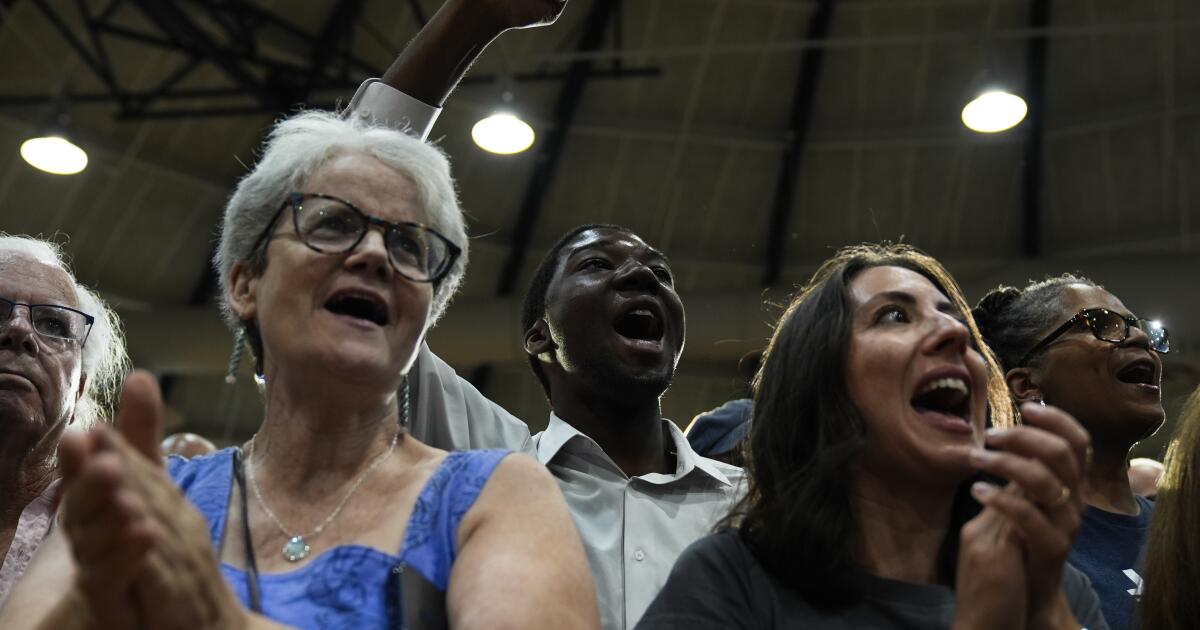
Disabled voters for Harris. White dudes for Harris. Crazy cat ladies for Harris.
Since Vice President Kamala Harris vaulted into becoming the likely Democratic nominee for president a week ago, a groundswell of identity-based grassroots groups have sprung up online to rally behind her. The nightly calls are raising millions of dollars and securing hundreds of volunteers, drawing comparisons to the grassroots efforts that fueled former President Obama to victory in 2008.
But in 2024, in an era when identity shapes so much of politics, the rise of the first Black woman and first Asian American to be nominated for president by a major party is drawing more identity groups out of the woodwork.
“This is unprecedented diversity in the political pool,” said Pei-Te Lien, a professor in UC Santa Barbara’s Politics of Identity program. “That’s another reason why ‘identity group’ comes up, because we also see identity being recognized and used as leverage in the campaigns, in an unprecedented level.”
Within hours after President Biden announced he would not seek reelection and endorsed Harris as his replacement nominee, more than 44,000 Black women and allies from across the country gathered online, raising over $1.5 million, according to organizers. The template for that event, organized by Win With Black Women, was repeated the next day by Win With Black Men, which organizers said brought 45,000 Black men and raised $1.3 million.
“It’s organic,” said Los Angeles City Councilmember Nithya Raman, who attended a Zoom call for South Asians supporting Harris last week. “I think people are clear-eyed about what this moment means. I think they just feel a sense of hope that we actually could defeat Trump, and we could do it with a candidate that reflects the America that all these immigrants live in.”
With fewer than 100 days to the election and a new candidate leading the Democratic Party, the flood of groups — including Latino Men for Harris, Caribbean-Americans for Harris, Dads for Kamala and Native Women + Two Spirit for Harris — are motivated by a “sense of crisis,” Lien said.
“They feel like we are not in the mainstream — we are not able to have too much influence,” she said. “But we feel like we need to do our share to be able to help change the course. To prevent, basically, the coming apocalypse or whatever.”
Former President Trump has pointedly courted Black and Latino voters this year, and has been drawing greater support from minority groups than he did in his previous two campaigns. But fewer identity-based groups are organized for Republicans.
When white women took to Zoom last week to support the Democrat, a technical glitch forced the livestream to abruptly end just a few minutes after it began. Later, organizers found out why in a message from Zoom: “You are officially hosting the Zoom webinar with the most registrants in our history!”
“Kamala Harris broke Zoom!” one of the hosts exclaimed.
Some of the white women who had logged on said the idea of supporting Kamala Harris as an identity group was necessary and empowering. But it was also uncomfortable.
“I have to admit: When I was writing stuff down, I was like, ‘Karens for Kamala’?” said Connie Britton, the actor who played Tami Taylor on “Friday Night Lights.” “Why is it so difficult for us to acknowledge and address ourselves as white women?”
The “White Dudes for Harris” call Monday, which 193,000 people attended, shared similar self-consciousness.
“What a variety of whiteness,” actor Bradley Whitford quipped. “It’s like a rainbow of beige.”
Ross Morales Rocketto, the group’s lead organizer, said a lot of people expressed discomfort about the concept of White Dudes for Harris. He understood their qualms: “Throughout American history, when white men have organized, it was often with pointy hats on.”
“The reason we are doing this is because the left has been ceding white men to the MAGA right for way, way too long,” Rocketto said, noting that Trump had won more than 60% of white men in 2016 and 2020. “That’s going to stop tonight. We know that the silent majority of white men aren’t actually MAGA supporters.”
But other attendees, such as Jeff Bridges — who played the Dude in the “The Big Lebowski” — wore their White Dudes for Harris hats with pride.
“A friend sent me this email today with your hat on there, and I said, ‘Oh, I gotta have one of those. I qualify … I’m white, I’m a dude, and I’m for Harris,’” Bridges said.
The group drew negative attention and mockery from conservatives.
“They should give it a more fitting name,” Donald Trump Jr. wrote on X. “Like Cucks for Kamala.”
Before Shannon Watts, the activist and founder of gun control group Moms Demand Action, organized the white women’s meeting, she called Jotaka Eaddy, organizer of the Black women’s Zoom, seeking her counsel.
“She told me that white women did need to come together as a community to do the work,” Watts said. “Because our work is very different.”
In addition to recognizing their privilege, railing against white supremacy and patriarchy, navigating the toxicity of online politics and offering practical pointers on campaigning, the more than 164,000 women who gathered online raised $2 million in 90 minutes. The white men’s call raised $4.2 million.
“Many white people don’t want to be identified with that white guy,” said Lien, the UCSB professor. “Identity matters only because they don’t want to be lumped together in the same camp as … white supremacists.”
Christopher Parker, a professor of political science at UC Santa Barbara, pointed to the 2016 election, when former Secretary of State Hillary Clinton — then the first woman to lead the Democratic ticket — lost to Trump. By 2020, he said, Democrats had coalesced behind Biden, but “were more voting against Trump than for Biden.”
Harris enjoys a double advantage, according to Parker: voters enthused by her as a candidate and voters who are anti-Trump.
“People got it right in 2020 that it was about an existential threat that Trump posed,” he said. “You have that here, but you also have this excitement over her candidacy and what she represents symbolically, and what she can do when it comes to policy.”
The Harris campaign has mostly hung back from directly engaging with the various group calls, except when Second Gentleman Doug Emhoff surprised a Black gay and queer men’s group by joining a call last week.
On Tuesday, Harris announced she would be headlining a “National Organizing Call” — open to all identities.

Politics
Jacob Frey praises Somali community as Minnesota faces renewed scrutiny over fraud investigations

NEWYou can now listen to Fox News articles!
Minneapolis Mayor Jacob Frey told members of the city’s Somali community over the weekend that they are “our family,” pledging solidarity and praising their contributions to the city during remarks celebrating Somali Independence Day.
Frey’s remarks came as Minnesota continues to face scrutiny over several high-profile fraud investigations and weeks after a Republican-led House Oversight Committee report alleged the Minnesota Governor Tim Walz’s administration failed to act on repeated warnings about widespread fraud in the state’s social services programs.
“Through the most difficult of times and through Operation Metro surge, we all saw that they tried to come for some of us,” Frey told members of the Somali community on Saturday. “And when that happens, we say that you’re coming for all of us.”
BLUE STATE’S ANTI-ICE PLEDGE COLLAPSES AS GOP WARNS OF NEW SANCTUARY ‘CONFEDERACY’
Minneapolis Mayor Jacob Frey speaks during a Somali Independence Day celebration in Minneapolis as attendees stand on stage holding Somali flags. (Credit: Mayor Jacob Frey X Post)
“In Minneapolis, we loved our neighbors. In Minneapolis, we do not see you as immigrants. We see you as our family,” he added. “You are our brothers. You’re our sisters. You have done so much for this incredible city, and for that, we stand with you.”
Frey appeared to reference Operation Metro Surge, the Trump administration’s immigration and public safety initiative in Minnesota.
The operation concluded in February after border czar Tom Homan announced it had resulted in the arrest of more than 4,000 people in the Minneapolis-St. Paul area and had reduced what he described as public safety threats.
BLUE STATE’S ANTI-ICE PLEDGE COLLAPSES AS GOP WARNS OF NEW SANCTUARY ‘CONFEDERACY’
Minneapolis Mayor Jacob Frey speaks to the media at City Hall on Jan. 9. (Aaron Lavinsky/The Minnesota Star Tribune via Getty Images)
Frey shared the video on X, writing, “Happy Somali Independence Day.”
“Here in Minnesota, home to one of the largest Somali communities in the United States, we celebrate the resilience, culture, and leadership that continue to enrich our city and community,” he said.
Earlier this month, a Republican-led House Oversight Committee report alleged Walz’s administration repeatedly failed to act on warnings about fraud involving state social services programs, including the Feeding Our Future scandal.
WALZ ADMINISTRATION IGNORED FRAUD WARNINGS AS BILLIONS VANISHED, HOUSE OVERSIGHT REPORT ALLEGES
Democratic Gov. Tim Walz speaks during a news conference on Tuesday, Jan. 6, 2026, in Minneapolis, Minnesota. (Alex Kormann/Star Tribune via AP)
The committee said more than 110 people have been charged in connection with various fraud schemes in Minnesota, including many defendants identified as members of Minnesota’s Somali immigrant community.
The report also alleged concerns about potential racial discrimination claims contributed to delays in addressing suspected fraud and estimated Minnesota lost roughly $300 million in stolen federal child nutrition funds during the COVID-19 pandemic.
CLICK HERE TO DOWNLOAD THE FOX NEWS APP
Walz administration officials have disputed the committee’s findings.
Fox News Digital’s Adam Pack contributed to this report.

For as long as I’ve been a journalist, which is a really long time, public entities have hated public records requests, even while claiming they don’t.
Ask your typical elected or hired official, from the governor to the animal control folks, and they’ll tell you transparency is vital and sunshine in government a key value.
Then turn in the most benign of public records requests — access to a calendar, for example — and prepare for weeks of delays and excuses. Want emails or financial records or, heaven forbid, anything from the police? Months or even years may pass before a single page is delivered, no joke.
That’s why I am deeply concerned about a bill winding its way through the California Legislature that would definitely slow down public records requests and likely make them more difficult and expensive. At its worst, it could push people into costly court battles just for having the audacity to ask for information.
The legislation, Assembly Bill 1821, is authored by Democratic Assemblymember Blanca Pacheco, whose district includes Norwalk, Downey and Bell, where legendary scandals are Example 1 of why public records matter.
Pacheco’s office told me Wednesday that the troubles with the bill are far from what Pacheco set out to do.
“It was never the author’s intention to take away people’s rights to a [Public Records Act] request,” said her chief of staff, Nikki Johnson.
Johnson said the bill was meant to curtail malicious records requests, which do happen, where a citizen goes after copious amounts of records just to be a jerk and cost the government time and money.
It was also meant to address the growing problem of artificial intelligence and other for-profit businesses requesting thousands of records with the intent of using the information to create money-making products — think of sites that already sell publicly available personal information as “background checks.”
I believe Johnson on the good intentions of the bill in addressing those real if nebulous difficulties, but you know what they say about the best-laid plans.
The bill passed through the Assembly recently with ease, largely because most of its problematic portions (I’ll get to those in a minute) were removed — though not all. Even in a watered-down form, which basically gave government more time to answer requests, I found myself in the unlikely position of agreeing with conservative Republican Assemblymember and Trump supporter Carl DeMaio of San Diego, who offered some of the only opposition from elected leaders during the Assembly vote.
“We cannot police the public’s right to know, and we want to err on the side of transparency in how government agencies operate,” DeMaio said.
Amen, brother.
But the Democratic-controlled Assembly erred on the side of secrecy and slowdown instead, and the measure sailed to the Senate, where seemingly out of the blue, a bunch of new provisions were added that fill it with loopholes, vague language and tons of room for abuse.
David Snyder, executive director of the First Amendment Coalition, said the bill as written now was “comprehensively bad for transparency and therefore for government accountability.”
Sean McMorris, transparency, ethics and accountability program manager for the advocacy organization California Common Cause, put it even more forcefully. He pointed out that “public records are the public’s records.”
“They’re not owned by the government,” he said. But this bill would shift that paradigm and make the public “prove why you need them.”
“It’s going to chill people who want to make requests, and it’s going to complicate the process, and it’s just wrong,” McMorris said.
In its new form, the bill basically allows government entities to decide if they feel a public records request is malicious or for commercial gain. If they do, they can petition a court to intervene — potentially sparking both legal costs and new fees associated with fulfilling the request.
It would also, Snyder said, force a requester to explain why they wanted the records — something California law has repeatedly avoided because it gives power to government to treat those it perceives as enemies differently.
In this age of fairness and reason, it’s hard to imagine a government official misusing power to keep secrets, but I’m told it happens. That makes it all the more crucial that people not be forced to explain why they want information, or if they will use it to, say, expose corruption — be it wrongdoing by a single individual or the entire system.
Faced with unintended consequences, Assemblymember Blanca Pacheco (D-Downey), shown in 2023, will seek to scale back the bill to its original form, according to her chief of staff.
(Rich Polk / Getty Images for Equality California)
“I have little doubt that some agencies will use that provision to overburden requesters that they view as political opponents, requesters that they view as just a hassle, requesters that ask for things the government doesn’t want to disclose,” Snyder said. “They can bring the requester into court, and at a minimum, slow down the process, and probably more likely get the requester to simply withdraw.”
As written, the bill also gives a shoddy carve-out meant to protect journalists, but which in reality could be used to curtail requests from freelancers, student journalists and more.
McMorris said access to public records is a “moral issue,” and fixing any problems with the current law requires “a scalpel, not a meat ax.”
This bill, he warned, is a meat ax.
“I don’t discount that there are abusive requests, and that there are requests that really are a burden on government agencies, but the law right now has ways for government agencies to address that,” he pointed out. “Once these laws go into place, they’re going to be hard to roll back.”
It could “fundamentally change” our access to public records, he said.
Johnson, Pacheco’s chief of staff, told me that faced with all these unintended consequences, the Assembly member is going to ask for the amendments to be removed, and for the bill to progress as it was written when it passed the Assembly. That could happen as early as next week, when the bill with the new provisions is scheduled to come up again in a Senate committee for debate.
Reverting to the bill the Assembly voted on would be better, but slowing down public records is in government’s best interests, not the people’s. The bill does nothing to address the problems it seeks to fix, but stretches out the time officials have to simply tell a requester if any records do exist — never mind delivering them.
So even back to its watered-down form, the bill remains a meat ax for a scalpel problem, chopping up transparency with good intentions.

NEWYou can now listen to Fox News articles!
Former President Joe Biden appeared to briefly seek directions before exiting the stage after delivering remarks at a Democratic gala Saturday night, capping his speech with an awkward onstage moment.
After delivering a roughly 10-minute keynote speech at the Maryland Democratic Party’s “Fight Back & Win Gala” near Baltimore, the 83-year-old paused onstage and looked toward the wings before pointing in two different directions, seemingly trying to determine where to exit. After receiving guidance, Biden turned and walked off the stage with his back to the audience.
Unlike several other speakers at the gala, who exited on the opposite side of the stage after their remarks, Biden left in a different direction.
EX-DEM INSIDER REVEALS SHE WILL EXPOSE DEMOCRATS WHO COVERED UP BIDEN’S COGNITIVE DECLINE IN NEW BOOK
Former President Joe Biden exits the stage after delivering remarks at the Maryland Democratic Party’s Fight Back and Win Gala near Baltimore on Saturday. (CSPAN)
The moment came after Biden delivered one of his sharpest public critiques of President Donald Trump since leaving office. During his remarks, Biden defended his own administration’s record while accusing the Trump administration of corruption. He also took aim at what he described as Trump’s “vanity projects,” including renovations to the White House, changes at the Kennedy Center and the ongoing saga with the reflecting pool on the National Mall.
“Whoa, what a loser,” Biden said.
After pausing several times to cough throughout his remarks, Biden concluded with a call for Democrats to “fight back,” saying the country could overcome its challenges by acting together.
“Folks, I guarantee we can do this. And we will. We just remember who in the hell we are. We’re the United States of America,” Biden said. “There’s nothing, nothing beyond our capacity if we act together. So let’s get up and fight back, God darn it.”
The latest onstage moment comes just days after another widely shared incident at the opening of the Obama Presidential Center in Chicago.
WATCH: BIDEN LEFT SEARCHING FOR FAMILY AFTER OBAMA PRESIDENTIAL CENTER CEREMONY
The star-studded ceremony brought together former Presidents Barack Obama, Bill Clinton and George W. Bush, along with former Secretary of State Hillary Clinton, former Vice President Kamala Harris and other political leaders and entertainers. At the conclusion of the event, Biden remained onstage after others had exited before calling out, “Where’s my granddaughter?”
Former First Lady Jill Biden then returned to the stage, took his hand and guided him off.
SIGN UP TO GET THE POLITICS NEWSLETTER
Former U.S. President Joe Biden and Former first lady Jill Biden appear on stage during the dedication ceremony for the opening of the Barack Obama Presidential Center in John Lewis Plaza on June 18, 2026 in Chicago, Illinois. (Scott Olson / Getty Images)
Biden has largely stayed out of the public eye since withdrawing from the 2024 presidential race after facing intense pressure from fellow Democrats to end his reelection bid.
CLICK HERE TO DOWNLOAD THE FOX NEWS APP
The former president has since made only occasional public appearances and recently disclosed that he is undergoing treatment for Stage 4 prostate cancer.
-

 Louisiana4 minutes ago
Letlow, Davis win Senate primary runoffs in Louisiana; will face off in November
-
 Maine7 minutes ago
Preserving Maine’s blueberry landscape proves difficult as barrens put up for sale
-

 Maryland12 minutes ago
Maryland Lottery Pick 3, Pick 4 results for June 28, 2026
-

 Michigan19 minutes ago
Three U.S. House hopefuls in Michigan own million-dollar D.C. homes
-

 Massachusetts21 minutes ago
Man cited for alleged wrong-way deadly crash
-

 Minnesota27 minutes ago
Minnesota leads all states with 12 draftees – Lets Play Hockey
-

 Mississippi34 minutes ago
Mississippi’s Top High School Quarterbacks: 10 Passers to Watch in 2026
-
Missouri37 minutes ago
Missouri Lottery Pick 3, Pick 4 winning numbers for June 28, 2026

