Politics
Amid Trump tariffs, the world responds with a free export: Humor


An evening show last week at the Hollywood Improv comedy club included poop jokes, a song about young people being too woke and a raunchy impression of Robert F. Kennedy Jr.
There were no quips about President Trump’s international tariffs, even from a comedian who had just posted a lengthy podcast episode about the on-again-off-again executive orders that have led to a global trade war and, many fear, could trigger a recession.
To get your fill of trade-related chuckles these days, there’s a much more reliable, if unexpected, source: the official Facebook page of the Chinese Embassy in Washington, D.C.
The site has been rapidly manufacturing memes and sarcastic captions to capitalize — unrestrained by any tariffs — on a hot international export, namely jokes at the expense of the United States and its tariff-loving president.
One meme shows a red MAGA hat on a store shelf bearing a “Made in China” tag. The $50 price is crossed out, replaced by a tariff-inflated cost of $77.
Another cartoon — labeled “The Art of the Deal,” after Trump’s 1987 book — shows a pair of gambler’s hands. One with the word “tariffs” on its suit sleeve draws from a deck of cards bearing percentages. The Embassy’s caption: “But… the cards are made in #China. #Tariffwar.”
In Canada, the premier of Manitoba, Wab Kinew, signed a decree in an oversized folder and held it up with his signature, à la Trump. “This order,” he said, “it’s a wonderful order. It’s a beautiful order. This order is pulling American booze off the liquor mart shelves.”
Premier of Manitoba Wab Kinew at the Mayflower Hotel in Washington on Feb. 12, 2025. In March, he signed a decree to remove American alcohol from liquor store shelves in response to tariffs imposed by President Trump.
(Ben Curtis / Associated Press)
And on Norfolk Island — a remote rock in the Pacific Ocean with about 2,000 residents and essentially no exports to the U.S. — a children’s book author memed a baffled-looking tropical wrasse fish. The caption: “When you find out Norfolk Island exports are getting hit with a 29% tariff … guess that’s one way to leave a fish floundering.”
There are many ways world leaders, businesses and consumers are grappling with the growing threat of a global trade war, but perhaps the easiest — and, for some, the most therapeutic — is to rely on dark humor.
Joking about Trump’s frenetic rollout of tariffs has become a common response to the altogether serious issue of an economic fight started by the president that has upended markets, led to boycotts of American-made goods and travel to the U.S., and sparked fears of a recession.
Some of the humor has a barbed, geopolitical aim in a war for the world’s hearts and minds — see the Chinese government’s fusillade of memes — but political scientists say that, for many people, humor is a natural response to stressful times.
Patrick Giamario, a professor at the University of North Carolina at Greensboro and author of the book “Laughter as Politics: Critical Theory in an Age of Hilarity,” said humor is an important part of the modern political process — and, for many, an attempt to make sense of events that feel overwhelming.
“The fact that we’re laughing so much now is a sort of sign of how broken things are,” Giamario said. “We laugh when things stop making sense.”
In addition to global angst, the levies have spawned: References to Trump as a “domestic tariffist.” Videos generated by artificial intelligence that show obese Americans toiling in garment factories. And lots of memes about over-taxed penguins angry about Trump’s tariffs, which targeted a few barren, uninhabited subantarctic islands.
“Poor old penguins, I don’t know what they did to Trump,” Australian trade minister Don Farrell quipped to the Australian Broadcasting Corp. “But, look, I think it’s an indication … that this was a rushed process.”

Australian Trade and Tourism Minister Don Farrell, left, arrives for a meeting with Chinese Minister of Commerce Wang Wentao, right, in Beijing, May 12, 2023.
(Michael Godfrey / Associated Press)
Trump’s tariffs have kept much of the world’s collective heads on a swivel. When he announced them, he said they would bring “jobs and factories … roaring back into our country” — despite skepticism from economists across the political spectrum.
On April 2 — which Trump dubbed “Liberation Day” — he announced a baseline tariff of 10% on imported goods from all foreign countries. He also announced higher rates, which he called “reciprocal tariffs,” for countries he said were unfairly taxing American goods. Financial markets plunged.
A week later, Trump changed course, saying he would pause the so-called reciprocal tariffs for 90 days while leaving the universal 10% tariff in place. He wrote on his Truth Social account: “BE COOL! Everything is going to work out well.” Markets surged.
Meanwhile, Trump escalated his standoff with China, hiking levies on Chinese imports — except, he later said, on electronics such as smartphones and laptops — to 145%.
Beijing retaliated by raising its levies on U.S. goods to 125%. The trade war was joined by a meme war.
Many of the Chinese memes portray American workers as unprepared for the kinds of jobs that bring products to their homes at cheaper prices.
During a press briefing last week, White House press secretary Karoline Leavitt was asked about Chinese officials sharing AI-generated videos depicting Trump, Vice President JD Vance and billionaire Elon Musk working in factories.
“I have seen the videos,” Leavitt said. “I’m not sure who made the videos or if we can verify the authenticity. But whoever made it clearly does not see the potential of the American worker, the American workforce.”
Screenshots of Leavitt herself being trolled by a Chinese diplomat who accused her of wearing a Chinese-made dress in the White House briefing room also have gone viral.

White House press secretary Karoline Leavitt speaks with reporters in the James Brady Press Briefing Room at the White House, April 15, 2025, in Washington.
(Alex Brandon / Associated Press)
“Accusing China is business. Buying China is life,” Zhang Zhisheng, China’s consul general in Denpasar, Indonesia, posted on X. “The beautiful lace on the dress was recognized by an employee of a Chinese company as its product.”
Ramesh Srinivasan, founder of the University of California Digital Cultures Lab, said it is clearly strategic for the typically staid Chinese government to turn to memes and internet jokes to communicate its stance on the trade war, which is that it “is ridiculous and unnecessary.”
“They’re presenting it in a much more innocuous and funny way, and that’s very, very intelligent,” Srinivasan said. “It’s a sign of the times.”
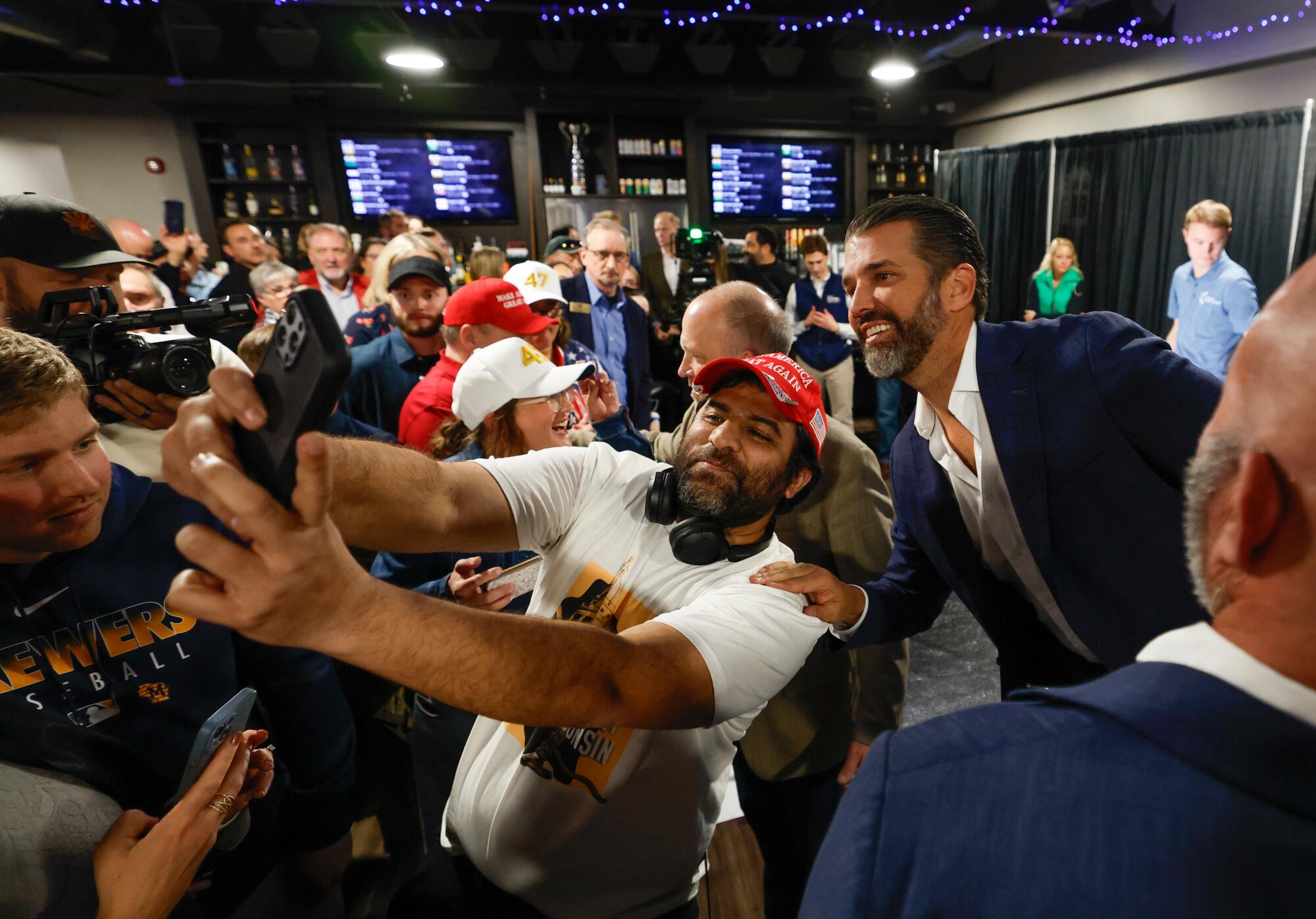
Donald Trump Jr. takes photos with supporters after a town hall meeting Monday, March 17, 2025, in Oconomowoc, Wis.
(Jeffrey Phelps / Associated Press)
Trump and his acolytes, of course, are veterans of the meme wars (his son and advisor, Donald Trump Jr., lists “Meme Wars General” in his Instagram bio). The president’s meme-filled X, née Twitter, account helped launch his political career, as did his crude-but-catchy nicknames for his opponents: Crooked Hillary Clinton, Sleepy Joe Biden and Little Marco [now Secretary of State] Rubio, among others.
Srinivasan said Trump, the former reality television star, has long been skilled at using dark humor to his advantage, especially online, where he is “this kind of hybrid troll-meme person.”

Traditional Russian wooden dolls called Matryoshka depicting China’s President Xi Jinping, President Trump and Russian President Vladimir Putin are displayed for sale at a souvenir shop in St. Petersburg, Russia.
(Dmitri Lovetsky / Associated Press)
On the internet, the tariff jokes keep coming.
One widely-shared POV — internet lingo for “point of view” — video on TikTok shows a grumpy toddler striding officiously through an empty office. The caption: “POV: Me on my way to HR yet again for nicknaming my co-worker ‘Tariff’ for costing the company more than they’re worth.”
On YouTube, Penguins International, an apolitical conservation nonprofit dedicated to studying and protecting penguins, couldn’t resist getting in on the fun.
After Heard Island and the McDonald Islands — Australian territories where lots of penguins and no humans live — were listed on Trump’s tariffs list, Penguins International announced an online Protest March of the Penguins.
“Waddle we want? No tariffs!” read one digital protest sign.
“Beaks up!” read another.
On Wednesday, the Colorado-based organization posted a YouTube video of the birds’ annual migratory trek across the ice to their breeding grounds. As they squawked and brayed, a narrator said: “This year, they march in protest. They are peaceful. They are flightless. But they are certainly not voiceless.”
“We wanted to take an unusual current event and make light of it and stir up some support for some penguins that are endangered and threatened to go extinct,” David Schutt, executive director of Penguins International, said in an interview. Before the tariff announcement, he added, “most people didn’t know about the islands that these penguins are on.”

James Austin Johnson as President Trump, left, and Andrew Dismukes as Howard Lutnick during the “Saturday Night Live” skit “Trump Tariff Cold Open” on April 5, 2025.
(Will Heath / Getty Images)
During an Easter-themed “Saturday Night Live” skit this month, Trump, played by James Austin Johnson, said: “Many people are even calling me the Messiah, because of the mess I, uh, made out of the economy — all because of my beautiful tariffs. So beautiful. They were working so well that I had to stop them.”
On her “Good for You” podcast on April 13, comedian Whitney Cummings joked about Trump’s stated motive of using tariffs to bring manufacturing jobs back to the U.S., where workers — especially young ones who prefer remote work — don’t want them.
“I have nieces who are Gen Z,” Cummings said. “They’re not going to work in a factory. They won’t even work at the Cheesecake Factory because that would mean they would have a boss.”

Whitney Cummings at Hollywood Improv.
(Troy Conrad)
American manufacturing largely moved overseas, she continued, because “no one in America believes they should be working for some corporation who treats workers badly. They want to be the head of the corporation who treats workers badly.”
Two nights later, Cummings did a stand-up set at the Hollywood Improv, performing on a stage that has hosted comedy legends such as Robin Williams, Chris Rock and Eddie Murphy.
Cummings made some mildly political jokes — including one about growing more conservative after having a child and trading in her electric car for a gas model because gas stations are the only places where it’s socially acceptable to leave a small child alone in a vehicle.
But during her short set, she stayed away from tariffs — which are, perhaps, funnier on the internet.



NEWYou can now listen to Fox News articles!
U.S. Immigration and Customs Enforcement (ICE) accused Everett, Washington, Mayor Cassie Franklin of escalating tensions with federal authorities after she issued a directive limiting immigration enforcement in the city.
Franklin issued a mayoral directive this week establishing citywide protocols for staff, including law enforcement, that restrict federal immigration agents from entering non-public areas of city buildings without a judicial warrant.
“We’ve heard directly from residents who are afraid to leave their houses because of the concerning immigration activity happening locally and across our country. It’s heartbreaking to see the impacts on Everett families and businesses,” Franklin said in a statement.
“With this directive, we are setting clear protocols, protecting access to services and reinforcing our commitment to serving the entire community.”
ICE blasted the directive Friday, writing on X it “escalates tension and directs city law enforcement to intervene with ICE operations at their own discretion,” thereby “putting everyone at greater risk.”
Mayor Cassie Franklin said her new citywide immigration enforcement protocols are intended to protect residents and ensure access to services, while ICE accused her of escalating tensions with federal authorities. (Google Maps)
ICE said Franklin was directing city workers to “impede ICE operations and expose the location of ICE officers and agents.”
“Working AGAINST ICE forces federal teams into the community searching for criminal illegal aliens released from local jails — INCREASING THE FEDERAL PRESENCE,” the agency said. “Working with ICE reduces the federal presence.”
“If Mayor Franklin wanted to protect the people she claims to serve, she’d empower the city police with an ICE 287g partnership — instead she serves criminal illegal aliens,” ICE added.
DHS, WHITE HOUSE MOCK CHICAGO’S LAWSUIT OVER ICE: ‘MIRACULOUSLY REDISCOVERED THE 10TH AMENDMENT’
U.S. Immigration and Customs Enforcement blasted Everett’s mayor after she issued a directive restricting federal agents from accessing non-public areas of city facilities without a warrant. (Victor J. Blue/Bloomberg via Getty Images)
During a city council meeting where she announced the policy, Franklin said “federal immigration enforcement is causing real fear for Everett residents.”
“It’s been heartbreaking to see the racial profiling that’s having an impact on Everett families and businesses,” she said. “We know there are kids staying home from school, people not going to work or people not going about their day, dining out or shopping for essentials.”
The mayor’s directive covers four main areas, including restricting federal immigration agents from accessing non-public areas of city buildings without a warrant, requiring immediate reporting of enforcement activity on city property and mandating clear signage to enforce access limits.
BLOCKING ICE COOPERATION FUELED MINNESOTA UNREST, OFFICIALS WARN AS VIRGINIA REVERSES COURSE
Everett, Wash., Mayor Cassie Franklin said her new directive is aimed at protecting residents amid heightened immigration enforcement activity. (iStock)
It also calls for an internal policy review and staff training, including the creation of an Interdepartmental Response Team and updated immigration enforcement protocols to ensure compliance with state law.
Franklin directed city staff to expand partnerships with community leaders, advocacy groups and regional governments to coordinate responses to immigration enforcement, while promoting immigrant-owned businesses and providing workplace protections and “know your rights” resources.
The mayor also reaffirmed a commitment to “constitutional policing and best practices,” stating that the police department will comply with state law barring participation in civil immigration enforcement. The directive outlines protocols for documenting interactions with federal officials, reviewing records requests and strengthening privacy safeguards and technology audits.
CLICK HERE TO DOWNLOAD THE FOX NEWS APP
Everett, Wash., Mayor Cassie Franklin issued a directive limiting federal immigration enforcement in city facilities. (iStock)
“We want everyone in the city of Everett to feel safe calling 911 when they need help and to know that Everett Police will not ask about your immigration status,” Franklin said during the council meeting. ”I also expect our officers to intervene if it’s safe to do so to protect our residents when they witness federal officers using unnecessary force.”
Fox News Digital has reached out to Mayor Franklin’s office and ICE for comment.
Related Article


The morning after Netflix clinched its deal to buy Warner Bros., Paramount Skydance Chairman David Ellison assembled a war room of trusted advisors, including his billionaire father, Larry Ellison.
Furious at Warner Bros. Discovery Chief David Zaslav for ending the auction, the Ellisons and their team began plotting their comeback on that crisp December day.
To rattle Warner Bros. Discovery and its investors, they launched a three-front campaign: a lawsuit, a hostile takeover bid and direct lobbying of the Trump administration and Republicans in Congress.
“There was a master battle plan — and it was extremely disciplined,” said one auction insider who was not authorized to comment publicly.
Netflix stunned the industry late Thursday by pulling out of the bidding, clearing the way for Paramount to claim the company that owns HBO, HBO Max, CNN, TBS, Food Network and the Warner Bros. film and television studios in Burbank. The deal was valued at more than $111 billion.
The streaming giant’s reversal came just hours after co-Chief Executive Ted Sarandos met with Atty Gen. Pam Bondi and a deputy at the White House. It was a cordial session, but the Trump officials told Sarandos that his deal was facing significant hurdles in Washington, according to a person close to the administration who was not authorized to comment publicly.
Even before that meeting, the tide had turned for Paramount in a swell of power, politics and brinkmanship.
“Netflix played their cards well; however, Paramount played their cards perfectly,” said Jonathan Miller, chief executive of Integrated Media Co. “They did exactly what they had to do and when they had to do it — which was at the very last moment.”
Key to victory was Larry Ellison, his $200-billion fortune and his connections to President Trump and congressional Republicans.
Paramount also hired Trump’s former antitrust chief, attorney Makan Delrahim, to quarterback the firm’s legal and regulatory action.
Republicans during a Senate hearing this month piled onto Sarandos with complaints about potential monopolistic practices and “woke” programming.
David Ellison skipped that hearing. This week, however, he attended Trump’s State of the Union address in the Capitol chambers, a guest of Sen. Lindsey Graham (R-S.C.). The two men posed, grinning and giving a thumbs-up, for a photo that was posted to Graham’s X account.
David Ellison, the chairman and chief executive of Paramount Skydance Corp., walks through Statuary Hall to the State of the Union address at the U.S. Capitol on Feb. 24, 2026.
(Anna Moneymaker / Getty Images)
On Friday, Netflix said it had received a $2.8-billion payment — a termination fee Paramount agreed to pay to send Netflix on its way.
Long before David Ellison and his family acquired Paramount and CBS last summer, the 43-year-old tech scion and aircraft pilot already had his sights set on Warner Bros. Discovery.
Paramount’s assets, including MTV, Nickelodeon and the Melrose Avenue movie studio, have been fading. Ellison recognized he needed the more robust company — Warner Bros. Discovery — to achieve his ambitions.
“From the very beginning, our pursuit of Warner Bros. Discovery has been guided by a clear purpose: to honor the legacy of two iconic companies while accelerating our vision of building a next-generation media and entertainment company,” David Ellison said in a Friday statement. “We couldn’t be more excited for what’s ahead.”
Warner’s chief, Zaslav, who had initially opposed the Paramount bid, added: “We look forward to working with Paramount to complete this historic transaction.”
Netflix, in a separate statement, said it was unwilling to go beyond its $82.7-billion proposal that Warner board members accepted Dec. 4.
“We believe we would have been strong stewards of Warner Bros.’ iconic brands, and that our deal would have strengthened the entertainment industry and preserved and created more production jobs,” Sarandos and co-Chief Executive Greg Peters said in a statement.
“But this transaction was always a ‘nice to have’ at the right price, not a ‘must have’ at any price,” the Netflix chiefs said.
Netflix may have miscalculated the Ellison family’s determination when it agreed Feb. 16 to allow Paramount back into the bidding.
The Los Gatos, Calif.-based company already had prevailed in the auction, and had an agreement in hand. Its next step was a shareholder vote.
“They didn’t need to let Paramount back in, but there was a lot of pressure on them to make sure the process wouldn’t be challenged,” Miller said.
In addition, Netflix’s stock had also been pummeled — the company had lost a quarter of its value — since investors learned the company was making a Warner run.
Upon news that Netflix had withdrawn, its shares soared Friday nearly 14% to $96.24.

Netflix Chief Executive Ted Sarandos arrives at the White House on Feb. 26, 2026.
(Andrew Leyden / Getty Images)
Invited back into the auction room, Paramount unveiled a much stronger proposal than the one it submitted in December.
The elder Ellison had pledged to personally guarantee the deal, including $45.7 billion in equity required to close the transaction. And if bankers became worried that Paramount was too leveraged, the tech mogul agreed to put in more money in order to secure the bank financing.
That promise assuaged Warner Bros. Discovery board members who had fretted for weeks that they weren’t sure Ellison would sign on the dotted line, according to two people close to the auction who were not authorized to comment.
Paramount’s pressure campaign had been relentless, first winning over theater owners, who expressed alarm over Netflix’s business model that encourages consumers to watch movies in their homes.
During the last two weeks, Sarandos got dragged into two ugly controversies.
First, famed filmmaker James Cameron endorsed Paramount, saying a Netflix takeover would lead to massive job losses in the entertainment industry, which is already reeling from a production slowdown in Southern California that has disrupted the lives of thousands of film industry workers.
Then, a week ago, Trump took aim at Netflix board member Susan Rice, a former high-level Obama and Biden administration official. In a social media post, Trump called Rice a “no talent … political hack,” and said that Netflix must fire her or “pay the consequences.”
The threat underscored the dicey environment for Netflix.
Additionally, Paramount had sowed doubts about Netflix among lawmakers, regulators, Warner investors and ultimately the Warner board.
Paramount assured Warner board members that it had a clear path to win regulatory approval so the deal would quickly be finalized. In a show of confidence, Delrahim filed to win the Justice Department’s blessing in December — even though Paramount didn’t have a deal.
This month, a deadline for the Justice Department to raise issues with Paramount’s proposed Warner takeover passed without comment from the Trump regulators.
“Analysts believe the deal is likely to close,” TD Cowen analysts said in a Friday report. “While Paramount-WBD does present material antitrust risks (higher pay TV prices, lower pay for TV/movie workers), analysts also see a key pro-competitive effect: improved competition in streaming, with Paramount+ and HBO Max representing a materially stronger counterweight to #1 Netflix.”
Throughout the battle, David Ellison relied on support from his father, attorney Delrahim, and three key board members: Oracle Executive Vice Chair Safra A. Catz; RedBird Capital Partners founder Gerry Cardinale; and Justin Hamill, managing director of tech investment firm Silver Lake.
In the final days, David Ellison led an effort to flip Warner board members who had firmly supported Netflix. With Paramount’s improved offer, several began leaning toward the Paramount deal.
On Tuesday, Warner announced that Paramount’s deal was promising.
On Thursday, Warner’s board determined Paramount’s deal had topped Netflix. That’s when Netflix surrendered.
“Paramount had a fulsome, 360-degree approach,” Miller said. “They approached it financially. … They understood the regulatory environment here and abroad in the EU. And they had a game plan for every aspect.”
On Friday, Paramount shares rose 21% to $13.51.
It was a reversal of fortunes for David Ellison, who appeared on CNBC just three days after that war room meeting in December.
“We put the company in play,” David Ellison told the CNBC anchor that day. “We’re really here to finish what we started.”
Times staff writer Ana Cabellos and Business Editor Richard Verrier contributed to this report.

NEWYou can now listen to Fox News articles!
President Donald Trump warned that Iran is working to build missiles that could “soon reach the United States of America,” elevating concerns about a weapons program that already places U.S. forces across the Middle East within range.
Iran does not currently possess a missile capable of striking the U.S. homeland, officials say. But its existing ballistic missile arsenal can target major American military installations in the Gulf, and U.S. officials say the issue has emerged as a key sticking point in ongoing nuclear negotiations.
Here’s what Iran can hit now — and how close it is to reaching the U.S.
What Iran can hit right now
A map shows what is within range of ballistic missiles fired from Iran. (Fox News)
Iran is widely assessed by Western defense analysts to operate the largest ballistic missile force in the Middle East. Its arsenal consists primarily of short- and medium-range ballistic missiles with ranges of up to roughly 2,000 kilometers — about 1,200 miles.
That range places a broad network of U.S. military infrastructure across the Gulf within reach.
Among the installations inside that envelope:
IRAN SIGNALS NUCLEAR PROGRESS IN GENEVA AS TRUMP CALLS FOR FULL DISMANTLEMENT
- Al Udeid Air Base in Qatar, forward headquarters for U.S. Central Command.
- Naval Support Activity Bahrain, home to the U.S. 5th Fleet.
- Camp Arifjan in Kuwait, a major Army logistics and command hub.
- Ali Al Salem Air Base in Kuwait, used by U.S. Air Force units.
- Prince Sultan Air Base in Saudi Arabia.
- Al Dhafra Air Base in the United Arab Emirates.
- Muwaffaq Salti Air Base in Jordan, which hosts U.S. aircraft.
U.S. forces have drawn down from some regional positions in recent months, including the transfer of Al Asad Air Base in Iraq back to Iraqi control earlier in 2026. But major Gulf installations remain within the range envelope of Iran’s current missile inventory.
Israel’s air defense targets Iranian missiles in the sky of Tel Aviv in Israel, June 16, 2025. (MATAN GOLAN/Middle East Images/AFP via Getty Images)
Multiple U.S. officials told Fox News that staffing at the Navy’s 5th Fleet headquarters in Bahrain has been reduced to “mission critical” levels amid heightened tensions. A separate U.S. official disputed that characterization, saying no ordered departure of personnel or dependents has been issued.
At the same time, the U.S. has surged significant naval and air assets into and around the region in recent days.
The USS Abraham Lincoln Carrier Strike Group is operating in the Arabian Sea alongside multiple destroyers, while additional destroyers are positioned in the eastern Mediterranean, Red Sea and Persian Gulf.
The USS Gerald R. Ford Carrier Strike Group is also headed toward the region. U.S. Air Force fighter aircraft — including F-15s, F-16s, F-35s and A-10s — are based across Jordan, Saudi Arabia and Bahrain, supported by aerial refueling tankers, early warning aircraft and surveillance platforms, according to a recent Fox News military briefing.
Iran has demonstrated its willingness to use ballistic missiles against U.S. targets before.
In January 2020, following the U.S. strike that killed Islamic Revolutionary Guard Corps Gen. Qassem Soleimani, Iran launched more than a dozen ballistic missiles at U.S. positions in Iraq. Dozens of American service members were later diagnosed with traumatic brain injuries.
That episode underscored the vulnerability of forward-deployed forces within reach of Iran’s missile arsenal.
Can Iran reach Europe?
Most publicly known Iranian missile systems are assessed to have maximum ranges of around 2,000 kilometers.
Depending on launch location, that could place parts of southeastern Europe — including Greece, Bulgaria and Romania — within potential reach. The U.S. has some 80,000 troops stationed across Europe, including in all three of these countries.
Iran is widely assessed by Western defense analysts to operate the largest ballistic missile force in the Middle East. (Majid Saeedi/Getty Images)
Reaching deeper into Europe would require longer-range systems than Iran has publicly demonstrated as operational.
Can Iran hit the US?
IRAN NEARS CHINA ANTI-SHIP SUPERSONIC MISSILE DEAL AS US CARRIERS MASS IN REGION: REPORT
Iran does not currently field an intercontinental ballistic missile (ICBM) capable of striking the U.S. homeland.
To reach the U.S. East Coast, a missile would need a range of roughly 10,000 kilometers — far beyond Iran’s known operational capability.
However, U.S. intelligence agencies have warned that Iran’s space launch vehicle program could provide the technological foundation for a future long-range missile.
In a recent threat overview, the Defense Intelligence Agency stated that Iran “has space launch vehicles it could use to develop a militarily-viable ICBM by 2035 should Tehran decide to pursue the capability.”
That assessment places any potential Iranian intercontinental missile capability roughly a decade away — and contingent on a political decision by Tehran.
U.S. officials and defense analysts have pointed in particular to Iran’s recent space launches, including rockets such as the Zuljanah, which use solid-fuel propulsion. Solid-fuel motors can be stored and launched more quickly than liquid-fueled rockets — a feature that is also important for military ballistic missiles.
Space launch vehicles and long-range ballistic missiles rely on similar multi-stage rocket technology. Analysts say advances in Iran’s space program could shorten the pathway to an intercontinental-range missile if Tehran chose to adapt that technology for military use.
For now, however, Iran has not deployed an operational ICBM, and the U.S. homeland remains outside the reach of its current ballistic missile arsenal.
US missile defenses — capable but finite
The U.S. relies on layered missile defense systems — including Terminal High Altitude Area Defense (THAAD), Patriot and ship-based interceptors — to protect forces and allies from ballistic missile threats across the Middle East.
These systems are technically capable, but interceptor inventories are finite.
During the June 2025 Iran-Israel missile exchange, U.S. forces reportedly fired more than 150 THAAD interceptors — roughly a quarter of the total the Pentagon had funded to date, according to defense analysts.
The economics also highlight the imbalance: open-source estimates suggest Iranian short-range ballistic missiles can cost in the low hundreds of thousands of dollars apiece, while advanced U.S. interceptors such as THAAD run roughly $12 million or more per missile.
Precise inventory levels are classified. But experts who track Pentagon procurement data warn that replenishing advanced interceptors can take years, meaning a prolonged, high-intensity missile exchange could strain stockpiles even if U.S. defenses remain effective.
Missile program complicates negotiations
The ballistic missile issue has also emerged as a key fault line in ongoing diplomatic efforts between Washington and Tehran.
Secretary of State Marco Rubio has said Iran’s refusal to negotiate limits on its ballistic missile program is “a big problem,” signaling that the administration views the arsenal as central to long-term regional security.
While current negotiations are focused primarily on Iran’s nuclear program and uranium enrichment activities, U.S. officials have argued that delivery systems — including ballistic missiles — cannot be separated from concerns about a potential nuclear weapon.
CLICK HERE TO DOWNLOAD THE FOX NEWS APP
Iranian officials, however, have insisted their missile program is defensive in nature and not subject to negotiation as part of nuclear-focused talks.
As diplomacy continues, the strategic reality remains clear: Iran cannot currently strike the U.S. homeland with a ballistic missile. But U.S. forces across the Middle East remain within range of Tehran’s existing arsenal — and future capabilities remain a subject of intelligence concern.
Related Article

Video: Prada Peels Back the Layers at Milan Fashion Week

Defense secretary Pete Hegseth designates Anthropic a supply chain risk

UN Human Rights Council chief cuts off speaker criticizing US-sanctioned official

ICE blasts Washington mayor over directive restricting immigration enforcement

‘SuperAgers’ stay mentally sharp well past 80, as scientists reveal the reason

Florida High School Football Rankings: Top 25 teams – Oct. 21

Cleary's 21 help Le Moyne down Central Connecticut State 69-64 in OT

How old is Bo Nix? What to know about Oregon quarterback ahead of 2024 NFL Draft

99th annual Pony Swim held in Virginia

Indiana Members Credit Union announced as new anchor tenant at Bottleworks District
ICE blasts Washington mayor over directive restricting immigration enforcement

Did the EU bypass Hungary’s veto on Ukraine’s €90 billion loan?

How the federal government is painting immigrants as criminals on social media

Where Iran’s ballistic missiles can reach — and how close they are to the US

Has India’s influence in Afghanistan grown under the Taliban?
-

 World2 days ago
Exclusive: DeepSeek withholds latest AI model from US chipmakers including Nvidia, sources say
-

 Massachusetts2 days ago
Mother and daughter injured in Taunton house explosion
-

 Montana1 week ago
2026 MHSA Montana Wrestling State Championship Brackets And Results – FloWrestling
-

 Louisiana5 days ago
Wildfire near Gum Swamp Road in Livingston Parish now under control; more than 200 acres burned
-

 Oklahoma1 week ago
Wildfires rage in Oklahoma as thousands urged to evacuate a small city
-

 Denver, CO2 days ago
10 acres charred, 5 injured in Thornton grass fire, evacuation orders lifted
-

 Technology7 days ago
YouTube TV billing scam emails are hitting inboxes
-

 Technology7 days ago
Stellantis is in a crisis of its own making