Politics
Amid Trump tariffs, the world responds with a free export: Humor


An evening show last week at the Hollywood Improv comedy club included poop jokes, a song about young people being too woke and a raunchy impression of Robert F. Kennedy Jr.
There were no quips about President Trump’s international tariffs, even from a comedian who had just posted a lengthy podcast episode about the on-again-off-again executive orders that have led to a global trade war and, many fear, could trigger a recession.
To get your fill of trade-related chuckles these days, there’s a much more reliable, if unexpected, source: the official Facebook page of the Chinese Embassy in Washington, D.C.
The site has been rapidly manufacturing memes and sarcastic captions to capitalize — unrestrained by any tariffs — on a hot international export, namely jokes at the expense of the United States and its tariff-loving president.
One meme shows a red MAGA hat on a store shelf bearing a “Made in China” tag. The $50 price is crossed out, replaced by a tariff-inflated cost of $77.
Another cartoon — labeled “The Art of the Deal,” after Trump’s 1987 book — shows a pair of gambler’s hands. One with the word “tariffs” on its suit sleeve draws from a deck of cards bearing percentages. The Embassy’s caption: “But… the cards are made in #China. #Tariffwar.”
In Canada, the premier of Manitoba, Wab Kinew, signed a decree in an oversized folder and held it up with his signature, à la Trump. “This order,” he said, “it’s a wonderful order. It’s a beautiful order. This order is pulling American booze off the liquor mart shelves.”
Premier of Manitoba Wab Kinew at the Mayflower Hotel in Washington on Feb. 12, 2025. In March, he signed a decree to remove American alcohol from liquor store shelves in response to tariffs imposed by President Trump.
(Ben Curtis / Associated Press)
And on Norfolk Island — a remote rock in the Pacific Ocean with about 2,000 residents and essentially no exports to the U.S. — a children’s book author memed a baffled-looking tropical wrasse fish. The caption: “When you find out Norfolk Island exports are getting hit with a 29% tariff … guess that’s one way to leave a fish floundering.”
There are many ways world leaders, businesses and consumers are grappling with the growing threat of a global trade war, but perhaps the easiest — and, for some, the most therapeutic — is to rely on dark humor.
Joking about Trump’s frenetic rollout of tariffs has become a common response to the altogether serious issue of an economic fight started by the president that has upended markets, led to boycotts of American-made goods and travel to the U.S., and sparked fears of a recession.
Some of the humor has a barbed, geopolitical aim in a war for the world’s hearts and minds — see the Chinese government’s fusillade of memes — but political scientists say that, for many people, humor is a natural response to stressful times.
Patrick Giamario, a professor at the University of North Carolina at Greensboro and author of the book “Laughter as Politics: Critical Theory in an Age of Hilarity,” said humor is an important part of the modern political process — and, for many, an attempt to make sense of events that feel overwhelming.
“The fact that we’re laughing so much now is a sort of sign of how broken things are,” Giamario said. “We laugh when things stop making sense.”
In addition to global angst, the levies have spawned: References to Trump as a “domestic tariffist.” Videos generated by artificial intelligence that show obese Americans toiling in garment factories. And lots of memes about over-taxed penguins angry about Trump’s tariffs, which targeted a few barren, uninhabited subantarctic islands.
“Poor old penguins, I don’t know what they did to Trump,” Australian trade minister Don Farrell quipped to the Australian Broadcasting Corp. “But, look, I think it’s an indication … that this was a rushed process.”

Australian Trade and Tourism Minister Don Farrell, left, arrives for a meeting with Chinese Minister of Commerce Wang Wentao, right, in Beijing, May 12, 2023.
(Michael Godfrey / Associated Press)
Trump’s tariffs have kept much of the world’s collective heads on a swivel. When he announced them, he said they would bring “jobs and factories … roaring back into our country” — despite skepticism from economists across the political spectrum.
On April 2 — which Trump dubbed “Liberation Day” — he announced a baseline tariff of 10% on imported goods from all foreign countries. He also announced higher rates, which he called “reciprocal tariffs,” for countries he said were unfairly taxing American goods. Financial markets plunged.
A week later, Trump changed course, saying he would pause the so-called reciprocal tariffs for 90 days while leaving the universal 10% tariff in place. He wrote on his Truth Social account: “BE COOL! Everything is going to work out well.” Markets surged.
Meanwhile, Trump escalated his standoff with China, hiking levies on Chinese imports — except, he later said, on electronics such as smartphones and laptops — to 145%.
Beijing retaliated by raising its levies on U.S. goods to 125%. The trade war was joined by a meme war.
Many of the Chinese memes portray American workers as unprepared for the kinds of jobs that bring products to their homes at cheaper prices.
During a press briefing last week, White House press secretary Karoline Leavitt was asked about Chinese officials sharing AI-generated videos depicting Trump, Vice President JD Vance and billionaire Elon Musk working in factories.
“I have seen the videos,” Leavitt said. “I’m not sure who made the videos or if we can verify the authenticity. But whoever made it clearly does not see the potential of the American worker, the American workforce.”
Screenshots of Leavitt herself being trolled by a Chinese diplomat who accused her of wearing a Chinese-made dress in the White House briefing room also have gone viral.

White House press secretary Karoline Leavitt speaks with reporters in the James Brady Press Briefing Room at the White House, April 15, 2025, in Washington.
(Alex Brandon / Associated Press)
“Accusing China is business. Buying China is life,” Zhang Zhisheng, China’s consul general in Denpasar, Indonesia, posted on X. “The beautiful lace on the dress was recognized by an employee of a Chinese company as its product.”
Ramesh Srinivasan, founder of the University of California Digital Cultures Lab, said it is clearly strategic for the typically staid Chinese government to turn to memes and internet jokes to communicate its stance on the trade war, which is that it “is ridiculous and unnecessary.”
“They’re presenting it in a much more innocuous and funny way, and that’s very, very intelligent,” Srinivasan said. “It’s a sign of the times.”
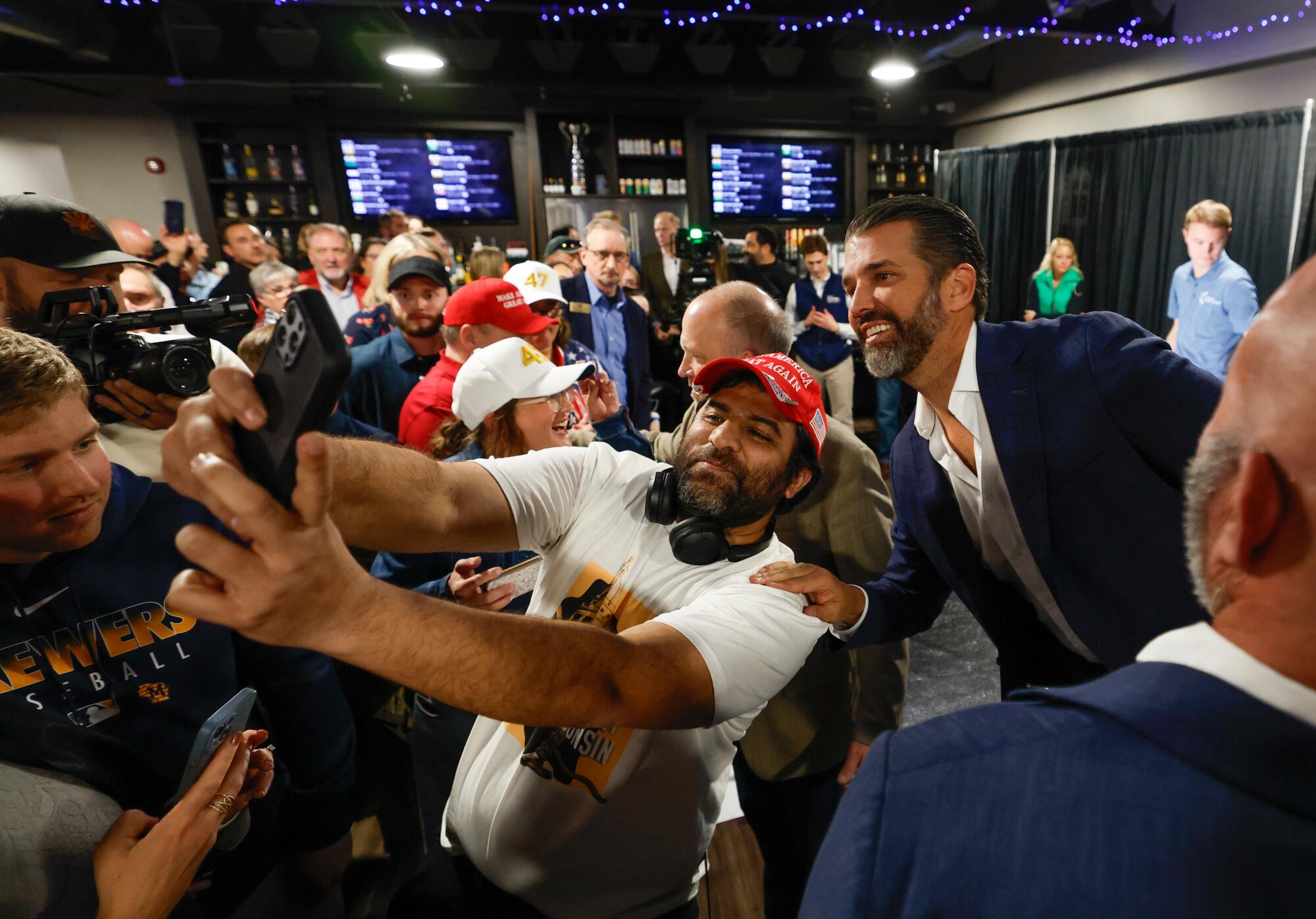
Donald Trump Jr. takes photos with supporters after a town hall meeting Monday, March 17, 2025, in Oconomowoc, Wis.
(Jeffrey Phelps / Associated Press)
Trump and his acolytes, of course, are veterans of the meme wars (his son and advisor, Donald Trump Jr., lists “Meme Wars General” in his Instagram bio). The president’s meme-filled X, née Twitter, account helped launch his political career, as did his crude-but-catchy nicknames for his opponents: Crooked Hillary Clinton, Sleepy Joe Biden and Little Marco [now Secretary of State] Rubio, among others.
Srinivasan said Trump, the former reality television star, has long been skilled at using dark humor to his advantage, especially online, where he is “this kind of hybrid troll-meme person.”

Traditional Russian wooden dolls called Matryoshka depicting China’s President Xi Jinping, President Trump and Russian President Vladimir Putin are displayed for sale at a souvenir shop in St. Petersburg, Russia.
(Dmitri Lovetsky / Associated Press)
On the internet, the tariff jokes keep coming.
One widely-shared POV — internet lingo for “point of view” — video on TikTok shows a grumpy toddler striding officiously through an empty office. The caption: “POV: Me on my way to HR yet again for nicknaming my co-worker ‘Tariff’ for costing the company more than they’re worth.”
On YouTube, Penguins International, an apolitical conservation nonprofit dedicated to studying and protecting penguins, couldn’t resist getting in on the fun.
After Heard Island and the McDonald Islands — Australian territories where lots of penguins and no humans live — were listed on Trump’s tariffs list, Penguins International announced an online Protest March of the Penguins.
“Waddle we want? No tariffs!” read one digital protest sign.
“Beaks up!” read another.
On Wednesday, the Colorado-based organization posted a YouTube video of the birds’ annual migratory trek across the ice to their breeding grounds. As they squawked and brayed, a narrator said: “This year, they march in protest. They are peaceful. They are flightless. But they are certainly not voiceless.”
“We wanted to take an unusual current event and make light of it and stir up some support for some penguins that are endangered and threatened to go extinct,” David Schutt, executive director of Penguins International, said in an interview. Before the tariff announcement, he added, “most people didn’t know about the islands that these penguins are on.”

James Austin Johnson as President Trump, left, and Andrew Dismukes as Howard Lutnick during the “Saturday Night Live” skit “Trump Tariff Cold Open” on April 5, 2025.
(Will Heath / Getty Images)
During an Easter-themed “Saturday Night Live” skit this month, Trump, played by James Austin Johnson, said: “Many people are even calling me the Messiah, because of the mess I, uh, made out of the economy — all because of my beautiful tariffs. So beautiful. They were working so well that I had to stop them.”
On her “Good for You” podcast on April 13, comedian Whitney Cummings joked about Trump’s stated motive of using tariffs to bring manufacturing jobs back to the U.S., where workers — especially young ones who prefer remote work — don’t want them.
“I have nieces who are Gen Z,” Cummings said. “They’re not going to work in a factory. They won’t even work at the Cheesecake Factory because that would mean they would have a boss.”

Whitney Cummings at Hollywood Improv.
(Troy Conrad)
American manufacturing largely moved overseas, she continued, because “no one in America believes they should be working for some corporation who treats workers badly. They want to be the head of the corporation who treats workers badly.”
Two nights later, Cummings did a stand-up set at the Hollywood Improv, performing on a stage that has hosted comedy legends such as Robin Williams, Chris Rock and Eddie Murphy.
Cummings made some mildly political jokes — including one about growing more conservative after having a child and trading in her electric car for a gas model because gas stations are the only places where it’s socially acceptable to leave a small child alone in a vehicle.
But during her short set, she stayed away from tariffs — which are, perhaps, funnier on the internet.

Construction workers unfurled a large printed tarp to cover scaffolding installed at the White House’s front entrance. Doug Burgum, the interior secretary, said President Trump had ordered the repairs after noticing damage to columns.
Politics
WATCH: Trump’s Energy chief reveals what escalating Iran tensions could mean for gas prices

NEWYou can now listen to Fox News articles!
Energy Secretary Chris Wright is telling Americans not to be concerned about the possibility of another surge of sharp increases in gasoline prices as tensions with Iran have started to escalate once again.
Asked whether Americans should worry about higher prices at the pump and how the Trump administration is preparing to keep the economy stable if the conflict continues to worsen, Wright told Fox News Digital: “It has not been any good behavior from Iran that’s allowed oil to flow. It’s been the United States military.”
“That’s not changing,” he assured, speaking from the Great American State Fair on the National Mall this week.
US CLAWS BACK KEY CONCESSION TO IRAN AFTER FRESH ATTACKS ON COMMERCIAL SHIPS IN STRAIT OF HORMUZ
(Mario Tama/Getty Images) (Mario Tama/Getty Images)
With Iran striking three commercial vessels transiting the Strait of Hormuz on Monday and Tuesday, Wright doubled down in urging citizens to not credit Iran for the U.S. military’s work to ensure oil shipments continue flowing through the strait.
“Look, the U.S. Military has been the key asset here,” he said. “They have assured the flow of oil and gas through the Strait of Hormuz throughout. Not at the beginning of this conflict, but through the last six weeks.”
Wright said the administration is closely monitoring global oil supplies as the tentative ceasefire with Iran seemingly came to come to a halt, with President Donald Trump telling Secretary-General Mark Rutte the call for peace with Iran is “over” at the NATO Summit in Turkey on Wednesday.
But, he pointed to the continued shipping through the Strait as evidence that markets should remain stable.
TRUMP SAYS IRAN CEASEFIRE IS ‘OVER’ AFTER IRANIAN ATTACKS TRIGGER MASSIVE US RESPONSE
President Donald Trump speaks at the White House on Tuesday, April 22. (AP/Alex Brandon)
“We’re of course constantly watching the supply of oil, the supply of refined products and what’s going on there,” Wright said. “And I think still all positive trends.”
Beyond geopolitical concerns, Wright also praised the new chain of discounted gas stations across Pennsylvania and New Jersey, Freedom Fuel, which promises customers prices below the national average.
The Trump administration, though not involved with the network, has heavily endorsed the new chain and its 25 locations.
“We love it,” Wright said when asked about Freedom Fuel. “I mean, look, any mechanism we can to lower energy costs for Americans of all kinds, we’re all in on.”
“With Freedom Fuels, they’re just lowering it down to their wholesale price of gasoline,” Wright said. “So they’re not making any money selling gasoline, but they’ve got convenience stores. That’s how most gas stations make money.”
NEWSOM UNDER FIRE AS CALIFORNIA GAS TAX HIKE SENDS PUMP PRICES EVEN HIGHER
Gasoline costs are a known concern for many Americans, and amid surging prices there has been a considerable increase in those opting to purchase electric vehicles to save money long-term at the pump — with Tesla dominating the market for these types of models.
Wright argued one of the benefits to living in America is having the option to choose what type of vehicle you drive.
CLICK HERE TO DOWNLOAD THE FOX NEWS APP
“We just want people to buy what they would prefer,” he told Fox News Digital when asked his thoughts on increasing calls for support of the electrification of cars. “Consumer choice — you wanna buy an electric car, you wanna buy a gas powered car, diesel powered car, buy a big truck. That’s the choice.”
“That’s why you live in America. You get the choice of all those.”

In 2023, California regulators levied more than $100,000 in fines against the private operator of a federal immigration facility, kicking off a three-year battle over whether detainees who do work at the facilities should be considered employees.
The question went beyond semantics: If considered employees, the detainees would be subject to state worker protection laws.
A legal settlement announced this week now affirms that private immigrant detention facilities are subject to California’s workplace safety and health requirements.
“Every worker deserves a safe and healthy workplace and should be able to report workplace hazards without fear of retaliation,” said Denisse Gómez, spokesperson for the California Division of Occupational Safety and Health or Cal/OSHA.
“Individuals who perform work in these facilities are entitled to workplace safety protections, and this settlement reinforces Cal/OSHA’s commitment to enforcing those protections and safeguarding vulnerable workers,” she added.
Under the settlement between California and the GEO Group, a Florida-based private prison company, the company recently withdrew its legal challenges and agreed to pay more than $100,000 in the fines.
The GEO Group did not respond to requests for comment.
Back in 2023, Cal/OSHA issued $104,510 in fines against the GEO Group. The agency had found six violations of state code by the company after detainees complained about a lack of protective equipment and proper training while cleaning the facility for $1 per day.
Detainees alleged they routinely wiped black mold off shower walls at the facility, saw black dust spew from air vents and used cleaning solutions that lacked instructions during the COVID-19 pandemic.
The biggest fine levied against the GEO Group was for failure to establish and maintain “effective written procedures to reduce employee risk of exposure to aerosol transmissible disease.”
Advocates viewed Cal/OSHA’S recognition of the detainees as workers as a victory that could pave the way for future labor rights fights at other detention centers in the state.
But the GEO Group appealed, arguing that detainees participating in ICE’s voluntary work program make their own schedules and aren’t employees, so hazard exposure couldn’t be “as a result of assigned duties,” as California law states. Plus, the company argued, there wasn’t enough evidence that detainees were exposed to any hazard.
Early last year, the state’s Occupational Safety and Health Appeals Board rejected the GEO Group’s argument and found that detainees should be considered “affected employees.”
The GEO Group sued, but three days before a California Superior Court hearing in May, the company and Cal/OSHA reached the settlement.
Along with paying the fines, the GEO Group agreed to draft plans for avoiding aerosol transmissions at 12 secure and reentry facilities in California, including five detention centers that hold immigrants.
“GEO ensures detainees are afforded the necessary tools, equipment, and personal protective equipment … to safely and effectively perform any necessary tasks,” the settlement states.
Gómez said the settlement also leaves intact the appeals board’s ruling that civil immigration detainees who participate in work programs can participate in proceedings anonymously, “acknowledging the potential for retaliation when individuals raise workplace safety concerns.”
But the question of whether detainees are employees and deserve certain protections isn’t entirely resolved — at least not for the federal government.
Last month, U.S. Immigration and Customs Enforcement released new standards for detention facilities across the country. The revised guidelines “emphasize that detainee volunteers participating in the voluntary work program are not considered facility and/or government employees” and thus not entitled to labor regulations.
Attorney Mariel Villarreal said the timing of the new detention standards made her question whether the GEO Group had asked ICE to specify in its standards that detainees are not workers in response to its battle with Cal/OSHA.
“To me, it’s a reaction to this very settlement,” she said. Villarreal works for the California Collaborative for Immigrant Justice, which filed the original complaint on behalf of detainees who said they worked in unsafe conditions.
Villarreal pointed to a Washington Post report that GEO Group executives privately asked ICE to specify that detainees are not employees of the facilities where they work. Two top Trump administration officials, border czar Tom Homan and acting ICE director David Venturella, previously worked for the GEO Group.
New versions of ICE detention standards take effect as contracts are established or modified, so this year’s rules won’t immediately apply to every facility.
An ICE spokesperson did not comment about the settlement. The spokesperson, who did not provide their name in an emailed statement Wednesday, said the agency has begun transitioning detention facilities to meet the 2026 standards, “building on its longstanding commitment to safe, secure, and professional detention operations.”
“ICE has consistently implemented many of these best practices independently, reinforcing its role as the leader in detention operations,” the spokesperson added.
The GEO Group and other immigrant detention center operators have faced other legal battles over workers’ rights, including lawsuits in Washington, Colorado and California over the $1-per-day payment.
Villarreal said she’s confident that the Cal/OSHA settlement would continue to hold even if California facilities incorporated the new standards. But she said she believes the statements are an attempt by the GEO Group to “sidestep responsibility” and avoid the possibility of being fined under similar circumstances in other states.
“These statements in the new standards are a way for them to try and preserve profits as much as possible,” she said. “GEO and ICE are so intertwined at this point that they have the same motives.”
-

 Los Angeles, Ca38 minutes ago
Knee irritation forces Shohei Ohtani out of Friday start, All‑Star game
-

 Detroit, MI60 minutes ago
Detroit Evening Report: Waymo cars blocking first responders – WDET 101.9 FM
-

 San Francisco, CA1 hour ago
San Francisco Mayor Daniel Lurie Blocks Vacant Grocery Store Tax Proposal | KQED
-

 Miami, FL1 hour ago
Oregon Battling Miami, Mario Cristobal for Four-Star EDGE Recruit
-

 Dallas, TX1 hour ago
FC Dallas Forward Logan Farrington Inks Contract Extension
-

 Boston, MA1 hour ago
Red Sox face lengthy travel issues ahead of series vs. Mets
-

 Denver, CO1 hour ago
What’s going on with the Nuggets? Unpacking an NBA offseason on hold
-

 Seattle, WA2 hours ago
Seattle Kraken Sign Goaltender Victor Östman and Defenseman Ville Ottavainen to One-Year Deals | Seattle Kraken

