Politics
A New Pacific Arsenal to Counter China


Since the start of his administration, President Biden has undertaken a strategy to expand American military access to bases in allied nations across the Asia-Pacific region and to deploy a range of new weapons systems there. He has also said the U.S. military would defend Taiwan against a Chinese invasion.
On Wednesday, Mr. Biden signed a $95-billion supplemental military aid and spending bill that Congress had just passed and that includes $8.1 billion to counter China in the region. And Secretary of State Antony J. Blinken traveled to Shanghai and Beijing this week for meetings in which he planned to raise China’s aggressive actions around Taiwan and the South China Sea.
Earlier in April, the leaders of the Philippines and Japan met with Mr. Biden at the White House for the first such summit among the three countries. They announced enhanced defense cooperation, including naval training and exercises, planned jointly and with other partners. Last year, the Biden administration forged a new three-way defense pact with Japan and South Korea.
President Biden held a trilateral meeting earlier this month with the leaders of Japan and the Philippines at the White House.
Yuri Gripas for The New York Times
“In 2023, we drove the most transformative year for U.S. force posture in the Indo-Pacific region in a generation,” Ely Ratner, the assistant secretary of defense for Indo-Pacific security affairs, said in a statement following an interview.
The main change, he said, is having American forces distributed in smaller, more mobile units across a wide arc of the region rather than being concentrated at large bases in northeast Asia. That is largely intended to counter China’s efforts to build up forces that can target aircraft carriers or U.S. military outposts on Okinawa or Guam.
These land forces, including a retrained and refitted U.S. Marine littoral regiment in Okinawa, will now have the ability to attack warships at sea.
For the first time, Japan’s military will receive up to 400 of their own Tomahawk missiles — the newest versions of which can attack ships at sea as well as targets on land from over 1,150 miles away.
The Pentagon has also gained access rights for its troops at four additional bases in the Philippines that could eventually host U.S. warplanes and advanced mobile missile launchers, if Washington and Manila agree that offensive weaponry can be placed there.
The United States has bilateral mutual defense agreements with several allied nations in the region so that an attack on the assets of one nation could trigger a response from the other. Bolstering the U.S. troop presence on the soil of allied countries strengthens that notion of mutual defense.
In addition, the United States continues to send weapons and Green Beret trainers to Taiwan, a de facto independent island and the biggest flashpoint between the United States and China. Mr. Xi has said his nation must eventually take control of Taiwan, by force if necessary.
“We’ve deepened our alliances and partnerships abroad in ways that would have been unthinkable just a few years ago,” Kurt Campbell, the new deputy secretary of state, told reporters last year, when he was the top Asia policy official in the White House.
What Deters China?
Taiwan’s foreign minister, Joseph Wu, said in an interview in Taipei that the strengthened alliances and evolving military force postures were critical to deterring China.
“We are very happy to see that many countries in this region are coming to the realization that they also have to be prepared for further expansions of the P.R.C.,” he said, referring to the People’s Republic of China.
To some Chinese military strategists, the U.S. efforts are aimed at keeping China’s naval forces behind the “first island chain” — islands close to mainland Asia that run from Okinawa in Japan to Taiwan to the Philippines.
U.S. military assets along these islands could prevent Chinese warships from getting into the open Pacific waters farther east if conflict were to break out.
Leaders in China’s People’s Liberation Army also talk of establishing military dominance of the “second island chain” — which is farther out in the Pacific and includes Guam, Palau and West Papua.
But several conservative critics of the administration’s policies argue that the United States should be keeping major arms for its own use and that it is not producing new ships and major weapons systems quickly enough to deter China, which is rapidly growing its military.
Some American commanders acknowledge the United States needs to speed up ship production but say the Pentagon’s warfighting abilities in the region still outmatch China’s — and can improve quickly with the right political and budget commitments in Washington.
“We have actually grown our combat capability here in the Pacific over the last years,” said Adm. Samuel J. Paparo Jr., the incoming commander of the U.S. Indo-Pacific Command. “But our trajectory is still not a trajectory that matches our adversary. Our adversaries are building more capability and they’re building more warships — per year — than we are.”
Mr. Paparo said new American warships were still more capable than the ones China is building, and the U.S. military’s “total weight of fires” continued to outmatch that of the People’s Liberation Army, for now.
Warplanes on the flight deck of U.S.S. Carl Vinson, an aircraft carrier, during a joint U.S. and Japanese military exercise in the Philippine Sea in January.
Richard A. Brooks/Agence France-Presse — Getty Images
The Intermediate-Range Nuclear Forces Treaty, a Cold War-era arms control agreement between Washington and Moscow, prohibited land-based cruise or ballistic missiles with ranges between 311 miles and 3,420 miles. But after the Trump administration withdrew from the pact, the United States was able to develop and field a large number of small, mobile launchers for previously banned missiles around Asia.
Even with the deployment of new systems, the United States would still rely on its legacy assets in the region in the event of war: its bases in Guam, Japan and South Korea, and the troops and arms there.
All of the senior U.S. officials interviewed for this story say war with China is neither desirable nor inevitable — a view expressed publicly by Defense Secretary Lloyd J. Austin III. But they also insist that a military buildup and bolstering alliances, along with diplomatic talks with China, are important elements of deterring potential future aggression by Beijing.
Chen Jining, the Communist Party chief in Shanghai, told Mr. Blinken on Thursday that “whether China and the U.S. choose cooperation or confrontation, it affects the well-being of both peoples, of both nations, and also the future of humanity.”
Japan
The new deterrent effort is twofold for American forces: increasing patrolling activities at sea and the capabilities of its troop levels ashore.
To the former, the Pentagon has announced that U.S. Navy warships will participate in more drills with their Japanese counterparts in the western Ryukyu Islands near Taiwan and with Filipino ships in the South China Sea, where the Chinese coast guard has harassed ships and installations controlled by the Philippines.
A swarm of Chinese militia and Coast Guard vessels chased a Philippine Coast Guard ship in the South China Sea last year.
Jes Aznar for The New York Times
To the latter, Marine Corps and Army units already in the Pacific have recently fielded medium- and long-range missiles mated to small, mobile trucks that would have been prohibited under the former treaty.
These trucks can be quickly lifted by Osprey tilt-rotor aircraft or larger cargo planes to new locations, or they can simply drive away to evade a Chinese counterattack. A new flotilla of U.S. Army watercraft being sent to the region could also be used to reposition troops and launchers from island to island.
In an interview last year with The New York Times, Gen. David H. Berger, then the Marine Corps’ top general, said the service had begun analyzing strategic choke points between islands where Chinese forces were likely to transit throughout the Pacific. He said the service had identified sites where Marine assault forces like the new Okinawa-based littoral regiment could launch attacks on Beijing’s warships using these new weapons.
Philippines
The Pentagon announced in February last year a new military base-sharing agreement with Manila, giving U.S. forces access to four sites in the Philippines for use in humanitarian missions, adding to the five sites previously opened to the Pentagon in 2014. Most of them are air bases with runways long enough to host heavy cargo planes.
Plotting their locations on a map shows the sites’ strategic value should the United States be called upon to defend their oldest treaty ally in the region, if the Philippines eventually agrees to allow the U.S. military to put combat troops and mobile missile systems there.
One, on the northern tip of Luzon Island, would give missile-launching trucks the ability to attack Chinese ships across the strait separating Philippines from Taiwan, while another site about 700 miles to the southwest would allow the U.S. to strike bases that China has built in the Spratly Islands nearby.
In 2023, the United States committed $100 million for “infrastructure investments” at the nine bases, with more funds expected this year.
Australia
The Pentagon has forged closer military ties with Australia and Papua New Guinea, extending America’s bulwark against potential attempts by the Chinese military at establishing dominance along the “second island chain.”
The Obama administration moved a number of littoral combat ships to Singapore and deployed a rotating force of Marines to Darwin, on Australia’s north coast, giving the Pentagon more assets that could respond as needed in the region.
Last year, the Biden administration greatly elevated its commitment to Australia, which is one of America’s most important non-NATO allies.
The U.S.S. North Carolina, a Virginia-class submarine, docking in Perth, Australia last year.
Tony Mcdonough/Agence France-Presse — Getty Images
A new multibillion dollar agreement called AUKUS — for Australia, the United Kingdom and the United States — will permanently transfer some of the U.S. Navy’s newest Virginia-class attack subs to Canberra. The location of the new bases for those subs has not been announced, but the first group of Australian sailors who will crew them graduated from nuclear power training in America in January.
These stealthy submarines, which can fire torpedoes and Tomahawk missiles, will potentially add to the number of threats Beijing faces in case of a regional war.
Just north of Australia, an agreement in August gave U.S. forces more access to Papua New Guinea for humanitarian missions and committed American tax dollars to update military facilities there.
To Admiral Paparo, this growing network of partnerships and security agreements across thousands of miles of the Pacific is a direct result of what he calls China’s “revanchist, revisionist and expansionist agenda” in the region that has directly threatened its neighbors.
“I do believe that the U.S. and our allies and partners are playing a stronger hand and that we would prevail in any fight that arose in the Western Pacific,” the admiral said in an interview.
“It’s a hand that I would not trade with our would-be adversaries, and yet we’re also never satisfied with the strength of that hand and always looking to improve it.”

Politics
Sanctuary county refused 615 ICE transfer requests, turned over just 11 illegal immigrants, records show

Angel mom Cheryl Minter demands accountability from Fairfax DA
The House GOP grilled Fairfax DA Steve Descano over his controversial soft-on-crime record, particularly his office’s leniency toward illegal immigrant criminals. During powerful testimony, Angel Mom Cheryl Minter detailed how her daughter’s murder by an alleged illegal alien with over 30 prior arrests highlighted the tragic consequences.
NEWYou can now listen to Fox News articles!
FIRST ON FOX: Records obtained by a conservative legal group show Fairfax County, Virginia, declined to transfer 615 illegal immigrants to ICE over the past 16 months, while turning over just 11.
Fairfax County, whose board includes one Republican supervisor for what is the most populous jurisdiction in the Old Dominion, formally designated itself a sanctuary jurisdiction in 2021 after passing the Public Trust and Confidentiality Policy or “Trust Policy.”
America First Legal filed a Freedom of Information Act request with the county seeking records from the office of Fairfax County Sheriff Stacey Ann Kincaid, who testified at a contentious House hearing earlier this spring on Fairfax’s reluctance to cooperate with federal law enforcement.
The data, obtained directly from a Fairfax County Sheriff’s Office document, showed that for the entirety of 2025, Kincaid’s office refused to transfer 448 illegal immigrants to the Department of Homeland Security for processing and instead only turned over a total of nine to ICE. During the first four months of 2026, Fairfax declined to transfer another 167 illegal immigrants, while turning over only two.
WATCH: ANGEL MOM TURNS TABLES ON SANCTUARY POLITICIANS WITH BASIC QUESTION ABOUT THEIR PRIORITIES
Fairfax County Sheriff Stacey Kincaid (Eva Russo/Getty Images)
Since then, county policy has barred law enforcement from honoring ICE civil detainers or otherwise assisting with federal immigration enforcement.
America First Legal (AFL), which first obtained the data, placed much of the blame on Fairfax County Commonwealth’s Attorney Stephen Descano, who sat beside Kincaid at the recent hearing and faced sharp questioning from Republicans over his prosecutorial discretion in cases involving illegal immigrants arrested in the county.
SOROS-BACKED DA’S LAX ILLEGAL IMMIGRATION POLICIES LED TO ‘PREVENTABLE’ BUS STOP STABBING MURDER: COMPLAINT
AFL said in a statement obtained by Fox News Digital that Fairfax’s overall framework encourages recidivism by illegal immigrant offenders and has directly led to several gruesome cases, including the murder of Fredericksburg, Virginia, woman Stephanie Minter, whose alleged killer is an illegal immigrant from West Africa with a lengthy criminal record in Fairfax County.
AFL noted that Descano is under investigation by the Justice Department’s Civil Rights Division over claims U.S. citizens are effectively discriminated against because of the prosecutor’s stated preferential policies, which appeared on his campaign pages and elsewhere and were highlighted by Subcommittee Chairman Tom McClintock, R-Calif., and others during the hearing.
The group pointed to fatal stabbings; the alleged assault of a woman on the Washington & Old Dominion Trail, a popular rail trail spanning from Washington, D.C., to Purcellville that has long been considered safe; and other crimes allegedly committed by illegal immigrants who, it said, received light sentences or had charges dropped.
FEDERAL JUDGE BLOCKS BLUE STATE’S LAW PROHIBITING ICE AGENTS FROM WEARING MASKS ON THE JOB
Descano has long defended his prosecutorial discretion as evidence-based and handled on a case-by-case basis.
A Descano spokesperson told Fox News Digital in a statement Thursday that the DOJ’s probe is politically motivated and has “distort[ed] the office’s policy.” The spokesperson also said the notice appeared to arrive intentionally just before Descano testified before McClintock.
“Our office’s policies are fair, legal and reflect the values of Fairfax County, and we will not be distracted from our mission of keeping this community safe and holding individuals accountable when they commit crimes,” the spokesperson said.
Fox News Digital also reached out to Kincaid’s office for comment.
Fairfax County Commonwealth’s Attorney Steve Descano, left, and Fairfax County Sheriff Stacey Ann Kincaid, right, testify before Congress. (Tom Williams/Getty Images)
AFL counsel Will Scolinos rejected the county’s defense, telling Fox News Digital that tragic cases such as Minter’s murder are the product of the Trust Policy and the shielding of “hundreds of illegal aliens … from federal law enforcement.”
“This deliberate obstruction by county officials protects illegal alien lawbreakers and endangers every family in Northern Virginia,” Scolinos said. “For too many families, it is already too late. But to protect other Virginians from future crimes at the hands of illegal aliens with prior arrests, Fairfax County must reverse this reckless, anti-American governance immediately.”
In the most recent month recorded, April 2026, 32 illegal immigrants were listed as being in the sheriff’s office’s custody, with none released to ICE. All 32 were subject to an “informed detainer,” and three were listed as convicted.
AFL also noted that Santa Clara County, California — home to the San Francisco 49ers’ new stadium — informed the group that it received 529 ICE detainer requests in 2025 and honored none.
SIGN UP TO GET THE POLITICS NEWSLETTER
“If each detainer represents a unique illegal alien, an average of 1.34 arrested illegal aliens were released into Santa Clara every day,” AFL said in April.
CLICK HERE TO DOWNLOAD THE FOX NEWS APP
The numbers reflect a pattern that is expected to continue drawing scrutiny from the Trump administration and groups such as AFL, which has also sought data from sanctuary jurisdictions nationwide.
Fox News Digital reached out to DHS for comment.
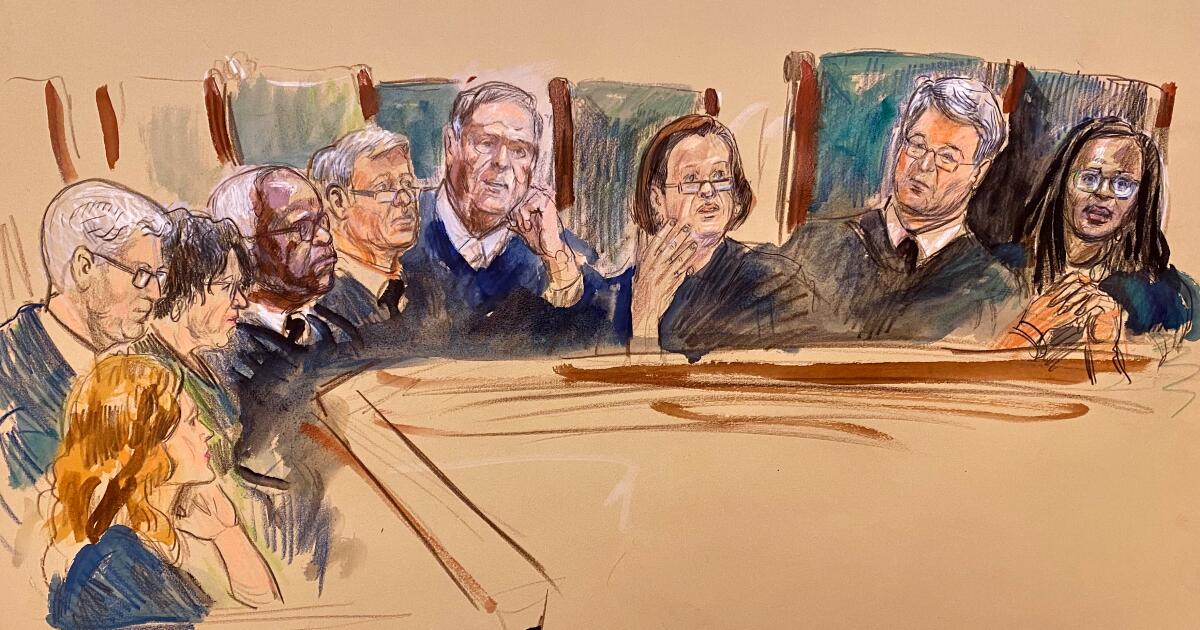
WASHINGTON — Chief Justice John G. Roberts Jr. led a fractured Supreme Court this year that both expanded a president’s power to run the government and dealt major defeats to President Trump.
In Trump’s second year back in the White House, Roberts and the court punctured his claim to have power with no limits.
The justices struck down his worldwide tariffs, ruling these import taxes are a matter for Congress, not the president.
They also threw out his executive order that would end the principle of birthright citizenship. The Constitution wrote this promise into law, Roberts said, and the president may not change it.
The court also ruled in December that the president did not have the power to put National Guard troops on the streets of Chicago.
The three decisions came over fierce dissents from conservative Justices Clarence Thomas and Samuel A. Alito Jr. and with Neil M. Gorsuch in two of them.
The three liberal justices dissented angrily when the court ruled the administration may end Temporary Protected Status for Haitians and Syrians.
They did the same when the court ruled the president may replace the top appointees of semi-independent agencies.
But they joined Roberts in a 5-4 ruling that affirmed the independence of the Federal Reserve and blocked Trump’s move to fire Fed Governor Lisa Cook.
Trump has won on most immigration fronts because Roberts and the conservatives believe Congress put the enforcement power in the hands of the administration. They point to the law authorizing temporary protection which says there shall be “no judicial review” of the decision to end the protection.
Roberts is a solid conservative who also tries to keep the court on a middle course. It’s an approach that rarely wins plaudits from the right and almost never from the left.
This year the chief justice prevailed with different coalitions.
This week, the court ruled by a 5-4 vote against the Republican National Committee and upheld state laws that allow for counting late-arriving mail ballots. Justice Amy Coney Barrett joined with Roberts and Justices Sonia Sotomayor, Elena Kagan and Ketanji Brown Jackson.
Barrett also joined the chief justice in the rulings on tariffs and birthright citizenship.
Chief Justice John G. Roberts Jr. speaks to the Georgetown Law School graduating class in 2025.
(Manuel Balce Ceneta / Associated Press)
This week, the court also limited the power of police to use cellphone data to look for crime suspects. This too came on a 5-4 vote when Justice Brett M. Kavanaugh joined Roberts and the three liberals.
Harvard law professor Richard Lazarus, who has been a friend of Roberts’ since their time in law school, said the chief justice “is clearly working very hard” to put together majorities.
“It is not easy to formally preside over a court in which five of its members (Justices Thomas, Alito and Gorsuch on the right and Justices Sotomayor and Jackson on the left) deride the kind of efforts at moderation that is the chief’s preferred signature and harshly condemn him when he strays from their own views.”
Washington attorney Roman Martinez, a former clerk for Roberts, said the court is “clearly right of center” but the decision on tariffs was the most important of the year.
“It is a huge deal for the court to say ‘no’ to the president on his major policy initiative,” he said.
Stanford law professor Michael McConnell agreed. “It’s hard to claim the court is in Trump’s pocket when he lost the major cases,” he said.
Trump responded to the tariff defeat by calling the justices in the majority a “disgrace to our nation” and “disloyal to the Constitution.”
They “sicken me,” he said of Justices Barrett and Gorsuch, his two appointees who joined Roberts in the 6-3 majority.
Trump went to the court in April to hear his top attorney defend his executive order on birthright citizenship. He left after an hour of mostly skeptical questions.
On the term’s last day, Roberts issued a clear and eloquent 26-page opinion setting out America’s history of according citizenship to children who were born in this country, without regard to their parents.
This view came from England “and crossed the Atlantic with the colonists — and was adopted with little fanfare after the Revolution,” he wrote. “Nothing is better settled,” Justice Joseph Story wrote in 1830.
But it was unsettled by the fight over slavery.
“In the odious decision of Dred Scott v. Sandford, this Court imposed the Southern States’ beliefs onto the Nation” and decreed Blacks could not become citizens, Roberts wrote.
Abraham Lincoln and Frederick Douglass were among the many who condemned the court’s decision, he said.
“It took more than a decade — and the addition of names such as Antietam, Gettysburg, and Chancellorsville to our national canon — but Douglass’s vision of ‘our common humanity’ would be fulfilled,” he wrote.
The Reconstruction Congress wrote this rule into the 14th Amendment and said “All persons born” here are citizens by birth.
The principle of birthright citizenship had been upheld by the Supreme Court in 1898, the chief justice wrote, and it had gone unchallenged until Trump returned to the White House last year.
But Thomas filed a 91-page dissent arguing that immigrants must be “domiciled” here before their children may become citizens.
Alito filed a separate 39-page opinion branding the Roberts opinion a “serious mistake.”
On that note, the court adjourned for its summer recess.

President Trump is trying to use the levers of the federal government, along with personal influence over state and local lawmakers, to reshape the rules governing the 2026 midterms and future elections in extraordinary ways.
Many of these efforts have been blocked by courts, stymied by the Constitution or stopped in Congress. But the relentless assault by the president on the electoral process — both administratively and rhetorically — is likely to sow doubt and lay groundwork for extensive challenges to election results.
Agencies and officials across the federal government have, at the direction of Mr. Trump, undertaken dozens of actions grounded in novel strategies and aimed at insulating Republicans from potential losses in November. Those actions fall into six major categories (and some fall into more than one).
Taking steps to nationalize elections
The United States Constitution puts control over elections in the hands of the states and grants Congress the ability to pass federal election legislation. It gives no explicit authority to the executive branch.
But in early February, Mr. Trump said he wanted the Republican-led federal government to “nationalize” or “take over” the running of elections. “A state is an agent for the federal government in elections,” he said.
Mr. Trump had already, in March 2025, signed an executive order seeking broad authority over elections. The order required documentary proof of citizenship to register to vote and mandated the return of mail ballots by Election Day. Those were almost universally blocked by courts, which found that the order clearly violated the separation of powers and exceeded the president’s authority.
But another provision, which instructed the U.S. attorney general to hunt for and prosecute election crimes, has been used to justify sprawling efforts by the Justice Department related to elections.
The Justice Department began demanding the complete voter files — state databases of registered voters that include sensitive personal identifying information — from every state as it worked to compile the largest set of national voter roll data it has ever collected.
More than half the states — many under Democratic control but some run by Republicans, too — have resisted this effort. In response, the Justice Department has sued at least 30 states and territories, seeking to force them to turn over their unredacted voter rolls. At least 16 states have provided or indicated an intention to turn over their lists, according to tracking from the Brennan Center for Justice.
In January, Pam Bondi, then the attorney general, requested that Minnesota turn over its voter rolls to “bring back law and order” amid protests against the Trump administration’s immigration crackdown. Minnesota officials dismissed the request as “outrageous.”
Though the Justice Department has yet to win a single lawsuit — it has lost at least 10 so far, as well as one federal appeal — election officials and Democrats fear the battle over voting records may be used in a post-election effort to challenge, discredit or spread disinformation about midterm results.
Acting on the same executive order, the Department of Homeland Security has been combing voter rolls for noncitizens who have voted. It has not found evidence of widespread fraud, and a federal judge barred the administration from letting states use a federal citizenship data tool to screen their voter rolls.
In March 2026, Mr. Trump signed a second executive order regarding voting policy, this time seeking to create state-by-state lists of citizens that would be used to determine voting eligibility and restrict the use of mail ballots. It was immediately challenged by nearly half the states and multiple voting rights groups. A federal judge sided with the states’ argument, blocking key provisions of the executive order.
Before that court decision, the United States Postal Service proposed a rule that would allow the agency to refuse to deliver mail ballots in states that didn’t turn over voter rolls to the federal government. The postmaster general has said the service will abide by any court order.
Separate from the executive orders, senior Justice Department officials last year began exploring whether they could bring criminal charges against state or local election officials if the administration determined they had not sufficiently safeguarded their computer systems.
Democrats fear that the president could weaponize federal agencies on or after Election Day. Mr. Trump told The New York Times last year that he regretted not seizing voting machines after the 2020 election.
Abigail Jackson, a spokeswoman for the White House, defended the president’s actions and policies regarding elections.
“President Trump is committed to ensuring that Americans have full confidence in the administration of elections, and that includes totally accurate and up-to-date voter rolls free of errors and unlawfully registered noncitizen voters,” she said in a statement. Ms. Jackson also pointed to a few specific examples of noncitizens who were charged with illegal voting and noted other ongoing investigations. She reiterated the president’s desire to pass federal voting legislation that would enshrine many of his voting objectives into law.
“Noncitizens voting is a crime,” Ms. Jackson said. “Anyone breaking the law will be held accountable.”
Trying to tighten voting restrictions
While Mr. Trump’s attempts to use executive orders to change elections have been largely blocked by courts, the president and his allies have found other avenues to add new restrictions to voting that are designed to help them win at the ballot box.
Soon after Mr. Trump took office, the Justice Department dropped or halted all of its open voting rights lawsuits that preceded Mr. Trump’s inauguration, easing the path for partisan gerrymanders and voting laws to withstand legal scrutiny. That included dropping a lawsuit against a voting law in Georgia.
The number of lawyers working in the voting-rights arm of the Justice Department, one of the government’s critical bulwarks against civil rights abuses in voting and elections, has dwindled from about 30 at the end of the Biden administration to the single digits after resignations, cuts and reassignments.
Last year, the Trump administration joined a lawsuit filed by the Republican National Committee against Mississippi that said the state’s policy of accepting mail and absentee ballots that were postmarked by Election Day but arrived in a short period afterward violated federal election law. (Far more Democrats than Republicans vote by mail.)
On Monday, the Supreme Court upheld Mississippi’s grace period.
The president has also sought to force Congress to pass voting legislation that would codify many parts of his executive orders into federal law. The legislation, called the SAVE America Act, would, among other things, require documentary proof of citizenship to register to vote as well as photo identification to vote. It would also require states to submit their voter rolls to the Department of Homeland Security.
Republicans lack the votes to overcome a Democratic filibuster and pass the legislation, but the president has continued to pressure Republicans to force a vote, threatening not to sign any nonbudgetary bills until it is passed.
Pushing for mid-decade redistricting
Perhaps no strategy embraced by Mr. Trump was more explicitly designed to prevent a midterm loss than the mid-decade redistricting wars of the past year.
Last summer, Mr. Trump and his allies at the White House began encouraging Texas Republicans to take the rare step of redrawing their congressional maps to try to save the party’s endangered majority.
By November, forcing Republican-led states to redraw their maps was at the center of Mr. Trump’s strategy to win the midterms and prevent Democratic control of the House of Representatives.
Texas, North Carolina and Missouri quickly redrew their congressional maps, netting seven new Republican-leaning districts. Ohio redrew its map as required by state law, adding as many as two new Republican-leaning districts.
Democrats responded by introducing aggressive gerrymanders in California and Virginia, which appeared to bring the redistricting wars to a draw — until the Supreme Court weakened a key component of the Voting Rights Act in April. After the ruling, Tennessee redrew its maps to eliminate the lone Democratic-held seat in the state, and Louisiana and Alabama quickly followed with new maps that would each eliminate another Democratic-controlled district.
At the same time, the Virginia Supreme Court struck down the Democratic gerrymander in the state, effectively eliminating four new Democratic-leaning districts and handing Republicans a multi-seat structural advantage heading into the midterms.
Cutting election security
The Trump administration has gutted key elements of the nation’s election security infrastructure. Experts warn that the changes could reduce visibility into nationwide cyberattacks and foreign influence campaigns while making it more difficult for state and local election officials to coordinate defensive operations.
Early in his second term, Mr. Trump signed two directives that administration officials have used to justify the dismantling of these programs.
The administration has weakened the Cybersecurity and Infrastructure Security Agency, terminated an F.B.I. task force aimed at combatting foreign influence in U.S. elections and ended a program responsible for sharing threat intelligence with state and local officials.
The actions are rooted in longstanding grievances from Mr. Trump and his allies, who have argued that, under the guise of fighting misinformation and disinformation, the Biden administration infringed on free speech.
In his first budget request to Congress, Mr. Trump proposed eliminating CISA’s disinformation offices, accusing them of “conspiring against the First Amendment rights of President Trump and his supporters.”
Mr. Trump’s attacks on CISA also reflect his animosity toward Christopher Krebs, the agency’s former director who oversaw efforts to secure the 2020 election and infuriated Mr. Trump by publicly debunking his lies about that election.
Undermining faith in the electoral system by questioning previous results
Mr. Trump refuses to concede that he lost the 2020 election and has used the White House to both legitimize and seek evidence supporting his debunked conspiracy theories.
On his first day back in office, he granted clemency to the nearly 1,600 people charged in connection with the attack on the Capitol on Jan. 6, 2021. Later, he introduced a page on the White House website falsely accusing Democrats of promoting a “gaslighting narrative” in their efforts to certify the “stolen election.”
Mr. Trump also ordered Tulsi Gabbard, then the director of national intelligence, to help manage an F.B.I. investigation of his baseless claims of voting irregularities in Fulton County, Ga. The move came after a team led by Ms. Gabbard seized voting machines from Puerto Rico to examine them for vulnerabilities.
The administration has also issued subpoenas for 2020 election records in Maricopa County, Ariz.; requested access to voting equipment used in Missouri; and, based on disproven allegations about the 2020 election, demanded 2024 election records from Wayne County, Mich. Last month, the top federal prosecutor in Los Angeles broke with decades of precedent in predicting election fraud charges related to California’s primary races while votes were still being counted.
In May, the Justice Department announced it was setting up a $1.8 billion fund to compensate people who claimed to be victims of government “weaponization,” which would most likely include people who stormed the Capitol in 2021. Todd Blanche, the acting attorney general, said on June 2 that the fund would not move forward, but Mr. Trump later said he still loved the idea.
Mr. Trump has stocked his second administration with people who are sympathetic to his denial of the 2020 election results. These officials have been put into positions where they could play a role in undermining this year’s and future elections.
Where Trump has installed election deniers in government
Punishing those who have worked against election denialism
While Mr. Trump has long used grievance as a political tool, retribution against his perceived enemies has become a centerpiece of his second administration. Much of that retribution has targeted anyone who has investigated the Jan. 6 attack or pushed back on his 2020 election denial.
Within hours of retaking office, Mr. Trump signed an executive order asserting that the Biden administration had engaged “in a systematic campaign against its perceived political opponents” and directing federal agencies to seek evidence that it did so.
The administration has purged F.B.I. agents and government attorneys who worked on investigations of Mr. Trump or his allies, revoked security clearances from dozens of people as punishment for alleged misconduct and opened investigations into Mr. Trump’s supposed “enemies.”
It has also sought to target ordinary citizens. In April, the Justice Department issued a federal grand jury subpoena demanding the identities of every person who worked on the 2020 election in Fulton County, Ga. The county’s motion to block the subpoena characterized it as intended “to target, harass and punish the president’s perceived political opponents.” The effort remains tied up in the courts.
As the only president in United States history to seek to overturn an election result, Mr. Trump has spent years using social media and campaign rallies to sow doubt about the integrity of U.S. elections. He continues to do so, but now he also wields the authority to direct his cabinet secretaries and other political appointees to implement his agenda. All of Mr. Trump’s directives underlying the above agency actions are based on several debunked election-related conspiracy theories, including:
His claim that undocumented immigrants vote illegally in large numbers.
“They want illegal immigrants to come in, criminals, doesn’t matter because they want to get their votes.”
— Republican fundraiser, March 25, 2026
His spreading of debunked claims of widespread fraud related to mail-in ballots …
“Mail-in ballots are corrupt. Mail-in ballots, you can never have a real democracy with mail-in ballots.”
— White House remarks, Aug. 18, 2025
… and voting machines.
“I am going to lead a movement to get rid of MAIL-IN BALLOTS, and also, while we’re at it, Highly ‘Inaccurate,’ Very Expensive, and Seriously Controversial VOTING MACHINES, which cost Ten Times more than accurate and sophisticated Watermark Paper, which is faster, and leaves NO DOUBT, at the end of the evening, as to who WON, and who LOST, the Election.”
— Truth Social post, Aug. 18, 2025
Broader unsubstantiated claims he has made of widespread voting fraud that include people voting multiple times or assuming dead people’s identities to vote.
“Every day you read in the papers about more and more fraud that’s discovered.”
— White House remarks, April 9, 2025
And finally, his belief in a “deep state” embedded in the government that has worked against him and other Republicans.
“We’re going to find the deep-state actors who have buried into government, fire them and escort them from federal buildings.”
— Campaign rally, Jan. 28, 2023
While many of Mr. Trump’s directives have been blocked or delayed by the courts, election experts say that their potential harm remains significant, and that some of the efforts have already eroded faith in the process.
“The point of so much of this campaign is not actually to change policy because they know they don’t actually have the authority to change policy,” said Sean Morales-Doyle, director of the Brennan Center’s Voting Rights and Elections Program. “It’s to inject distrust and confusion into our elections, both to discourage people from participating and to lay the groundwork for calling elections into question after the fact.”
-

 Augusta, GA1 minute ago
FBI presents leadership award to John Ryan for #StrongAugusta
-

 Washington, D.C8 minutes ago
Air Force officer arrested at Capitol after calling for Trump’s impeachment
-

 Cleveland, OH11 minutes ago
Mason and Bell preview all-Ohio showdown – FIGHTMAG
-

 Austin, TX16 minutes ago
2 Austin murder suspects arrested by U.S. Marshals
-

 Alabama23 minutes ago
Alabama Department of Transportation worker speaks of heat exhaustion experience during week of dangerously high temperatures
-

 Alaska26 minutes ago
Alaska lawmakers roll out draft compromise tax cut bill for the proposed AKLNG gas line
-

 Arizona31 minutes ago
High-upside three-star CB commits to Arizona over Washington football
-

 Arkansas38 minutes ago
August special primary set for vacant southeast Arkansas state Senate seat | Arkansas Democrat Gazette

