Northeast
Window mounted heat pumps in NYC represent 'promising climate solution'

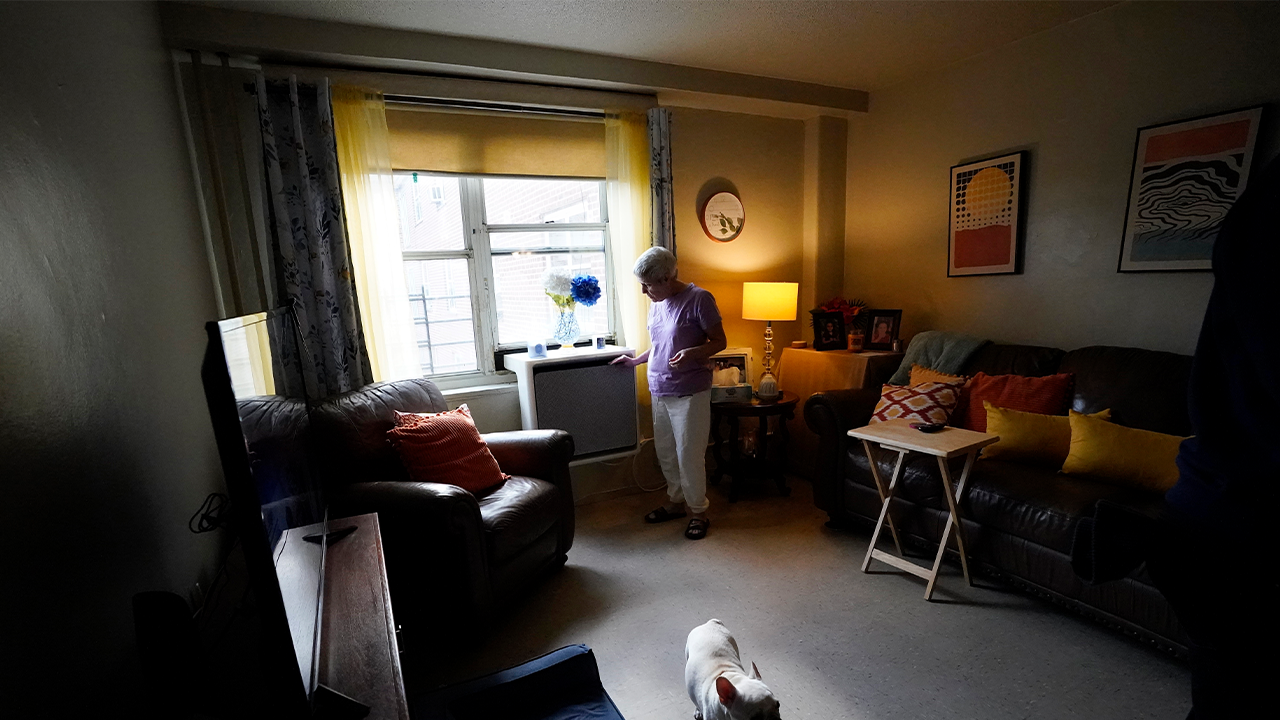
For 27 years, the heat in Regina Fred’s Queens apartment building came from a noisy steam radiator that she couldn’t control and sometimes didn’t come on at all, leaving her shivering. Sometimes, the radiators ran so hot that residents had to keep their windows open in the middle of winter for relief.
That all changed a few months ago, when she got a window-mounted heat pump as part of a pilot project by the New York City Housing Authority aimed at cutting energy costs and lowering emissions. Suddenly, all Fred has to do is touch a dial to bump her temperature up or down, and she found herself enjoying “a very good silence.”
“They did a demonstration for me and I was thrilled,” Fred said. Now, her grown children call the heat pump “the best thing” she has in her apartment, and her neighbors have knocked on her door to check out the unit.
NEW YORK CITY TAKING A SLICE OUT OF ICONIC PIZZA SHOPS WITH NEW GREEN RULE
Heat pumps, a highly efficient technology that has grown in popularity in recent years to rival gas furnaces, have mainly been an option for owners of houses. But new designs are making them practical for apartments, too, which often rely on inefficient centralized steam boilers powered by oil or gas. That represents a promising climate solution for buildings, whose operations account for 26% of global energy-related carbon emissions, according to the International Energy Agency.
The IEA said last year that installing heat pumps in apartment buildings and commercial areas should “be a priority area” to maintain the growth necessary to meet national climate pledges worldwide. The U.S. alone has 23 million apartment units, according to the National Multifamily Housing Council, representing a huge sector of people who could use less energy with heat pumps.
New York law requires buildings to make big cuts in greenhouse gas emissions over the next decades. To comply, NYCHA is targeting heating and cooling, the largest source of emissions for the agency, which houses about 528,000 people across more than 2,400 buildings — or about one in 17 New Yorkers, said Shaan Mavani, the agency’s chief asset and capital management officer.
Centralized steam boilers powered by natural gas or oil typically provide the heat, and they are wasteful — the NYCHA’s climate mitigation roadmap calls steam heat “19th-century technology incompatible with 21st-century needs.” Mavani said between 30% and 80% of heat is lost through old and leaky infrastructure before it reaches apartments. And that doesn’t account for the waste when residents have to open their windows to dissipate excess heat from a system they can’t control.
Queens borough resident Regina Fred touches one of her window-mounted heat pumps. The installation of heat pumps is part of a New York City Housing Authority pilot project, which aims to cut costs and emissions. (AP Photo)
Eric Wilson, a senior research engineer for the Department of Energy’s National Renewable Energy Laboratory, led a team that analyzed heat pump performance in various electric grid scenarios and found even the lowest-efficiency pump would cut greenhouse gas emissions and save on operating costs in every U.S. state. That analysis didn’t include the kind of pump being tested in Queens because it wasn’t yet on the scene, but Wilson said he would expect similar results.
Most heat pumps require ductwork, which isn’t an option for renters in a unit they don’t own. And ductless systems typically require extensive installation that includes wiring, making a hole in a wall and a sizeable external compressor.
Gradient and Midea, the two companies making the units in the pilot project at Woodside House, downsized it all into something that looks a bit like a window air conditioner but with a much lower profile. Exterior and interior halves drape over a sill to leave the window mostly unobscured. Gradient, one of the companies, says its unit installs in 15 minutes and plugs into an ordinary wall outlet.
Wilson said the interior portion of the units “take up more space on the inside than you might be used to” but Fred called it “very beautiful.”
“Look, I even have it for decoration,” she said. Her three window units are usually topped by flowers and decorative candles. In one room on a particularly sunny day, morning light shone on a rose, a jar of rose petals, decorative boxes and a “LOVE” sign atop one of them.
Z Smith, an architect at the firm Eskew Dumez Ripple who isn’t involved in the Queens project, said such retrofitting “is the carbon-smart way to get to better comfort for occupants.” That’s because one of the most effective ways to cut emissions from buildings is to avoid putting up new ones, which result in significant emissions due to all the new concrete, steel and wood.
He called the low-profile heat pumps a “lightweight intervention” because they’re so easy to install.
The NYCHA will evaluate results of the pilot project, with plans to eventually install more than 4,000 heat pumps over two years in the Woodside development if all goes well. The authority expects to save money on operating and maintenance costs with the heat pumps, but is waiting to see for initial results before it projects those savings.
Gradient was founded seven years ago in San Francisco with the ambition to decarbonize buildings with a window unit heat pump that can be easily installed without technicians. Part of their goal was a solution for people just like those at Woodside, CEO Vince Romanin said — people in older multi-family buildings with complaints about their window ACs or aged radiators that don’t have a temperature setting.
“We think that if you’re not building solutions for people who need it most, if you’re not building solutions for people who have insufficient heating (and) cooling today, they’re not really solving climate change,” Romanin said.
Read the full article from Here

Boston, MA
Boston Police Blotter: Man charged with allegedly trafficking thousands of fentanyl, meth pills

A Weymouth man was arrested on several drug trafficking charges Sunday following the culmination of a multi-agency investigation.
Edgar Baez-De La Rosa, 38, faces two counts each of trafficking in a Class A controlled substance and Class B controlled substance, according to Boston Police.
The BPD Drug Control United, the Norfolk County Police Anti-Crime Task Force, and the Drug Enforcement Administration Task Force executed the warrant at an apartment on Kerwin St. in Dorchester.
When officers entered the apartment, they located Baez-De La Rosa and took him into custody without incident, BPD said in a statement.
Police recovered more than 340 grams of fentanyl (including over 1,700 pills), 800 grams of cocaine, and almost 500 grams of methamphetamine, totaling about 1,600 pills, BPD said.
In addition to the drugs, officers said they discovered a “large amount” of cash in U.S. dollars at the apartment as well as digital scales, multiple cell phones, IDs, and drug packing materials.
Baez-De La Rosa is expected to be arraigned in Dorchester District Court.
Incident Summary
BPD responded to 170 incidents in the 24-hour period ending at 10 a.m. Monday, according to the department’s incident log. Those included one robbery, six aggravated assaults, two commercial burglaries, one residential burglary, one larceny from a vehicle, 14 miscellaneous larcenies, and two auto thefts.
Arrests
All of the below-named defendants are presumed innocent until proven guilty.
— Colin O’Brien, no address listed. Assault and battery on a family/household member.
— Erik Scanlan, no address listed. Felony breaking and entering at nighttime.
— Renand Pierre-Louis, 58 Bicknell St., Dorchester. Trespassing.
— Matthew Rivera, 75 Winthrop Ave., Revere. Assault and battery.
— Kayla Brooks-Torres, 7 Dalkeith St., Dorchester. Assault and battery on a police officer.
Pittsburg, PA
Below freezing temperatures to return Wednesday morning, ahead of 80-degree weather this weekend


A motorcyclist died in a crash in Chevy Chase, Maryland, early Tuesday, shutting down a busy stretch of Connecticut Avenue for hours, police said.
A vehicle and a motorcyclist crashed near Manor Road and Connecticut Avenue, and officers responded about 6:15 a.m., Montgomery County police said.
Connecticut Avenue is closed between Manor Road and Jones Bridge Road, the Metropolitan Area Transportation Operations Coordination (MATOC) Program said about 10 a.m. Commuters should expect delays and look for other routes.
Access to Connecticut Avenue (also called MD-185) was blocked from the Inner and Outer loops of the Beltway, the MATOC Program said.
“An extended closure is expected,” they said.
The crash happened about a half-mile south of the Capital Beltway (I-495) exit for Connecticut Avenue.
Information on the identity of the motorcyclist and the cause of the crash wasn’t immediately released.

Nothing’s noise-canceling CMF Buds 2A are down to just $19.99 just for today

China aiding Iran missile program amid US-Israeli strikes, reports say

Democrat swing candidate called Biden’s border handling ‘a huge misstep’ after backing his approach as mayor

Drug-soaked paper is killing inmates amid reports of prison smuggling trends

WWE star suffers giant bump on her head before WrestleMania 42 match

Florida High School Football Rankings: Top 25 teams – Oct. 21

How old is Bo Nix? What to know about Oregon quarterback ahead of 2024 NFL Draft

Cleary's 21 help Le Moyne down Central Connecticut State 69-64 in OT

99th annual Pony Swim held in Virginia

Indiana Members Credit Union announced as new anchor tenant at Bottleworks District
Democrat swing candidate called Biden’s border handling ‘a huge misstep’ after backing his approach as mayor

‘Policy of abuse’: Women march in Cuba against US energy blockade

Acting AG says ‘Nobody has any idea why’ Pam Bondi was fired except for Trump | CNN Politics

Ilhan Omar calls Trump an ‘unhinged lunatic,’ urges booting him out of office
Between Budapest and Brussels: Péter Magyar’s political tightrope
-

 Atlanta, GA3 days ago
1 teenage girl killed, another injured in shooting at Piedmont Park, police say
-

 South-Carolina1 week ago
South Carolina vs TCU predictions for Elite Eight game in March Madness
-

 Movie Reviews5 days ago
Vaazha 2 first half review: Hashir anchors a lively, chaos-filled teen tale
-

 Vermont1 week ago
Skier dies after fall at Sugarbush Resort
-

 Politics1 week ago
Trump’s Ballroom Design Has Barely Been Scrutinized
-

 Politics1 week ago
JD Vance says he was ‘obsessed’ with UFOs, believes aliens are actually ‘demons’
-

 Atlanta, GA1 week ago
Fetishist ‘No Kings’ protester in mask drags ‘Trump’ and ‘JD Vance’ behind her wheelchair
-
 Entertainment6 days ago
Inside Ye’s first comeback show at SoFi Stadium